Designing Instruments of Change
Neurodiversity, mindset shift, and the extended mind
How mindset shift and emerging instruments of change can empower neurodivergent learners and create spaces for transformative learning
Alisdair Gurling
A practice-informed PhD by project · WonderLab, Department of Design, Monash University
Before the Fits
Preliminary pages
Preliminary vii
Abstract
Neurodivergent learners are continually pushing back against the bounds of educational settings and societal narratives that fail to empower us. The obstruction lies not only in an external lack of adaptability to our learning, but in the deficit-focused stories neurodivergent learners absorb from our environments and go on to tell ourselves, where inhibitions and prohibitions narrow self-directedness and joyful being. This difficulty is rarely met once; it can feel like a chronic, compounding mismatch in which low confidence and difficulty deepen one another. This sketches parts of the landscape that informs this doctoral inquiry. The resulting approach to research resists incremental adjustments and seeks to explore a more transformative response to how neurodivergent learners relate to our own minds, and to the tools, people and places that extend them.
Grounded in the social model of disability, the neurodiversity paradigm, and extended mind theory, this practice-informed design PhD examines how we can design pluriversal learning encounters to expand capacity for agency, learning, and positive self-perception, extending what neurodivergent learners perceive as possible for ourselves. This PhD’s wager is that once a learner becomes open to extending their cognition, they can do so by assembling instruments of change spanning digital prosthetics, introspective mind-body strategies, relational practices, and space-making practices. These instruments are not prescribed; each learner assembles them into a personal repertoire for extending their own cognition. Three questions guide it: how practice-informed design research can shape transformative encounters; which experiential and playful interventions invite mindset shifts; and how facilitation, specific practices and enabling conditions can support learner transformation.
The approach is a reflexive, practice-informed design inquiry, carried out across a series of co-learning workshops with neurodivergent young people at Youth Inc, Australia. The design workshops were supported by a parallel making practice and followed up with semi-structured interviews and ethnographic reflection. The inquiry iteratively developed and tested inclusive, collaborative, and adaptive frameworks for transformational change for neurodivergent learners. Subsequently, created materials and digital artefacts were designed to further enable this agency-growing mindset shift.
This practice revealed several contributions for designing and delivering transformational experiences for neurodivergent learners. First, key principles for supporting and sustaining neurodivergent shiftwork emerged: a strengths-based focus, the value of playful and material sense-making, and need for relational care. Secondly, alongside these principles, this work also produced materials to guide the design of further transformative learning encounters: the Neurodiversity Playbook, which offers modular exercises, materials and facilitation guidance for scaffolding mindset shift for neurodivergent learners, and SEAT (Surfacing, Envisaging, Actioning, Together), a framework for assembling these exercises into broader transformative learning experiences. Finally, the Neurodiversity.tools database offers learners a guided exploration of instruments of change via cognition area to support further shiftwork after workshop experiences.
See the creative artefactThe Neurodiversity Playbook
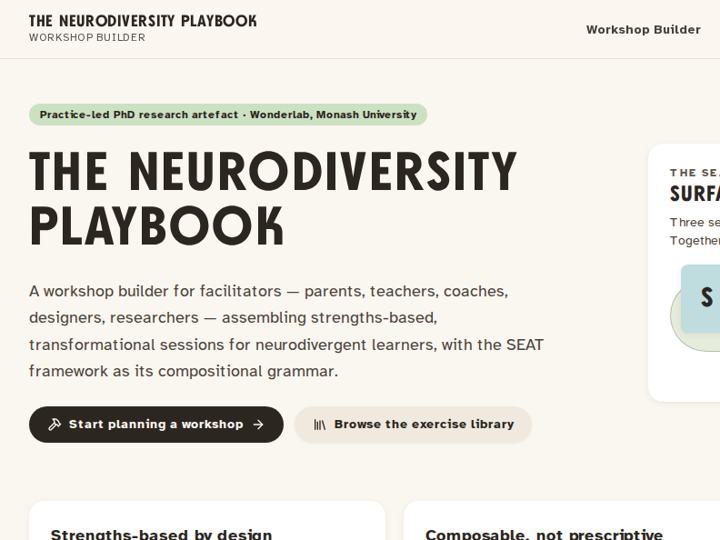
Exercises, materials and a workshop builder for the community of care, structured by SEAT.
See the creative artefactThe SEAT framework
Surfacing, Envisaging, Actioning, Togethering: the structuring logic of the Playbook and its workshop builder.
See SEAT in the PlaybookSEAT in actionBuild a workshop with it
This work was crafted by and for those of us who think differently. I occupy both positions at once, as designer of the practice and member of the cohort it is built with. Its contribution is a practice and a framework that reveal the methods and materials that support neurodivergent learners to take up new ways of thinking and to extend our own cognition. It is an invitation to a wider community of care to create encounters that scaffold mindset shift built on lived experience and embodied knowledge and sustained through continued experimentation.
KEYWORDS: Neurodiversity, Transformative Learning, Mindset shift, Cognitive extension, Practice-based design research, Strengths-based learning, Pluriversal design
Preliminary viii
Acknowledgements
Three marvellous supervisors, a delightful partner, a fun and raucous family, a bunch of friends and a (literally) wonderful community have fundamentally shaped, formed and reformed this research many times. I cannot overstate how much joy and gratitude I have for all those that have helped me along this winding way, named below or otherwise, thank you.
Lisa Grocott gave me an understanding of what creative design practice can look like as a form of research inquiry and demonstrated that it is possible to actively design experiences, workshops, and artefacts for transformation and transformational learning environments and that these sorts of research projects can be specifically designed for impact.
Dion Tuckwell demonstrated, through his concept of joining in his PhD work, how meaningful it is to actively communicate towards the communities you join; that by studying and learning from a community, you are necessarily joining it.
Isa Brandalise joined my supervision team in the last year and has been an enormous help in refining and discussing my thoughts and positioning them in writing. Through her own PhD work, Isa also helped me realise that I am still engaged in an active process of disenthralling myself from the self-importance of bureaucracies, and that the frictions and stuffiness of academia are not the same as the value of academics and their theoretical outputs.
My partner, Kate Barlock, has acted as an intellectual and creative partner throughout all of these years. Their skill, kindness and support has been boundless. Their existing creative practice, along with their independent inquiry into psychology, neuroscience, and behaviour studies, has produced a rich ongoing dialogue that echoes back and forth, up and down this exegesis, my practice and our live. I would certainly not have been attuned to where this research sits both comfortably and discordantly within prevailing discourses of care had we not been able to discuss it over this time.
Meryl Dahlitz, my mother, has helped me down this intellectual path at so many different junctures with prescient advice and warm encouragement. My twin Laurel and elder sister Holly have been kind, unwaveringly supportive and have aided in my thinking in all manner of ways. I also want to thank and say hello to my lovely nephew Caspian who was born during this process.
A wider community of collaborators and friends have equally shaped this work. I first bonded with Myriam D. Diatta, Iran Sanadzadeh, Paris Balla, and Myfanwy Doughty in Prato through a shared project, Ethnographies of the Ineffable. Myriam showed me, through her work and temperament, a quiet grace that can permeate academic thinking with a social conscience. Myf highlighted the power of submerging conditions and demonstrating what a better world would actively look like, rather than simply critiquing what is wrong with this one. She also helped soften the artificial gravity that made my final weeks’ writing so hard. Iran demonstrated the strength required to navigate academic spaces and the pressing need for creative practitioners to remain in them. Paris helped me understand, in a bodily sense, the power of Crip theory and togethering, through their work and through their own period of introspection after our time in Prato.
Stacy Holman Jones showed me the power of autoethnography and using, as she puts it, tools for writing as tools for living. Shanti Sumartojo demonstrated the power of ethnographic interviewing and how gentleness and forcefulness in research environments are not always in tension but can work together to create deep shifts in the kinds of knowledge and concepts that can be generated through engagement with participants.
To Ali Colwell-Matsuura who started this PhD with me and to Anna Conrick who finished with me, we did it!
Together, these people constitute the WonderLab, a research group and community of practice inside Monash University, that focuses on designing transformative learning encounters. The WonderLab has been, in my experience, a singular place to conduct design and creative arts research with a social conscience that is concerned about impact, and a place that wants to experiment with different ways of being in academia and making an academic community.
Branden Nickerson very kindly lent his support to use his beautiful fonts to many parts of this project.
James Meadowcroft very generously offered his creative counsel and technical advice on the underlying informational and technical architecture that the neurodiversity.tools database utilises.
To the WonderLab Goslings, past, present and future: Kelly Anderson, Paris Balla, Nicola Brown, Sofia Carbonara, Ali Colwell-Matsuura, Anna Conrick, Myfanwy Doughty, Alli Edwards, Megan Flamer, Laura Hartnell, Nic Hearn, Vera Hijkoop, Leander Kreltszheim, Aleithia Low, Robbie Lundberg, Josh Richardson, David Robertson, Katie Stubley, Delaram Talebkhangarouss, Linda Tan, Karissa Taylor, Yuzhe Zhu and the wider set of academic colleagues and friends; Zanitha Hamilton Månegaard, Maryke Laubscher, Troy McGee, Arth Misra, Michel Nehme, Paulina Noches, Conner O’Brien and Belinda Routley, it has been a pleasure to think with you.
This community of thinkers, collaborators, and friends has shown me another way of engaging with academic life, a way of delight and warmth. I am immensely excited to keep wandering down that path.
This research was supported by an Australian Government Research Training Program (RTP) Scholarship and the Monash Equity Scholarship.
Also in the preliminary pagesThe copyright notice, generative AI statement, image credits, ethics approval and colophon
Preliminary i
Copyright notice
I certify that I have made all reasonable efforts to secure copyright permissions for third-party content included in this exegesis and have not knowingly added copyright content to my work without the owner’s permission.
Preliminary ii
Generative AI Statement
I acknowledge the use of a number of generative and non-generative AI tools used in the production of this document both experimentally and substantively. I also acknowledge the potential moral hazards of these tools and the effect they can have on academic discourse and output, along with the emancipatory potential and increase in access and autonomy neurodivergent researchers find in using these tools. They are listed below:
Dictation & Transcription: WisprFlow, Otter.ai, Meetily, Handy
Text-to-Speech: ElevenLabs Reader, Voice Dream, Swift Read
AI Writing Assistance to provide editing and citation formatting support. The output from these tools was used to support the planning and editing process with structure, tense, and phrasing as well as some citation formatting.
Grammar, Spelling and prose editing: Thesisify, Grammarly, Jenni AI, Writefull, CoTabby, ProWritingAid, LanguageTool
Citation Management and Academic Database Search: Consensus, Elicit, Research Rabbit, Anara, Semantic Scholar, NotebookLM, Zotero MCP Server (via Claude)
Image and Audio generation used in reading, draft design and as part of workshop materials: Recraft.ai, ElevenLabs, Midjourney and Google’s Gemini Nano Banana.
Models known to have been used: Anthropic’s Claude Opus 5 and Claude Fable 5 & 5.1, OpenAI’s ChatGPT Sol 5.6, Google’s Gemini 3.5 Pro and Gemma 3 and 4, and Qwen’s Qwen 3.5. The tools listed may use other models, but this is not made clear to end users.
Other tools explored during this research that can be used in academia can be found at: researchengines.tools and neurodiversity.tools
See the creative artefactThe Neurodiversity Tools Database
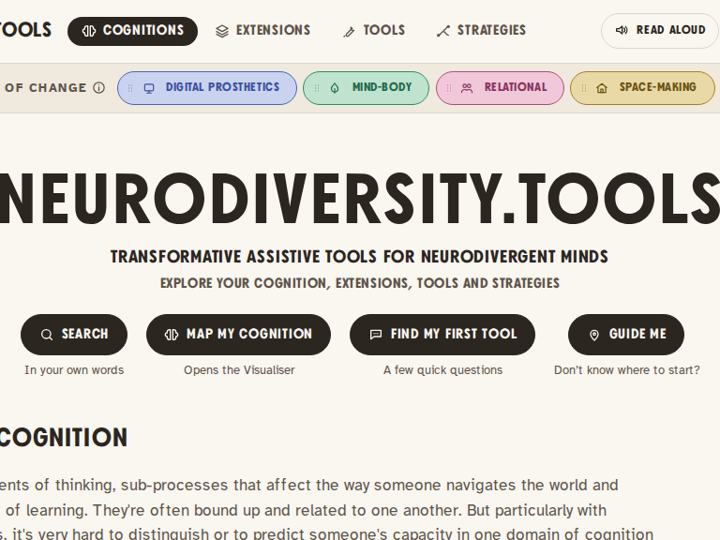
A browsable database of tools, extensions and strategies, organised by the part of thinking they carry, with examples and advice.
Preliminary iii
Image Credits
All images have been produced by the author unless otherwise stated.
Permission has been obtained for the use of all images where possible, and non-professional credits have been noted.
Preliminary iv
Monash University Ethics Committee Approval
The use of materials and photographs from the workshop and subsequent recorded conversations was approved by the Monash University Ethics Committee.
Preliminary v
Colophon
This text is set in Atkinson Hyperlegible from the Braille Institute under an Open Font License.
Some Things I like by Lemn Sissay from Listener 2016 reproduced with permission of Canongate Books through PLSclear.
The audio edition is read by Chris Brift, a synthetic voice from ElevenLabs (Eleven v4), apart from the preface and the interludes, which are read by the author.
Preliminary ix
Exegesis Structure
This PhD and this exegesis are organised in a set of three sections or fits. The term fit is from Old English, particularly poetry, meaning a section break in an ongoing story or dialogue. In this case it is also used to mean in good health, and a tantrum of ideas.
Between each fit and chapter, there are a series of interstitial quotes, poems, and short ethnographic reflections that make up interludes. These epigraphs aim to contextualise this writing within my wider sensibilities, orientations, and inspirations demonstrating the priming and interstitial materials I have used before, during, and after research workshops to reinforce senses of comfort, care, and playfulness.
The exegesis proceeds as follows:
Chapter One - The Boat, introduces the researcher and the research: who is conducting this work and what I carried into it, what the work is and aims to do, and why it matters now.
Chapter Two - The Ocean, concerns itself with theory and context, the ideas I am working with and the threads that bind them together actively holding space for interdependencies.
Chapter Three - Charting a Course, sets out how the work was done: its methodology, research design and methods, the shape of the Neuroformer workshop series, and the research question.
See the creative artefactThe Neuroformer Workshop Series
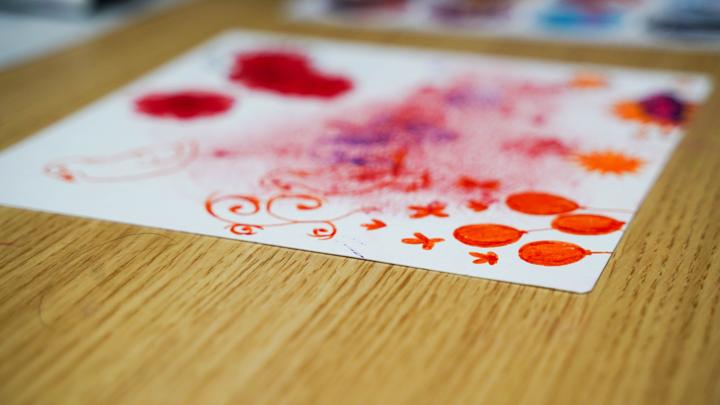
Three workshops with neurodivergent young people at Youth Inc in Adelaide, where both communities met; the materials are photographed on the outputs page.
Chapter Four - Ugly Ducklings, is a practice chapter that explains and analyses the circumstances of this research’s creative practice, blending my professional, theoretical, and lived experience to document what happened and why it matters.
Chapter Five - The Swans, explores the project’s creative outputs, explored across two communities: that of care for neurodivergent learning and direct experience of neurodivergent learning. It details what artefacts, materials, exercises, and workshop structures round out this research and bridge the gap between theoretical contribution and tangible social impact.
Chapter Six - Contributions, the penultimate chapter discusses the contributions of this program of inquiry and distils the new concepts and creative practices that are designed to help neurodivergent learners make sense of themselves and the world.
Chapter Seven - Reasons to be Excited, concludes and summarises the effect of this work and speaks to the kinds of actors that might take these ideas up and move them further forward. It articulates why this research is exciting and is designed for impact.
Preliminary x
Engaging with this PhD by Project
The development of this doctoral inquiry has been an ongoing process of probing, querying, questioning, clarifying, and sense-making. The creative practice took shape through an iterative sequence of design practice experiments and activities co-created with WonderLab, a co-design research community at Monash University’s Department of Design, as well as with collaborators and workshop participants. The exegesis came together through a series of Socratic dialogues with my supervisors, my partner Kate, and friends. The writing itself, all too often, I had to do alone.
Choosing to bring a practice-informed approach to my PhD inquiry was a deliberate, strengths-based decision. My neurotype enjoys divergent thinking, persuasive storytelling, playful material making, reflexive engagement, and synthesis of oftentimes incommensurable threads and novel ideas. My practice thrives when co-creating, playtesting tactile activities, facilitating with care, and building relational connections in real time with neurodivergent kin. This doctoral inquiry offered the space to honour that creative practice as my primary site of research, while designing a writing approach that actively plays to those same strengths.
To construct this accompanying exegesis, I operationalised my own research framework and extended my cognitive capacity. I brought voice recordings, recursive transcriptions, and AI tools to my Socratic discussions as intermediary agents to deepen my thinking and translate my ideas. This setup allowed me to be kind to my dyslexic mind. I was able to leapfrog the mechanical drag of raw drafting by translating dynamic, spoken, divergent thought iteratively and patiently into academic prose. More than a workaround, this auditory and dialogic approach is an intentional experiment in research-creation (Loveless, 2019) where I could model a creative-relational state of academic being (Grocott et al., 2023). I leaned into writing methods that embraced playful constraints and prototypical thinking, like using writing prompts to create one hundred-word paragraphs that pursue one line of thought, at a time (Berlant & Stewart, 2019).
This exegesis represents years of creative research during which my interpretation of what was important changed frequently. I love that my mind generates new stories, new ways of interpreting the research, and new ways to support people. I think this is a strength. You will find traces of my old thoughts in this document, even though three years later they no longer match my perspective. Leaving these visible threads of evolving thought honours the dynamic reality of practice-informed inquiry, offering a level of integrity that a sanitised hindsight narrative simply flattens out. For my neurotype, structuring, refining, and re-entering a large body of text presents a fair degree of cognitive friction. Working with a document of this scale was especially challenging. I am grateful to my research inquiry for granting me the grace to step away from obsessing over academic research standards imported from another period in time and from other disciplines. I chose instead to focus on writing for the educators, parents, facilitators, and neurodivergent learners who want to put these ideas to work in the world. My commitment is to story, clarity, and impact.
Preliminary xi
Wayfinding the PhD Components
What you are reading here is the exegesis for a PhD by Project, it tells the story of the research inquiry.
The exegesis serves as the translation layer that bridges and contextualises the creative artefacts and tools generated through the research. There are two primary pathways to navigate this document:
The Full Journey: Follows all seven chapters, using interludes as brief reflective rests between them.
The Core Synthesis: Reads Chapters 1, 3, 6 and 7 to move directly through the core research questions, the design of the inquiry, the primary contributions, and future directions. Chapters 2, 4 and 5 hold the underlying theory, workshops and outputs supporting those contributions, which Chapter 6 references whenever you wish to examine the underlying evidence.
Creative Outputs: There is a panoply of practice components, the production of which has suited me, my sensibilities, and my neurotype. A map of key outputs made through the research, sits at overview.neurodiversity.tools. This is the primary site of the research’s exhibition, the place where the practice is indexed, can be shared, and is brought to life. It offers a repository of resources, insights, and materials for people who want to put the research to work. The digital exhibition materials and exegesis speak to each other and can be engaged with as parallel texts for understanding the inquiry.
As this is a PhD grounded in practice, I invite you to spend some time with the practice before engaging with the exegesis. The website presenting the text of the exegesis is phd.neurodiversity.tools and contains interactive elements, links to practice examples of what is being described and embedded image galleries.
I want to offer readers the same relational integrity and care I bring to workshop participants and my design practice. Because I value auditory ways of knowing, I have produced an accessible audio version of this exegesis. You can listen to the text at: phd.neurodiversity.tools/audio.
Four components are worth meeting first. The Neurodiversity Visualiser (visualiser.neurodiversity.tools) offers a scaffolded strengths-based way of picturing your own cognition and how instruments of change might extend it. The neurodiversity.tools database (neurodiversity.tools) gathers the tools and strategies themselves, organised by the part of thinking each one supports rather than by diagnosis. The stamp sheet (stamps.neurodiversity.tools) lets you try a digital version of the cognition-mapping exercise participants did with ink and paper in the workshops. The Neurodiversity Playbook (playbook.neurodiversity.tools) holds the exercises those workshops were built from and lets you curate a workshop of your own, including run sheets, slides, interactive timers, print packs to make facilitating learning encounters as low friction as possible.
See the creative artefactMark-Making Cognition
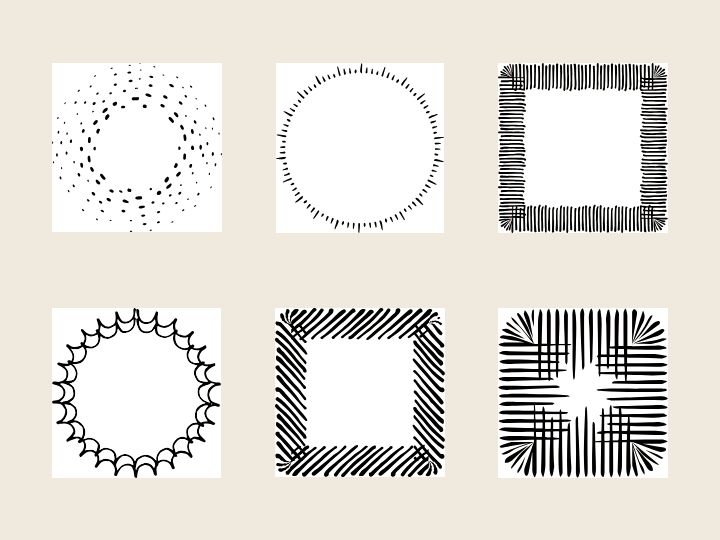
The stamp-based cognition mapping exercise: custom stamps, ink pads and a canvas, with the feelings stickers over the top.
See the creative artefactThe Neurodiversity Visualiser
A strengths-based portrait of a cognition, extended by instruments of change, drawn from your own words.
Whichever path you take, I encourage you to spend time with the website and the exegesis together. It will be easier to read Chapters 4 and 5, with the workshops and the materials made for them engaged with side by side.
Preliminary xii
Prolegomena: Conceptual Foundations
This prolegomenon outlines the core concepts, introduces basic terms and nods to the research orientation that underpin this PhD by Project.
From Diagnostic Deficit to Human Variation
To begin, let’s re-evaluate the primary paradigm through which cognitive difference is conventionally understood. Neurodivergence refers to natural variations in human cognition that diverge from what is considered neurotypical, a term collectively developed by neurodivergent people (Botha et al., 2024). Diagnostic frameworks such as the DSM-5 categorise these variations as “neurodevelopmental learning difficulties” or “disorders,” encompassing conditions including dyslexia, ADHD, autism spectrum disorder (ASD), and dyscalculia, a framing this exegesis returns to and complicates below.
An individual is neurodivergent; a community is neurodiverse. I use neurodiversity, neurodivergent, Dyslexic, ASD/Autism, and ADHD/VAST (variable attention stimulus trait) interchangeably throughout this exegesis, though I often find VAST the more useful term. These broad descriptions let the analysis move across interconnected neurodivergent experiences, particularly given the crosscurrents and emerging links between conditions such as ADHD and dyslexia.
Thinking with Systems, Communities and Strengths
Understanding cognitive difference requires an equal understanding of how environments disable or support those differences. This exegesis moves away from an individualised deficit view and toward systemic barriers, neuro-affirming practices, and strengths-based approaches, an argument the literature review develops in full.
Disability, as I use it here, follows the social model (Oliver, 1990): it is something produced by an environment’s barriers, not something located in an individual’s impairments or differences; ability and disability sit in tension with one another rather than in opposition, the relation Dan Goodley (2014) writes as dis/ability. Extending beyond clinical categories, I intentionally adopt language forged within lived neurodivergent communities. Neurospicy and neurowiggly are emergent, community-generated terms that playfully reframe identity away from deficit; including them signals a commitment to language coming from these communities. I use “neurowiggly” throughout this exegesis to describe the non-linear, associative, and sometimes unpredictable qualities of neurodivergent cognition, including my own.
This is, at its foundation, a strengths-based project: it begins from what individuals and communities already possess rather than from deficits to be remediated, positioning participants throughout as experts in their own experience. This doesn’t mean denying difficulty, a tension the literature review takes up directly, only that difficulty is never the starting point.
Creative Practice in Action
Having established a strengths-based, extended view of cognition, a PhD by Project in Design requires a precise vocabulary for how research moves through action, self-examination, and material form:
Practice, the noun, names a sustained and situated body of doing: my creative practice, the WonderLab community of practice, or a doctor’s practice. Practise, the verb in Australian English, names the doing itself, particularly rehearsal: participants practise with an instrument of change inside a workshop so it can travel beyond it. Praxis names the reciprocal movement where theory and practice remake one another: theory imbricated within practice (Nelson, 2013) and reflection/action transforming the world (Freire, 1970/2000). In this research, praxis is reserved for moments where a theoretical idea and a practice move changed one another in a spiralling exchange: carrying extended cognition or the social model into exercise design, observing what happened in the room, and letting the outcome revise the idea. Where insights arose simply from doing, the exegesis uses practice or practice informed. Praxis objects (defined below) are the material form this exchange takes.
Because praxis is an ongoing spiral, the researcher cannot remain a detached observer. This inquiry requires a reflexive methodology that turns critical attention back onto my own embodied, neurodivergent positionality. This research distinguishes Donald Schön’s (1983/2017) reflective practice (thinking within action to improve it) from reflexivity, which turns attention back onto the practitioner’s assumptions and onto how being a dyslexic, dyspraxic researcher with ADHD shapes what I notice, make, and claim (Braun & Clarke, 2019). Reflexive praxis names this mode of inquiry: theory and practice remade one another while I remained one of the systems under transformation, applying what the research surfaced to my own learning and treating those findings as evidence rather than noise.
Extended cognition also asks that this reflexivity extend beyond cognitive self-inspection to encompass the emotional and felt experiences of being a neurodivergent researcher, an affective engagement aligning with post-qualitative calls to recognise researcher emotion as a site of knowledge rather than noise (Bradley et al., 2026). Attending to these lived experiences offers what Stacy Holman Jones (2016) describes as a “living body of thought,” where personal narrative directly illuminates the doing of creative work. It is why the practice stories are written in the first person and why the autoethnographic thread runs alongside the participatory one.
Finally, to anchor this reflexive praxis in collaborative environments, the research deploys boundary objects. These are entities that translate ideas across culturally defined boundaries between communities of practice (Star & Griesemer, 1989; Fox, 2011). In this research, workshop materials and design provocations function as boundary objects enabling shared meaning-making. This exegesis identifies two subtypes: praxis objects, which embed conceptual frameworks into physical form, and reflexive objects, which provide structured surfaces for participant introspection.
Preliminary xiii
Preface
When I was four years old, my mum needed to find a school for me to attend for a few weeks when I joined her on a work trip. After a trial day at one school, the head teacher sat me down and said, “Alisdair, you can’t stay…... The problem is, you’re too short…. Now, what can you do about that?”
That moment was perhaps the first time in my life I felt really, truly, small. Everyday millions of neurodivergent learners are made to feel small and in many different ways. It might be ADHD, Dyslexia or Autism, and the challenges can range from struggling to focus, spell, read or sensory overload. It can be crippling to be constantly bucked off the horse you’re told you need to ride to be a success.
It is important here to note that being neurodivergent is not all deficits and limitations. There are strengths too, attention to detail, extraordinary hyper-focus, the ability to make unusual connections. These strengths and weaknesses are inextricably linked. However, the problem remains, we neurodivergent learners (myself included) suffer from educational environments and social norms that can fail to empower us and, over time, limit our mindsets and tell us the story that it’s us who are broken and that we cannot ever be fixed.
This exegesis and my PhD practice have explored how design, learning and technology can work together to create transformational encounters for neurodivergent learners and begin to shift our narratives and the limiting effect they have on educational outcomes.
So, what did I say to the head teacher that asked what I could do about being too short? I replied with one word, “Stilts”.
I think there are a few things that happened when I said the word stilts. I imagined myself as being more than I am, which was a conceptual leap that validated my own capacity to grow, to be autonomous, to transform myself. I called into being the idea of an external entity that would help me achieve that goal, in this case it was stilts, but it could’ve been anything.
The thing that was the prerequisite to adopting the technology of stilts was the belief that I was capable of wearing them, that my height was not a limitation that was prescribed, defined, and enforced on my end, but instead from another, external, side.
Initially, my research was focused solely on designing ways of recommending emerging assistive tools, but over the first few months of my PhD, I came to realise there is a hidden friction that hinders uptake. In my interactions with neurodivergent students, I noticed that students lacking an open, strengths-based mindset, struggled to adopt assistive strategies and tools even if they knew what they were. So, I began to create workshops and develop exercises that scaffold mindset shifts in order to extend cognition and develop a sense of ownership, self-direction and autonomy over our own minds and capacity for growth.
To create the initial round of mindset workshops, I also drew from my experiences at the progressive, play-based, experiential, embodied school I ended up attending after being turned away from the school that demanded there be more of me. I was never able to recreate the depth of joy, play, and learning that I experienced there during the remainder of my school years. I did, however, get to revel in it for those four weeks, all because I was rejected from the norms and structures of a conventional school. This school helped solidify my self-conceptual jump from insufficient to capable, and in many ways inspired the playful, experiential tenets at the centre of this transformation work.
For me, I recall these stories as living evidence of possibility in the face of opposition and a kindling of belief towards a deeper and more expansive sense of my own mind. The potential impact of this work is more than just allowing neurodivergent learners to reach beyond parity with our neurotypical counterparts. I hope it can unlock, in each wonderful neurodivergent mind, a sense of joy in learning that could be lying dormant for a chance to be unleashed.
This exegesis is for the stilt people.
Alisdair Gurling - 17th February 2026
Interlude beginsInterlude 1: Some Things I Like, Lemn Sissay
Some Things I like by Lemn Sissay (2016)
I like wrecks, I like ex-junkies,
I like flunks and ex-flunkies,
I like the way the career-less career,
I like flat beer,
I like people who tell half stories and forget the rest,
I like people who make doodles in important written tests,
I like being late. I like fate. I like the way teeth grate,
I like laceless shoes cordless blues,
I like the one-bar blues,
I like buttonless coats and leaky boats,
I like rubbish tips and bitten lips,
I like yesterday’s toast,
I like cold tea, I like reality,
I like ashtrays, I write and like crap plays.
I like curtains that don’t quite shut,
I like bread knives that don’t quite cut,
I like rips in blue jeans,
I like people who can’t say what they mean,
I like spiders with no legs, pencils with no lead,
Ants with no heads, worms that are half dead.
I like holes, I like coffee cold. I like creases in neat folds.
I like signs that just don’t know where they’re going,
I like angry poems,
I like the way you can’t pin down the sea.
See.
Interlude ends
Fit the First
Dolphin Diving
The seas of praxis
In which this practice-informed research is mobilised by theory to create an informed context for inquiry.
Containing: Chapter 1: The Boat, Chapter 2: The Ocean & Chapter 3: Charting a Course
This Fit contains three chapters:
The first, The Boat, is shaped and formed by my positionality and context. It establishes what this work is and why it matters: who is conducting this research, why it is needed at this moment in time, and the research goals, questions, and methodological orientations that guide the inquiry.
The second, The Ocean, concerns itself with theory and context, exploring the ideas this research works with and the warm data threads that bind them together, holding space for their interdependencies. Warm data is Nora Bateson’s (2016) term for the trans-contextual interrelationships that hold a complex system together; Chapter 2 defines it in full.
The third, Charting a Course, sets out how the work was done: the methodology and research design, the methods and the shape of the Neuroformer workshop series, and the research questions with the contributions that answer them.
See the creative artefactThe Neuroformer Workshop Series
Three workshops with neurodivergent young people at Youth Inc in Adelaide, where both communities met; the materials are photographed on the outputs page.
When I call this research practice informed, I mean that as a researcher I do not privilege the academic bias toward theoretical or oftentimes abstract knowledge. The contribution I wish to make visible is less to the discipline of design, the field of neurodivergence, or the social model of disability than to the practice space where they intersect. My hope for this research is that it supports the practitioners designing pluriversal learning encounters that ultimately help learners navigate cognition, technology, and self-perception. The dolphin is my visual metaphor for how theory and practice interact in this research. Academic theory and concepts are the ocean, creative practice is the air above, and the researcher is the dolphin. The deeper the dolphin dives toward the ocean floor, the more immersed it becomes in the academy; and when it rises out of theory and into practice, it is made more buoyant and given ever more momentum to soar into the air. Practice allows more freedom of movement, more joy, is more visible, and lets the researcher orient themselves before immersing again in the ocean of theory and its unknown depths.
Chapter 1
The Boat
In which the researcher is introduced, and the orientation to practise, practice, and praxis is delineated.
1.1Introduction
The prologue to this exegesis tells a story of possibility and belief in the face of opposition. It introduces the personal and affective stakes of this research through a personal narrative, because the felt experience of being made small, and the impulse to imagine oneself as more, is central to the inquiry. This narrative orientation is meaningful and constitutes a key stance within this research. This chapter takes up where the Prologue leaves off, formalising that orientation into a scholarly frame and research design.
The inquiry is guided by a central research question:
How can we design learning encounters that extend what neurodivergent students perceive as possible for themselves?
Three questions sit beneath it and guide it. The first asks how practice-informed design research might shape the development of transformative encounters. The second asks what experiences and playful design interventions invite mindset shift in neurodivergent learners. The third asks how facilitation, specific practices, and enabling conditions can be designed to support learner transformation.
These questions were pursued through practice. I designed, prototyped, and playtested creative methods and materials with the WonderLab community through playdates, and with neurodivergent educators at the Neuro-Ability Symposium in Dunedin, New Zealand. I then took those prototypes into the field to learn from neurodivergent students themselves: the Neuroformer workshop series, three participatory co-learning workshops with fifteen neurodivergent young people aged 17 to 24 at Youth Inc., a partner educational organisation in Adelaide, run across in-person and online formats with iteration between each session. What the workshops surfaced was later analysed through a mix of qualitative methods. Chapter 3 breaks down each question alongside the mode of inquiry that pursued it and the contribution that resulted.
See the creative artefactThe Neuroformer Workshop Series
Three workshops with neurodivergent young people at Youth Inc in Adelaide, where both communities met; the materials are photographed on the outputs page.
The chapter moves in three movements: the researcher and what I carried in; where the research is located, in the ontology, epistemology, axiology and methodology it works from; and why this inquiry matters now and the challenge of compatibility that shadows it. Chapter 2 then maps the theory the work thinks with, and Chapter 3 sets out how the work was done, from methodology to the shape of the Neuroformer series and the full expansion of the questions, ending with an evaluative commitment about who defines success.
1.2Positioning Myself
I acknowledge the confluence of experiences that led me to this work at this point in time, and how the contexts I draw from inform the kind of person I am and the kind of work I engage in. I arrived at this PhD carrying five starting points: training as an industrial designer with an ongoing making practice and a belief in materiality; a lifelong practice of magic, which brought with it a commitment to playfulness and delight; years of one-on-one tutoring with neurodivergent learners and the conviction that my own neurodivergence is an asset; and a belief in the value of assistive technology. These are intersecting sensibilities more than discrete roles, and they collectively orient how I approach questions of learning, technology, and cognition. This section introduces each as I held it when the research began. The section that follows traces how the research shifted each of them.
My training as an industrial designer gave me a making practice and a conviction that materials matter. Ideas that can be held, turned over, and passed between hands behave differently from ideas that remain on slides or in speech. I entered the PhD believing that the physical quality of what a designer brings into a room performs communicative and relational work of its own, a belief this exegesis develops considerably.
From the age of eight or so, magic has been a lifelong hobby and vocation. By early adulthood I was regularly performing professionally at shows and parties. When I say magic, I do not suggest anything supernatural; I mean illusion, showmanship, and performance. This interest has wound its way into my sensibility as both a designer and technologist. Indeed Arthur C. Clarke (1973, p. 21) famous third law holds that “any sufficiently advanced technology is indistinguishable from magic,” and I am not the first to notice the kinship between design and trickery. Magic surfaces and subverts expectations, expands our sense of what is possible, and encourages us to imagine what could be. Vilém Flusser (1999, p. 17), in his etymological meditation on the word “design,” observes that “a designer is a cunning plotter laying his traps,” connecting the term to the Greek mechos, a device designed to deceive, and the Latin “ars,” sleight of hand. Lewis Hyde (1998/2008) extends this logic through trickster mythology: tricksters are boundary-crossers and culture-makers whose deceptions are generative, producing new possibilities from the disruption of the expected.
Magic contributed two enduring commitments to my practice. The first is directed attention. Successful prestidigitation depends on direction, and it is directed attention that makes illusions appear impossible and, at their best, delightful. Considered, curated design is a way to avert mundanity and resist things feeling commonplace, which matters most when the aim is transformational change. The second is an experiential, embodied way of knowing. A trick lands in the body of the spectator before it is understood analytically. The experience comes first, and the sense-making follows. Both commitments, to delight and to experience preceding explanation, travel throughout this research.
Alongside and after my design training, I spent years as a tutor and coach working one-on-one with neurodivergent young people navigating institutional expectations, meeting them individually and advising them on assistive tools they could integrate into their lives. The magical sensibility bled into this work. I noticed early on that small sleight-of-hand reframes could shift a stuck conversation. When a student arrived convinced, they could not write, I might ask them to describe their idea aloud, transcribe it back to them, and reveal that they had just composed their opening paragraph. The trick is simple, and its effect disrupts a limiting self-perception and opens space for a different story. These sessions taught me that the barrier was rarely capability itself; more often it was the story a learner had absorbed about their capability, and that story could move.
I brought my own neurodivergence with me too. I am dyslexic, dysgraphic, dyspraxic and have ADHD, and I entered the PhD believing at various times that my own neurodivergence wasn’t relevant or that I ought to keep it hidden to avoid judgement. In other moments I saw my neurowiggly cognitions were assets, sources of insight, pattern recognition, and lateral connection that the deficit framing surrounding me had never been able to describe. This conviction was personal before it was scholarly. Lived experience gave me an interior view of what it feels like when a learning environment is built for a cognition other than your own, and equally what it feels like when a tool, an environment, or a person meets your cognition where it is.
The final starting point is the one that named the project. My early educational experiences with assistive technology taught me the tension between tools that grant a greater feeling of autonomy and other external supports that, however well-intentioned, can diminish it. I experienced the difference between having dictation software on a personal laptop and having a human scribe. The two produced the same outputs, yet working with just myself and my tools came with far more sustenance for self-perception and agency. This lived understanding, that technology can extend cognition and amplify ability when the learner holds an open, strengths-based mindset, seeded the belief I carried to my application, where I named it with the language of digital prosthetics, a term Chapter 2 defines in full and places among the instruments of change.
1.2.1The Paradox of the Neurodivergent Researcher
There is a profound, almost cruel paradox inherent in this research project. For me, dyslexia can mean that words unexpectedly gang up on me, fuse together, and block my attempts to penetrate them. My dyspraxia means that, try as I might, long before I started my PhD, I had developed a doctor’s scrawl so illegible that not even I could decipher my own written hieroglyphics. My neurowiggly cognition means ideas can bubble up unexpectedly or resolutely pop at the slightest handling. I have known these things about myself since childhood. No two people’s experiences of neurodivergence are the same, and yet the institutional burden is weighted in consistent ways: the academy demands a performance of neurotypical linearity that my cognition does not naturally align with. It is well documented that stress can exacerbate these patterns, creating a perilous spiral where the ground feels as though it is giving way (Shields et al., 2016). This tension has surfaced within my own research experience, where the stasis of dyslexia has collided with the institutional imperative to produce.
This struggle is a hurdle to be overcome and tender data. The pain of this friction arises because I know, intimately, that, as my colleague Myfanwy Doughty (2025) has it, “it does not have to be this way.” My research challenges standard assumptions of “good scholarship” by recognising that intellectual rigour can be achieved through plural pathways. The experience of navigating this friction makes clear the two duelling forces at play.
The first is the terrible truth that this kind of work is so often a painful experience at the very edge of my own capacity to push through it. Writing this document and adhering to academic expectations feels like a windy outcrop on a blustery day, hammered by rain, facing the sea at the end of the world.
The second is that the world turns and the sun shines through the storm. In practice, this has meant I have come to rely on my own research findings to get me this far. The reframing exercises I developed for workshop participants became strategies I applied to my own writing process. The SEAT framework, introduced in Chapter 3 and unpacked in Chapter 5, helped me recognise when I was reaching for survival rather than flourishing. This double agent position, as researcher and beneficiary of my own findings, deepened the research and helped me to navigate these wild, rocky cliffs.
See the creative artefactThe SEAT framework
Surfacing, Envisaging, Actioning, Togethering: the structuring logic of the Playbook and its workshop builder.
See SEAT in the PlaybookSEAT in actionBuild a workshop with it
The paradox at the heart of my writing, also governs how I read and engage with scholarly literature. Sustained, linear immersion in dense text is where my dyslexia exacts its highest toll, and for most of my education I treated that as a private deficit to be mitigated and kept out of sight. Through this PhD, I have given permission to myself to dive, surface, swim and resurface in a manner that suits me, taking scholarship in through audiobooks, podcasts, recorded lectures, and Socratic conversation as readily as through chapters and papers. Taylor and Vestergaard (2022) identify dyslexic cognition as specialised for explorative search, and Taylor, Zaghi and Rankin (2023) argue that marginalising dyslexic researchers, and the connective moves we make, is bad for science. I therefore leap between fields to test what connects, and I have come to understand this as a designerly way of reading (Cross, 2025), one that makes connections in service of the practice contribution rather than exhaustive coverage of any single sub-discipline’s scholarship.
1.2.2What the Research Made of my Assumptions
Materiality proved the most generative starting point, resolving into three distinct concepts. Material care names the way the designed quality of workshop materials signals to participants that the facilitator has considered them and cares, reinforcing the psychological comfort that transformation requires. Psychological scaffolding names sequences of incremental exercises built for shifts too large to take on all at once. Praxis objects are made things that carry a metaphor and help a person think. Each receives its full treatment in the practice chapters, where the materials themselves appear.
One starting point was a nascent belief in relationality, present in the one-on-one tutoring work and in the collaborative principles of my design practice. This matured into togethering, a concept introduced with the SEAT framework in Chapter 3 and developed across the exegesis. Another seminal belief was a desire to serve the neurodivergent community, but servicing my own neurodiversity and surfacing what my experiences could contribute to the research was not something I initially sought to or wanted to centre.
Alongside these conceptual maturations sat an assumption that the practice dismantled early. I arrived believing the problem was fundamentally one of access: that a vast system of capable hardware and software already existed, and that if the right tools could be discovered, catalogued, and surfaced in the right way, neurodivergent learners would adopt them and their learning would be radically improved. I blindly assumed that everyone I worked with shared my open intent, a willingness to experiment with new tools and to try familiar ones in speculative new ways. Both assumptions were complicated almost as soon as the practice began. What emerged in their place, the recognition that readiness precedes adoption and that mindset must be scaffolded before a tool can land, became the evolving theory of change this exegesis follows, and Chapter 4 traces how.
Digital prosthetics, the founding idea of this exegesis, now lives as one of four instruments of change, alongside mind-body strategies, relational practices, and space-making. The expansion of that taxonomy (set out in Chapter 2) is itself a record of the expansion of the work: what began as an inquiry into digital tools became an inquiry into the wider ecology of things a learner can reach for.
That dismantling did constructive work too, braiding with the culture I was researching within to mature what my training had left most settled: my sense of what a designer is for. WonderLab has a distinctly co-learning, co-creative culture, most visible in its playdates, where the community learns alongside one another. Researching inside that culture expanded what I believed my role as a designer was. I arrived intending to design tools for neurodivergent learners to use, and the research redirected that intention toward the encounter itself. The tools I made, the praxis objects and workshop materials, are designed to establish the psychological, environmental, and conceptual conditions a transformative encounter depends on. The instruments a learner reaches for remain theirs to choose and assemble; my designing concentrates on the conditions of the reaching.
The remaining starting points transformed differently. Magic and playfulness underwent less a conceptual maturation than a diffusion into method, becoming the facilitation sensibility of delight, directed attention, and experience preceding analysis that runs through every workshop and learning encounter. The tutoring practice, likewise, dissolved into the co-learning stance of the workshop series, where advising an individual gave way to learning alongside a group.
| What I carried in | What the research made of it |
|---|---|
| A belief in assistive technology | Extended cognition, arrived at through cybernetics |
| Digital prosthetics, the founding idea | One of four instruments of change |
| Materiality | Material care; psychological scaffolding; praxis objects |
| Relationality informed by co-design principles | Togethering as part of community that I am a part of |
| A tool-maker’s idea of the designer’s role | Designing encounters, and the material conditions that enable them |
| Magic and playfulness | A facilitation sensibility of delight, directed attention, and embodied knowing |
| One-on-one tutoring | The co-learning stance of the workshop series |
1.3Locating the Research
1.3.1Research Ontology, Epistemology, Axiology and Methodology
This research operates from a relational, pluriversal ontology grounded in social constructivism (Vygotsky, 1978; Gergen, 2015) and critical relational theory (Escobar, 2017). It views reality not as a static, objective truth awaiting external measurement, but as a fluid landscape constituted through entanglements between the researcher, the community of caregivers and people with lived experience of neurodivergence and the broad range of tactile and experiential tools developed across this inquiry. Rather than viewing the individual as an isolated, self-contained unit, this stance understands human existence as fundamentally interconnected and relational. In alignment with Arturo Escobar’s concept of the pluriverse, a world where many worlds fit, this inquiry rejects the reductive dichotomies that percolate through normative educational discourses, such as able/disabled, normal/abnormal, and expert/novice. Instead, reality is understood as plural, dynamic, and co-constituted through the active interactions of human actors, the social environment and the material tools designed to be adapted across diverse learning contexts.
Epistemologically, this inquiry brings together Interpretivism and Pragmatism to treat knowledge as inherently subjective, contextual, and functional (Dewey, 1938; Schön, 1983/2017). To navigate these two epistemic orientations, this Design PhD by Project anchors its subjective, autoethnographic inquiry in a pragmatic commitment to real-world impact (Biesta, 2015). Here, knowledge is validated not through detached abstraction, but through its functional utility: testing whether the resulting design tools, playbooks, and workshop activities actually work to empower the neurodivergent learners, educators, and communities they are built to serve. Over the course of the inquiry, treating the researcher’s positionality as a vital primary resource rather than a bias to be controlled for became essential (Dietz et al., 2020). This interpretive lens validates embodied, affective, and intuitive knowing over detached, objectivist observation (Holman Jones, 2021; Adams et al., 2021), positioning lived experience as both the site of insight and the generator of practical action.
The axiological framework of this inquiry is explicitly value-driven, centred on care, relational ethics, and justice (Noddings, 2013; Costanza-Chock, 2020). It accords primary value to a participatory approach that honours and elevates the Lived Experience of neurodivergent participants and the researcher alike, an ethic enacted directly in the room during the participatory workshops with Youth Inc. Rejecting deficit-oriented models that position neurodivergent individuals as objects of study or clinical correction, this work treats young neurodivergent people as the true experts of their own lives and cognitive modes. Inheriting its ethical commitments from participatory design traditions (Ehn, 1988) and co-design principles (Sanders & Stappers, 2008), the research holds a fundamental value for agency, mutual care, and accessibility. The worth of the research outputs, whether physical artefacts, digital tools, or workshop activities, is evaluated by their capacity to nurture generative, supportive relations between learners, facilitators, and their environments.
Methodologically, this Research by Project adopts a practice-informed design framework, an approach I draw directly from Robin Nelson (2013). Nelson distinguishes practice-based research, where the creative artefact is the primary research output, from practice-led research, which foregrounds the practitioner’s internal process. He proposes practice-informed research to emphasise the recursive conversation where theoretical knowledge and practical making continuously inform one another. This inquiry operationalises that recursive loop across iterative cycles: prototyping experiential activities, facilitating participatory workshops, and synthesising findings into open-access playbooks and digital platforms. The creative practice did not follow a pre-established theory, nor was theory simply extracted post-hoc from the practice; instead, practice and theory engaged in a continuous Socratic dialogue supported by autoethnographic reflections, ethnographic field interactions, and iterative design prototyping.
1.4Why This Work, Why Now?
We live in a time of enormous technological and social flux. Awareness of neurodivergence is growing (den Houting, 2019; Johnson & Ahluwalia, 2025), more neurodivergent people are entering education, and many experience considerable distress while doing so (Fielding et al., 2025). At the same time, AI and increasingly automated digital technologies have been systematically tearing up historical norms in teaching and learning environments (Bauer et al., 2025). Technology is developing at a pace that risks neurodivergent individuals being forgotten, or their experiences distorted, if that development is not guided by careful, human-centred approaches to technology and change. I want this work to be a practice proof of a human-strength-centred way of approaching neurodivergent autonomy in our current social and technological context.
This convergence creates fertile ground. Design leads the inquiry into it, and the dolphin values diving into many waters: the research is enriched by engaging with disability studies and the neurodiversity paradigm, the psychology of mindset and motivation, learning theory, cybernetics and extended cognition alongside posthuman thought, and the scholarship of play. Chapter 2 maps each of these waters and the currents that run between them. What makes this moment fertile is the collision of speed and stasis: understandings of cognition and learning are being rapidly renegotiated, while the institutional environments that hold neurodivergent learners remain calcified, and practical creative outputs that carry strengths-based understandings into those environments remain infrequent. Practice-informed research is how the dolphin navigates all this. It is how a researcher learns what is truly possible for neurodivergent learners, and how these rhizomatic theoretical threads are held together. This work endeavours to help people live lives and learn things in ways that meet their own personal, subjective, interior standards rather than adhering to normative standards directed by others.
Interlude beginsInterlude 2: Who You Were Meant to Be, Lindsay Gibson
“That is what this book is for: preparation for your new life. It will help you move aside the tangled debris of old loyalties and mistaken self-identities in order to find the part of you that is still green and growing.”
Excerpt from Who You Were Meant to Be by Lindsay Gibson (2000)
Interlude ends
Chapter 2
The Ocean
In which theoretical threads and intellectual eddies, are clarified, commended, and excoriated?
2.1Introduction: A Narratively Informed Literature Review
This chapter presents a narratively informed literature review. It is a mapping of an intellectual journey as it unfolds in relation to practice moving beyond a categorical survey of a given discrete sub-field. The work is led by design and ranges widely in its service, engaging with neurodivergence, mindset, learner autonomy, creativity, cybernetics, and extended cognition. Rather than attempting exhaustive coverage within bounded domains, this review draws on traditions that understand knowledge as situated, relational, and constituted across disciplines (Haraway, 1988; Nicolescu, 2002).
This orientation to literature is necessary. The diversity of fields engaged reflects the nature of the problem itself, which spans cognitive, social, technological, and educational dimensions, and cannot be adequately addressed from within a single discipline. This research begins with a gap in practice rather than a gap in the literature: the challenge of designing meaningful encounters for neurodivergent youth. Literature is engaged in response to that gap, sharpening what might be possible within practice rather than representing whole fields. Most of all, I was trying to understand how to create the conditions for mindset shift in relation to the specific needs and strengths of neurodivergent learners. An awareness that these needs are mutual, held on both sides of the communication gap rather than owed by one side to the other, can begin to bring down the barriers that prevent neurodivergent learners from being in and part of the world.
In this sense, the review operates as a recursive conversation between practice and theory. The practice-informed design activities surface questions, tensions, and possibilities; literature is then drawn in to help interpret, extend, or reframe what is occurring; and these insights are returned to practice for further iteration. Theory is actively sought, selected, and recomposed in relation to the needs of the work as it unfolds. I describe this as a practice-informed, design-led synthesis.
This mode of inquiry is necessary because of its epistemic alignment with a neurodivergent orientation to knowledge: one that is associative, pattern-based, and oriented toward connecting ideas across domains (Taylor & Vestergaard, 2022). The movement across disparate fields, the rapid engagement with emerging concepts, and the emphasis on synthesis over specialisation is a way of knowing that is particularly suited to the design of novel encounters. This approach is grounded in my lived experience as a neurodivergent practitioner-researcher, shaped by Dyslexia, Dyspraxia, Dysgraphia and ADHD (try writing and spelling those on forms quickly!), where iterative, connective, and practice-led sense-making operates not as a workaround, but as a form of expertise. The methodology models the same strengths-based orientation that underpins the research. What may appear as breadth is, in fact, an alignment between the complexity of the problem, the demands of practice-informed research, and my mode of sense-making that is iterative, relational, and generative.
This chapter reflects the concepts and theories that became active in the design of encounters, shaping decisions, being tested through use, and evolving in response. Rigour is therefore located in the clarity of selection, the coherence of composition, and the extent to which these ideas generate and are grounded in practice.
One way to visualise this is as scooping a glass of water from the ocean. The intention is not to account for the totality of the sea through this small sub-sample, but to examine how particular currents, when brought together, behave and interact in each context and moment in time. The chapter is structured as a series of questions: those that emerged as necessary to move the work forward. Each section assembles theory in response, tracing how ideas converge, diverge, and become operational in practice.
My colleague and graduate supervisor Kate Coleman once posed a question that has stayed with me: if you were to invite all the thinkers who have shaped your research to a dinner party, who would be there? Around this table sit contributors from disability and crip theory, learning theory and neurodiversity research, cybernetics, extended cognition, and creative practice. The value of this gathering lies in the generative tensions and alignments that emerge when these perspectives are brought into relation around the experience of the neurodivergent learner.
In dialogue with these thinking friends, I arrive at several core arguments that thread through this chapter: that neurodivergence is best understood through a social model that locates barriers in systems rather than individuals; that cognition extends beyond the skull into instruments, environments, and relationships; that transformation requires new knowledge, shifts in self-perception; and that design practice, when oriented toward strengths and co-learning, can create the conditions for such shifts.
Running beneath these is a narrative orientation that the chapter inhabits: a questioning of the supremacy of deficit language, and the slow work of assembling a more fruitful perspective from which to live a neurodivergent life. These arguments emerge from the friction and resonance between theory and the demands of practice.
2.2Dis/ability & Neurodiversity: A Foundational Re-framing
2.2.1Prevailing discourses around disability?
The prevailing discourse surrounding disability is shaped by complex interplay of social, medical, and psychological constructs, primarily framed within two dominant models: the medical model and the social model. This research fundamentally rejects the medical model and broadly accepts the social model, while holding some critiques of the latter. Separating impairment from the concept of disability, as some strong social-model positions do, can result in the model not fully engaging with the impact of disability on lived experience (Palmer & Harley, 2012). This research seeks to respond to that oversight by incorporating lived experience directly into the design of its workshops and creative outputs, particularly in the context of education, where the mismatch between neurodivergent learners and neurotypical institutions produces friction that cannot be resolved by naming social barriers alone.
The medical model conceptualises disability as a biological phenomenon marked by impairments or deficiencies in function, thereby vesting cognitive authority in the hands of medical professionals and scientists (Haegele & Hodge, 2016). Diagnostic frameworks such as the DSM-5 exemplify this: they categorise neurodivergent variation as “neurodevelopmental... disorders,” a deficit-focused terminology that fails to capture how neurodivergent people actually live, and one that remains historically biased and unfit for diverse populations (Chapman, 2021; Attoe & Climie, 2023; Loomes et al., 2017). In contrast, the social model, first articulated by disability rights activists such as the Union of the Physically Impaired Against Segregation (UPIAS, 1976) and formalised by Mike Oliver (1983, 1990), argues that while impairment may be real, disability is the product of social, environmental, and attitudinal barriers that exclude people with impairments from full participation. Here, the cognitive authority is reallocated to the individuals with impairments, situating them as the primary interpreters of their experiences (Haegele & Hodge, 2016).
Within this dichotomy, scholars such as Dan Goodley forcefully advocate for a paradigmatic shift towards a strengths-based perspective. Moving away from the pathologising tendencies inherent in the medical model, Goodley posits that societal structures, rather than individual limitations, function as the primary agents of disability. Throughout my life and through my practice I have witnessed these structures systematically marginalise individuals with diverse abilities and capacities (Goodley, 1997, 2014, 2016, 2021).
Furthermore, a nuanced understanding of disability necessitates an examination of the ongoing social pressures of ableism and disablism. Ableism promotes the formation of societal norms based on an idealised version of human function, often predicated on at least average capacities across various domains. On the other hand, disablism engenders stigmas and systematically disadvantages those who do not conform to societal expectations of function and ability. Goodley suggests that these two forces should be studied in tandem to understand the complexity of the lived experience of being neurodivergent (Goodley, 2014; Haegele & Hodge, 2016).
Crip theory extends this analysis further, reclaiming the term “crip” as a non-compliant, anti-assimilationist position that insists disability is a desirable part of the world, as Alison Kafer (2013) argues. Kafer’s concept of crip time challenges normative expectations of pace and productivity, arguing that rather than bending disabled bodies and minds to meet the clock, we should bend the clock to meet them. This reimagining of temporality has particular resonance for neurodivergent learners, for whom the pace and sequencing of conventional education is often a source of friction and exclusion. Aimi Hamraie and Kelly Fritsch (2019) build on this in their Crip Technoscience Manifesto, which positions disabled people as effective agents of world-building through practices of critique, alteration, and reinvention, and frames interdependence, rather than independence, as a political technology.
2.2.2What is neurodiversity and the neurodiverse lived experience?
The differences in cognition between a neurotypical learner, a neurodivergent learner, and between different neurodivergent learners ourselves are varied and never unequivocally a benefit or a loss to the learner. Rather, these unique and interrelated subjective experiential frames are inextricably linked with the personality and identity of each learner and inform how they experience life (Griffin & Pollak, 2009; Singer, 2017). The frame of neurodiversity argues that the strengths and weaknesses of neurodivergent learners are interrelated and bound to a collective self that interacts with an, at times, hostile world (Corker & French, 1999). This broad movement advocates for the rights of non-neurotypical people (Milton, 2020) and seeks to change social norms and endeavours to respond to the unique traits and values of neurodivergent people.
Many design decisions sit downstream of where disability is located. If the deficit lives inside the person, as the medical model holds, then an intuitive response is remediation, with a workshop as a new form of treatment. If instead the disabling lives in the arrangement between person and world, as the social model insists, which Dan Goodley (2014) would call dis/ability, then the response is redesign, and a workshop becomes a site where learners and their environments can be renegotiated together. Goodley’s notation holds both terms in tension, recognising that disability and ability are co-constituted by social, cultural, and political forces rather than neutral norms. The social model returns interpretive authority to those with lived experience. A strengths-based perspective (Armstrong, 2012; Chapman & Botha, 2023) replaces the ineffectual intent of a deficit frame to produce change while still acknowledging the peaks and troughs of cognition are inseparable and can be attended to together. Crip theory continues to directly advocate for power and action, refusing assimilation and positioning neurodivergent and disabled communities as agents of world-building rather than recipients of accommodation (Kafer, 2013; Hamraie & Fritsch, 2019). Braided together, these threads centre power and action in neurodivergent communities themselves.
For neurodivergent learners, navigating educational environments designed around neurotypical assumptions can be a source of persistent friction, from the pace and sequencing of curricula to the formats in which knowledge is assessed (Hamilton & Petty, 2023; Tcherdakoff, Marshall, et al., 2025; Tcherdakoff, Stangroome, et al., 2025). This friction is a social structure that compounds over time, shaping academic outcomes, self-perception and wellbeing, as learners expend invisible labour conforming to norms that were never designed for them (Syharat et al., 2023).
The experience of neurodivergence can range enormously and can include lack of socio-emotional reciprocity (American Psychiatric Association, 2013), increased capacity for intellectual inquiry and the objective measurement of phenomena (Silberman, 2015), altered or diminished executive function and language decoding like reading and spelling (Peterson & Pennington, 2012) and inattentiveness (Faraone et al., 2021). It is important to note that literature will often explore either the strengths or the weaknesses of neurodivergence but seldom the relationship between the varied parts of the neurodivergent experience in spite of the difficulty of demonstrating the neurological distinction between medical diagnoses of neurodivergence and more general difficulties (Elliott & Gibbs, 2008). Nancy Doyle (2020) offers one way to hold these together: reframing these conditions as neurominorities with “spiky profiles,” in which specific difficulties sit alongside neurocognitive strengths within the same person, calling for functional, strengths-based frameworks rather than deficit-only diagnostic ones.
2.2.3What are the barriers that limit neurodiverse learners’ access to support?
Two further dynamics compound these barriers. The friction between autistic and non-autistic social actors is commonly read as a one-way deficit; Damian Milton’s (2012) double empathy problem reframes it as a mutual barrier between communities of varied cognition, where a learner’s needs cannot be reliably read from the outside. Institutions compound this: schooling, as Ivan Illich (1970) argued, trains compliance with norms and procedures, and that training carries particular weight for neurodivergent learners, whose masking is an outgrowth of institutional pressure rather than an inherent feature of their cognition. Naming these barriers is also an argument for redesign: increased autonomy and agency arrive with the ability to genuinely choose the extent of one’s compliance with norms. Diagnostic gatekeeping restricts the capacity for self-affiliation with neurodivergent labels, thereby hindering access to institutional resources, validation, and socio-economic support (Elliott, 2020).
The traits of the neurodivergent experience may be obfuscated through various modalities: either as twice-exceptional learners (Reis et al., 2014), via adaptive coping mechanisms that mitigate perceived deficits, or through the presence of comorbid conditions that mask behaviours and challenge standard clinical diagnostic paradigms, for example ADHD coexisting with Autism. Fifty percent of students with one learning difficulty have another, and some argue that discrete categories of diagnosis do not even exist, and instead sit along a spectrum (Kaplan et al., 2001). Intersectional variables such as gender (Fusar-Poli et al., 2022), economic standing, educational context, cultural and linguistic diversity (Schmengler et al., 2021), lower socio-economic status, and geographical accessibility to resources (Chen et al., 2007) further contribute to the under-recognition of learners who could otherwise benefit from understanding and support. Even intersectional and complex instances of neurodivergent lived experience have been responsive to technological interventions (Rizza, 2006).
2.2.4How does advocating a social and evolutionary view change the frame?
The theory of complementary cognition proposed by Helen Taylor, Brice Fernandes and Sarah Wraight (2022) holds that neurocognitive diversity is not an unintended side effect of human development but a necessary component of it. Taylor and colleagues argue that our species cooperatively adapts through a system of group-level cognition, where individuals specialise in different modes of cognitive search. Some minds are oriented towards exploration, others towards exploitation, and the interplay between them drives cultural evolution and collective adaptation. In a subsequent paper, Taylor and Martin Vestergaard (2022) apply this framework directly to dyslexia, arguing that people diagnosed with developmental dyslexia are specialised in explorative cognitive search and play an essential role in human adaptation. Neurodiversity, from this evolutionary perspective, is the mechanism by which our species thrives.
And yet, as Goodley (2014, 2016) and others in disability studies have long argued, social norms and institutional structures consistently push people on the peripheries of cognitive bell curves towards conformity. Systems built around an idealised average learner, what Todd Rose (2016) calls the myth of the average, systematically disadvantage those whose cognitive profiles are, in his term, “jagged,” strong in some areas and weak in others. Over time, bureaucracies and educational systems develop an incentive to create structures that speak to the average rather than act in everyone’s best interest. For neurodivergent learners like myself and my research participants, this produces a cruel tension: the very cognitive variation that Taylor’s evolutionary account reveals as essential is flattened by systems that were never designed to accommodate it.
2.2.5In what way is neurodiversity a political act?
In contorting discourses of neurodiversity around reaction and resistance to medicalised stigmas of the neurodivergent experience, as predictably as a metronome swing, discussion turns towards a more social perception of disability. What we miss here is a third axis to consider: disability as a political act and neurodivergent communities as political forces. Crip theorists have long insisted on this political dimension, positioning disabled people not as subjects of policy but as agents of world-building whose non-compliance with normative expectations is itself a form of political action (Kafer, 2013; Hamraie & Fritsch, 2019). Ari Ne’eman and Elizabeth Pellicano (2022) frame neurodiversity explicitly as politics, while Timothy Beck (2024) argues that neurodivergent identity is produced through processes of disidentification with mainstream cultural norms under neoliberal capitalism, rather than identification with a particular social category. Peter Sedgwick explored the political economy of mental health, in Psycho Politics (1982), arguing that the accidents of heredity and the blows of the environment do not add up into the social position and personal identity of being mentally ill. This logic when applied to neurodiversity shows that neurodivergence can be as much a political, as a medical, designation. It is a category that has been created by those who wish to distribute resources, and it therefore demands of neurodivergent learners themselves, and of our discourses around them, a consideration of the wider political economy of neurodivergent minds in a neoliberal, market-driven world (Walters, 2025).
So how do we avoid a system-wide critique that limits the remaining agency that the individual has? When Byung-Chul Han published Psychopolitics: Neoliberalism and New Technologies of Power (2017), he explored how neoliberal systems create a crisis of freedom in an age of transparency, where Procrustean technologies and increasingly privatised care programs prevent those affected from meeting and organising together. This logic sidesteps any questions about the social causes of distress, or our collective responsibility for alleviating it, and overlooks shared issues such as housing, education, and threats to welfare benefits. When pressuring neurodivergent learners to reach neurotypical normative expectations, we ignore the wider implications and costs of that adherence. These expectations are bound up in neoliberal capitalist notions of performance, with the underlying suggestion that unless you are able to provide excess labour beyond the cost of sustaining yourself, you are not a worthy member of a productive market society (Beck, 2024).
The overarching point is that neurodivergent learners are not outside of a system but rather one part of it, and as a community they have the capacity to act, adapt, respond to, and improve that system as much as any other actor does. We are an interconnected, integrated part of the very thing we are trying to change. The logic of “nothing about us without us” necessitates the community themselves taking some of, but not all of, the responsibility to effect change.
It is important to note that this research in no way seeks to diminish or unreasonably critique the underlying neurochemical, neurological, psychological, and medical realities of living with what is often termed neurodevelopmental learning difficulties. There is substantial evidence that the heritability of various forms of neurodivergence is significant: meta-analytic twin studies estimate the heritability of autism spectrum disorder at 64-91% (Tick et al., 2016), while ADHD heritability is estimated at 64-86% and has remained stable over time despite increasing prevalence (Taylor et al., 2023). These are real neurological differences with a strong genetic basis. Certainly, this is not anti-psychiatry or anti-medical work. Nor do I suggest any discontinuation of prescription medications for the treatment of ADHD. From my research, personal experience, and academic reading, it seems clear to me that the judicious and considered use of stimulant medications, along with other strategies, have enormous potential to be a meaningful and worthwhile tool in navigating the experience of VAST. What this work instead tries to do is question the supremacy of deficit language.
2.2.6What paths are available for neurodivergent learners navigating educational environments?
What the previous sections describe is the system as it appears from above: the discourses, clinical models, and deficit framings through which neurodivergence has historically been narrated. What they do not yet account for is what happens at the level of the learner, in the small, daily mechanics of moving through that system. It is here, at the point where systemic conditions meet individual response, that this research arrives at its own specific site of inquiry.
One of the ways that I have developed to break down the different responses neurodivergent learners can have when navigating educational environments is by distinguishing three paths. This typology is my own. It emerged from years of teaching neurodivergent learners, was clarified through reflection on my own route through formal education as a dyslexic, ADHD student, and has been tested and refined in conversation with students, colleagues, and supervisors across the life of this research.
The first is brute force: what happens when a student is determined to get through a piece of work without any intervention. It is certainly the most painful. It means putting an inordinate amount of time and pressure on yourself to complete work in suboptimal environments. It means spending four hours on an essay when everyone else spent half an hour. It is excruciating, and so often the default.
The second is sidestepping: learning your way around a particular problem. It might be adopting multisensory instruction methods such as the Orton-Gillingham or VAKT approaches when traditional literacy instruction fails (Birsh & Carreker, 2018). It might be executive function coaching, environmental modifications like flexible pacing or reduced sensory input, or changing the type of classes you study and the formats you study them in (Hamilton & Petty, 2023). In other words, sidestepping is to move from one pedagogy into another that conforms more fluidly around your learning style.
The third, and to me the most exciting, is leapfrogging. Is it possible to use some intervention or technology to completely leapfrog the bottleneck and produce a radically more accessible environment? A simple question illustrates this: do you need to be literate to be literary? Using audiobooks, we can reorder the dependencies of literacy, allowing someone to read the great works and indulge in fantastical worlds without relying on their word decoding. In other words, they can read with their ears rather than their eyes.
This research sits in leapfrog territory. While it acknowledges the reality of brute force and the value of sidestepping into alternative pedagogies, it is oriented around the possibility of reordering, sequencing and maximising what the learner has at any given point in time.
2.3Mindset Shift, Learner Autonomy & Change
2.3.1How does a deficit-based mindset diminish learner autonomy, and what would it take to break that cycle?
One of the major barriers in creating change, and that change being transformational and producing learner autonomy, is understanding how mindsets are formed, how they calcify, and how we can help make them shift. This section explores the mechanisms of mindset formation and calcification in neurodivergent learners, examines theories around scaffolding transformational change, and argues for the value of imbuing autonomous thinking into theories of change to increase the mobility of learners who have been locked out of self-determined decision-making. One relevant idea that I will explore later is cognition as ecological, assembled across body, place, tools, and other people, so a learner’s sense of what is possible for them is partly a property of their ecology, and ecologies can be designed (see 2.5.7, Cognition as Ecology). A theory of change, as Carol Weiss (1995) defines it, is a comprehensive description of how and why a desired change is expected to happen in a particular context.
Carol Dweck’s (2017) research on mindset has demonstrated that learners who believe their abilities are fixed tend to avoid challenge, interpret failure as confirmation of inadequacy, and disengage from learning environments that feel threatening. For neurodivergent learners who have been repeatedly measured against neurotypical standards they cannot meet, a fixed, deficit-based mindset can calcify early and deeply. I have experienced this in practice and seen first-hand the impact of learners being told they are broken and that they cannot ever be fixed. After a while, they believe it. Robert Kegan and Lisa Laskow Lahey’s (2009) theory of immunity to change may offer an explanation for why this calcification can be so resistant to intervention: even when learners consciously want to change, competing commitments and hidden assumptions create what amounts to an immune system that protects existing ways of thinking. A neurodivergent learner may genuinely want to adopt new strategies yet simultaneously hold an unexamined belief that they are fundamentally incapable of learning differently. Understanding these mechanisms of formation and resistance is a prerequisite for designing interventions that can meaningfully scaffold change.
There is a vicious cycle at work, from which this project is trying to break out. A negative, deficit-based mindset diminishes learner autonomy, and environments that instil negative mindsets also tend not to allow for autonomy. Richard Ryan and Edward Deci’s (2000, 2017) self-determination theory provides a framework for understanding why this cycle is so damaging: learners have three basic psychological needs, autonomy, competence, and relatedness, and when these are thwarted, the result is a loss of motivation and diminished wellbeing. Autonomy, in this sense, is not only an individual disposition: disability scholarship casts it as a collective, political achievement too, captured in the demand of “nothing about us without us” (Charlton, 1998), and feminist theorists describe it as relational, exercised with and through others rather than in solitary independence (Mackenzie & Stoljar, 2000). For neurodivergent learners, this thwarting is often compounded by rejection sensitivity, where a heightened sensitivity to perceived failure or criticism informs negative self-perception (Sandland, 2025; Bedrossian, 2021). If you are sensitive to rejection and then you feel guilty about being sensitive to rejection, that shame compounds. Over time, this cycle produces learners who have internalised a view of themselves as deficient, who lack the autonomy to advocate for their own needs, and who inhabit environments that confirm and reinforce both conditions.
While autonomy is important for all learners, it is particularly key for neurodivergent learners for two reasons that surface consistently in both the literature and in my own teaching practice. First, they are uniquely placed to know what is going on with themselves. No external framework, however well designed, can match the fidelity of a learner’s own understanding of their cognition once they have the autonomy to develop that understanding. This critically engages with Milton’s (2012) double empathy problem, which reframes the epistemic gap between neurotypical and neurodivergent people as reciprocal rather than one-directional, and with a growing body of neurodivergent-led scholarship that treats lived experience not as anecdotal data but as a form of expertise in its own right (den Houting, 2019; Bertilsdotter Rosqvist et al., 2023).
Second, the needs of each neurodivergent learner are so varied that autonomous decision-making is the only way interventions can be sufficiently granular to be meaningful. Educational policy, by definition, operates beyond the scale of the individual learner’s needs: the variance in the neurodivergent population (Kaplan et al., 2001) makes such abstraction necessarily a dilution of the potential of a learning environment (Clouder et al., 2020). One-size-fits-all approaches leave the burden on neurodivergent students to self-advocate or tolerate inadequately conducive conditions for their learning (Beaux et al., 2024). What is needed instead are alternative methods that position the learner as an active participant in designing their own learning environments. Participatory and co-design approaches, where neurodivergent learners are engaged as co-creators, offer one such alternative (Raman & French, 2022a, 2022b) and are the methodological orientation this research adopts. These approaches can create the conditions for genuine participation through asset-based narratives and multi-modal engagement, producing interventions that respond to the specificity of lived experience rather than the abstraction of policy (Hamilton & Petty, 2023).
Jack Mezirow’s (1997; Mezirow & Taylor, 2009) transformative learning theory argues that critical and autonomous thinking must take precedence over the uncritical assimilation of knowledge, and that transformation requires learners to become aware that there is a need for change before they can begin to enact it. While Mezirow’s ten steps of transformation provide a useful articulation of this process, they are sequential and linear, following a logic that aligns more comfortably with normative educational structures than with the experience of neurodivergent learners, whose processes of change are iterative and non-linear while lurching forward and hanging back in unexpected ways. The transtheoretical model of change (Prochaska & DiClemente, 1983; Raihan & Cogburn, 2025) similarly maps stages from precontemplation through to maintenance, offering a framework for understanding readiness but not the design of conditions that enable it. Lisa Grocott’s (2022) SEED framework, Surfacing, Envisaging, Empowering, and Doing, carries this idea forward into practice-informed research. It shows how a transformative learning environment can be built that operationalises wonder: participants recognise existing knowledge, envision alternative futures, build capacity for action, and translate insight into practice. It is iterative and responsive rather than prescriptive, and it foregrounds the role of design in creating the conditions in which transformation happens. These conditions are not always made up of large, singular exercises or interventions. They are sometimes small, seemingly insignificant moments or actions that can open new possibilities for thinking and acting, what Erin Manning (2016) calls minor gestures. These micro-conditions accumulate and make different orientations thinkable. Mezirow conceived of the disorienting dilemma that triggers transformation as a singular event; for neurodivergent learners the dilemma is a chronic, sustained, accumulating mismatch between the learner and the structures they are expected to navigate.
It is from this lineage that the SEAT framework (Surfacing, Envisaging, Actioning, Togethering) emerges. Developed as part of the creative practice of this PhD, SEAT adapts Grocott’s SEED framework in both structure and goal: it keeps Surfacing and Envisaging, modifies Empowering/Doing into Actioning, and adds Togethering as a novel fourth movement, reflecting this research’s emphasis on collective meaning-making and relational practice. It is also informed by the stages of change in the transtheoretical model and Mezirow’s transformative learning theory and is designed specifically for the neurodivergent context. It provides a scaffold for transformative learning that is playful, pluriversal, and responsive to the learner’s own experience. The framework is discussed in full in Chapter 5, where its development, application, and the insights that emerged from its use are explored in detail.
See the creative artefactThe SEAT framework
Surfacing, Envisaging, Actioning, Togethering: the structuring logic of the Playbook and its workshop builder.
See SEAT in the PlaybookSEAT in actionBuild a workshop with it
2.4Learning and Transformation
2.4.1What learning theories support transformation?
The previous section explored why transformation and autonomy matter for neurodivergent learners, drawing on psychological and motivational literature. This section turns to a parallel but distinct set of questions, rooted in pedagogy and learning theory. What kinds of learning theories, sensibilities, and environments actually encourage transformation rather than compliance? How might these theories interface with an increasingly digitally mediated world and a deeper awareness of the variety of neurodivergent learners’ needs?
The theories engaged within this section are not intended as a comprehensive survey of educational thought. They have been selected because they can be put to work at the scale at which this research operates: the workshop, the exercise, the encounter between learner and instrument, and the digitally mediated environments that connect them. Much of educational theory reinforces the normative structures and vicious cycles already discussed in this chapter. Many of the genuine alternatives to those structures work best at the scale of a whole school or educational system. The theories gathered here are of a different kind. Taken together, they let this research argue that transformative learning for neurodivergent students can be supported by pedagogies that position the learner as an active, relational participant in the world and in their own learning, and that such pedagogies can be designed into the texture of workshop practice rather than requiring whole-institution reform.
Several progressive traditions share sympathies with this research without aligning with it; Table 2.1 names what is shared and where this work parts company.
| Montessori (1967) | Steiner / Waldorf | Freire (1970/2000) | |
|---|---|---|---|
| Shared sympathy | Designed environments and exercises that keep self-direction and autonomy intact | Creativity, imagination, embodied learning | Liberatory education; the political force of new experience |
| Where this research parts from it | A whole-school system, most developed for early childhood; this work is with late adolescence and early adulthood | Resistance to technology in learning (Mavrelos & Daradoumis, 2020) against this research’s commitment to digital extension | Does not re-orient around grassroots activism and consciousness-raising |
Lev Vygotsky’s (1978) zone of proximal development describes the space between what a learner can do independently and what they can do with support. It is a productive space, neither so difficult that the learner cannot engage with any level of assistance, nor so easy that they can already do it alone. In order to scaffold learning, this research creates instruments of change, defined at the close of this chapter and shown in context in Chapters 4 and 5. These are tools and creative encounters that operationalise extended cognition, positioning learners into this zone and balancing support and independence. Jean Lave and Étienne Wenger’s (1991) concept of situated learning argues that learning is not an abstract cognitive process but something that happens through participation in the practices of a community. Their subsequent work on communities of practice (Wenger, 1998) extends this, describing how groups of people who share a concern or passion for something learn how to do it better through regular interaction.
The workshops and creative encounters are designed to foster exactly the kind of communities of practice Wenger describes spaces where neurodivergent learners learn with and from one another through shared activity. What gives these communities traction in practice are the artefacts that circulate within them. The exercises, visual metaphors, and toolkits produced through this research function as what Fox (2011), building on Susan Leigh Star and James Griesemer’s (1989) foundational concept, calls boundary objects: entities that have the capacity to enable knowledge, ideas, or outcomes in one domain to translate into knowledge in others. A boundary object might be a workshop exercise, a visual metaphor, or a physical toolkit, something that sits between the learner’s existing understanding and the shifts the research is trying to enable. Nora Bateson’s (2016) work on warm data offers a complementary lens, arguing that the interconnectedness of knowledge across different contexts is itself worthy of study, and that the relational threads between ideas, people, and environments carry meaning that is lost when knowledge is reduced to isolated data points. These relational orientations scale upward in the work of Gert Biesta.
Biesta’s (2021) framing of world-centred education situates the learner in the wider context of the world, enabling students to interact with it without placing themselves at the centre of it. Biesta describes a truly eccentric student as one who accepts they are a part of the world but not the centre of it. He argues that there is a false dichotomy between teacher-centred and student-centred learning, and that attempts to define progressive or conservative education inside those silos are insufficient for truly transformative educational pedagogy. Instead, world-centred education encourages learners to spend time tackling how they can become active participants in the world. Learners are not means to an end, that is, a successful educational system, but rather ends in and of themselves and crucially for themselves. Elsewhere, Biesta (2020) argues that education should be oriented towards three domains of purpose: qualification, socialisation, and subjectification. It is the third of these that most directly concerns this research.
Subjectification has to do with the existence of the student as the subject of their own life, not as an object of educational interventions. When educational systems overvalue qualification at the expense of subjectification, they produce compliant learners rather than free ones. For neurodivergent learners, this imbalance can be particularly damaging, as it reduces the rich complexity of their cognition to a set of measurable outcomes that were never designed to capture what they can do. This research takes Biesta’s world-centred orientation as a starting point and tries to extend it into digitally mediated environments. The argument, developed across the next section, is that world-centred education and post-humanist thought can be productively integrated, so that the world a learner learns in and with includes the digital instruments and extended cognitive environments that make certain forms of learning possible for neurodivergent students at all.
The collaborative and participatory methods used in this research are a pedagogical and political commitment to redistribute who gets to shape the conditions of their own learning. Three thinkers, read together, help make this claim legible. The principles of democratic education, amazingly, from more than a century ago (Dewey, 1916), provide a historical context for why participatory design methods fit effectively inside progressive forms of education, a tradition Sant (2019) shows has since grown to encompass participatory, critical, and agonistic discourses well beyond Dewey’s original liberal framing, and one whose relevance only grows as digital environments diminish the structural forces historically used to justify more hierarchical forms of learning. Dewey (1916) argued that thinking depends on real-life situations and that separating thinking from acting is obsolete: learning is something done in and with the world, not received from above. Alfred Adler’s individual psychology (Ansbacher & Ansbacher, 1956), popularised for a contemporary audience by Ichiro Kishimi and Fumitake Koga (2018), extends this into a theory of human relationships, arguing that healthy development depends on horizontal rather than vertical relationships. Where vertical relationships position one person above another through praise, punishment, or judgement, horizontal relationships are built on mutual respect and shared endeavour. For neurodivergent learners who have spent much of their educational lives positioned beneath neurotypical expectations, horizontal relationships are a structural precondition for the trust this research’s workshops depend on.
bell hooks (1994) extended the democratic tradition further into a feminist and liberatory frame, insisting that the classroom be a space where the lived experience of marginalised learners is centred. Critically, hooks (1994) also argues that a democratic space must acknowledge tensions rather than aspire to what Peter McLaren, critiquing sanitised models of multiculturalism in a related register, describes as “an undisturbed space of harmony and agreement” where social antagonisms are hidden from view (Steinberg, 1992). For hooks, insufficient engagement with the marginalisation and harm that sits outside the classroom, often due to the fact that educators “lacked strategies to deal with antagonisms,” can create “space for disempowered collective backlash,” (hooks, 1994, p. 31) potentially pushing people away from being open to radical paradigm shifts. Spaces for collective discovery and horizontal, democratic learning also involve active labour to navigate and engage with tension and different perspectives. Dewey, Adler, and hooks together underwrite this research’s orientation toward horizontality: as historical grounding, as interpersonal ethic, and as feminist liberatory practice respectively. There is further work to be done on habits of mind and how to encourage such habits around extended cognition (Holdo, 2023; Mezirow & Taylor, 2009), work that this research attempts to contribute to through its creative practice.
Crip theory, introduced earlier in this chapter as a political and philosophical frame, also has significant implications for how learning environments are designed. Kafer’s (2013) concept of crip time not only challenges normative expectations of pace and productivity in the abstract; it directly reshapes how we think about the temporality of learning. Neurodivergent students can experience time differently in educational settings: the rigid temporal frameworks of conventional education can displace the very community time and creative time where the most meaningful learning happens (Smith, 2024). Neurodivergent students are made to feel as though they are falling behind time, wasting time, and losing time, a struggle that compounds harm to their wellbeing, confidence, and sense of self (Edwards & Sudlow-Haylett, 2023). Abrams, Floyd and Abes (2024) argue that crip theory tenets, including fluidity, interdependence, and crip time, can be applied directly to creating accessible academic experiences through co-constructing course access and de-stigmatising non-normative academic timelines. In my own research, the insights of crip space-time surfaced not as an underlying principle I began with but as part of the practice insights that emerged and are described in the fourth and fifth chapters. When these practice insights were analysed, they were discovered to mirror crip theory, for example in an openness around time and rest, with participants taking long, meaningful breaks along with frequent discussions of care and community. Due to these emergent features found in practice this research sits in deep alliance with crip theory.
This work positions itself within the same space, sharing its commitments to making room, making community, and refusing the temporal logics that disable neurodivergent learners. My WonderLab colleague Alison Colwell-Matsuura and their PhD on Soft and Slow Designing (under review) have been an important bridge here. Our ongoing and deep conceptual dialogue around alternative and expansive ways of thinking about creativity, practice, and time has been one I have immensely enjoyed engaging with, and one that, on reflection, felt present in our conversations all along, even before crip theory surfaced explicitly in my understanding of this research.
As we move beyond normative expectations of practice and time, a question emerges: where does this leave us when it comes to interacting with technological systems, and to what extent can learning exist in those systems? Connectivism, introduced by George Siemens (2005), argues that learning in digital environments occurs through interconnected systems where knowledge is passed between different users and digital agents, enabling emergent learning and discoveries through increasingly complex network activity (Siemens, 2005; Siemens & Tittenberger, 2009). The use of connectivism can draw clarity out of fields that historically have worked at cross purposes to one another (Corbett & Spinello, 2020). This approach places a continually changing and diverse community at the centre of learning and links directly with the co-created learning environments that are made as part of this project’s creative workshops. If learning is networked, distributed, and digitally mediated, what is the role of technology in that network, and how do we ensure it serves the learner rather than the other way around?
2.5Technology, Cybernetics, and Extended Cognition
2.5.1Where do we end and the tools we use begin?
In the prologue, I offered this question: where does your mind end and the tools you use begin? If I asked you to document something, I would not be surprised if you used a pencil and paper, or a phone, or a computer to make notes. We wear shoes to modify the terrain we can walk on. We have accepted some technologies, particularly older ones, as extensions of self, and society has adapted and conformed, even its language, to have a more capacious sense of who we are. Few consider a hearing aid to be cheating, or a bicycle a moral blight on those that wish to walk somewhere, or that a meeting never took place because it was a video call rather than in person. There is a long conversation in design and science and technology studies about the politics embedded in artefacts. Langdon Winner (1980) argued that technologies carry politics regardless of the intentions of their makers, and Peter-Paul Verbeek (2005) extended this into a post-phenomenological account of how designed objects actively shape the conditions of human action. The argument I want to make here is a specific instance of that wider claim, applied to the domain of cognitive extension. If a dyslexic learner chooses to read with their ears rather than their eyes, or an ADHD learner uses a tool to help structure their writing, something shifts. An invisible line appears to have been crossed: the line between the particular cognitive extensions we socially accept and those that we do not.
This is extended cognition set out through Clark and Chalmers (1998) meeting the social world, where the coupling of mind and instrument is accepted for some extensions and policed for others. Chapter 4 records how policing arrives in lived experience, where are participants told that an aid was a crutch or that a support would be removed once they were functioning. The responses to this crossing are rarely dramatic, but they accumulate: the suggestion that listening to an audiobook is not really reading, that a spellchecker is a crutch, that extra time in an exam is an unfair advantage. I have received versions of all of these, as a student and later as an educator, and they share one implication, that the assisted or aided version of the activity somehow counts for less. I call this division the tool line: the arbitrary, culturally constructed boundary between the cognitive extensions we accept and those we stigmatise. I do not believe this line has a consistent logic, and I think it moves depending on who is using the tool, what they are using it for, and whether the context demands an adherence to historical ways of demonstrating capacity rather than a determination of outcome. As Chalmers (2018) has argued, asking what an individual can do unaided by the technologies available to them in everyday life is fundamentally an uninteresting question when those resources will always be available. Assistive technology is still too often framed as a problem-solving response to a medical model of disability, pathologising the very people it is supposed to support (S. A. Brown, 2023). McNicholl et al. (2021) argue that harnessing mainstream devices as assistive technology for all students would facilitate inclusion and reduce stigma, suggesting that the tool line could be dissolved entirely if we stopped treating cognitive extension as an accommodation and started treating it as a universal feature of how humans learn. The Crip Technoscience Manifesto (Hamraie & Fritsch, 2019) goes further, positioning disabled people not as passive recipients of assistive technology but as expert designers and hackers of their own tools, whose practices of critique, alteration, and reinvention should be understood as technoscientific activism. This hacking sensibility is what Otto von Busch (2022) calls making trouble: design as material activism, in which remaking a made world that was not designed for your life is itself a form of dissent. The tool line, from this perspective, is politically constructed, and refusing it is an act of self-determination. Part of the same difficulty, in providing tools that help neurodivergent learners meet their goals with greater ease, is determining what those needs actually are. Are they authentic, intrinsic desires that, when met, allow for a more autonomous flourishing? Or, by virtue of growing up with neurotypical expectations placed upon us, are they built first around the desire to survive, to act in compatibilist ways, adhering to potentially problematic and pervasive normative standards? This tension between survival and flourishing, between intrinsic and extrinsic motivation, runs through the whole neurodivergent community (Hull et al., 2017; Pearson & Rose, 2021; Syharat et al., 2023). It is also in evidence for me in this work, as I have struggled to navigate the normative expectations I hold for myself while communicating the very frameworks that help neurodivergent learners bypass them. Section 1.2.1 traced how this same tension has shaped my own relationship with scholarly reading, and why this exegesis engages literature the way it does.
2.5.2The Dyslexic Room
The tool line is an abstract claim, and questions of where legitimacy ends are best tested where they live, in intuition. To do that, I want to propose a thought experiment of my own, the Dyslexic Room. Its purpose in this exegesis is specific: it isolates the question this research keeps returning to, whether we value the process by which knowledge is acquired or the fact of its acquisition, and it does so in a form portable enough to be carried into a workshop and handed to a learner. It is based on perhaps the best-known thought experiment in the history of modern computing, the Turing test. Proposed by Alan Turing, this philosophical question asks: is the entity I am interacting with a human or a machine?
It is an intuition pump that blurs the line between real and simulated human cognition by some form of digital agent. It is now widely regarded as having been far surpassed by modern AI chatbots. Within a few years of being proposed, a secondary one by philosopher John Searle called the Chinese Room rendered it largely moot. In the Chinese Room, a question in Mandarin is posted through a door. The person inside shortly posts another letter with the response, again in Mandarin. The question is this: what is the distinction between the mind of a genuine Mandarin speaker and the mind of an English speaker who has an English-to-Mandarin and a Mandarin-to-English dictionary? This question probes at a deep fork in moral philosophy, between consequentialist and deontological ethics. Do the consequences matter, or is the process a moral good in and of itself? Let me posit a different experiment, this time with the dyslexic in the room. A book is posted under the door and after enough time has passed, questions are asked to determine the comprehension of the reader. There is outwardly no distinguishing factor between a book being passed under the door and being read conventionally with your eyes, or transferred to a different medium and read with your ears. The inability to distinguish these two states is a protective veil that prevents the outside observer from knowing, or needing to know, which method was used. If the comprehension is equivalent, the medium of reading becomes irrelevant. The Dyslexic Room collapses the tool line entirely. It reveals that the insistence on a particular method of reading is not a measure of comprehension but a policing of process, a deontological commitment to how knowledge should be acquired rather than a consequentialist interest in whether it was. For neurodivergent learners, this distinction matters enormously. It is the difference between being told you cannot read and being shown that you already can, just with your ears rather than your eyes.
2.5.4Where does the mind stop and the rest of the world begin?
In the year I was born, 1998, Andy Clark and David Chalmers proposed an answer to this question. Their proposal can be summed up simply: “Cognitive processes ain’t (all) in the head!” (Clark & Chalmers, 1998, p. 8). In other words, it is possible for cognition to exist externally to the human, or even as a coupled system that acts in dialogue with a human organism to create a cognitive system in its own right. A year later, Richard Dawkins (1999) released The Extended Phenotype, suggesting an even more axiomatic, evolutionary repackaging of this idea: that the influence of a gene rather than being limited to the cells that hold it or the body that carries it, can extend into environments that it shapes. The dam made by a beaver, for instance, is an extended phenotype programmed into the inherent sensibilities of beavers themselves. Kim Sterelny (2010) pushes this in another direction, highlighting the distinction between minds that are genuinely extended and minds that are scaffolded with environmental supports, suggesting that there is not a binary between inside and outside but rather a set of more varied, more interesting connections.
In the psychological literature, agency is often read as the intentional influence a person exerts over their own functioning and life circumstances (Bandura, 2001), operating from an internal locus of control rather than from externally defined normative standards (Rotter, 1966). This research reads learner agency differently, through its posthuman and extended cognition commitments. Gilles Deleuze and Félix Guattari (1987) offer this dissolution with an older, stranger vocabulary: the assemblage, a working arrangement of heterogeneous parts, bodies, tools, signs, spaces, that holds together long enough to do something. In an assemblage, agency is a property of the arrangement; capacities emerge between the parts and belong to no single one of them, and arrangements stabilise or recompose as components enter and leave. A dyslexic learner with their extensions can in this reading act as a novel form of such an assemblage: reading happens, but it happens in no one place in particular. Read alongside Clark and Chalmers, the logic of assemblage adds what the extended mind underplays, that these couplings are dynamic, political, and constantly remade. Crip technoscience’s account of disabled people’s hacking, tinkering, and remaking of worlds extends this same logic to agency in its fullest form: not something possessed by an individual mind, but something enacted through the assemblage of learner, tool, and community (Hamraie & Fritsch, 2019).
All of these ideas triangulate the same notion: that cognition can extend into digital spaces through technological tools that offload part of our cognitive processing. Where the tool line names the social boundary policing which of these extensions are deemed legitimate, the extended mind tradition dissolves the cognitive boundary altogether. The two arguments work in concert, one describing what minds can do, the other describing what culture permits them to do. This matters for neurodivergent learners, whose neurowiggly cognition can hold extraordinary capacities bottlenecked by the least of their abilities, and it is precisely here that this research finds its opportunity. When external tools and resources can extend cognition, deeply driven by the needs and preferences of the neurodivergent learner, not imposed on them as fixes to deficits–new possibilities unfurl. Learners can turn inward to reflect on themselves and explore new forms of embodiment, cognition, and learning, without having to confront perceived deficits directly or resolve intractable limits of ability. These couplings of interventions vary in closeness. Verbeek (2005, 2011) maps a spectrum of human-technology relations, from tools we consciously point at the world to embodiment and fusion relations, where the boundary between user and tool dissolves. One example is Endel, an app that generates music from weather, time of day, and heart rate to hold a listener in focus. It sits in this state of fusion. When used, you can easily forget you are using a tool at all, making it less tiring for some neurodivergent learners and more likely they will continue to engage over time. I set out to create workshops, materials, and other surfacing experiences in line with the maxim that good design can be invisible (99% Invisible, 2010).
2.5.5How can mind and machine learn from one another?
Cybernetics, originating in the work of Norbert Wiener (1948/2019), describes the study of circular, feedback-driven relationships between systems, and how those systems regulate themselves through communication and control. In the context of this research, cybernetics provides a way of understanding the spiralling, co-learning relationship between neurodivergent learners and the technological systems they use. This is an iterative dialogue where each shapes and is shaped by the other, and it positions this research, and the neurodivergent learners it engages with, inside these systems rather than outside them: not as subjects of the systems that shape their learning, but as interconnected, integrated actors within them, with the capacity to act, adapt, and effect change. N. Katherine Hayles (1999) traces how the boundaries between human and machine have been progressively blurred through the history of cybernetics, arguing that we have always been entangled with our technologies in ways that challenge any clean distinction between the organic and the informatic. Since Harvey Blume (1998) first used the term neurodiversity in print, connections between cybernetics and the neurodiverse experience have been raised. However, an in-depth exploration integrating social models of disability with post-humanist theories remains largely unexamined both socio-culturally and within academic discourse. This research attempts to contribute from a practical perspective to that largely uncharted space.
Hayles’s scholarship helped me explore this space. Her account of cybernetic entanglement is also foundational to post-humanism, the broader ontology within which this research is situated (Braidotti & Hlavajova, 2018). Post-humanism challenges the boundaries of the traditional human subject, embracing the potential for diverse forms of embodiment and cognition to coexist and enrich collective environments; Donna Haraway (1991) was among the first to argue that the boundary between human, animal, and machine had already dissolved in practice, if not yet in theory. New materialist scholarship (Barad, 2007; Braidotti, 2019) extends this further, attending to the agency of non-human actors, materials, and technologies in shaping how we know and act in the world. Alongside these orientations, a connectivist perspective (Siemens, 2005) treats learning as distributed across networks rather than contained within individual minds, a claim developed in the discussion of learning theory earlier in this chapter. Together, these framings support this research’s central claim: that cognition can be extended into digital and material tools without treating that extension as a deficiency to be corrected, but as constituting an expanded, hybrid self, in which the boundary between learner and instrument is negotiable and productive.
The most visible contemporary site of this entanglement is artificial intelligence, and it is worth being precise about its place in this research. AI is treated here as a subset of a wider, evergreen field of emerging and assistive technologies, a lineage running from the first writing, typing, through text-to-speech, spellcheckers, and adaptive human-computer interfaces. Each generation of that field has renegotiated the boundary between mind and machine; AI renegotiates it again, with greater speed, responsiveness, and intimacy. It is plausible that adaptive systems of this kind will become the central medium through which cognitive extension takes place for the next generation of neurodivergent learners, which makes the orientation of those systems a question this research cannot avoid.
A distinction I draw between two design intentions helps navigate this. Productive AI is designed to maximally satiate its user: to auto-complete, to generate, to do the work for you. Didactic AI is designed to create a zone of proximal development with the learner, the space just beyond what they can currently do unaided (Vygotsky, 1978; Luckin & Cukurova, 2019), and to stretch and expand cognition rather than replace it. The distinction matters for this research because a tool that does the thinking for you cannot produce a shift in how you understand your own mind, while a tool that thinks alongside you, adapting to the contours of your cognition, might. Whatever medium these transformations arrive through, the orientation argued for here is humanistic. Emerging technologies earn their place by how far they magnify human intention and preference, never by how much human activity they can absorb.
2.5.6How do you know if a technology flattens variance or encourages flourishing?
The risk of technology flattening variance is a real one. We see this in the way education has been shaped by pathways of technological change, from the printing press to machine-markable standardised tests. There has been a steady encroachment on the personality and outlook of the individual. The filmmaker and critic Adam Curtis (2010) once observed that in our age of individualism we see computers as ways through which we can express our individuality, but the truth is that computers are really good at spotting the very opposite: they can see how similar we are, and from that they can predict what choices and decisions we will make. This infinite scalability and possibility of pre-emptive intervention is a tempting one, and I certainly felt its tug throughout this project.
The cultural and technological historian Lewis Mumford once observed in an interview (Short, 1968) that mechanical collective technology systems can use both punishment and rewards to create compulsive and compliant systems. Carrots rather than sticks, he argues, are the “most dangerous of all the systems of compulsion,” because they would be not just hell but “it would be a worse hell because we wouldn’t realise we were there”. Catherine D’Ignazio and Lauren Klein (2020) extend this critique into the domain of data, showing how data systems encode the biases and power structures of the societies that build them, and how claims of objectivity in technology often serve to obscure rather than challenge existing inequalities.
Against this flattening logic, Nora Bateson’s (2016) concept of warm data offers a different orientation: one that attends to the relational, contextual, and interdependent threads between knowledge rather than reducing experience to isolated, extractable data points. The question for this research is how to use technologies in ways that preserve and amplify the cognitive diversity of neurodivergent learners rather than compressing it into a more manageable shape.
2.5.7How can technology act as the servant and not the master?
Or as Neil Postman (1992) put it, paraphrasing Henry David Thoreau, how can we avoid being a tool of the tools? How can technology be used to truly increase learner agency, autonomy, creative self-expansion, and self-discovery rather than be used as an enormously complex system that induces compliance under cover of claimed individualism? In other words, how can machine systems, interventions, and tools work in concert with you, as the servant and not the master?
Ivan Illich (1973) gave this question its most enduring conceptual frame. Convivial tools, in his account, are those that give each person who uses them the greatest opportunity to enrich the environment with the fruits of their own vision; industrial tools, by contrast, shape their users to the tool’s own logic. The distinction predates the digital age, which is part of its value: it offers a test that travels across every generation of technology this research touches. Navigating contemporary discourse in human-computer interaction, I return constantly to this framing, technologies as the servant and not the master, not guiding events but aiding human intention, improving quality of life according to personal, subjective preferences. Tim Berners-Lee (2025) calls one of the potential interventions data sovereignty, the idea that your digital footprint is yours and you should have control over it rather than it being in the hands of any other actor. In the broader world, this looks like social media companies and tech monopolies accumulating and monetising the data of their users. In the context of this research, it means that the assistive technologies and digital prosthetics we use should work for us in human-centred ways, and carry no ulterior motive: no ads, no upselling, none of the engineered nudging that mature attention-economy technologies (social media feeds, freemium learning apps, recommendation systems) rely on as a business model. This is not a claim that any designed artefact can be neutral. As Winner (1980) and Verbeek (2005) establish earlier in this chapter, every artefact carries politics and shapes the conditions of its use, and an instrument that scaffolds is, in a way, still steering. The distinction that matters is whose ends the steering serves and how legible it is to the person being steered. A convivial tool declares its intent and answers to the learner’s purposes; a nudging system conceals its intent and answers to someone else’s.
D’Ignazio and Klein (2020) argue that building just and accountable data systems requires centring the perspectives of those most affected by them, a principle that maps directly onto the participatory logic of this research. Extending cognition into digital spaces by using technology for the offloading of part of our cognitive processing (Clark, 2001, 2008; Sterelny, 2010) can encourage introspection of the self without seeking to correct perceived deficiency, but rather, embraces the potential for diverse forms of embodiment and cognition to coexist and enrich collective environments (Haraway, 1991).
2.5.8Cognition as Ecology
As we have seen, thinking of cognition as an isolated internal mechanism of the mind contributes to the current limitations of deficit models of education and designed interventions for neurodivergent learners. Extended cognition is not solely about the use of technology or software, rather it argues that our thinking routinely loops through conceptual tools, environments, and other people (Clark & Chalmers, 1998); this framework shaped how I identified what needed shifting in my own practice, and how I approached designing transformative encounters for neurodivergent learners. Extended cognition belongs to a wider family of positions known as 4E cognition, which holds that cognition is embodied in the moving, feeling body; embedded in the environments that scaffold it; enacted through engagement with the world; and extended into the instruments the thinker chooses to connect with (Newen et al., 2018). What these four accounts of cognition all have in common is that they are ecological, a property made up of the arrangement of person, body, place, and external tools rather than of the brain alone. Andy Clark and David Chalmers’ (1998) Extended Mind Thesis puts the coupling precisely: when an external artefact becomes reliably coupled with a person’s thinking processes, it functions as part of their cognitive system rather than a mere aid. In line with post-humanist and crip theory’s refusal to separate mind and body, I use extended cognition rather than extended mind as the theoretical grounding throughout this PhD, treating assistive technologies not as external accommodations but as structural expansions of cognitive capacity itself. If cognition is ecologically assembled, then the qualities education treats as interiorities cannot be entirely independent from these extended contexts. Mindset and autonomy are two such qualities.
A learner’s sense of what is possible for them is informed by what their expanded ecological context has extended to them: a mind offered low friction, accessible extensions learns one story about its capability, and a mind whose extensions are withheld, rationed, or stigmatised learns something else entirely. A deficit mindset, read through the theories of extended cognition, is partly the product of an impoverished or hostile cognitive ecology rather than a private personal failure of belief or imagination. When a mind is capable of extension, but, denied it, a deficit mindset can ensue. This self-perception can be taught early, repeatedly, and with institutional authority.
Autonomy viewed in this way produces an argument for a learner’s right to self-extension by external instruments of cognition, because if my cognition is partly constituted by my extensions, then the freedom to choose those extensions is a fundamental part of my freedom to be a mind at all. Where do mindset and autonomy live? Partly in the water, and only partly in the swimmer.
This understanding of autonomy for neurodivergent learners lays the groundwork of instruments of change, the design vocabulary of this exegesis. If the ecology of extended cognition shapes the mind, the ecology can be designed, and the four instrument categories this research works with reach across the four Es: digital prosthetics extend, mind-body strategies work in embodied and enacted registers, space-making tends to what cognition is embedded in, and relational practices distribute thinking across people.
See the creative artefactThe four instruments of change
Digital prosthetics, mind-body strategies, relational practices and space-making: the four directions a learner's instruments of change can take, and the four rooms of the database.
2.5.9What are instruments of change?
The preceding sections have moved from the tool line, through extended cognition and assemblages, to the question of what a technology owes its user. One more piece of vocabulary is needed before this exegesis turns to practice, and it is the central one: instruments of change. This research uses the term as an umbrella for the entire range of interventions that can support a neurodivergent learner, mapped across four directions. Digital prosthetics are individual stacks of hardware and software (spelling and grammar checkers, timers and planners, dictation and notetaking software) that modify and extend cognition; the term is deliberately invoked to reframe assistive technology from a deficit-marker to a legitimate ability extension. Mind-body strategies concern metacognition, awareness of needs, and the positioning of emotion so that the learner is in a state of openness. Relational practices enable collective reflection, co-discovery, and the joy of finding yourself surprised by how differently others think. Space-making addresses the direct environment: light, soundscape, temperature, sensory design, and the rigid or flexible pedagogical structures a space enforces. These instruments are not siloed domains but act in concert, like an orchestra, producing effects together that none could achieve alone.
The vocabulary sits deliberately between two established frames. Clark and Chalmers’ (1998) extended mind, discussed above, primarily addresses individual couplings of tool and mind; it dissolves a boundary without taxonomising the kinds of support that cross it. Urie Bronfenbrenner’s (1979/2009) bioecological model organises context into environmental layers, but it cuts along settings rather than modalities of support. Instruments of change cut the other way. They name what can be picked up, practised, and deployed, by a learner or with them, across any of those layers. Illich’s convivial test applies to all four directions equally, and so does the tool line, since a breathing exercise or a quiet corner can be policed as readily as a spellchecker.
I have tried to move to the language of instruments rather than tools. Tim Ingold (2000) describes skilled practice as a process in which the tool is incorporated into the body’s way of attending to the world: a violin is not used so much as played, and the playing changes the player. An instrument, in this sense, is something you learn, something that produces music in concert with others, something that develops intimacy over time. Where a tool extends a capacity, an instrument reshapes the learner’s relationship to that capacity. How this language emerged from the practice, and what it took to unlearn a tool-first framing is told in Chapter 4. Between the survival of full compliance and the exposure of outright refusal, this work pursues a third way. Extending the social model, Carol Thomas’s (1999, 2007) feminist and relational approach recognises that impairment effects and psycho-emotional disablism deeply shape a person’s day-to-day mode of being. Responding to these intertwined physical and emotional realities, an open mindset and frequent use of instruments of change can assemble what I think of as an intermediary agent: a chosen, configurable layer of technology, community, and environment that sits between, and conforms around, a learner’s cognition and the demands of the world, much as a boundary object sits between different communities’ ways of knowing (Star & Griesemer, 1989). With that layer in place, the worst vicissitudes of life no longer fall on your mind alone to manage. Navigating external demands shifts from an unmediated condition of survival to an agential decision, where learner and world are helped into a generative relation with one another.
The vocabulary this exegesis has assembled can now be gathered in one place, from the widest claim to the most concrete instance.
| Term | What it names | How I use it |
|---|---|---|
| Extended cognition | The theoretical position: thinking loops through tools, environments, bodies, and other people (Clark & Chalmers, 1998; Newen et al., 2018) | The umbrella claim the rest of the vocabulary operationalises |
| Instruments of change | This exegesis’s organising framework: the full range of supports a learner can adopt to extend cognition | Four directions: digital prosthetics, mind-body strategies, relational practices, space-making |
| Digital prosthetics | Technological artefacts that modify or extend cognitive capacities | One direction among the four; the founding idea this research began with |
| Extensions | Categories of support directed at a component of everyday learning (note capture, time sensing, reading by ear) | The middle layer of the neurodiversity.tools ontology; each extension gathers tools and strategies |
| Tools | Specific software, objects, or techniques, wielded for a purpose chosen by their user (Illich, 1973) | The concrete instances; a tool extends a capacity |
| Strategies | The underlying methods one or more tools employ (the Pomodoro Technique beneath a timing app) | What survives when a specific tool is swapped out |
| Instrument, as against tool | A support the learner corresponds with over time, reshaping their relationship to the capacity itself (Ingold, 2000) | Tools become instruments through practice and intimacy; the relational register this exegesis prefers |
2.6Design, Creativity & Play
2.6.1What kind of design is this research doing?
This research is perhaps best described as practice-informed participatory co-learning design. I, as a designer and a neurodivergent one at that, apply my experiences and sensibilities to create experiences and objects that dovetail into spaces I facilitate and lead. In these spaces I try to learn with my participants: I respond to what they are saying, I adapt to their critique, and I do not try to defend the choices I have made that do not work for them. I learn with them, to emerge in second and third attempts more closely aligned with what their needs actually are. Where collective sense-making, participatory design, and collaborative creativity did occur, I tried to grasp it, often through group reflection at the end of workshops and through constant, continued re-engagement with my participants over multiple sessions.
Linda Candy (2006) distinguishes practice-based research, in which a creative artefact is itself the basis of the contribution to knowledge, from practice-led research, which leads primarily to new understandings about the nature of practice. Christopher Frayling’s (1993) earlier taxonomy of research into, through, and for design maps similar territory. Michael Biggs (2002) sharpens the stakes of these labels, arguing that the presence of practice does not by itself constitute research: an artefact can carry part of an answer, but only the surrounding argument makes that answer communicable and transferable. Cameron Tonkinwise (2014a, 2014b) adds that design can be a mode of inquiry that generates knowledge through its own processes of making, prototyping and intervening, rather than borrowing its legitimacy from adjacent disciplines.
This research is practice-informed: the workshops and creative outputs are instruments of the inquiry and evidence within it, informing and testing the theoretical claims, while the contribution is carried by the written argument and the outputs together rather than residing in an artefact alone. Participatory marks that the people the research concerns shaped its course; co-learning names the kind of environment the workshops created, one in which participants and facilitator generate knowledge together.
The collectivist impulses of this work sit within a tradition of design practice that has shifted, over the last several decades, from designing for people to designing with them. Pelle Ehn’s (1988) early participatory design work in Scandinavian workplaces tied that shift to a democratic principle, a history Simonsen and Robertson (2012) trace and revised in a contemporary account (Smith et al., 2025): the people whose lives a designed system will change hold a right to shape it. Elizabeth Sanders and Pieter Jan Stappers (2008) describe co-design as collective creativity applied across the whole span of a design process, a move that repositions the people who will use, inhabit, or be affected by a design as active participants in its creation rather than passive subjects of it. Sasha Costanza-Chock (2020) extends this into a justice-oriented frame through the Design Justice Network, arguing that design should be led by the communities most affected by its outcomes and that the process of design itself, not just what it produces, is a site of power. Light and Akama (2012) ground this lineage in the body of the facilitator: participation, they argue, is enacted through the situated, improvisational touch of the person holding the space, however well designed the methods. This research holds onto that democratic commitment while proposing a distinction between co-design and co-engagement.
There are five operative co-design principles that have been taken up in this research. Participants are treated as the experts of their own experience, and the content of the workshops bends to what they surface. Mutual learning, Ehn’s (1988) founding principle, is built into the facilitation: I learn the participants’ worlds while they learn the instruments I bring. Creative initiative is distributed across the span of the encounter rather than reserved for a single generative phase, in Sanders and Stappers’ (2008) sense. Iteration happens with the same people over multiple sessions, so that critique in one workshop visibly reshapes the next. Finally, decision-making is made transparent: participants see what was designed for them, and why, and are invited to redirect it.
Tone Bratteteig and Ina Wagner (2012, 2014) argue that participation is, axiomatically, a matter of shared decision-making, and they trace how influence concentrates wherever decisions are made out of view. Making the decision points visible is what converts involvement into influence. John Vines and colleagues (2013) extend the argument to the configuration of participation itself, where researchers decide how people get to participate, and disclosing that configuration, rather than presenting it as natural, is part of treating participants as partners in the process. Lucy Suchman (2002) gives the position its genealogy in located accountability: design knowledge is always produced from somewhere, and naming the somewhere is a condition of honest relations.
For neurodivergent participants a pedagogy whose rationale is withheld repeats the structure of the assessments and interventions many neurodivergent learners have already endured, while a legible scaffold, one whose purpose can be seen and questioned, lowers the suspicion that something is being done to you and turns the design itself into material participants can redirect. Chapter 4 returns to this at the moment in practice where a participant saw the scaffold of an exercise and anticipated its next move.
A commitment to participant agency and collective engagement carries a complication. Katta Spiel and Kathrin Gerling (2021) found that play and design research involving neurodivergent populations is overwhelmingly top-down and driven by extrinsic goals, which makes the design justice demand to centre neurodivergent voices urgent (Costanza-Chock, 2020). At the same time, the cognitive and executive demands of full participatory engagement can be exclusionary in their own right: some forms of collaborative design place the intellectual labour of resolving design questions on participants, labour that many neurodivergent learners cannot take on while they are acutely struggling. There is a tension between these two positions, and this research sits with it through a methodological stance I name co-engagement, defined in Chapter 3.
This is also why I hold the language of co-design with caution. I am wary of what my supervisor Lisa Grocott calls “faux design”: the declaration of using co-design principles, collective creativity in Sanders and Stappers’ sense, without applying them fully. Over this project I have had to consider how my community of care may or may not have capacity to engage in the labour of co-design, and I do not think all the work I have done here is co-design. Naming that plainly seems more honest than borrowing the term’s legitimacy.
Inside the disciplinary bounds of design research, the affordances and constraints of designed objects are often viewed as independent from the affordances and constraints of the cognition of the user (Norman, 1998). The tool line, discussed in the previous section, shows the same separation from the other side. What an object affords depends on which user, and which uses, the culture around it is prepared to legitimise. Inclusive and critical design traditions refuse this separation. They treat the object and the cognition of its user as one coupled system, which makes it possible to design deliberately for particular minds: amplifying what a specific pairing of learner and tool affords, and removing the constraints that make a tool ineffective for that learner. There is a WonderLab lineage of design research praxis (Grocott, 2022; Tuckwell, 2020), where the act of designing is understood not as the application of a solution but as a mode of inquiry, a way of asking questions through making. Designed materials carry tacit knowing of their own (Polanyi, 1966; Cross, 1982), which is part of why made things count as knowledge in that lineage. I believe this is also happening here.
2.6.2Why does this research critique affirmatively?
There is plenty of critique embedded within this research, and very little of it takes the form of a directed attack on existing structures. The position taken here is that an effective critique of one paradigm is to populate the logic of a countervailing line of inquiry: by existing as a generative centre of knowledge, such work operates propositionally rather than oppositionally.
Critique, Bruno Latour (2004) argued, has run out of steam: the deconstructive gesture keeps revealing what lies beneath yet assembles nothing in its place, and its habits of suspicion have proven portable, borrowed with ease by climate sceptics and conspiracy theorists. His remedy redirects attention from matters of fact to matters of concern, the things people gather around because they care about them and recasts the critic as “the one who assembles”, the one who “offers the participants arenas in which to gather” (Latour, 2004, p. 246). To call something constructed, on this reading, is to recognise it as fragile and in need of care and caution. Critique becomes a practice of adding materially to the world rather than subtracting from it.
Braidotti (2006, 2019) gives this orientation its ethics. Her affirmative ethics, rooted in Deleuze’s account of affirmation (Deleuze, 1994), treats affirmation as the activation of transformative and critical thinking, a way of working with what a situation makes possible. This is a different sense of “affirmative” from Dunne and Raby’s (2013) pejorative use of “affirmative design,” design that reinforces the status quo; here, affirmation is generative and propositional rather than complacent. Manning (2016) carries the orientation into the texture of practice through the minor gesture. The minor, for Manning, is the variation that runs inside every major form, and a minor gesture is a small, relational act that shifts the field of what can be felt and done without waiting for the authority of a major institutional intervention. A workshop exercise that lets a learner reframe their own cognition is a minor gesture in exactly this sense: it alters the relations in the room, and the alteration travels.
Michalinos Zembylas (2022) brings affirmative critique into educational settings, discussing how negative critique now shares its gestures of unmasking and debunking with post-truth suspicion, so intensifying exposure feeds the cynicism it sets out to counter. Drawing on Foucault and Butler to treat critique as a practice rather than a verdict, he argues for pedagogies that engage learners’ attachments, build capacities and generate alternatives. This is important for this PhD, as a deficit story a learner holds about their own cognition shifts when a more liveable account becomes available to think and act with, and correction and critique alone rarely supplies one.
Shari Daya (2025) turns the same attention onto academic practice itself. Of the positions assembled in this section, hers is the one this research aligns with most completely. The prevailing culture of critique, she argues, operates from a deficit model: reading for the flaw, rewarding the takedown, mistaking severity for rigour. She calls for a changed culture oriented towards context, creativity and care, critique that is situated in the circumstances of the work, alive to what it is attempting, and invested in its flourishing. Her diagnosis of academic critique and this exegesis’s suggestion of how neurodivergent cognition has been described are the similar lines of thinking at different scales and contexts, a trained habit of reading for deficit that forecloses what a piece of work, or a person, might be capable of. Encountering her paper was an experience of recognition for me, naming the value of a care-full, situated and creative critique. This research is committed to enacting a form of critique that is generative, propositional, and capable of producing new configurations of knowledge: the ultimate affirmative critique is demonstrating that researching with neurodivergent learners produces richer, more impactful knowledge, exposing the limitations of systemic exclusion simply by modelling a more effective alternative.
An exegesis that argues for strengths-based readings of neurodivergent cognition cannot be coherently prosecuted through a deficit-based critique. An affirmative, at times celebratory, critique approaches knowledge production the way strengths-based practice approaches learners, beginning with existing capacities, working with what is present, and trusting that accounts and discourses can be improved when offered something better to think with. What this research refuses is the claim to universality: quantitative, structuralist frameworks devised without neurodivergent learners have too often presented themselves as the whole of legitimate knowledge about neurodivergent minds.
Each Neuroformer workshop was an arena (Latour, 2004), gathered around a matter of concern, the participants’ own cognition, in which learners, facilitators and instruments of change could produce knowledge together. The pedagogy Zembylas argues for happened at this scale, in sessions that worked with learners’ existing attachments to their diagnoses and their tools and built from them.
See the creative artefactThe Neuroformer Workshop Series
Three workshops with neurodivergent young people at Youth Inc in Adelaide, where both communities met; the materials are photographed on the outputs page.
This line of logic developed through supervision conversations with Isa Brandalise, whose own doctoral research practises affirmative critique from inside entrenched institutional structures (Brandalise, 2024). Isa works through what she calls “prefigurative instantiations”: embodied alternatives, enacted within a system, that open precedents and point to possibilities the system already contains (2024, p. 128). Her position is “non-escapist yet self-critical” (2024, p. 24); where withdrawal or refusal might be expected, she showcases unexpected options instead. The workshop series was prefigurative in the same way, with each session modelling the inside of reimagined future versions of educational structures, a way of engaging neurodivergent cognition that the surrounding system had not yet made space for.
2.6.3Why does this research require a pluriversal rather than universal design approach?
Universal Design for Learning, developed by CAST and articulated by Meyer, Rose and Gordon (2014), proposes a framework of multiple means of engagement, representation, and action to create learning environments accessible to the widest possible range of learners, shifting design from individual accommodation to proactive flexibility. It offers a centralised frame, arguing that it is possible to create a sufficiently expansive output that can assist people across a spectrum of users. This is a tantalising goal; after all, only one system would need to be devised to assist all users in their wide and multifaceted variance.
The challenge to this thinking, particularly in the context of working with neurodivergent communities, is that needs are sometimes not just varied but antithetical to one another. In its most extreme form, the visually impaired user needs the exact opposite of the deaf user. This fundamental incompatibility does not always surface immediately while using universal design as a methodology, but nevertheless it can introduce necessary tensions, accidentally marginalise individuals who still fail to meet this wider norm, or prioritise new perceived norms rather than create psychologically safe spaces for inquiry (Baglieri, 2020; Hamilton & Petty, 2023). While universal design offers utility in broad contexts, it often lacks the nuance required for deep, individualised introspection and transformation. Recent evidence supports this: even well-designed UDL interventions differentially benefit students depending on their neurodivergent characteristics, pointing to a need for more tailored support within inclusive frameworks (Taylor et al., 2025).
Arturo Escobar’s (2017) concept of the pluriverse, a world where many worlds fit, offers an alternative orientation for design: one that does not centre on one place but rather in many places, responding to each person or context, morphing to react to constantly emerging needs. Escobar (2017) argues for radical interdependence and autonomy, channelling design’s world-making capacity towards ways of being and doing that are deeply attuned to the communities they serve. Pluriversal approaches assume differences from the start. Of course everyone is different, and it naturally follows that we must be responsive down to the level of the individual. What a joy that realisation is. That to me, the most fun, meaningful, direct form of engagement is perhaps the only space where we can create effective and lasting interventions for the neurodivergent community.
Without containing the whole, the idea of any grand unifying theory seems at least in some way to be reductive, compressing an uncapped kaleidoscope of divergencies into a bounded set. It is worth adding here that this set is, thankfully, greater than the single point we have seen so much before, where any needs that spread away in any direction from the norm were swept up and deposited in a bin of non-engagement. Nevertheless, starting from a constrained theory of change causes havoc on working toward the final goal of transformative change. The core logic of this research challenges the static nature of traditional educational environments, invoking the metaphor of the adjustable seat. Standardised pedagogical environments, much like static furniture, fail to conform to the individual, forcing the learner to contort themselves to fit the institution. We can move beyond an unnuanced critique of universality toward a model of pluriversal adaptability. This pluriversal adaptability is what shapes the modular, non-prescriptive structure of the Neurodiversity Playbook itself.
See the creative artefactThe Neurodiversity Playbook
Exercises, materials and a workshop builder for the community of care, structured by SEAT.
2.6.4What role does play serve in this work?
Play is used in this research in two distinct but interrelated ways. The first is play as an end in itself, valued intrinsically for the experience it offers, in the workshops this approach appears in signposted ‘play interludes’ without any pedagogical motive aside from reinforcing a playful sensibility across the length of the encounter. There is a rich tradition of play scholarship, from Gregory Bateson’s (1955) foundational work on play and fantasy, which argues that play creates a frame within which actions carry different meanings than they would outside it, through to the contemporary Danish play research tradition at Design School Kolding. Helle Marie Skovbjerg’s (2021) mood perspective on play provides a language for understanding this. Skovbjerg distinguishes between play media (what you play with), play practices (what you do), and play moods (the feeling of involvement you experience). From this perspective, good play is play that goes on and on because it makes sense to those who are playing. There is no external metric by which it is judged.
See the creative artefactPlay interludes
Play between the exercises: fast bursts that shift the room's register, and quieter interludes that let it settle.
Skovbjerg and Anne-Lene Sand (2022) frame Scandinavian approaches to play as intrinsically valuable. The same case is made loudly within play practice itself: at CounterPlay, the international play festival founded by Mathias Poulsen, whose 2026 edition I attended in the course of this research, the recurring argument runs against the instrumentalisation and rationalisation of play, insisting that play is of value in itself because it is fundamentally bonded to human life. Sune Gudiksen and Skovbjerg (2020) extend this into a practical guide for designers, showing how the phenomenal characteristics and potentials found in strong play experiences can be engaged across learning, innovation, and design contexts. Mathias Poulsen (2022) explores the deep kinship between play and democracy, arguing that play is a powerful tool for societal change and transformation. A. S. Neill (1960), who founded the progressive democratic school in Suffolk, UK, Summerhill, took a similar position decades earlier: that the aim of life is to find happiness, which means to find interest, and that education should be a preparation for life rather than an exercise in conformity.
The second way play is used is more instrumental: as a means to an end, positioning learners in a particular state, playfulness, and creating psychological scaffolding and safety. Miguel Sicart (2014) is useful here: playfulness, in his account, is an attitude that can be brought to bear on any activity, separable from the formal structures of games. Playfulness in this mode can aid the cultivation of an open mindset, broadening attention and building the resources from which openness draws (Fredrickson, 2001), lowering the stakes of experimentation, and creating the conditions under which learners feel willing to take risks with how they think about themselves. Skovbjerg’s (2021) play moods are useful here too: the mood of devotion, of being absorbed and present, can be designed for. It is not guaranteed, but the conditions that invite it can be created through careful attention to materials, pacing, and tone.
The politics of play is the decision, or not, to instrumentalise it. Brian Sutton-Smith (1997) names this the central ambiguity of play scholarship: the rhetoric of play as developmental progress sits in permanent tension with play as an intrinsic good. To use play as a way to achieve educational or learning outcomes is to place it in service of something beyond itself. There is a risk in this: that play becomes merely a delivery mechanism for content, losing the very qualities that make it transformative. There is also a risk in refusing instrumentalisation entirely, because it can leave playful methods out of educational contexts that would benefit from them.
For ADHD, the stakes of this politics are unusually high. Jaak Panksepp (1998) argued that rising ADHD diagnoses and the routine prescription of psychostimulants may partly reflect an institutional intolerance of childhood playfulness: classrooms with shrinking room for rough-and-tumble play recast playful, high-energy behaviour as symptom, then medicate the behaviour rather than restore the play. He suggested the causality may run the other way entirely, that abundant physical play is one of the ways young brains learn to regulate impulse, and asked whether suppressing it amounts to a tragedy in the making. Read through the social model, the deficit sits in the environment’s tolerance of playfulness, and a pedagogy that designs playfulness back in is meeting a need rather than indulging a distraction. This research tries to hold both orientations of play in tension, creating spaces where play is valued for its own sake while also recognising that playful encounters can scaffold the kinds of mindset shifts that neurodivergent learners need in order to engage with new tools, new strategies, and new ways of thinking about themselves.
2.6.5What is the value of delight?
Creativity, magic and playfulness are all approaches in pursuit of the sensation of delight and, more broadly, positive affect, the term psychology gives to the felt, embodied quality of emotional experience. I use the term deliberately, because for the learners this research serves the felt quality of a learning encounter is rarely incidental. Throughout this work I have come into contact, both overtly and indirectly, with critiques of prevailing educational norms, systems, and theory. In the workshops at the heart of this research, I met neurodivergent learners who described their education as friction, failure, and a steady erosion of self-belief. For learners carrying that history, encounters that are genuinely enjoyable might be a precondition for openness. If educators want learners to be willing to experiment with new tools, to reimagine their relationship to their own cognition, and to take the risks that transformation requires, my working assumption is that we must first create spaces where they want to be. The question that follows from all of this, from the theories of learning, the technologies of extension, and the designed environments of play, is: what does it mean to fold all of this into a creative practice?
2.7Conclusion
This chapter has assembled a confluence of ideas from disability studies, learning theory, cybernetics, extended cognition, design, and play. The theory assembled in this chapter is not a foundation laid before the building begins. It is the ocean through which the dolphin dives, gaining depth and momentum, before rising into the air of practice to reorient and to see more clearly. What follows in the next chapters is the practice itself: how I applied these concepts in practice, how I observed them emerge and play out in the room, what that made possible, and what those encounters taught me in return.
Interlude beginsInterlude 3: Vigil, George Saunders
‘An inevitable occurrence, upon which, therefore, it would be impossible, even ludicrous, to pass judgment.
Who else could he have been, but who he was?’
George Saunders’ novel Vigil (2026)
Interlude ends
3.2Introduction
Chapter 2 argued that cognition is ecological, extended through instruments, environments and other people, and that a strengths-based reading of neurodivergence follows from locating barriers in systems rather than in individuals. Those are the waters this research navigates, and this chapter sets out how they were translated into a way of working: into the SEAT framework, the instruments of change, the Neuroformer workshop series and neurodiversity.tools. What follows is the methodological ground, the research design, the methods, the shape of the workshop series, and the research questions with the contributions that answer them.
See the creative artefactThe SEAT framework
Surfacing, Envisaging, Actioning, Togethering: the structuring logic of the Playbook and its workshop builder.
See SEAT in the PlaybookSEAT in actionBuild a workshop with it
See the creative artefactThe Neurodiversity Tools Database
A browsable database of tools, extensions and strategies, organised by the part of thinking they carry, with examples and advice.
This research is methodologically grounded in the posthumanist ontology (Braidotti & Hlavajova, 2018) (see Section 2.5.4). It offers a strengths-based way to extend what neurodivergent learners perceive as possible for themselves. Cognition here is treated as something that can be extended through instruments of change, with the boundary between learner and instrument negotiable and productive rather than fixed. Read alongside crip technoscience (Hamraie & Fritsch, 2019), this ontology has a direct methodological consequence: neurodivergent learners are positioned throughout as active agents in the design of their own instruments of change, as expert knowers and makers in their own right, rather than consumers of solutions designed for them.
| Layer | Position |
|---|---|
| Ontology | Posthuman, relational |
| Epistemology | Social constructivist, pluriversal, embodied knowing |
| Methodology | Practice-informed, design-led, participatory |
| Methods | Co-learning workshops, playdates and playtesting, practice stories, interviews, debriefs, autoethnographic reflection, designerly inquiry through making |
| Types of Knowing | Experiential, procedural, narrative, material |
3.3Research Design
For the research design to meet the intention to be practice-informed this PhD program is exploratory. It proceeds through design practice, generating practical creative outputs and reflecting on their effects. The underlying aim is to create instruments of change, materials, and frameworks that may support educators, facilitators, parents, and other space-makers, the community of care this research designs primarily for. Neurodivergent learners (whether students or themselves, the community of experience, are understood to be the ultimate beneficiaries: the people who may be further empowered by strengths-based, autonomy-oriented approaches to learning. Informed by WonderLab’s community of practice that understands the potential for “designing for social impact,” the prospective social impact of the research arrives through resources that scale, travel, and transform (Grocott & Sosa, 2018). This orientation, designing from the outset with potential impact in mind, calls for a commitment to co-engagement, working with participants and communities rather than for them; the co-learning environments this stance produced are described in Methods below, and the relationship between these two communities is developed further in the discussion of scales that follows.
3.3.1Practice-Informed Research
As I introduced earlier the Nelson’s (2013) practice-informed methodological framing foregrounds the practitioner’s process, emphasising the interplay between theoretical knowledge and practical knowing. In this research program this frame sits within a living tradition, and my relationship to it is direct. Lisa Grocott and Dion Tuckwell, whose work anchors what follows, are my supervisors within WonderLab, the design research community where this PhD lived. Their approach was informed by Donald Schön’s (1983/2017) concept of the reflective practitioner, a mode of knowing that surfaces through action and doing, where the designer remains in dialogue with the materials of the situation.
Grocott’s (2012) doctoral research advocated for design-oriented inquiry, drawing on Fallman (2008) to position design practice as a primary means of producing knowledge. In this view, design practice is a legitimate mode of research that generates insights through the iterative framing and reframing of problems. Vaughan (2017) extends this by arguing that design research yields knowledge through prototyping new possibilities, while Tuckwell (2020) demonstrates how practice connects ways of becoming with collaborative research. What I take from this tradition is less a set of labels than a shared set of commitments: an embrace of the slipperiness practice brings to research, a reflexive orientation, and a recognition of material artefacts as knowledge productive.
The context this research works within makes that frame apt. The questions it asks are transdisciplinary by nature. No single discipline holds the learner, the technology, the pedagogy, and the politics of neurodivergence in view. Design is well suited to working across those bodies of knowledge. Contemporary design practice is framed less by a parent field than by the context it works within. A design inquiry organises itself around the situation at hand, recruiting whatever knowledge that situation requires. Design, as Tonkinwise (2014a, 2014b) argues, generates knowledge through its own processes of making, prototyping and intervening. I am a designer working with ideas from other fields to advance a problem outside of design. The conscious act of taking those theoretical understandings and weaving them into the design of workshops and creative outputs is what constitutes praxis (Nelson, 2013; Freire, 1970/2000). Practice, meanwhile, suits work that is constructivist in its paradigm and seeks to make a practical, pragmatic contribution: the knowledge this research generates is meant to be used.
Within that praxis, made things matter as knowledge. The quality and care of workshop materials perform communicative and relational work of their own, signalling to participants that they have been considered; care of this kind is, as design scholars Ann Light and Yoko Akama (2012) argue, a designed condition of participation. The praxis objects and creative outputs of the research embed logics of eccentricity, transformation, and strengths-based orientation, carrying the tacit knowing that design research has long recognised in designed materials (Polanyi, 1966; Cross, 1982). The practice was grounded in the sites of its future use: following Alain Findeli’s (2010) account of project-grounded research, where the design project itself serves as the research vehicle, this inquiry was framed in the context it hopes to serve, shortening the gap between its academic contribution and its practice contribution.
Using a practice-informed frame means I am able to access multiple registers of knowing: my experience as a practitioner-researcher documenting what I thought whilst facilitating; my reflections as a neurodivergent designer following design hunches of the kind validated under the paradigm above; and my perspective as a neurodivergent learner with my own lived experience. This methodology is entangled and co-created with others (Sanders & Stappers, 2008) in pursuit of relevance and usability. The method of knowledge generation must not reproduce the very barriers the research seeks to dismantle.
The instruments of change produced through this research are working prototypes rather than resolved artefacts, useful in their current form and open to further development. In Fallman’s (2008) terms, design here is the means and knowledge the goal: the prototypes have demonstrated their capacity to shift mindsets in co-learning workshops, and they may yet travel beyond this research into the hands of educators and learners, but their role within the PhD has been generative. Throughout this exegesis I locate a discursive engagement with theory alongside other interwoven practices. Theoretical insights emerge from a practice of making, a participatory practice is shaped by thinking with extended cognition theory, just as a practice of teaching and reflecting is drawn on throughout. Here I tease out the practices that are always entangled, as to make visible the different strands being drawn into the research conversation.
3.3.2Five Interwoven Practices
The inquiry was conducted through five interwoven practices, concurrent strands that ran the length of the PhD and continually informed one another.
A theory practice: reading, and extended conversations with my primary supervisor Lisa Grocott, the WonderLab community, and authors living and dead. This strand surfaces throughout the exegesis and receives its fullest expression in Chapter 2.
A participatory practice: the Neuroformer workshop series with Youth Inc., where each workshop was informed by the participants of the one before.
See the creative artefactThe Neuroformer Workshop Series
Three workshops with neurodivergent young people at Youth Inc in Adelaide, where both communities met; the materials are photographed on the outputs page.
A making practice: an experimental design practice probing extended cognition, mindset, surfacing, imagination, agency, and playfulness through small exercises. This strand shaped the workshops, the creative artefacts, and the analysis.
A design education practice: classroom teaching and facilitating design workshops for a range of WonderLab co-creative, learning projects was instructive to the inquiry. The mentoring opportunities to practise how to design for and facilitate clarified the transferability of these methods beyond the context of my own inquiry.
An autoethnographic practice: experimenting and introspecting with and on myself with techniques for extending my own cognition. As the Paradox of the Neurodivergent Researcher in Chapter 1 records, my cognition sat at the edge of being unable to do this kind of work at all. Configuring the work so that I could do it was research in its own right, and it directly informed how I ran and analysed the workshops.
3.3.3Three Phases
These five practices moved through three broad phases. Figure 3.1, which opens this chapter, maps the phases, the activities nested within each, the methods employed, and the types of knowing each generated.
The first phase, Discovery, combined theoretical exploration with the design, prototyping, and playtesting of materials alongside my supervisors and the WonderLab community. This happened through playdates, a neurodivergence conference, and adjacent projects. Playtests and playdates are focused iterative testing sessions with the WonderLab community who offer feedback that can guide further iteration and development of a specific prototype. The phase generated the interventions themselves and, through continuous practice reflection, the first practice insights.
The second phase, Application, was the main fieldwork in the middle of the second year: the Neuroformer series at Youth Inc, three workshops on non-consecutive days, one online and two in person, the count chosen to balance a workshop weighted toward research insight against one aimed squarely at transformation. The phase closed analytically, with interviews, debriefs and a warm data synthesis of the material, procedural, experiential and narrative knowing accumulated to that point.
The third phase, Translation, turned synthesis outward: documenting what happened, theorising why it might be useful elsewhere, and curating the playbook for the community of care.
See the creative artefactThe Neurodiversity Playbook
Exercises, materials and a workshop builder for the community of care, structured by SEAT.
3.3.4The Through-Line: Scales, Warm Data, and the Formation of SEAT
A compelling through-line holds the phases together. Thinking with cybernetics and Nora Bateson’s (2016) warm data, drew my attention to the interactions between scales: the personal and highly varied experience of neurodivergence set against society-scale shifts in technology, education, and norms. Two communities sit between these scales and give them shape:
The community of experience is the neurodivergent learners themselves: the primary audience and ultimate beneficiaries of this research’s creative outputs, whose direct experience of barriers to learning and being in the world I treat, following the logics of co-design, as legitimate expertise and an essential partner in design.
The community of care extends the concept of community of practice to foreground affective, ethical, and relational dimensions, mutual responsibility, vulnerability, and sustaining connection, and refers here to the teachers, facilitators, parents, and other space-makers who create the environments in which neurodivergent learners can do this work. The Neurodiversity Playbook and SEAT framework (see Chapter 5) are designed primarily for this second community, offloading organisational and administrative burden so that uptake does not depend on already-overtaxed learners.
Impact, in this sense, moves outward in stages: from the individual encounters of the workshops, through the community of care that sustains them, to the wider community of experience and the mindset and practice shifts this research hopes will ripple beyond the scope of the PhD itself. The workshops consequently became a site for prototyping a framework, systems that work at the level of the individual yet could be used beyond this one inquiry. That framework is SEAT: Surfacing, Envisaging, Actioning, and Togethering. SEAT is in conversation with and extends the SEED framework Lisa developed in Design for Transformative Learning (Grocott, 2022). SEAT began to emerge in my practice at the end of the first year before the main workshops. Within the workshop series, SEAT names four moves: surfacing current mindsets, envisaging different stories neurodivergent learners can tell themselves, anchoring changed narratives in action, and amplifying change within mutual community support. Togethering, the fourth move, is my addition to the lineage. The mechanics of SEAT in practice are unpacked in Chapter 5.
3.4Methods
The research was conducted across a landscape of practice that included multiple sites, communities, and modes of creative engagement. At its centre were the Neuroformer workshops, a series of participatory co-learning workshops with neurodivergent young people aged 17 to 24 at Youth Inc., a youth-focused organisation in Adelaide, South Australia. Alex Bruhn, the project lead at Metaversity, an experimental program within Youth Inc., partnered with me to recruit participants and organise the workshops, while the workshop content remained my own design.
This formal inquiry ran concurrently with the living reflexive praxis described in the previous section, which spurred the development of the materials and exercises that both served and generated insights within those workshops. Reflective practice, in Schön’s (1983/2017) sense, operates here as a disposition rather than a standalone method, holding the other methods together and providing continuity across the life of the inquiry; reflexivity is the turn of that attention back onto myself as a neurodivergent researcher inside the system being studied (see Reflexive praxis in the lexicon).
The specific contexts, participants, exercises, and creative outputs are described in detail in the practice chapters that follow. What matters here is orientation: every method employed was designed to be consonant with the community, to generate knowledge through engagement rather than extraction, and to position neurodivergent learners as contributors to the development of the instruments that support them.
Participants were the neurodivergent young people who engaged in the Neuroformer workshop series; Youth Inc invited them to take part regardless of whether they had a formal diagnosis, and regardless of whether they were disclosed, undisclosed, or undiagnosed. Many carried multiple concurrent conditions alongside intersecting forms of disadvantage and marginalisation, though the wide variance and co-occurrence of conditions across the cohort was not itself what this research set out to explore. It is worth noting that the specific cohort engaged with, i.e. learners whose support needs allowed participation in group workshop settings, reflect a practical constraint of the scope of a PhD rather than a theoretical limitation of the work’s broader applicability. A diagnostic or medicalised framing of this cohort would describe mild-to-moderate neurodivergence or neurodevelopmental learning difficulties; I note this framing for clarity while declining its deficit orientation. Participants are understood throughout as collaborators and co-learners rather than subjects; consistent with the co-engagement stance described below, and for clarity, brevity, and the anonymity of a relatively small cohort, their contributions are described collectively rather than attributed individually.
3.4.1Participatory Co-Learning Workshops
The primary method of engagement was the participatory co-learning workshop. Prior to the Youth Inc. series, I developed and explored creative methods through WonderLab playdates. Playdates are a place where the community gathers to test, play with, and refine research in progress. I further learned from bringing these approaches to conferences, symposia, and events. These allowed me to refine exercises before bringing them to the Youth Inc. community, a process whose implications I explore later.
The Neuroformer workshops were collaborative environments where exercises were iterated and reshaped with the input of participants, who were invited to be contributors rather than just experiencers, offering suggestions that were adapted into exercises used and updated in subsequent workshops. This was co-learning rather than co-design in the strict sense: participants did not collaboratively author the creative methods themselves but commented on them and informed their iteration and development, shaping the direction of inquiry through their responses and contributions. The stance that made this possible I call co-engagement, where the designer takes on the labour of pre-emptive scaffolding and keeps the standing between designer and participants even through transparency, so that participating does not exhaust the people it is for.
3.4.2Ethnographic Methods
I chose ethnographic methods, specifically semi-structured interviews and unstructured group reflections, because they allowed me to listen carefully and gather insight from participants about their experiences without imposing the hierarchical, literacy-dependent, and attention-demanding instruments that would work against the needs of this community. Individual semi-structured interviews with participants at Youth Inc. probed their experiences, perceptions, and shifts in thinking. Unstructured group reflections followed each workshop, creating space for collective sense-making.
The ethnographic gaze also turned toward my own practice. As the facilitator-designer, I closely observed and reflected-in-action on what was occurring in the room, and used the intuition gathered through that engagement to author ethnographic reflections. Here I draw on the WonderLab method of practice stories: first-person accounts that engage with theorising from practice by storying a kind of knowing which can be lost in third-person academic prose (Korsmeyer et al., 2022; Holman Jones et al., 2026).
These practice stories sit within a broader autoethnographic method (Adams et al., 2021) that validates the researcher’s own friction, triumphs, and lived experience as rigorous data. Autoethnography is increasingly valued by designers exploring social-material relations (Schouwenberg & Kaethler, 2021; Fuller, 2024). The practice stories may not always be critical autoethnography in the sense Holman Jones (2016) or Adams and colleagues (2021) would recognise, because they do not always connect to theory. They connect to practice, and they surface the experiential and procedural knowing that emerged through facilitation. While autoethnography is not the sole mode of knowledge generation in this research, it provides a crucial reflexive layer, mapping my intellectual and emotional journey in a way that resonates with the community of experience, something the clinical language of the medical model has limited capacity to do. The full role of this strand is formalised among the five interwoven practices above, and it included experiments in extending my own cognition.
3.4.3Designerly Inquiry Through Making
A third method encompassed the design of creative materials, the development of exercises, and the making through which creative outputs took shape. Making was a method of knowledge production in its own right. Building these materials involved learning from the act of designing them, generating new metaphors and new ways into mindset shift that could not have arrived at through analysis alone. This method is consistent with a practice-informed approach (Nelson, 2013) in which the act of making is itself a form of inquiry in pursuit of know-what, where tacit praxis is made explicit through critical reflection.
3.5Workshop Trajectories
The Neuroformer series set out to magnify participants’ sense of agency and autonomy in extending their own minds with different instruments of change. This section gives the structural logic of the series: how each workshop was built, what participants encountered, and how the series shifted as it progressed. The detailed account of what happened in the room, and the analysis of why it mattered, belongs to Chapter 4.
3.5.1Before, During, and After
Each workshop is best understood through three acts, and each act carried distinct work for the participants and for me as researcher. Figure 3.3 maps this architecture.
Before each workshop, my work was preparatory in two registers. The first was material: designing, prototyping, and playtesting the exercises and materials through the playdates, conferences, and events described above, then preparing the considered, carefully made materials whose quality itself signals care to participants. The second was relational: working with Alex, the teacher coordinating the program at Youth Inc., to recruit participants and organise the setting, so that the practical conditions for psychological comfort were in place before anyone arrived. For participants, the before phase meant recruitment, consent, and orientation, arriving with some sense of what the space would ask of them and what it would not.
During each workshop, participants moved through a sequence of playful exercises and experiences structured by SEAT’s four moves. The exercises themselves, and the creative materials that carried them, are described fully in Chapter 4, with the mechanics of SEAT unpacked in Chapter 5. My concurrent work was facilitation in the practice-informed mode established: holding the room, directing attention, and tracking what was occurring so that the intuition gathered could be authored into ethnographic reflection.
After each workshop, the acts diverged. Participants took part in unstructured group reflections, and individually in semi-structured interviews, making collective and personal sense of the experience. Beyond the research frame, they carried forward whatever strategies and reframes had landed. For me, the after phase was where the practice generated its insights: authoring practice stories, conducting the debriefs, and feeding what was learned directly into the design of the next workshop, so that each workshop was informed by the participants of the one before.
3.5.2Shifts Across the Series
The series was designed to shift in character as it progressed. The inquiries prior to the Youth Inc. days, the playdates and adjacent workshop opportunities, were generative: they existed to produce and refine methods. Within the series itself, the first workshop ran in person, the second online, and the third in person again, with iteration running between the days. The initial Youth Inc. day remained particularly generative in this sense. I was learning alongside my participants about what worked for us collectively, and about what shifts needed to take place for the workshops to genuinely achieve their goals. The subsequent workshops carried those adjustments, and the balance moved accordingly, away from generating research insight about the methods and toward the transformative encounter itself, magnifying participants’ agency and autonomy in extending their own minds. Figure 3.4 maps this movement across the series.
3.6Research Questions and Contributions
The introduction to Chapter 1 stated the questions guiding this inquiry in brief. With the methodology, research design, methods, and workshop structure now established, they can be expanded in full, each paired with the mode of inquiry that pursued it and the contribution that resulted. Figure 3.5 maps this structure.
Question diagram containing, methods and contributions.
The central research question is:
How can we design learning encounters that extend what neurodivergent students perceive as possible for themselves?
Beneath it sit three questions that guide it.
How might practice-informed design research shape the development of transformative encounters?
Practice-informed design research, following Robin Nelson (2013), is a mode of inquiry in which theoretical knowledge and practical knowing inform one another recursively. Here, the emphasis falls on how insights shuttle back and forth between making and theorising, drawing on multiple registers of knowing: experiential, procedural, narrative, and material (Vaughan, 2017; Grocott & Korsmeyer, 2018). In this research, that means the creative workshops, artefacts, and facilitation experiences generate the theoretical insights the exegesis offers to the field, rather than merely illustrating pre-existing theory.
This question was pursued iteratively, through the recursive loop between the five interwoven practices, where each round of designing, delivering, and reflecting reshaped the approach itself. Its contribution is a research orientation: a precedent for practice-informed design research in which participatory and reflexive engagement cannot easily be pulled apart.
What experiences and playful design interventions invite mindset shift in neurodivergent learners?
This question was pursued by surfacing lived experience, creating co-learning conditions in which participants’ own accounts, responses, and contributions revealed what landed and what did not. Its contribution is a set of practice insights for designing mindset shift, carried by the Neurodiversity Playbook and the SEAT framework for the community of care.
How can facilitation, specific practices, and enabling conditions be designed to support learner transformation?
This question was pursued through warm data synthesis, interpreting the material, procedural, experiential, and narrative knowing the research accumulated in a way that respects different types of knowing rather than flattening them into a single register. Its contribution is a theorisation of the enabling conditions and facilitation gestures that support transformation, told through the practice stories.
3.7What Does Success Look Like, and Who Gets to Define It?
This research’s theory of change (Weiss, 1995) operates at two levels: the explicit articulation of how workshop encounters are designed to shift participants’ relationships with assistive technologies, and the broader argument for how strengths-based approaches can transform neurodivergent learning experiences. At that broader level, the ultimate goal, the state of preferred transformation, is greater self-efficacy, quality of life, easefulness, and joy, achieved through lower friction and difficulty in everyday life. Consistent with the principle that learners’ own standards, and no one else’s, set the direction of this work, that goal becomes an evaluative commitment: the standards against which transformation is judged are self-developed, vary radically across cognitions, and evolve as the needs of the learner change. Critically, I consider the deepest determinant of transformation to be when the learner thinks so, rather than by applying externally defined neurotypical standards of the kind embedded throughout educational policy and the normative assumptions it is built on.
3.8Boundaries of the Inquiry
Before the questions are put to work, the boundaries of the inquiry are worth naming, so that the chapters that follow are read as situated provocations rather than universal claims. The boundaries are honest accounts of where this work sits in relation to what it did not do, what it cannot claim, and what must always accompany it.
3.8.1Situated Pluriversality
The workshops operated within specific contexts, with particular participants who self-selected into workshops aimed at neurodivergent learners. This means the findings are provocations, not prescriptions. The knowledge generated through this practice-informed, reflexive, autoethnographic inquiry draws its rigour from deep engagement with my own lived experience alongside the experiences of participants.
3.8.2The Legibility of Transformation
Transformation in neurodivergent cognition is difficult to observe and measure. Self-report provides some but not complete clarity, particularly because the shifts this work hopes to encourage are lifelong ones that unfold long beyond any researcher’s ability to track them. My orientation as a neurodivergent researcher helps me capture the complexity of what took place and attune to it in space.
3.8.3This Work Alongside Allied Practice
This research does not position itself as an anti-psychiatry, anti-medicine, or anti-medical model. The clinical, psychological, and therapeutic work that supports neurodivergent learners is critical, and this work is designed to sit alongside it, not replace it. Neurodivergent cognition is not discrete from other difficulties of life, and some participants navigate mental health challenges, trauma, and intersectional harms that exceed the scope of what a design-led workshop can address. Naming this clearly is important: the compatibilism between this practice and allied professional support is a feature of the work.
3.9Conclusion
This chapter has set out how the inquiry was designed and conducted: the practice-informed frame it inherits from WonderLab, the five interwoven practices and three phases through which it moved, the methods it used, the shape of the Neuroformer series, and the three questions with the contributions that answer them. Fit the Second, Travels, shows how this played out in practice, taking us on the journey into the workshops themselves.
Fit the Second
Travels
The landscape of practice
In which the messy reality of fieldwork, workshops, creative practice and iterative designerly discovery is documented.
Containing: Chapter 4: Ugly Ducklings & Chapter 5: The Swans
This Fit documents the landscape of practice: the workshops conducted with neurodivergent learners, the iterative design of materials and exercises, and the discoveries that emerged through facilitation.
Chapter 4: Ugly Ducklings traces the arc of practice from initial assumptions through the messy reality of three workshops.
Chapter 5: The Swans presents the creative outputs that crystallised from this work.
To demonstrate how theory and practice co-produce one another across this Fit, the chapters that follow contain reflective notes. These are sightlines: moments where the narrative pauses to look sideways, forward, or inward. Each is indented and labelled so that the register of praxis it works in stays visible, and each show how my experience as a designer and facilitator shaped an iteration, or how a material informed an output.
There are three types: practice, impact and theoretical. Together, these sightlines embody the rich relationality between theory and practice that make up praxis, functioning as what Nora Bateson (2016) calls warm data: threads of living context that resist being separated from the relationships that give them meaning.
A [PRACTICE STORY] grounds frameworks and methods, drawing on participant quotes, artefact descriptions and my own ethnographic and autoethnographic reflections as a designer, facilitator and neurodivergent person.
An [IMPACT SIGHTLINE] casts forward, articulating what the potential value of an idea or approach might be in the real world, helping people in the day-to-day trenches of everyday life.
A [THEORETICAL GROUNDING] note situates wider reading or theory that enriches the work and frames my understanding, while still connecting it back to practice.
Interlude beginsInterlude 4: This Is Water, David Foster Wallace
“There are these two young fish swimming along and they happen to meet an older fish swimming the other way, who nods at them and says, ‘Morning, boys. How’s the water?’
And the two young fish swim on for a bit, and then eventually one of them looks over at the other and goes, ‘What the hell is water?’
This is a standard requirement of US commencement speeches,
the deployment of didactic little parable-ish stories.
The story thing turns out to be one of the better, less bullshitty conventions of the genre... but if you’re worried that I plan to present myself here as the wise old fish explaining what water is to you younger fish, please don’t be.
I am not the wise old fish.
The immediate point of the fish story is merely that the most obvious, ubiquitous, important realities are often the ones that are hardest to see and talk about. Stated as an English sentence, of course, this is just a banal platitude — but the fact is that, in the day-to-day trenches of adult existence, banal platitudes can have a life-or-death importance.
Or so I wish to suggest to you on this dry and lovely morning.”
The opening of David Foster Wallace’s commencement address to Kenyon College (2009, p. 8)
Interlude ends
Chapter 4
Ugly Ducklings
In which we travel through practice and see what happened there and underscore what came from it.
4.1Introduction
In 1843, the Danish author Hans Christian Andersen published a short fairy tale (Andersen, 1843). The story, if you’re not familiar with it, revolves around the experience of an ugly duckling, who never seems to fit into their brood. They are bullied, belittled, and minimised for all the things that make them different, only to discover that they were never truly a duck as they had been led to believe, but were in fact a beautiful swan, realising their true identity when they came across and then joined a wedge of swans in flight.
The tale epitomises a few of the central discoveries of the Neuroformer workshop series, a sequence of three participatory workshops I designed and facilitated with neurodivergent learners as part of this research. First, that navigating the at-times adversarial neurotypical world requires an active acknowledgement of what you have internalised from that experience. Second, neurodivergent learners seldom experience their lives independent of other intersectional concerns. Third, that people are positioned at different places along a continuum of self-acceptance: as an egg, perhaps undiagnosed and unaware of why the world feels ill-fitting (Gibbs et al., 2025; Quinlan & Emery, 2026); as an ugly duckling, perhaps undisclosed or without a supportive learning environment in which to make sense of their difference (Grimes et al., 2017; Gregg, 2007); or already a swan, searching for a community to be together with.
See the creative artefactThe Neuroformer Workshop Series
Three workshops with neurodivergent young people at Youth Inc in Adelaide, where both communities met; the materials are photographed on the outputs page.
As such, I have used the structure of this story to break this chapter into two parts.
First, The Eggs lays out the arcs of expansion and manoeuvring across successive theories of change, each encouraging a successor, until these frames could hatch firmly into the current practice.
Second, The Ducklings explores the messy and exciting process of producing practice-informed, collaborative, pluriversal workshops and what many of the exercises that I developed did for the participants and myself.
4.2What did I do?
Before tracing the realisations that emerged from practice, it is worth laying out what that practice entailed; Table 4.1 gathers it. I had an existing relationship with Youth Inc, an alternative education provider in Adelaide, and through it with Alex, the teacher coordinating Metaversity, its experimental program in technology and gamification. I petitioned them to let me join their community and run workshops that were at once a creative output and a space to experiment with exercises and formats. Participants chose which workshops, group reflections and interviews to take part in, so the series flexed around availability and need; some attended all three, others one or two. The wide variance and co-occurrence of conditions, experiences and diagnoses across the cohort meant meeting people where they were, finding a way into their lives through their neurodivergence, learning and cognition while holding space for other intersectionalities.
| Detail | |
|---|---|
| Partner | Youth Inc, Adelaide, through Metaversity (coordinator: Alex) |
| Cohort | Fifteen young adults aged 17 to 24, most disengaged from mainstream education; invited regardless of formal, undisclosed or no diagnosis; many with co-occurring ASD, ADHD, depression, anxiety, visual impairment, and other intersecting disadvantage |
| Workshops | 3 Workshops over two months: Workshop 1 in person, Workshop 2 online, Workshop 3 in person |
| Exercises | About twenty across the series, new, adapted and repeated |
| Follow-up | Unstructured group reflections after each workshop; individual semi-structured interviews by consent, including repeat interviews |
| Data | Images, video and audio, transcripts, researcher, participant and staff observations, interview notes, and the physical artefacts produced, particularly the mark-making outputs |
The three-workshop structure gave enough time to test a spread of exercises across two vectors, the conceptual scaffold of SEAT and the format of the exercises themselves. Of roughly twenty exercises, some were new, some drawn from an existing repertoire (the Systems Thinking Playbook (Booth Sweeney & Meadows, 2001), WonderLab workshops, the mindset and motivation workshops I co-facilitated with Lisa Grocott and Shanti Sumartojo for Melbourne Design Week), some built inside known co-design structures such as card sorting; some were repeated to be refined, some tested as variants, and some entirely new for each session. In a way, the workshop materials are collaboratively designed datums that leave a material impression on future workshops. What follows traces the realisations that hatched from this entanglement of data, practice and iteration.
See the creative artefactThe Neurodiversity Playbook
Exercises, materials and a workshop builder for the community of care, structured by SEAT.
See the creative artefactThe SEAT framework
Surfacing, Envisaging, Actioning, Togethering: the structuring logic of the Playbook and its workshop builder.
See SEAT in the PlaybookSEAT in actionBuild a workshop with it
4.3Eggs (Initial Realisations)
Each workshop has been formed by the theory of change I held when I designed it, this section traces the assumptions that undergird these frames and how they began to shift in dialogue with the workshops.
4.3.1How has the project’s theory of change evolved, and why?
Going into the PhD, my work was oriented around hardware and software interventions with little to no mindset intervention. My conception of this research space was that there was a system of technologies, both software and hardware (Mueller et al., 2020; Engelbart & English, 1968; Want et al., 2002), and that bringing them into the learning environments of neurodivergent learners would instantaneously help (Motti, 2019; Puckett et al., 2017). Because of the actions and reactions that have fuelled my personal experience in this space, I felt that the problem was one of access (Puccini et al., 2013). If only these tools were discovered, tested, catalogued, and surfaced in the “right” way then we could recommend the best possible tool to a neurodivergent learner, and that they would adopt the tool and have their learning in and out of any classroom radically improved (Southall et al., 2023; Puckett et al., 2017; Carnine, 1994).
As I worked with a wider community of neurodivergent learners the convictions of my personal experience were complicated and extended. I became aware of the limitations of this simplistic technological solutionism (Nicolaides et al., 2022). My theory of change (the underlying logic of how transformation occurs) had assumed that a mindset shift would mostly occur after confidence had been bolstered by the uptake of assistive tools. Many of these tools do carry transformational potential for neurodivergent learners’ lives (Pontikas et al., 2020). Yet through the research I started to recognise that the process at play is not unidirectional or sequential. Something else needs to happen concurrently.
4.3.2Realising that simply offering tools is insufficient; learners first need a scaffolded process to become ready to adopt them
The nuance that became clear around the end of my first year of research was the need to scaffold mindset shift towards an open and expansive frame that allows neurodivergent learners to be excited and willing to test and experiment with new tools and play with them. All the theory and practice I had been engaging in over that year showed the importance of this scaffolding process (Davis & Miyake, 2004; Pea, 2004; Harris et al., 2007; Belland et al., 2013; Joubert & Slabbert, 2017; Elmore, 2018; Grocott, 2022), a process whose conceptual roots in Vygotsky’s zone of proximal development are laid out in Chapter 2. Through discussions with my WonderLab colleagues, I interrogated my own neurodivergent experience of adopting new ways of learning and researching, and the experiences of other people I had run programs with professionally, in schools and as a tutor. This revealed that I had been pre-emptively assuming an open intent, that we were all willing to experiment and try out numerous tools or even the same tool in speculative new ways. Implicit in this assumption is the premise that different tools work differently for different minds, and that neurodivergence may offer unique and useful paths forward that normative, prescriptive methods of learning may not open up (Hamilton & Petty, 2023; Chapman & Botha, 2023; Armstrong, 2012; Sullivan, 2010). I had not yet created the conditions to ensure that people would always arrive at that premise themselves.
The value of exploring strengths-based mindsets was, if not invisible, then foggy to me to begin with: I was inadvertently applying it to myself and the other neurodivergent learners I worked with, without fully seeing the necessity of it. I kept saying, “Aren’t we lucky we get to leapfrog all of these challenges with these new emerging tools!”, reinforcing my excitement towards a positive and strengths-based mindset (Dweck & Yeager, 2019; Pearn & Downs, 1989; Daskalovska et al., 2012; Duckworth et al., 2007). Where I was challenged was in really breaking down this scaffold into observable, replicable steps so that I could reliably construct this mindset shift in a participatory, power-sharing way with anyone I worked with, and then to observe how this, in turn, impacted tool adoption.
Two experiences prior to this research crystallised the need for scaffolding. The first was in my work as a tutor for neurodivergent students for a dozen or so schools and families around Melbourne. I would try to encourage them to take up the use of assistive tools from my database of recommendations (Sukhai & Mohler, 2017). I was surprised that they didn’t accept and adopt the tools delightedly on their own accord. Many students frequently told me they were getting overwhelmed. I kept saying, “Why? They’re so exciting. Aren’t you excited to try them?” A student said, “Well, I am excited, but I’m also nervous, doesn’t this mean I’m broken?” I heard versions of this from neurodivergent colleagues too. The resistance was not stubbornness or apathy; it was often the recognition that adopting a new tool carried identity implications. To accept a prosthetic is, for some, to accept the premise that something about you needs to be extended, which can easily be cast as a negative act.
[THEORETICAL GROUNDING] - Beginning with what hurts is a deliberate sequencing choice, and it cuts against the grain of some positive psychology practice, where interventions often open by inventorying strengths and cultivating positive affect before difficulty is approached (Seligman & Csikszentmihalyi, 2000; Biswas-Diener et al., 2011). The workshops move the other way: surfacing the deficit stories a learner already carries, sitting with the feeling of them, and only then moving towards envisaging and action. The strengths-based commitment of this research is a destination rather than an opening condition. For learners whose institutional experience of positivity has often been a demand to perform wellness, an invitation that starts by naming what is wrong can be more credible than one that opens in celebration, and a positive frame is made believable in the later shift towards excitement. Surfacing, in SEAT, exists precisely because the shame is already in the room, named or not.
The second signal was an assistive technology audit I conducted with one of my supervisors. I sent my supervisor a long list of suggestions from my database of recommendations, and they came back having applied only one or two. Not because the suggestions were necessarily bad, but because they saw that it was not clear how they could apply them to everyday life, what kind of trajectory they would set, and what kind of effect they would actually have.
That opacity probably made it so much harder for them to build momentum or to experiment with new approaches. That even someone deeply embedded in this research space struggled to integrate tools into daily practice reinforced that this was a structural problem in how tools are introduced, not a deficit in the person receiving them. The opportunity, I realised, was to create exercises that build an internal narrative where you have agency over the boundaries of your own capacity, your own cognition and your own learning (Biswas-Diener et al., 2011).
4.3.3Situating digital prosthetics among a broader set of interventions
I’ve realised that there are so many approaches that are really effective for learning and for being a neurodivergent person in the world. Yes, they often complement the digital prosthetics of hardware and software, but they also move beyond them and can be far more expansive. So, in addition to my language around digital prosthetics, I describe a few of these approaches as instruments of change. These instruments include interventions like breathwork and body-doubling and can play together to produce a kind of symphonic resonance to complement ways of being. This incredible orchestra of interventions offers both a more structured way of learning with a melody to pull you forward, and an instrument that you can learn to play. This wider thinking about instruments of change, which I arrived at by the latter half of this research, has led me to pull away from just tools and traditional learning approaches and to integrate these new potentialities into my practice (Addessi, 2020). Unpicking the frictions and limitations of this research was for me an act of unlearning. What these instruments look like in practice, and the framework I have developed to describe them, will be explored in the final section of this chapter.
See the creative artefactThe four instruments of change
Digital prosthetics, mind-body strategies, relational practices and space-making: the four directions a learner's instruments of change can take, and the four rooms of the database.
4.3.4Shifting from ‘tools’ to ‘instruments of change’
I have used the language of tools from the very beginning of this work. The reason I originally gravitated to tools is that the word seemed to imply agency, the learner wielding and directing the intervention rather than being passively subjected to it. This resonates with Illich’s conviviality, which describes tools that enable autonomous and creative engagement rather than dependency. For Illich, “tools foster conviviality to the extent to which they can be easily used, by anybody, as often or as seldom as desired, for the accomplishment of a purpose chosen by the user” (Illich, 1973, p. 22). Drawing on affordance theory (Davis, 2020), these tools can go further than enabling action; they can actively encourage it. Tools grant capacity: a hammer lets you hit things harder than before, and you can feel good about your increased ability, not because you suddenly have developed calluses on your hands that let you hit things with more force, but because you’ve developed an understanding of the nature of the tool and how it can be utilised by you, in certain contexts, to achieve certain ends. You begin to develop yourself and capacity symbiotically with the tool. Similarly, the language of prosthetics speaks to me because it feels even closer to self. It’s about extending deep qualities of yourself rather than just extending general capacities reaching out to normative standards.
The danger of instrumentalised language is centring the tool at the heart of the ecosystem, instead of the learner, and inadvertently adopting a techno-rationalist and techno-deterministic view of assistive technology and technology adoption. I am shifting the language from tools to instruments of change to reflect the centre of this research, which is the intentions and the latent potential of the learner to build positive agency and mindset shift (Pritchard et al., 2021; Dawe, 2006; Kintsch & DePaula, 2002). The distinction I have come to make is this: a tool extends a capacity, but an instrument can reshape how you understand yourself in relation to that capacity. The conceptual statement of this distinction, and the four directions it opens onto, was laid out at the close of Chapter 2; this section has traced how the practice forced me to arrive at it. The full vocabulary, from extended cognition down to individual tools and strategies, is gathered at the close of Chapter 2 and put to operational work in the neurodiversity.tools ontology in Chapter 5.
See the creative artefactThe Neurodiversity Tools Database
A browsable database of tools, extensions and strategies, organised by the part of thinking they carry, with examples and advice.
4.5Ducklings (The Messy Middle)
4.5.1What has hatched in practice?
What follows is the messy, iterative, practice-led account of what happened when those realisations were formed in the unpredictable reality of working with neurodivergent learners in a real educational setting. The workshops did not unfold as planned. They unfolded as received, and the distance between those two things is where much of the learning took place.
4.5.2Joining Practice: The intentional work required to build trust and respectfully enter a community as an outsider
As I began to prepare for the workshops, designing structure, collecting and testing exercises and developing materials, I realised that I was at the messy, pulsating, practice-based heart of my PhD. There were a few principles that I kept pulling on. I wanted to join and participate fully in the educational community that I was researching with. I sought to centre the participants and create spaces open to their experiences, meeting the exercises as they were received rather than as I designed them. I sought to respond to the immediate, emergent needs of the participants in the room, rather than pursuing a static, platonic archetype of the “perfect” workshop, a fantasy where, after cycles of iterative refinement, one might declare “Eureka” and unveil a universal template that forecloses the necessity for further design. This adaptive, pluriversal orientation was a way to signal that I deeply valued the community’s collective wisdom, time, and lived experiences (Russell & Wilkinson, 2023) and that those needs were constantly evolving and emerging, requiring cycles of design and iteration.
Multiple inroads sought to signal that I valued Youth Inc’s community and my place as a part of it. I spent just over two full days in and around Youth Inc in Adelaide and another online. Saying I was neurodivergent made an enormous difference in the participants’ comfort and awareness of my positionality and speaks to the idea of “nothing about us without us” that we see across neurodiversity literature (Ne’eman & Pellicano, 2022). Dialogue with my participants also made me feel differently. It revealed that being neurodivergent was not a burden on my research or on these participants but rather a tool for connection (Gillespie-Lynch et al., 2021; McGuire & Michalko, 2011). For me this research is informed not just by what I read and speak to people about, but also by what I experience.
One of the ways I tried to signal care to my participants in the workshops was in preparing my explanatory statement and ethics documentation. Rather than just attaching a wall of text to an email to be supposedly scrutinised, comprehended and signed off on by the participants, some of whom were likely to be dyslexic and/or ADHD, I recorded audio and video versions of the explanatory statement so that participants could navigate it in whatever medium suited them. Alex, the teacher coordinating my presence, told me that this gesture increased the sign-up for my workshops because participants potentially saw the invitation as acknowledging other ways of being. Given the impacts of adopting emerging tools, truly informed consent seemed particularly important (Abbas et al., 2024).
In one sense providing accessible documentation was a small, administrative act. It was what Erin Manning (2016) might call a minor gesture: a subtle shift in the conditions of encounter that quietly reconfigures who feels invited to participate and on what terms. It was also an early instance of the scaffolding logic that would run through the workshops themselves. Before asking participants to engage with unfamiliar ideas about their own cognition, the invitation to do so needed to meet them in a form they could actually access.
4.5.4Workshop 1: Neuroformer
Initial exercise selection, underlying framework, and scope
All three workshops were first developed with the SEED framework in mind, with exercises and discussions that engaged in surfacing (S), envisaging (E), experiencing (E) and driving (D) new intentions. I found that many of the exercises I developed with the aim of generating new or renewed intentions were grounded through active experience (Grocott, 2022), so I began using the term actioning to encompass both frames. The first workshop was primarily designed to surface: to draw out participants’ general awareness of what neurodiversity was and to encourage strengths-based discourses around the abstract concept of neurodivergence (Goodley, 1997, 2011, 2014).
I went into this first workshop, a 3 hour in-person session at Youth Inc, with an underlying structure and more exercises prepared than I had spaces in that structure. The surplus meant that the repertoire could be varied in register: some exercises were contemplative, mapping cognition or reflecting on past experience, while others were energetic, involving pairs or whole-group movement. In instruction, some needed detailed explanation, like card sorting with its interlocking steps, while others were intuitive and driven by self-discovery, like the puzzle boxes. The structure also held spaces for play interludes, games like Kitty Wants a Corner or 1, 2, 3, designed to shift register and allow the room to breathe between heavier provocations (Gudiksen & Skovbjerg, 2020). Which exercises filled the structure could only be decided in the room. I knew from past experience as a facilitator to read the room first, to understand what the group was showing up for that day and what excited or unsettled this particular cohort, before determining the final sequence. Light and Akama (2012) describe this as the human touch of participatory practice: methods and tools do not run themselves, and what they become depends on the situated, improvised judgement of the person facilitating. There was a deliberately emergent quality to this design, and it bore out in ways I had not anticipated: the workshop became much more introspective, and at times contentious, than I expected, with moments where real tension and pain were surfaced, where exercises opened experiences of institutional failure and accumulated harm that participants carried with them.
See the creative artefactPlay interludes
Play between the exercises: fast bursts that shift the room's register, and quieter interludes that let it settle.
See the creative artefactJapanese puzzle boxes
Boxes that look alike from the outside and open by different methods: a metaphor for invisible difference.
It was important to communicate to the participants, and to remind myself, that my place here was not to magically make the challenges of education go away, or to render their relationship with their neurodivergence instantaneously harmonious. Nor was it to build a grand unifying theory to improve their psychological wellbeing across every domain of their lives. That goal is too expansive, and one I am not trained for. I am not a mental health care professional, and it was important that I did not purport to be. The presence of play interludes from the very beginning signalled that the exercises would not all be heavy, while also allowing participants to accept that the structured exercises were designed to allow the documenting of a particular belief or the discovery of a particular relationship between cognition and extension, rather than being entirely open.
[THEORETICAL GROUNDING] This emergent approach to facilitation resonates with the argument in Gudiksen and Skovbjerg (2020) and Skovbjerg et al. (2024) that play has been historically placed outside adult learning spheres but is now being revived for its phenomenal characteristics and potential in structured pedagogical settings. The deliberate inclusion of play interludes within a serious facilitation process is a design decision that acknowledges different registers of engagement and allows participants to move between them. It also connects to Dietkus’s (2022) call for trauma-informed design research and practice: when exercises risk surfacing pain, the design of the session itself needs to hold space for that possibility without either forcing or foreclosing it. I felt an obligation to design responsibly for contexts where this pain might emerge. That involved actively signalling that participants could step out of the workshop at any time and for any reason, building in numerous coffee breaks, and cultivating a sense that the room was a permeable space, one you could move through and out of rather than one you were sealed inside.
The Word That Wasn’t There
The workshop opened with an exercise from the systems thinking playbook that I modified to be about learning and education. Twelve words are on a slide. Words like “education,” “classroom,” “study,” and “curriculum.” I then asked participants to close their eyes, and read out a series of words, asking them to raise their hand if they thought the word had appeared on the slide. The one word I named that was not on the slide was “learning.” This exercise was a kind of magic trick that I designed to surface two things: that the mind can generate stories that differ from what we objectively experience; and, more directly, that all the accoutrements of educational systems and structures can exist and learning can still not take place if the individual learner is not considered and their needs are not met.
See the creative artefact12 Words
Twelve words to describe how your thinking works, before any label does it for you.
One participant picked up immediately that there was a semantic relationship between all the words. They were so caught up in the semantic analysis that they found it hard to track what the wider point of the magic trick was. A few others described the words as “rigid” and “tethered to expectations,” highlighting that they already had a negative relationship with the language of educational systems. One participant observed that “divergence defines itself against the normative standard.”
[PRACTICE STORY] I chose these twelve words for a simple reason. I think if you are neurodivergent, or you are just disadvantaged in a normal learning environment, there can be a push for literacy, there can be teaching, there can be lessons, there can be knowledge that someone is trying to show you, and yet no learning can actually happen if people don’t respond to you and the way you think about the world. Teachers, institutions, and sometimes learners themselves can be convinced that learning was there when it was not.
This exercise was also the first moment where my own neurodivergent experience became visible in the room. I told the group directly: “I do this work in part because I am neurodivergent, with ADHD and dyslexia. And so, for me, this is both research for people, and those people are me.” This disclosure was intentional and again speaks to the principle of “nothing about us without us” that runs through neurodiversity research (Bertilsdotter Rosqvist et al., 2023; Ne’eman & Pellicano, 2022). I also said clearly: “This is an experiment that I am really interested in what you guys think about. But it’s not a test.” I attempted to soften the evaluative register of the workshop by framing it as an experiment rather than an assessment, based on advice from other facilitators of neurodivergent spaces that many neurodivergent learners have been primed by past adverse educational experiences to notice and feel judgement. Several participants in the post-workshop group reflection verified this.
The Scenario Matching Exercise
The workshop’s core exercise was a scenario matching exercise. I presented participants with scenario cards depicting situations where someone’s neurodivergence was creating friction in their learning: a student being forgetful, a student struggling to read, a student experiencing sensory overwhelm. Alongside these were extension cards, but not literal tools or software recommendations. These were fabled extensions: a reminder elf that would remember things for you, an idea catcher, a focus magnifier. I scaffolded the idea of an intervention, and acceptance of it, first; the details of implementation could follow. The fundamental purpose of the exercise was to drive people towards acknowledging that a situation is flexible, mutable, and can be responded to, and then to help them consider what that response might be in an abstract or narratively driven way. Every scenario card had at least one or two extension cards that would map onto it, but there was no one-to-one relationship and no overwhelmingly obvious response, although some were easier than others.
See the creative artefactFabled extension cards
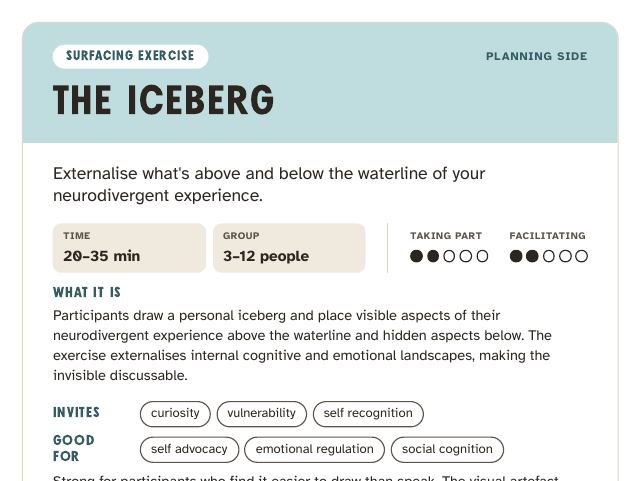
Cards for imagining situations and the extensions that might meet them, used in the scenario matching exercise.
The feeling component used a palette sheet of emotions that I had designed for participants to consult as they reflected on the scenarios. This palette was later revealed to be a sticker sheet, and the feeling stickers reappeared in exercises across the workshop series. Their first appearance here established them as a resource for naming emotional experience in the context of learning. This think-feel-do structure was important: it asked participants to sit with the emotional reality of a situation before moving to intervene (Sanders & Stappers, 2012). Lisa Grocott and I had adapted the say, think, feel, do structure described by Sanders and Stappers into this form across a number of motivation workshops we designed together, and it carried over into the Neuroformer series.
See the creative artefactFeelings stickers
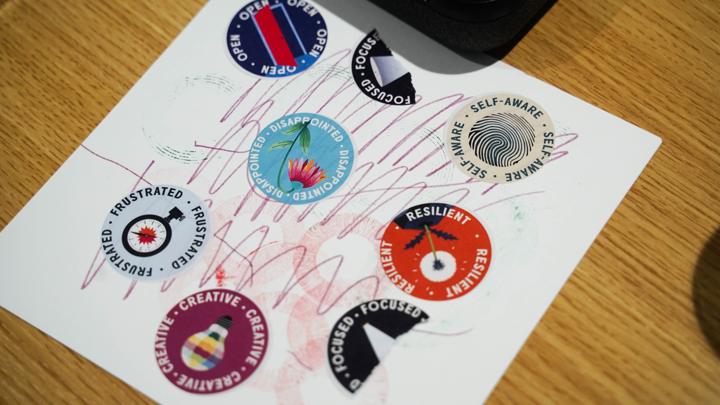
Round stickers, each carrying a feeling word in its design, used in the room and kept afterwards. They are also offered in the margin of this edition.
One participant engaged with the fogginess of this exercise. They described how the non-obvious structure made intuitive sense to them: “The fact that we had the five situations, but then we have like ten extension cards, and yes, out of those ten there’s five that clearly map. And then your kind of like, okay, I have these other five. What am I meant to do with those? It’s clear these don’t map. There’s clearly meant to be some outside of the box thinking here.” They described pairing a card with an image because they could “just imagine this image, that little blimp flying around inside.” It seemed that for this participant, the mismatches were not confusing, they explained: “not being logical and direct made sense to me, as we just had different experiences.”
[PRACTICE STORY] I was delighted when this participant described the cards as visually rich, as being able to imagine what the illustrations might do in movement. It told me that the fidelity and care I had put into producing these materials was communicating something beyond the content of the exercise. The cards were just clear enough to understand in more ways than just words. There was a multi-modality to them. This connected to something I was beginning to understand about the role of material care in this work: that the effort invested in the design of the physical materials was in fact relational, signalling to participants that their engagement was valued and that the exercises were worthy of their attention.
The Split Response
This first workshop involved physical materials, and the form of those materials, as much as their content, surfaced tensions that ran across the workshop series. The scenario matching exercise had three layers. First, participants identified a scenario. Then they matched a feeling sticker to it, naming the emotional register of the situation before reaching for a solution. Only then did they match a fabled extension to the scenario.
One participant had a visceral and negative response. They described the exercise as too constrained, obvious, and infantilising. Their reaction was grounded in years of clinical experience: “I am someone who has been in and out of counselling and therapy pretty much all my life, and it felt like, it feels like we just had an interpersonal therapy session.” They then connected the activity to the specific practice of being shown scenario cards depicting emotional states and being asked to identify and resolve them: “This person feels sad. Why do they feel sad? How can we make them feel better?” For this participant, the exercise triggered a frame of reference they had spent years trying to move beyond. Another participant resonated: “It felt very close to play therapy.” The participant who had the strongest negative reaction elaborated: “As someone who’s always been in counselling, it just felt like being a child again and having to be told I don’t understand things. Here’s cards helping you figure out how to understand things that you’re not understanding.”
Their history of being given emotion-recognition exercises in clinical settings, of being “sat down to do these things and learn how to read emotions, how to understand people, because I was always getting in trouble for not being able to read people,” meant that the scenario matching exercise, regardless of its actual intent, was received through a lens of clinical management.
A third participant described it as “reminding me of primary school, but not in a bad way,” noting that they could see how it could feel infantilising for others while they personally found it fun and restorative. And responding to the same exercise, another participant offered an entirely different reading:
“Doing the 1-2-3 thing,” an earlier exercise designed to help participants become comfortable with failure and with extending beyond their comfort zone, “and also the memory, twelve words, immediately gave me the vibe that it’s an unlearning thing. That we’re meant to be looking at things through a slightly different frame of reference.”
This split was revelatory. The same exercise, operating on the same group in the same room, was being received simultaneously as patronising clinical assessment and as a beautiful unlearning provocation. Neither reading was wrong. The participant who found it infantilising was drawing on a long and painful history of being clinically managed; the one who found it generative came from a place where they could suspend that frame and engage playfully. What the split revealed to me was that participants were at radically different points in their relationship to their own neurodivergence, and that a single exercise could not assume a uniform nor universal starting point.
[PRACTICE STORY] This threw me into the deep end as a facilitator. I had to navigate this interaction into a moment of productive tension, to help people see the duality and the spectrum of responses in the room rather than collapsing into one reading. To begin with, it was hard for me to process the critique because I was worried that I had seriously mis-targeted the tone of the workshop, that it was all too childish and paternalistic. It took me a few days of reflecting on it to really feel confident that there was always going to be this wide spread of responses, and that the spread itself was informative rather than damaging. When I had play-tested this exercise with younger neurodivergent participants and with older neurodivergent play researchers, the accusation of infantilisation and paternalism had not come up. As an educator I am familiar with mixed receptions; I have seen the same exercise light up one student and leave another cold. What surprised me was the forcefulness and spread of response inside a small group and aimed at a perceived register of clinical management over care rather than at the content. Some younger participants were still open to being presented with an experience and running with it, without engaging in the critique of power structures. Adults, particularly those who had experienced playful interventions and creative exercises before, could bring a sense of security to the experience. This cohort of young adults was in between: still moving into their sense of selves and perhaps more temperamental in their response and less able to stand on their own position than those at either end of the age spectrum. The exercise had inadvertently revealed a developmental sensitivity between adolescence and adulthood that I had not designed for.
[IMPACT SIGHTLINE] This split response directly informed the design of subsequent workshops. The critical thing I took away was that perhaps I hadn’t offered enough theoretical context, and these students seemed hungry for it. They seemed eager to engage with theoretical ideas and eager to move beyond abstraction into practical ways to improve their learning experiences. After Workshop 1, there was a clear request for more context. A few participants said that while the exercises were explained well, they did not know exactly why they were doing them, and this led to a sense of being disconcerted rather than having an open and reciprocal space to explore. One participant put it plainly: “I already know what answers you’re looking for. It doesn’t mean anything. Because I knew it was a workshop.” Another suggested that perhaps some participants would only need Workshops 2 and 3, because Workshop 1 covered ground they had already traversed in their own lives. This feedback reshaped how Workshop 2 introduced theoretical underpinnings directly to participants, and also began to suggest that a fixed, linear workshop structure might need to give way to something more like a playbook.
Stepping back from the specifics of the exercise, one participant observed something about the shape of the workshop that has stayed with me. They noted that the workshop “essentially works really well, but because we’re also used to just having things brute forced at us, someone presents one of the other two options,” referring to the three paths framework of brute force, sidestep and leapfrog explained in chapter two, “and we don’t even recognise it. We just go into it assuming it’s more brute force.” In other words, the very conditioning that the workshop sought to unsettle was also shaping how the workshop itself was received. The participants’ prior experience of education had trained them to expect a particular register, and when something arrived in a different register, some read it through the only frame they had been given.
The Feelings Palette
Within the scenario matching exercise, the feelings palette surfaced a rich conversation about the interpretive frames that participants were bringing into the room. Several participants noticed a personal bias towards seeking out negative emotions, partly because the exercise began with a moment of discomfort. One participant observed: “I noticed that I subconsciously weigh ‘sensitive’ as a neutral, a good thing. And I just realised most people probably wouldn’t weigh that as a good thing.”
Another offered a striking reframe of “overwhelmed”: “Overwhelmed isn’t always negative. The first time I saw snow, I was so overwhelmed I had to just sit down. But it wasn’t an uncomfortable overwhelmed. It was, oh my god, this is gorgeous, I need to sit down and take this in. I’ve been positively overwhelmed a lot as well.”
The group noted that the colour and design of the stickers themselves shaped interpretation: “overwhelmed” rendered in red and black invoked a negative reading regardless of the participant’s own relationship to the word. Participants suggested that “joy” should be included, that “energised” would work better than “hyperactive,” and that “righteousness” or “misunderstood” were common neurodivergent experiences worth naming. One participant described the concept of distraction as “a leaf floating and footsteps leading off to the side, or a half-drawn design.” Some participants tore up the feeling stickers to communicate a disjuncture between parts of emotions and their experience, reassembling fragments to better represent what they actually felt. I had also included blank stickers so that people could draw their own emotions if the existing palette did not hold what they needed.
This moment revealed something important about the design of the materials themselves. The visual language of the stickers pre-emptively shaped the emotional register of the exercise. Norman (2004) argues that objects evoke emotional responses through their aesthetic qualities before any cognitive evaluation takes place. Tong and Diatta (2018) extend this consideration of the affect to centre emotion as a material to be designed with and for. Dernikos and colleagues (2020) make the case that affect is not incidental to learning but constitutive of it. The way something feels shapes what it becomes possible to learn. What participants were telling me was that the affordances of the sticker design either opened or closed certain readings before anyone had even begun the exercise. The initial set was based on the feelings I noticed when engaging with my own cognition, along with those suggested by neurodivergent colleagues while prototyping. The visual vocabulary of rounded forms and relatively vibrant pastels was selected to be as engaging and varied as possible while still feeling cohesive. The goal was for the objects to be memorable. The participants’ suggestions were used to collaboratively redesign the materials and also show, through discussion, the plurality of emotions that can come from similar experiences and how those emotions can coexist amongst us. The frame we enter with, as one participant put it, determines what we find.
These comments directly informed the updated version of the feelings palette used in subsequent workshops: it engaged more deeply with colour theory and offered a broader spread of emotions, positive, negative and neutral, to map the register learners bring to reflecting on their own learning. The act of tearing stickers apart, of drawing new ones, of refusing the given palette, these were themselves acts of design, and they taught me that the materials needed to be as flexible and as varied as the minds they were designed to serve.
Before and After
Near the end of the workshop, I invited participants into a spoken reflection on how they felt before and after the session by asking them to describe their ‘emotional weather’. Before, one participant suggested; “drowsy fog and uncertainty”, after, “still clouds in the sky but the fog has mostly cleared. Dewy.” One participant offered the word “petrichor,” which is the smell of the air, concrete and earth after rain. This language was striking because it was sensory, atmospheric, tentative, and hopeful. Their descriptions of changing weather systems evidenced the shift that had taken place through the workshops.
[PRACTICE STORY] It was not an accident that students used sensory language to describe their emotions. I introduced the What’s the weather exercise by telling the group about how I reflect with my twin, Laurel. Both of us are neurodivergent. We have joked for years that Laurel can’t read very well and I can’t write or spell very well, but together we function much better. One of the things we have been doing for a number of years is to ask one another, rather than how we are or how we feel, what the weather is. We don’t mean the weather outside. We mean the weather in our own minds, the emotional weather. Is it dry, wet, blustery, ominous? I offered this to the group as a way in, and the language they returned was richer and more textured than anything a single-word feeling descriptor could have captured. The atmosphere of the weather seems to allow us to engage more deeply with the subtlety of emotion, and might help us sidestep any pre-existing difficulties we have sharing our feelings. I am also not sure this level of introspection, this sense of a collective breathing out, would have happened in the same way if I had asked participants to fill in a survey or to give their quantitative judgements out of ten. The spoken, relational quality of the reflection mattered. It was itself an exercise in the kind of atmospheric attunement the workshop had been building towards.
[THEORETICAL GROUNDING] The atmospheric quality of this language connects to Sumartojo and colleagues’ (2020) work on designed atmospheres and the ways in which environments are felt before they are cognitively apprehended. The shift from “fog” to “petrichor” is not a measurable outcome in any conventional sense, and yet it speaks to a felt change in the conditions under which learning and self-reflection might become possible. It also resonates again with Nora Bateson’s (2016) warm data: relational, contextual, and resistant to being reduced to a single variable.
The Understory: What Was Not Immediately Visible
What I could observe in the room was only part of the story. After the workshop, the teacher coordinating my presence shared observations that reframed what I thought had happened. The teacher told me that one participant had been smiling during the session and actively engaging with others for the first time at the school, as far as they could tell. Another was actively participating in discussion rather than prioritising other activities like coding, again perhaps for the first time. A third participant, who had told both me and the teacher that they had initially not wanted to take part, arrived late and said they would rather just observe but ended up engaging actively and joyously.
One participant in particular unsettled my assumptions. Throughout the workshop, they kept using their laptop rather than engaging in the exercises. They occasionally looked up and joined parts of the discussion, picked up one of the decks of cards I had produced or explored the feeling stickers for a few minutes before returning to their screen. I worried that I hadn’t fully engaged them and that for this participant the workshop hadn’t been especially meaningful. That concern faded when I heard feedback from the teacher after the workshop ended. They told me that this participant had been at the school for more than eight months and that this was, in this teacher’s experience, the most they had engaged in a learning activity and also the most they had smiled at anybody at any point over that time. My expectation of what real change and transformation looked like was entirely at odds with the way it manifested in the mind and outward temperament of this participant.
The teacher also noted that the high quality of the physical materials, despite being early prototypes, communicated dignity, respect and value for participants from backgrounds where they were generally distrusting of formal organisations and guest facilitators (Diatta, 2015). The teacher and I both observed that this care increased a sense of psychological safety and of being seen, heard and validated.
[PRACTICE STORY] I had been focused on the vocal responses, the critiques, the tensions, while underneath the conversation shifts were taking place that I could not have detected through observation alone. What I read as the laptop participant’s disengagement was, by the measure of someone who knew them far better than I did, their most sustained engagement in months. Because the cognition of neurodivergent learners is so varied, and when you bring even a few neurodivergent learners together you experience the range of that variance, it can be easy to mistake engagement of a different kind for indifference. Even asking participants directly or encouraging them to self-report might not yield the clarity you are seeking. Rather, someone who has a deeper understanding of the context and the way excitement or interest manifests can offer clarity. It is also true that some people are already more open than others, and that some people might make a really significant change that still does not put them in an idealised position after the workshop, whereas there are others who are already primed and pre-resourced to get more out of it.
A Participant Interview Following the First Workshop
Following the first workshop, I conducted a semi-structured interview with one of the participants. Interviews were offered to everyone as part of the consent design rather than selected by me. This participant volunteered, and their willingness, given how much the session had visibly surfaced for them, was itself significant. This conversation deepened and complicated much of what had surfaced in the group session, and it remains one of the most moving and meaningful exchanges of the entire research. The participant described their relationship to learning with an intensity that reframed the entire premise of the workshop: “I adore learning. It used to be my escape at school. The passion of knowing that I would learn more was enough to get me through the bullying and everything. I put hope into being able to learn and experience over everything else that was happening in my life.”
Yet, as they reported, the educational institutions they had moved through had systematically misread this love of learning. They described a moment that I think is possibly the clearest illustration of the gap between capacity and normative measurement, and is the entire argument of my PhD in miniature:
“I had the lowest reading level in my year level for years, and then I got caught in the library reading a really advanced book and they were like, what the fuck? And I was like, I can’t borrow these and they don’t count towards the quizzes. And then the SSO [School Services Officer] worker was like, we can finagle that. And then I got the best reading level in the class. It’s just because it wasn’t the way that they wanted it or in the sequence that they wanted it.”
What I read from this episode is that the capacity was always there. The system simply could not see it until it was expressed in the form the system recognised.
Punished Strategies
This participant that I interviewed had also developed their own cognitive strategies long before any formal support was offered. They described mark-making, doodling and drawing as a habitual practice that helped them sequence information, maintain interest, and feel like they were contributing even when they could not process everything coming at them: “It gives me a habitual thing that I can fall back on, that I can transmute into whatever I’m doing, which then creates some semblance of comfort and gives me a foundation to build off of, even in uncertain circumstances.”
See the creative artefactMark-Making Cognition
The stamp-based cognition mapping exercise: custom stamps, ink pads and a canvas, with the feelings stickers over the top.
This practice had been punished in school. They told me they were reprimanded for “destroying” textbooks, for drawing during class, for carrying an art book. I understand these as self-developed cognitive strategies being punished rather than supported. The participant was undiagnosed until their twenties, and the absence of clarity around their cognition, in the form of a diagnosis, had led to a broken self-conception: “I was undiagnosed until I was 20, 21-ish. I’ve been my entire life just thinking that I was broken and like I was just drowning in everything that I was going through.”
[THEORETICAL GROUNDING] The participant’s self-developed practice of doodling and mark-making as a cognitive strategy resonates with Jackie Andrade’s (2010) research on what doodling does for attention and information retention, and more broadly with the argument that neurodivergent learners often develop effective learning strategies independently, only to have them punished or pathologised by normative educational environments (Geyer, 2021; Syharat et al., 2023). What was characterised as distraction or destruction by the school system was in fact a sophisticated self-regulatory mechanism.
From Shame to Understanding
When I asked in the interview whether it was possible to believe in yourself without a diagnosis, the response was unequivocal:
“I tried for so long but I would just reach a point where, why can’t I function? Why aren’t I the same? I always thought it was a mix between being my fault because I couldn’t overcome what had happened to me, or that it was the fault of the people around me. And now I know that it’s a mix, but it’s predominantly the fact that I have lived a, thankfully, not standard life on top of not seeing or experiencing the world in the same way as other people.”
The narrative here moves from self-blame to release. The diagnosis, when it finally arrived, freed them to understand who they were: “It has helped me to not be so mean to myself, to try to let go of a lot of the shame. It has helped me to grow as a person because now I can look at the fact that I do need support, I do need help.”
They framed the difference with striking clarity: “Do you want your child to live out their life with the thought, ‘I’m struggling because I have this condition that means I need extra help,’ or do you want them to go, ‘I’m terrible, I’m so bad at life, I can’t function, I’m a failing human’? That is the difference.”
Accessibility as a Standpoint
This interview also surfaced perspectives on assistive technology that connected directly to the research. The participant described the Temi robot, which allowed them to hold spatial presence in the classroom while attending remotely, as a transformative tool: “I hold space in a room and I can move. People acknowledge it. They’re like, oh yeah, that thing is a thing.” They described subtitles, transcripts, recordings, and multiple modalities of access as essential: “It’s such a capacity to give you multi-levels of learning, whereas in school a lot of times it’s a projector screen and a person talking while there’s a ton of other people talking in a room with shitty lights.”
See the creative artefactWind-up robot figures
Small wind-up robots given out in the third workshop as physical commitment devices, and taken home.
And they articulated something that could stand as a design principle for the entire research: “Accessibility shouldn’t be built in when it’s needed. It should be there as a standpoint so that people aren’t excluded from the get-go.”
[PRACTICE STORY] This interview confronted me with the depth of what participants were carrying into the room. These workshops were operating on people whose relationship to learning had been shaped by years of institutional failure, misdiagnosis or non-diagnosis, punished self-advocacy, and the compounding effects of intersecting marginalisation (Dietkus, 2022). The participant’s self-developed strategy of mark-making, independently arrived at and then punished by the very system that in my view should have supported it, is a precise example of what happens when normative educational environments cannot recognise capacity that presents in non-standard forms. That this participant could still say “I adore learning” after everything they had been through is not a testament to resilience in the individualised, bootstrapping sense. I see it as evidence that the desire to learn persists even when institutional signals tell you that the way you learn is wrong.
The Contentious Exchange: Collective Sense-Making in Action
We had a group reflection following the first workshop, in which a participant made a provocative claim: “Society is currently incapable of producing an autistic person who isn’t traumatised, and that’s just a huge problem.” They elaborated: “If we somehow stopped doing that, probably everyone would have a much better view of themselves, including neurotypical people, oddly enough.”
Other participants met this with immediate and genuine disagreement. In what unfolded I could notice at least three distinct perspectives emerging in real time. The first was an absolute, universal claim: that society is incapable of producing an untraumatised autistic person. The second was a counter-example: another participant responded that they had met autistic people who had grown up fine, functioned well, and did not carry trauma. The third was a complication: a participant observed that events most neurotypicals would not consider traumatising can be genuinely traumatising for neurodivergent people, but the neurodivergent person experiencing them may not recognise them as trauma because they have been told “it should not be a problem, you should feel fine about this, this is normal.”
What happened next seemed to me remarkable. The participant who had made the original claim paused, took in the responses, and publicly amended their position: “If you don’t identify as traumatised and you are autistic, that is totally valid, and I apologise for insinuating otherwise.” They then extended the provocation further: “I would probably honestly extend my statement to say that it is impossible for our society to produce any person who is entirely untraumatised, which is its whole other thing.”
The initial statement was collectively considered, challenged, and then retracted and amended to incorporate a more capacious view of what it was possible to feel about oneself while being neurodivergent. The blunt assertion of something being universally true was sharpened into one that described more deeply what was true for the person who said it. This was not a facilitated therapeutic resolution. Nobody mediated. Nobody corrected. The participants held space for a genuine disagreement, and they arrived at a more nuanced position together.
This exchange demonstrated the need for pluriversal approaches and framings rather than universal ones (Escobar, 2017) which I talked about in Chapter 2. Declarative, empirical statements about the neurodivergent experience, much like claims of universal design as an absolute statement of accessibility, can flatten the very variance they seek to advocate for. What this room showed me was that three people with significantly overlapping experiences of neurodivergence could hold three genuinely incompatible readings of the same phenomenon, and that the incompatibility itself was the data, not an obstacle to be resolved.
This exchange became, for me, a foundational example of what I would come to call togethering: the process by which collective, participatory reflection among neurodivergent learners can gently unsettle fixed narratives about the neurodivergent experience. By dis-intermediating educational systems or curricula, creating direct, horizontal learning encounters that bypass hierarchical structures, and encouraging collaborative, participatory reflection, the participants and I could begin to disassemble the deterministic impulse that comes from reflecting on our experiences only as individuals. Making visible the non-homogeneity of neurodivergent experience might allow us to understand and respond to the depth and variety of it. Actively valuing and interrogating together how varied their experiences and perceptions were gently upset settled notions of how other people respond to the world, and by consequence the definitions and rules that arise from those responses.
[IMPACT SIGHTLINE] This moment also carried a methodological implication. As a researcher trying to analyse and reflect on what took place in these workshops, I might miss or flatten the complexity of the sense-making taking place in the minds of participants. The difference, when compared to other quantitative or positivist research orientations, is in the stated goal: to notice the complexity of what actually took place and attune to it, rather than dismissing the non-homogeneity as outlying, non-statistically-significant data points, or attempting to justify, adjust for, or simply ignore a version of events that cannot be cleanly modelled beyond an individual scale. I believe this form of ethnographic reflection is particularly powerful at serving the actual theory of change that will benefit neurodivergent learners: personalised, responsive shifts in individual experience.
4.5.5Workshop 2: Neuroformer - Return of the Neurowiggly
Responding to the Room
The first workshop had surfaced a clear request: participants wanted to know not just what they were doing, but why. This second workshop leaned further on introducing participants directly to theory, and specifically to the nature of their own mind and how it is possible to have digitally mediated cognitive extensions (Clark & Chalmers, 1998; Drayson, 2010; Dror & Harnad, 2008). By offering some of the theoretical underpinnings and intentions behind the workshops directly to the participants as part of the workshop itself, my intention was to gesture towards the greater context of the exercises, so that participants could examine each one’s didactic intent.
Each workshop engaged all four moves of what I have come to call the SEAT framework, surfacing, envisaging, actioning, and togethering, a modified version of Grocott’s (2022) SEED framework developed specifically for the context of neurodivergent learning, and I described this structure to participants in plain terms. There was a deliberate bias towards experimenting with different components across the different workshops. Where the first workshop leaned most heavily on surfacing, this second workshop leaned towards envisaging: what might it look like to think of your mind as something that extends beyond your skull?
This workshop was conducted online, and there seemed to be an increased willingness to be introspective. Participants volunteered first-person reflections earlier and with less prompting than in the first workshop, and pauses were held rather than filled. This may have been due to a few things. Each participant was comfortable in their own space and could disengage on their own terms simply by muting their microphone or turning off their camera. The participant group was smaller, and all had attended the first workshop. The exercises used the impermanence of a digital space: shapes and marks could be configured and reconfigured infinitely (Bratteteig & Wagner, 2012; Mörtberg et al., 2010). The malleability of a digital canvas invites speculation in a way the permanence of physical mark-making does not always allow; you can try something, discard it, and try again without waste or evidence of failure. The connection to introspection is direct: when every mark can be unmade, looking inward costs less, because whatever surfaces can be revised before it hardens into a statement about the self.
Opening with Context: My Own Story
Before sharing the theoretical underpinnings and intentions of the workshop, and rather than opening with an exercise, I began this second workshop with context. I shared my own history with assistive technology, academic struggle and neurodiversity. I told the group that among other things I am dyslexic, and that there was always a large gap between the kind of writing I could do and the kind of thinking I was doing. In other words, I told them it is possible to be literary before you are literate. I described being the first student in the UK to be permitted to use dictation software for my GCSEs, and of having a laptop so heavy that it caused me back pain, along with the fact that there was a single plug in the back of a room so I was always at the back of the class. I told them, to illustrate the rate of change in technology, that I had finally removed the dictation software I first used from my database of recommended tools because emerging ones had far surpassed it. The tools had moved on, but the need to find them, test them, and build relationships with them remained.
[PRACTICE STORY] I shared this story to demonstrate three things. First, that I had been able to engage with assistive technology in embodied, material ways for as long as the possibility had been open. Second, that the space to do that work had not existed for most of my education. When I first used the dictation software Dragon, it had been expensive, clunky, physically burdensome, and onerous. Third, that this landscape of tools had changed so rapidly that awareness and selection of tools had little utility compared with developing a sensibility and capacity to evaluate and adopt new tools. For me, the Dragon story is not just useful as a personal anecdote to demonstrate the history of technology. It is evidence of structural, ongoing problems without fixed solutions.
A participant responded with a story about educators in specialised settings who, when a child was functioning well with a particular support, meaning meeting the classroom’s expectations while the support was in place, would remove it so the child could “learn how to be normal functional.” I offered a response: it is a little bit like asking someone who wears a prosthetic every day to practise hopping. The logic assumes the aid is a crutch when it is in fact a capacity. I found that this exchange set the tone for the workshop: personal, grounded, and willing to name what was broken.
Ka Mua, Ka Muri: Walking Backwards into the Future
At the transition of the workshop from surfacing to envisaging, I introduced a whakatauki shared with me by my supervisor Lisa Grocott, who often brings Māori knowledge into contact with discourses around transformation, design, and relationality. I chose that moment because envisaging asks participants to face a future, and ka mua, ka muri offers an expansive framing for doing so.
Ka mua, ka muri, walking backwards into the future, inverts the typical Western orientation towards what comes next. You turn around and face the past: the further back you look, the foggier your memory becomes, but the present might be immediate and clear. The future is behind you, emerging and undetermined. I offered this to the group as a way of thinking about neurodivergence: it allows acknowledgement of the past without being trapped by it and positions the future as something you can influence but cannot see. The reorientation did observable work in the room: throughout the rest of the session, participants spoke differently about their futures and were able to posit possibilities. In that uncertainty, experimentation was allowed to blossom. Offering the future as something emerging behind you, rather than a wall to be faced, lowered the demand of the exercises that followed. Participants could begin from grounding in evidence instead of prophecy.
[THEORETICAL GROUNDING] Integrating indigenous knowledge into a design research context carries responsibilities. Western engagement with indigenous thought has historically overemphasised content at the expense of the processes of knowledge transmission and creation, as Tyson Yunkaporta (2019) argues. My use of Ka mua, ka muri is an attempt to engage with the process: to bring a relational and non-linear orientation to time into contact with the workshops, not to extract or instrumentalise a cultural concept but to allow it to reframe what is possible. Linda Tuhiwai Smith (2021) reminds us that research involving indigenous knowledge must be conducted with care, reciprocity, and an awareness of the colonial histories that have shaped academic inquiry. Humphries (2022) asks what the mauri, the life force, of a system is, and whether a colonial system can naturally produce indigenous outcomes. I do not claim that it can. I think that allowing indigenous orientations of time and knowledge to sit in contrast to Western pedagogical frames, without subordinating to the latter, is a necessary step towards the pluriversal approach this work aspires to. More capacious knowledge systems exemplify other ways of knowing that many neurodivergent learners seem so hungry for. Both Escobar (2017) and Yunkaporta (2019) model this holding-in-contrast, indigenous and Western knowledge thinking alongside one another.
From the Platonic Learner to the Neurowiggly Shape
After the whakatauki, I presented a sequence of learning theory diagrams directly to participants, drawing on the theories laid out in Chapter 2. The sequence of diagrams explained first a traditional model of learning, where a teacher delivers content and a neurotypical learner absorbs it, through progressive and connectivist models, to a posthumanist connectivist frame in which responsive technology mediates between human cognition and the world (Siemens, 2005). The conceptual move represented in the diagrams was from the platonic ideal of the learner, equally capable in all domains, to the neurowiggly shape: the jagged, asymmetric, spiky form that neurodivergent cognition actually takes.
See the creative artefactMapping Neurowiggly Cognition
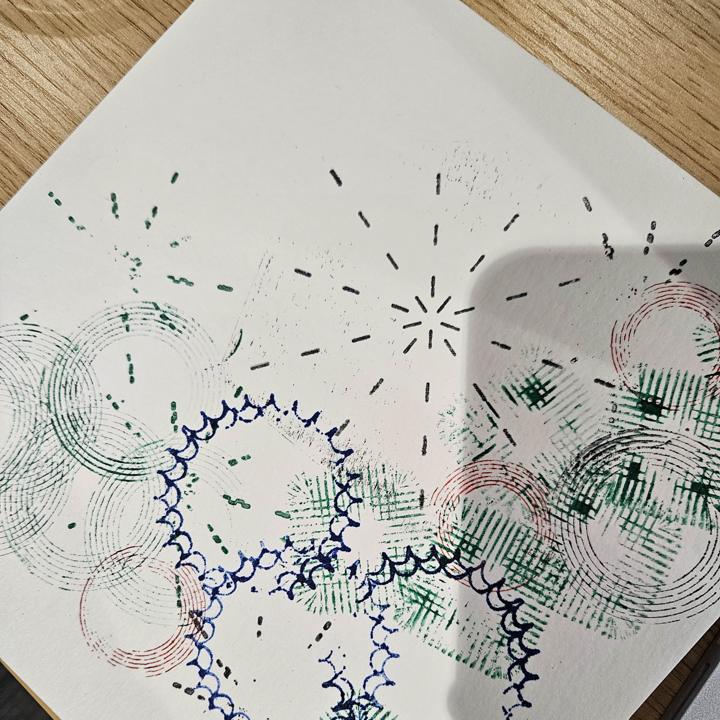
Drawing the shape of a cognition, then the extensions, tools and strategies that reach from it; a variant of the stamps and the Visualiser.
The exercise in the PlaybookVisualising Your Wiggly Cognition
I shared the results of my own educational psychology assessment from 2015, as an illustration of what I was trying to represent through the diagrams. The scores were so varied that the system could not derive a standard IQ. It simply said: “IQ cannot be derived.” I showed the group how those scores produced a shape and told them: “I don’t think those numbers matter nearly as much as that shape.”
[PRACTICE STORY] I found it quite vulnerable to share my Ed Psych report the first time I did it. Vulnerability comes from clarity about my weaknesses. It is very easy, when introducing it, to just focus on the strengths, on what you are good at, but that necessarily contrasts with what Alex, the teacher, observed: that assessments tend to say less about strengths. In a way, I am quite proud of the idea that my IQ cannot be derived. That my mind breaks a system I don’t believe in just by existing. It cannot be constrained into a particular box. I think communicating how I struggle and how I am strong may well be useful because it reveals more of who I am than just naming my diagnosis. This is the same move as the Dragon dictation story that opened the workshop: sharing my own history so it can do pedagogical work.
Participants immediately tested this against their own experience. One described being told they were “dumb” despite having “incredible intellectual capacity” in some areas. Another had been given multiple hearing tests as a child because they were quiet, not because they couldn’t hear. A third described how their occupational assessment barely registered them as disabled because “on paper I seem fine,” but real-world application told a different story. It was nice to see other participants share moments where they jarred or disrupted systems trying to categorise them.
Standardised measurements that average a neurowiggly profile into a handful of flat numbers (or in the case of IQ a single number), misrepresents and flattens the scope, scale, depth and breadth of neurodivergent cognition. This flattening has insidious consequences, once you have optimised for a diminished environment, once a limiting belief has been locked in and reinforced, unpicking it is extraordinarily difficult. This phenomenon, described by Robert Kegan and Lisa Laskow Lahey (2009) as immunity to change, explains how people resist transformation not because they lack motivation but because tacit assumptions produce competing commitments that maintain the status quo. For neurodivergent learners who have spent years internalising a deficit narrative, these competing commitments can be deeply entrenched, a structure visible in the first workshop’s interview: strategies punished in one environment, commitments formed to survive it, both outliving the environment itself. Sharing the neurowiggly shape was an attempt to interrupt this immunity by providing a visual language for something participants had felt but perhaps had not been able to articulate. Visual metaphors and externalisations provide different ways into understanding that verbal or written articulation alone cannot access (Lockton et al., 2019). The shape enabled the texture of my cognition to become legible to me, and in doing so, invited others to consider the form of their own cognition.
Assembling and Extending Cognition
The central exercise of this second workshop asked participants to build a visual representation of their own cognition using semi-transparent shapes on a Miro board, and then to extend it with a second set of shapes representing the instruments of change they wished they had: the tools, strategies, supports, and spaces that would let the cognition they had just mapped flourish.
See the creative artefactMiro digital twins
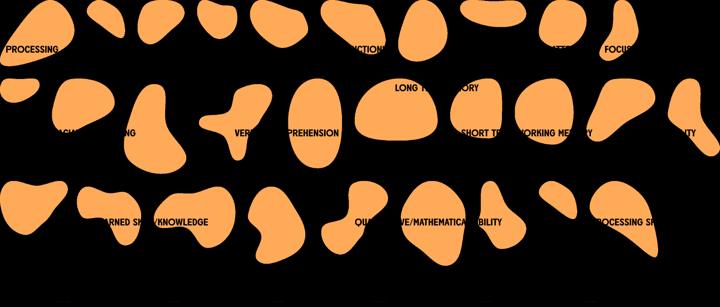
Digital twins of the workshops, used alongside the physical cards to make a hybrid space.
The exercise was preceded by a brief mindfulness exercise in which I asked participants to notice a point of friction in their immediate environment: a dead leg, wool on skin, the smell of cold coffee, a fridge buzzing through the wall. This was an instrument of change in action: a mind-body strategy, a strategy for self, practised before the mapping began.
The cognition shapes participants built were remarkably varied, and each revealed something different about how people engage with the idea of their own mind. One looked like a dog, which the participant told us they built without intention but recognised with delight afterwards, showing how playfulness can emerge even in an exercise designed for introspection. Another was described by peers as both an explosion and a flower, suggesting that people often engaged with one another’s cognitions differently to how the maker themselves understood it. One participant placed executive functioning at the centre, the spikiest shape, because they said it took the most effort to maintain. A further participant described their cognition as a web of strings and loops rather than blobs: “I string things together in my mind to make a bigger picture.” Another spontaneously shared a hand-drawn map they had previously created, featuring locations like “Seeker’s Plight,” “Get Me Not Forest,” and “Bloom Island,” a landscape of past trauma and future hope.
One participant placed learned skills at the centre and explained: “I sat there for a good minute being like, I don’t know who I am. So I kind of just went, who am I trying to be? Everything is just a learned skill.” This is a statement shows some degree of introspection. What it surfaced to me was an awareness that masking was occurring: a pressure to and practice of diminishing the self, to adapt or conform to the world without an intermediary layer taking up the slack. For this participant, it seemed, the shape they built represented who they had learned to perform rather than who they were.
When I introduced the extending exercise, one participant said they had anticipated it: “I did hope this was coming, because I literally built parts of my structure with the intention of, I can also map out the way I would add things to this.” The workshop’s design logic had become legible. The participant could see the scaffold, and seeing it was part of what made it work. The exercise asked for honest self-mapping, and with a legible scaffold that lowers the suspicion that something is being done to you, the design itself becomes material a participant can work with, and even ahead of. Chapter 2 traced why visible decisions (Bratteteig & Wagner, 2012) and a disclosed configuration of participation (Vines et al., 2013) matter in co-design; here the principle stopped being procedural and became felt. For a cohort whose educational histories often involved having rationales withheld, an open pedagogy that shows its working seemed a precondition for introspection.
This workshop enacted the SEAT framework with greater visibility to participants than the first. I also interleaved this activity with physical metaphors and experiential exercises, including a wrist-turning exercise that asked participants to turn their palm from up to down without twisting their wrist to show that seemingly impossible movements are within reach with a change of insight and strategy (it’s not just or even primarily about bodily awareness). These were designed to help them attune to their position, to their body in space, rather than living entirely inside the shared digital environment.
The Tool Line: Who Draws It, and Where
I brought the tool line, the provocation about the nature of extended cognition discussed in Chapter 2, directly into the workshop.
I prompted the students: We accept clothes, pens, laptops, and glasses as extensions of self. So where do we draw the line? And why do we draw it where we do? One participant responded through the Zoom chat:
“As a creative writer I have never used Grammarly, I turn off spell checker wherever I can, because I love to use odd grammar, deliberate misspellings, weird page formatting as a thematic part of my writing, to produce a specific effect, which Grammarly would erase. What would be useful is a tool that can adapt to my style more effectively to ignore things I’m doing on purpose and catch my actual mistakes instead.”
To me, this comment pointed towards a distinction between tools that flatten towards a median and tools that extend what is already there. The participant was not rejecting assistive technology; they were requesting assistive technology that actually assists and extends. The same participant challenged the logic of aid dependency: “The whole idea of an aid is to make things easier and accessible. There’s no over-using an aid. That is not a thing.” It is not possible to overuse a part of self that helps you meet your needs. The comment arrived in the chat while I was speaking, and I almost missed it. The online format had created a parallel channel of conversation, and some of the sharpest contributions emerged there. I saw the Zoom chat as itself an example of cognitive extension. A participant who might have needed to wait for a gap in spoken conversation could compose their thoughts fully and offer it without social friction. That the tool line provocation generated its sharpest response through a digitally extended mode of participation was not lost on me.
4.5.6Workshop 3: Neuroformer Three - The Final Extension
The final workshop returned in person and moved the discourse outward with 14 participants, all of whom had attended at least one earlier workshop. Where Workshop 1 had leaned on surfacing and Workshop 2 on envisaging, this workshop focused more on actioning: grounding the conversation in the real-world constraints and hardships documented across disability studies (Goodley, 2001, 2014; Siebers, 2008), the lived negotiation of assistive technology (Ravneberg & Söderström, 2017), and the untapped potential of the neurodivergent experience (S. A. Brown, 2023; Beckett & Callus, 2023). Through collective mapping exercises, participants were invited to lay out the boundaries of their personal cognitive mobility, as well as how it fit into the mobility of the neurotypical community more broadly.
By exploring cognitive extension in the context of the world, the exercises aimed at grounding the discourse of disability in societal disabling rather than individual incapacity. The sense of the world being something participants could engage with and as part of, but were not responsible for, sought to soften the self-critique that can otherwise take hold when exploring new ways of learning (Chappell et al., 2001; Biesta, 2021). By leaning further on a world-centred frame, this workshop encouraged me to think of participants as primarily human beings and as recipients of education afterwards (Apple et al., 2022; Biesta, 2007a, 2007b).
[IMPACT SIGHTLINE] Actioning, in the context of the SEAT framework, is not about deploying a single intervention. It is about orienting participants towards the possibility that transformation is not confined to the workshop but extends into the whole of their lives. The world-centred frame matters because it resists the implication that learning, introspection, and cognitive extension are experiences bound to this learning environment or to institutional or educational contexts only (Biesta, 2020, 2021). If we accept that neurodivergent learners navigate the world as whole people, not as students in a classroom, then the instruments of change they adopt must be responsive to that whole life, and the shift from bounded learning to living must be made visible and actionable.
The Clasping Trick
One of the workshop exercises detailed in the playbook involved a magic trick from my performance repertoire. I asked participants to clasp their hands together, and then I unclasped them in a way that they were unable to. Here is how I put it during the workshop:
“You and I, we look like we’ve done the same activities. I’ve done this, I’ve done this, I’ve done this. And in that moment, I can just do that, which looks a lot like this, but is in fact a magic trick. Here’s the point: what might appear to be the same experience, under the surface, often isn’t. In fact, you can be living worlds away in the recesses of your mind. Your experience can be fundamentally different from the way people interpret you and from what it looks like to someone next to you doing exactly the same thing. I just want to acknowledge that what I’m suggesting to you is not a universal strategy, but I think it’s a path that works, even if it doesn’t solve every possible problem.”
One participant later reflected that “acknowledgement is really useful, either acknowledging that things are difficult and hard, that’s enough for us all to go, yeah, it is hard, isn’t it.”
[PRACTICE STORY] I would not have done this exercise in the first workshop. The clasping trick creates a momentary separation between facilitator and participants, a knowledge asymmetry, since the performer briefly holds a secret, which can be confronting if the horizontal, collaborative environment has not yet been established. By the third workshop, there was enough trust and comfort that this separation could be read as playful rather than hierarchical. If I were to run this workshop again, I might teach one of the less engaged participants to perform it with me, or instead of me, to further distribute the facilitation and avoid centring myself unnecessarily. For me, magic entertains cyclically: first as it delights, and then again when I understand how it works. I wanted this exercise to do a similar thing: to create a moment of surprise that becomes, on reflection, an illustration of something the participants already knew to be true about their own experience.
See the creative artefactPerspective Circles, Wrist Twist and the Clasping Trick
Brief exercises that give a felt sense of perspective shift in the body.
Mapping Cognition into the World
The mapping exercises asked participants to first identify parts of their cognition, then the elements that extended it, and finally to explore how a hybrid, extended self could navigate the wicked problems of the world. The workshop tried to situate the shift work of extending cognition in a zone of proximal development (Wells, 1999; Harland, 2003), moving from what participants could already do to what became possible with appropriate instruments and community.
The materials, custom stamps and cognition-mapping canvases revealed progressively, were designed to act as boundary objects (Fox, 2011): objects that translate between the internal experience of cognition, which is private and difficult to articulate, and an external, shared representation that can be collectively examined, discussed and built upon. In this sense the workshop operated as a temporary community of practice (Wenger, 1998) in which learning took place through the social act of making and reflecting together rather than through instruction (Lave & Wenger, 1991).
I introduced the idea of stacking: that no single tool or strategy solves everything, but that you layer interventions on top of one another until you build something more complete. I did this by demonstrating and talking through my own stacks:
“There’s no one thing. You just stack things on top of another until you build an environment, a framework that surrounds you completely. It’s not just a partial thing. It’s a more complete thing.”
The model is one of accumulation, a set of instruments, digital, relational, environmental and internal, that together create the conditions for a different way of being in the world.
Educated vs Well-Learned
A discussion during the group reflection at the close of the workshop surfaced a distinction that felt important to me. Participants considered what it means to be educated. One participant said:
“When you are finished with school or your growth, that’s it for you. You don’t get supports anymore. You are ready to work, to be a functioning member of society. You can take care of yourself. You are not a problem to the people around you. That is what it is to be educated. You’ve passed the test.”
Another responded: “Well-learned, I think of a person who’s gone through a lot of shit and who’s grown from it. But if you tell me someone’s well-educated, I presume they mean they’ve gone to the big schools and they’ve learned, they’ve got the big degree. And to me that means they are probably emotionally stunted. They’re a good worker for the machine.”
This debate was not one I had introduced. It emerged from the group and articulated the difference between being processed by an educational system and having actually learned, on your own terms, in ways that matter to you. To me, the first participant’s description of being “educated,” no longer a problem, ready to work, having passed the test, reads as the successful production of a compliant, self-managing subject who has internalised the metrics of the system as self-worth (Han, 2017). The distress this produces in neurodivergent learners who cannot or will not comply can go beyond a personal grievance; it can manifest as a suffering that demands structural change and deeper relational engagement (Sedgwick, 1982). The second participant’s reframe, that being “well-learned” means having grown through difficulty, suggests a fundamentally different relationship with knowledge, one that is experiential, relational, and earned as opposed to credentialed. Education, in the world-centred sense, is not the production of competent workers but the cultivation of grown-up, agential, responsible relationships with the world (Biesta, 2021), and these participants were articulating that critique from inside their own experience of it (Goodley, 2014).
Have You Tried: Togethering in Action
In the latter half of the workshop, I introduced an exercise called “Have you tried,” where I asked participants to discuss their experience of unsolicited advice and how unpleasant it can be to receive. Once that discussion was over, I explained that this exercise was about solicited advice. Participants were invited to share a problem they were facing, and others would respond with ideas that might help, with one condition: “It’s very important that you don’t assume judgement. If someone has a problem, don’t say that’s a stupid problem. Just say, have you tried this?”
This exercise, adapted from my WonderLab colleagues, was, to me, the moment that most directly demonstrated togethering without centring me as the facilitator. Once I set up the conditions for the gathering to take place, collective problem-solving took over. In pairs, participants bounced ideas off one another, built on suggestions, and offered perspectives the person with the problem had not encountered. One participant described how helpful it was to “speak ideas after somebody, have them criticise or just bounce off ideas together.” Another noted the value of body doubling and doing things in groups, even when the extensions being discussed were not actively being used: “Creating a space to do that, I think, is beneficial for the students who don’t feel comfortable experimenting on their own.”
[PRACTICE STORY] When I saw this exercise working, I felt giddy. The scaffolding of consent to provide solicited advice, producing a space that tried to encourage inquiry and personal introspection without judgement, seemed so clarifying. It was clarifying for me too: it was genuinely useful to get all this advice from such a wonderful array of thinkers and people. I think the trust built across all three workshops created the conditions to engage in this collective sense-making, and once those conditions were set up, little facilitation from me was required in the moment. This is what togethering can look like in practice: it is a set of submergent conditions of safety, curiosity, generosity, and pluralism. For me, Bateson’s (2016) concept of submergent conditions was repeatedly shown as a way to enliven and configure practice through Myf Doughty’s (2025) PhD exegesis and exhibition. Myf’s work helped me see how participants held space for one another’s difficulties to sit in right relation, and how the gathering sustained itself.
Excitement followed the structured sharing. Participants were bursting with ideas. Many wanted to keep going even after they had each had a turn. The desire to help was palpable in the growing length of the exchanges. Some suggestions were silly and playful, others were serious and sincere, and in every case, learners were opening up to supporting one another beyond the bounds of the workshop. This is evidence that a relational instrument, such as Have You Tried, designed carefully and scaffolded with the fitting conditions, can generate a disposition toward mutual support that the participants carry with them.
Grit and the Three Paths
Chapter 2 introduced the Three Paths framework for navigating educational challenges: brute force, sidestep, and leapfrog. In this workshop, I brought it directly to participants. I named brute force for what it is: the sheer, bloody-minded determination to keep going, which is sometimes the only option and is almost always the most painful one. I acknowledged that I find it difficult too, and I think that mattered. Naming the reality of struggle without pretending to resolve it, meeting difficulty with compassion rather than performance pressure, can be a pedagogical act that creates conditions for persistence (Hamilton & Petty, 2023). Participants may benefit from hearing directly that their brute force work was recognised as real and valid before they could be open to alternatives.
Alongside brute force, we explored sidestep and leapfrog. One participant reflected on their own relationship to tool adoption:
“I tend to habitualise, and then go back to comfort. So I find it incredibly difficult to use new software or materials without being prompted to, or without having access to somebody helping me with it.”
In Workshop 2, I had described my own approach as driven by novelty: trying new tools constantly, drifting in and out, treating experimentation as worthwhile even when things do not stick. The contrast illustrated exactly why a one-size-fits-all approach to tool adoption fails. Different minds adopt differently.
The habitualisation pattern is one I recognise in myself and in many of the neurodivergent learners I have worked with. It is not laziness or resistance. It might be the friction of cognitive switching costs compounded by the absence of scaffolding. The framework seeks to hold both novelty-driven and comfort-driven patterns of adoption, not privilege one over the other.
Resolving the Infantilisation Tension
A thread that ran across all three workshops reached its resolution here. In Workshop 1, a participant had described the scenario matching exercise as infantilising. In Workshop 3, one participant offered a retrospective reframe comparing the two experiences:
“Today’s exercise didn’t feel infantilising.”
When the group discussed how they felt about the first workshop, the consensus was revealing. One participant synthesised it as: “It felt childish, not because of the format and the tools, but because it lacked challenge.” Another participant reflected:
“Part of why it came across that way is because for a lot of schools, they stop doing engaging, hands-on learning really young, so it reminds you of before they stopped that. Because you’re consciously taught that hands-on, engaging learning is for little kids and you’re a big kid now, you don’t get that anymore.”
The association between play and childhood is not inherent; it is taught (Sutton-Smith, 1997; Christiansen, 2022). The participants were identifying a conditioning process by which the educational system trains out the very modes of engagement that might serve neurodivergent learners best (Gudiksen & Skovbjerg, 2020). The addition of introspection was perhaps what made the later workshops feel more adult, as declared by a participant: “Having it be more introspective and thinking about your own cognition, I think that makes it feel more adult.”
[IMPACT SIGHTLINE] This resolution has implications for how future workshops might be designed. The issue is not whether to use playful, hands-on exercises with adults, but whether those exercises are pitched at a level of cognitive challenge that respects the depth of introspective work participants have already done. One participant proposed an opt-in model: from a cohort of 25, perhaps 10 would opt in to all three workshops, 10 would do Workshops 2 and 3, and the remaining 5 would only require Workshop 3. This treats the workshops less as a fixed sequence and more as a playbook, where people enter depending on where they are in their journey.
Commitment Devices in the Final Workshop
At the close of Workshop 3, I gave participants small robot figures to take with them. “I really want you guys to walk from your minds into the world. And this is kind of my little mind.” The robots were metaphorical objects: commitment devices that could carry the ideas from the workshop out into everyday life. I imagined them sitting on a desk as a physical reminder of extensions generally or of one chosen strategy, prompting a return to other materials, or by starting the conversation in which a participant explains concepts from their experience to someone else. As later discussed in Chapter 5, the feelings stickers unintentionally ended up serving a similar capacity for many of the participants, who stuck them to their personal belongings and kept them there long after the workshop series ended.
4.6In summary: What the Workshops Revealed
The first workshop and interview communicated to me that the act of doing was much harder for participants than the act of saying. People responded to the exercises in different ways, in part because they varied in the extent to which they had done introspective work on their own neurodivergence, and in part because of genuine differences in preference, belief, and the weight of prior institutional experience. A single workshop could not assume a uniform starting point. The design of the exercises themselves, their visual language, their material quality, their degree of openness, shaped what was possible before anyone had even begun. And underneath the visible surface of the conversation, shifts were taking place that I could not have registered through observation alone. The interview revealed the depth of what participants carried into the room and the distance between institutional readings of capacity and actual capacity. What I believe the first workshop achieved was a surfacing: of attitudes, of frames, of the sheer variety of ways that a room of neurodivergent young adults could receive the same provocation. That surfacing was the necessary first layer.
The second workshop demonstrated that providing theoretical context was not just an iteration to Workshop 1’s feedback but was itself a form of scaffolding. When participants engaged with the extended mind thesis, the exercises that followed seem to be received not as opaque provocations but as invitations to test a hypothesis against their own experience. The online format revealed that some participants were more willing, or more able, to contribute through text than through speech, and that designing for multiple channels of engagement seemed essential. Even in an online environment, it was the collective reflection and group interaction where I could notice new knowledge was most often generated: participants building on one another’s observations, challenging one another’s self-representations, and arriving at shared language for experiences they may have had to previously navigate alone.
The final workshop grounded the earlier work in the world. While all three workshops engaged in surfacing, envisaging, actioning, and togethering, this one spent more time in the actioning space than its predecessors. It moved participants from thinking about neurodivergence abstractly to thinking about how an extended, hybrid self could navigate the demands and difficulties of daily life. The mapping exercises, the stacking concept, the Three Paths, the “Have you tried” exercise, and the collective reflection on what it means to be “educated” versus “well-learned” all pointed towards a richer, more personalised, more responsive approach to supporting neurodivergent learners than any single strategy could offer.
4.7Four Types of Instruments of Change
To create change and mindset shift for neurodivergent learners, I found that the workshops were scaffolding a new narrative around participants’ own cognition, with the goal of helping them become more open to adopting what I have come to call instruments of change. The four types of instruments were modelled on the embodied, embedded, enacted and extended 4Es of cognition and assembled and tested for use as interventions through the workshops. Each session kept surfacing supports that would not fit the category I had arrived with the mindfulness exercise in Workshop 2 was doing real work with no software in sight; Have You Tried extended thinking through other people; the pacing, and the arrangement of the room were changing what participants could engage with before any exercise began. Digital prosthetics, my founding category, acquired three companions. Differentiating the four proved helpful in two ways. Naming lets a learner see which registers of support they already draw on and which they have never been offered, and separation makes the complementarity visible: instruments from different directions reinforce one another rather than compete, which is what the stacking concept in Workshop 3 put into participants’ hands.
Instrument 1: Digital Prosthetics. Digital prosthetics are individual tools that can modify or enhance cognition. The concept is that you have a tool which utilises a known psychological strategy, but it is enabled by a digital prosthetic. For example, a task manager utilises the strategy that if you write down tasks you do not need to remember them; the digital tool facilitates this offloading of cognitive load. In Workshop 2, the extending exercise on the Miro board asked participants to identify the digital instruments they wished they had, and the neurodiversity tools database offered a practical endpoint for discovering specific tools mapped to cognitive need instead of diagnosis.
See the creative artefactMiro digital twins
Digital twins of the workshops, used alongside the physical cards to make a hybrid space.
Instrument 2: Mind-Body Strategies (Strategies for Self). Mind-body strategies involve metacognition, awareness of needs, and wrangling feelings to position emotions so that one is able to learn more deeply. These can be as simple as breathing exercises or as complex as engaging with therapy to work through ideas. In Workshop 2, the mindfulness exercise that asked participants to notice a point of friction in their immediate environment was a strategy for self in action: an introspective instrument designed to accept what is present before attempting to imagine what could be different.
Instrument 3: Relational Instruments. Relational instruments of change are things you do through collective challenge, collective experience, and collective sense-making. Examples include collective reflection or friendship that expands a deep relational social life with other neurodivergent learners. This involves the joy of finding yourself surprised and delighted by the fact that people think in very different ways to you. The “Have you tried” exercise in Workshop 3, where participants solicited advice from one another without judgement, was a relational instrument in action, as was the contentious exchange in Workshop 1 where disagreement became a site of collective growth.
Instrument 4: Space Making. Space making refers to the direct environment: the lights, soundscape, temperature, and sensory environment as well as the educational pedagogy used. This includes the material conditions (such as the architectural environment) and the conceptual environment (whether it is structured and segmented, or loose and rhizomatic). It asks whether the space suits your temperament, mind, and wellbeing. The atmosphere is not a fixed property of an environment, but something actively produced through relational, caring practices within it (Sumartojo et al., 2020). The workshops demonstrated the impact of space making. The atmosphere shifted not just when the space changed from physical to digital to physical, but when the quality of care, pacing, and facilitation shifted. The Miro board’s impermanence invited speculation, while the physical materials communicated care and dignity. Space making, in the context of this framework, encompasses both the architectural and the relational.
4.8From Workshops to Playbook
Feedback through collective discussion and individual semi-structured interviews across the three workshops converged on several practical points. The group’s consensus was that ninety minutes in one go was too long; one hour was preferable. Less is more: fewer exercises, delivered with more depth. One participant’s suggestion was to end on a high note: “No matter what you add to it, if people feel fatigued and they feel tired, even if it’s good things you’re implementing, it still always ends on a lower note than if it was shorter and ended more on a higher note.”
A movement the participants initiated was to move discussion away from the workshop format and towards something more like a playbook: a collection of exercises, provocations, and materials that could be easily selected, sequenced, and adapted.
“I’ve taken the idea and run with it, which is now thinking, well, what if it’s less of a structured workshop and more of a kind of playbook where it’s like, here are all the things you could do.”
4.9What Took Flight
What hatched here does not resolve in this chapter. The swans are the outputs that follow in Chapter 5. The insights that recurred across the series, about material care, storytelling through objects and togethering, together with the four instruments of change and what each workshop revealed about the conditions for change, took form there as a playbook, materials and a library that other people can pick up, and Chapter 6 reads what they carry as the contributions of this research.
Interlude beginsInterlude 5: Expert at the Card Table, S. W. Erdnase
There’s a book I’ve loved all my adult life. It’s called Expert at the Card Table and was published at the start of the twentieth century, by an unknown author, publishing pseudonymously as S.W. Erdnase. In it the author teaches the reader sleight of hand and how to cheat at cards (this is perhaps why he was so cagey about his identity). This book is so famous in the world of legerdemain and card manipulation that it is commonly referred to as “the Bible.” Here is what its introduction has to say on the nature of play:
‘The passion for play is probably as old, and will be as enduring, as the race of man. Some of us are too timid to risk a dollar, but the percentage of people in this feverish nation who would not enjoy winning one is very small. The passion culminates in the professional. He would rather play than eat. Winning is not his sole delight. Some one has remarked that there is but one pleasure in life greater than winning, that is, in making the hazard.’
— S.W. Erdnase, Expert at the Card Table (1902)
Over the course of this PhD, I’ve realised that when it comes to spaces of transformational learning, in addition to enjoying being in them, I really love constructing them; in other words, I want, desperately, to design the hazard. The Playbook is my attempt to make something for other people who want help making the hazard.
Interlude ends
Chapter 5
The Swans
How using and making playful pluriversal design artefacts might act as an engine for change and knowledge production.
5.1Introduction
In this chapter I present the creative outputs of this research and the audiences each is designed for. They are the swans that have grown from the ugly ducklings of Chapter 4, the reflections tied to single moments, hatched into once the patterns that recurred across the series took material form. The chapter argues that the creative outputs produced across this course of study are themselves sites of knowledge generation, the tangible ongoing evidence of a practice that resists neat categorisation. Where Chapter 4 traced what happened in the practice, here I detail the convivial tools (Illich, 1973; Voinea, 2018) I designed to empower others to create transformative, community-driven learning spaces.
I treat the Neurodiversity Playbook, SEAT framework, exercises and materials described below as epistemic tools: they reveal tacit processes and simultaneously create new evidence of change through use, surfacing new thinking and sending it across into practice.
See the creative artefactThe Neurodiversity Playbook
Exercises, materials and a workshop builder for the community of care, structured by SEAT.
See the creative artefactThe SEAT framework
Surfacing, Envisaging, Actioning, Togethering: the structuring logic of the Playbook and its workshop builder.
See SEAT in the PlaybookSEAT in actionBuild a workshop with it
As in Chapter 4, reflective notes are labelled as practice stories, impact sightlines or theoretical grounding, so that the different registers of praxis stay visible.
5.1.1What Did Transformation Look Like in This Practice?
Chapter 3 established the goal of the learner defining success by their own standards. This section asks the companion question, what did transformation actually look like as the practice unfolded, and on what timescales did it surface?
Transformation here doesn’t mean the eradication of negative learning experiences nor the removal of all negative self-perception or critique. Rather, it looks like a reappraisal of how neurodivergent learners relate to their prior deficit narrative. By having the agency, energy, and materials to respond to new contexts without automatically applying a critical narrative of themselves, new possibilities are opened to find joy and autonomy. At a comfortable right distancedness from yourself, your challenges and your place in the world, you can reconcile yourself to reality and move beyond sense-making to transformation of self as a wider political act (Arendt, 1994; Ayduk & Kross, 2010; Biesta, 2016).
What I design are the spaces, materials, and instruments that allow transformation to take place: the scaffolding, in the fullest sense of that word, rather than the change delivered. Transformation belongs to the learner and unfolds on their timescale. What a designer can claim is quality of conditions.
[IMPACT SIGHTLINE] One student appeared to have a hostile reaction during the first workshop reflection, but was extremely complimentary during the third workshop, almost two months later. When asked, they couldn’t pinpoint exactly when the shift had taken place, but rather it had grown on them slowly as they connected ideas from the workshop to experiences, they were having in their life. This shows, I think, that transformation is not an event but a condition that develops through repeated contact between workshop ideas and lived experience.
These shifts certainly don’t present identically amongst the panoply of participants. I have found it hard to always determine how much an exercise or workshop has connected with the group and have required follow-up discussions with participants and feedback from parents and teachers to shed light on what shifts have actually taken place. I’ve noticed that some shifts happen during the workshop, and for others, they emerge far later either when they relate something in the workshops to an educational experience they’ve had or as they continue to use the artefacts and materials of the workshop in their everyday life.
[THEORETICAL GROUNDING] This slow-burn temporality of change aligns with the transtheoretical model’s stages of change (Raihan & Cogburn, 2025), where movement between precontemplation and action is neither linear nor uniformly paced. It also resonates with Mezirow’s observation that perspective transformation often requires a period of gestation before a disorienting dilemma resolves into a new frame of reference (Mezirow, 1997). From a crip time perspective (Kafer, 2013), the insistence on normative schedules of progress, where change should be visible within a single session or semester, is itself an ableist temporal expectation. Neurodivergent learners may operate on temporalities that resist institutional timetables, and workshop design must accommodate this.
Mapped against those stages, this work concentrates its effort where neurodivergent learners are most often stranded: the movement out of precontemplation, where change is not yet imaginable, and through contemplation, where it is imaginable but not yet actionable. Surfacing and envisaging do their work across these two stages; actioning reaches into preparation and action; and togethering, with the commitment devices, tends to maintenance. The framework’s centre of gravity, though, sits early, because that is where the boundary before uptake lives.
5.1.2Pluriversal and Rhizomatic Outputs
The needs of a neurodivergent cohort of learners are varied, as I could observe in the workshops. In fact, they are often so varied, due to the heterogeneity of neurodivergence, that they can be antithetical to one another. For example, the novelty of an exercise or artefact that might be needed for a student with ADHD/VAST (Variable Attention Stimulus Trait) to remain engaged might preclude the sensory restraint someone seeks if they have ASD and are experiencing sensory overload (Belek, 2019). The progressive reveal of materials offered novelty and curiosity for participants that needed it, while reducing sensory and cognitive load for those who were sensitive to overwhelm.
As a result, in this work I decided to design each workshop as one of many possible permutations, varying qualities that include length, medium, social format, difficulty, degree of empowerment, and the need for previous experience of introspection. These variable qualities draw from my own experience and from dialogue with my community of practice, and the capacity and resources of whoever facilitates the exercises must be weighed alongside them.
For example, the Neurodiversity Playbook offers an overlapping smorgasbord of exercises, conceptual shifts across different modalities, that attempts to meet the depth and variety needed within the community. The underlying structure of surfacing and envisaging, actioning and togethering remains the mechanism through which I aim to achieve change.
One benefit of divisible exercises inside a wider framework is that they can be experimented on, expanded, or used individually within the facilitation or learning practices of those who adopt the playbook. The structure of the playbook is not just pluriversal (Escobar, 2017), it is rhizomatic (Deleuze & Guattari, 1987).
Rhizomatic, in Gilles Deleuze and Félix Guattari’s (1987) botanical figure, describes growth without a central root or governing hierarchy: any node can connect to any other, and the structure spreads horizontally, regrowing from wherever a piece is taken up. For the playbook this means avoiding a dependence on a beginning, spine, or sequence. Facilitators can enter anywhere and take what serves their room; what they take up takes root and regrows in their practice.
The aim is for strategies and concepts to spread as far and wide as possible, re-contextualised by the approaches of others (Jamaludin & Hung, 2016). It actively resists a hierarchical model of learning, moving away from prescriptive manuals and encouraging dynamic, non-linear trajectories for engagement. This structure aligns with connectivist theory, where knowledge is networked, and learning is defined as the process of forming, growing, and navigating these networks, focusing on the capacity to know more rather than the current state of knowing (Downes, 2008; Duke et al., 2013; Siemens, 2005).
This orientation positions the playbook as a set of convivial tools to become part of the facilitators and participant’s extended cognitive network, where human and non-human elements come together to form new assemblages (Adkins, 2015; Deleuze & Guattari, 1987), potentially increasing the wider community’s agency and creativity (Haraway, 2003).
Other creative outputs share these qualities. Neurodiversity.tools is rhizomatic by construction: its many-to-many ontology means there is no trunk, no prescribed entry point, and no correct path; a learner can arrive through a cognition, an extension, a strategy, or a specific tool and travel outward from any of them. It is pluriversal in refusing diagnosis as its organising category, meeting each learner in the shape of their own cognition instead. The materials carry the same logic at smaller scale: variants, blank stickers, and adaptable canvases assume from the start that no single form will fit the room.
See the creative artefactThe Neurodiversity Tools Database
A browsable database of tools, extensions and strategies, organised by the part of thinking they carry, with examples and advice.
5.1.3Who Are the Creative Outputs For?
The creative outputs of this research have been produced for two primary audiences:
First, The Community of Experience: the neurodivergent learners themselves.
Second, The Community of Care: teachers, facilitators, parents, and other space makers.
The two audiences are distinguished because their needs diverge so significantly. It’s worth noting here, however, that the central animating community that this research serves is the Community of Experience, with the Community of Care seeking to create environments in which shift work can take place and learner agency can be encouraged.
The Community of Experience is served through outputs that prioritise mindset shift and psychological scaffolding with minimal friction and low activation costs. These outputs are tactile, intuitive, and pluriversal. Some of these tools need to extend beyond an individual workshop and act as reminders to encourage experimental discovery; detailed descriptions follow in the sections below.
The Community of Care, however, needs customisable, flexible resources that lower the burden required to produce pluriversal, transformational learning environments. This looks like adaptable ways of sorting through the array of exercises and other materials of the workshops to be able to produce clear, actionable plans that conform to the learners in the room. Table 5.1 pairs each output with the community it serves.
Community of Experience
| Output | What it does |
|---|---|
| Neurodiversity.tools | A digital library of instruments of change including digital prosthetics, reflective, relational and space making interventions that can be filtered, explored, experimented with and returned to at the learner’s own pace. |
| Visual, Physical and Perceptual Reflective Materials | A collection of objects, metaphors and concepts to reimagine and extend learners’ sense of self. |
| Commitment devices | Tangible aide-mémoires to reinforce, remind and aid learners as they take shifts and new stories about themselves out into the world. |
Community of Care
| Output | What it does |
|---|---|
| The SEAT framework | A structure that employs an adapted transformational and transtheoretical model of change (Grocott, 2022; Raihan & Cogburn, 2025) to build compelling pluriversal workshops aimed at neurodivergent learners. |
| The Neurodiversity Playbook | A collection of exercises with detailed facilitation notes, instructions, and suggested variants that can be used both to sort and select exercises. |
| Materials and other ephemera | The things that allow the workshops and their exercises to run smoothly and aid in the production of personalised commitment devices and aide-mémoires. |
On Establishing a Reciprocal Exchange Between the Designer and the Community of Neurodivergent Participants
In spite of my desire to co-develop and co-learn with participants, collapsing the power hierarchy as far as possible, the burden of organising and designing the sequencing and materials of the workshop was mine as the designer. For me, co-design is both a practical and ethical imperative. As a result, I tried to develop the workshops in such a way that I could learn with and as part of a community of neurodivergent learners without foisting unnecessary labour on the participants. Additionally, I had in mind that neurodivergent learners often have a particular resistance to authority and so sometimes seek to re-establish control over spaces in which they have been historically mistreated (Armstrong, 2010; Auzoult, 2015; Borsotti et al., 2024).
As both the neurodiversity literature and my own practice attest, neurodivergent learners often need activation energy from others to be spurred into action. First-hand accounts of autistic inertia describe intentions that cannot be enacted without external prompting (Buckle et al., 2021). Initiating shift work can be particularly draining (Bochman & Kroth, 2010). The workshops recorded the same pattern in participants’ own words: “I find it incredibly difficult to use new software or materials without being prompted to, or without having access to somebody helping me with it. ”A key design move is to share organisational and administrative work with willing members of the community of care, so uptake is not dependent on already-overtaxed learners who are quite rationally inattentive (Jones et al., 2024). I wished to offer an experience that was novel and sufficiently engaging that people were willing to accept this support.
Practically, as I adapted learnings from the workshops into the playbook, I moved the logistics from my hands into the community of care. In the workshop series the labour was mine, recruiting, preparing and pacing materials, holding space and sensibilities in place. The playbook redistributes it. Step-by-step instructions smooth out the logistics, material lists reduce prep times, and ready-made facilitator scripts lower the threshold for adoption, so the burden a workshop once placed on a single person, and might otherwise fall on the learners themselves, is carried instead by the teachers, facilitators, and parents the playbook equips.
5.2For the Community of Experience (Neurodivergent Learners)
The outputs in this section are for the Community of Experience. They need to communicate that this space is distinct from the normative or diagnostic spaces many neurodivergent learners have encountered before, and to travel beyond the workshop into everyday life without friction.
5.2.1Neurodiversity.Tools
Neurodiversity.Tools is a database of extensions that span all the instruments of change rather than the singular domain of assistive technologies. The value of this kind of catalogue resides not in the person or the database alone, but in the networked, relational connections that emerge as learners engage in self-discovery and experiment with these instruments of change. Rather than rely on medicalised language around diagnosis and disability, this database employs the language of cognitions, which I describe as components of thinking that affect the way someone inhabits the world and engages in the process of learning. By moving away from diagnostic and ableist language, we encourage a strengths-based view of cognition, which tangibly makes engagement, and uptake, more likely. The library’s semantic ontology and search functions are designed to resist a universal one-size-fits-all approach, allowing learners to navigate and find tools on their own terms, reflecting the pluriversal needs of the neurodivergent community.
See the creative artefactThe four instruments of change
Digital prosthetics, mind-body strategies, relational practices and space-making: the four directions a learner's instruments of change can take, and the four rooms of the database.
[PRACTICE STORY] This database started with my own personal collection of tools I’ve tested and researched to use for myself and for other students and academics that I’ve tutored or worked with. It has expanded and remained relevant in this work because of how excited I noticed it made participants. Every workshop I’ve run as part of this PhD where the database has been brought up has ended with people coming up to me asking to tell them exactly what the domain name is, to explain how I put it together, how I select things. It is fabulously exciting for me too, and drives me to keep improving the ways I work and extend myself. It can also be a scaffold that is poorly met by an advertising-fuelled web run by a few hegemons whose surveillance-driven business models treat attention as the product (Zuboff, 2019; Doctorow, 2021) and whose tools fail the convivial test Illich sets, that a tool serves purposes chosen by its user.
The database organises instruments of change through a semantic ontology of four nested layers (cognitions, extensions, tools, strategies), crossed by the four directions of the instruments of change framework. A single instrument of change could be a digital prosthetic tool like Session that incorporates the Pomodoro Technique, or a relational or introspective strategy like mindfulness enabled by a meditation app. The ontology allows for a trans-scalar approach for learners to find their way to, through, or between instruments of change from multiple vantage points and entry points, depending on the layer of their cognition they’re working with. Table 5.2 sets out the layers and the lens that crosses them; Figure 5.1 draws them.
| Layer | What it names | What it lets a learner do |
|---|---|---|
| Cognitions | Components of thinking that are often bound up and related to one another, but whose relations are sometimes quite hard to predict, particularly with neurodivergent learners. | Subdividing them is useful because it is difficult to predict someone’s capacity in one domain of cognition by referencing directly to another. Depicting them separately gives a more accurate picture of self, and invites experimentation with domain-specific instruments of change. |
| Extension Areas | Categories of tools and strategies that aid particular parts of everyday life and learning. They take the elements of cognition and expand and direct them towards actual elements of self-extension. | Transfer that cognition area over to an assistive tool and an extended digital space, often to free up the mind to do more of what it’s best at. |
| Instruments of change (a lens across every layer) | A way of categorising interventions into cognition into four directions (digital prosthetics, mind-body strategies, relational instruments, space-making), operating as a cross-cutting lens over the whole ontology rather than as a single layer within it. Every entry in the database belongs to at least one direction. | Filtering by direction lets a learner move between registers of support, from a piece of software to a breathing practice to a way of arranging a room, without leaving the cognition they are working on. |
| Strategies | The underlying methods that one or more tools utilise to extend cognition. | If a tool stops working well, compare it with other tools that utilise the same strategy to take a step sideways, or try different tools that utilise very different strategies to shift approach entirely. |
| Tools | Very specific software, objects, or techniques. For this database I research and select tools individually, testing a number of different tools in a given extension areas to work out which perform best in terms of style, function, features, price and platform. | Choose from the broadest possible spread of personalised recommendations, weighing cost (free or paid), platform and style. |
An example, told through the ontology: focus is the type of cognition; time sensing and attention anchoring are the type of extensions directed at it; Session is a tool inside those extensions, a digital prosthetic; and Session utilises two strategies, the Pomodoro Technique, a mind-body strategy for pacing attention, and ambient soundscaping, a form of space-making. Another tool, Endel, shares the ambient-music strategy but not the Pomodoro structure, and has quite a different space-making temperament. Depending on the style of your cognition, you might find one or the other works for you, which is why the database provides both rather than a single universal recommendation, and why strategies are catalogued separately: when a tool stops serving, the strategy shows you where to step sideways.
As different instruments of change are surfaced through the database, they can either be stacked together, layering on top of one another, building depth or redundancy within a single domain of cognition, or bundled across domains of cognition. This bundling is a kind of capacity transference, part of an ongoing, expanding practice of self-extension, constantly additive and in flux.
One idea I hold as my own working aphorism is that flux is the system. Neurodivergent learners can often rely on novelty-seeking and creative inquiry to provide motivation to try new things. If you lean into that sensibility, you can find joy and value in the process of regularly adapting to new conditions, discarding the old, and making new discoveries while in contact with the new. This system is built to support iterative and ongoing discards and discoveries through its multiplicity of options within each category.
In many ways, the database is built to offer support to the learner long after a workshop experience has ended. Each listing in the database has examples and specific advice that I’ve written, a kind of editorial layer on top of the raw descriptions of the tools. This editorial voice binds the database entries back to the workshop experience and to the wider strengths-based orientation of the research. This kind of artefact is a practical path to enable real transformation after the researchers have packed up and gone home and the real difficulties of life are left to be ameliorated by new neurodivergent communities, independently.
5.2.2Visual, Physical and Perceptual Materials
Each workshop activity can also be understood by the materials that helped to activate the exercise. I use ‘materials’ here to describe the different entry points I developed to invite participants into the workshop’s concepts and physical artefacts, and their own bodily experience. These materials animate different qualities and components of self-understanding and change through visual, physical and perceptual registers. They are embodied, tactile, and immediate. They work because they bypass the cognitive front door, offering learners a felt experience of concepts like perspective shift, incremental progress, or oppositional defiance before those concepts are named. In this research, they take three forms: visual materials that reframe thinking through concepts and metaphors, physical embodied exercises that create a felt sense of perspective shift, and perceptual materials that use magic and puzzles to create joy in uncertainty. The following examples differentiate how plural forms of engagement show up in the workshop materials.
Perspective Circles and Wrist Twist
Two brief embodied exercises anchor key concepts early in a workshop, and both are written up as cards in the Playbook. In perspective circles, a finger circling clockwise above the sight line is seen to turn anticlockwise once it drops below the eyes, though the muscles never change direction: a felt metaphor for the power of shifting perspective, and a non-confrontational way to experience mindset shift. In the wrist twist, a palm that cannot be turned over in one move flips easily in two: an embodied case for step-by-step incremental progress, and for stacking shifts and instruments of change on top of one another.
See the creative artefactPerspective Circles, Wrist Twist and the Clasping Trick
Brief exercises that give a felt sense of perspective shift in the body.
Rattleback
The Rattleback is a sculptural curio that spins smoothly one way and, spun the other, wobbles and reverts. In the workshops it makes visible a story of oppositional defiance: the trait so often observed when a neurodivergent learner is forced against their own direction, where external momentum without buy-in produces dissatisfaction or outright rebellion. In hand, it argues for working with a learner’s momentum rather than against it, and it doubles as a fidget object.
See the creative artefactRattleback
Spins smoothly one way and, spun the other, wobbles and reverts. A 3D-printable file is on the outputs page.
Columbus Egg
The Columbus Egg is a spheroid that, spun quickly, lifts itself upright; I use a 3D-printed one as a visual locus, and there is delight in the room whenever someone discovers how it works and shows another. It carries three playful metaphors: that stability comes through momentum and transformation rather than the status quo; that a learner can invert from a feeling of failure into clarity and a recognition of their own value, even where others do not see it; and that creativity can arrive as a bolt from the blue. The physics and provenance of both objects are on the website.
See the creative artefactColumbus Egg
A spheroid that, spun quickly, lifts itself upright. A 3D-printable file is on the outputs page.
[PRACTICE STORY] This reminds me of my experience of learning to read. When I was in grade four, I couldn’t read at all. They had three or four shelves of books, each a different complexity, and I was always on the bottom shelf. Then within two weeks I dashed from the bottom shelf to the top. It was neurodevelopmental: my reading ability wasn’t there until suddenly it was. I’d been pushing at a locked door again and again until one day it startlingly unlocked and I just walked through. For me, I tried to ameliorate, brute-force and sidestep certain things for so long, and suddenly I could leapfrog them. This sudden rush of realisation of the light is one that helped me maintain belief that there would be a way through academia, through this project, and through all my learning generally. To me, the Columbus Egg encapsulates this sensation and helps me communicate it more viscerally, more experientially, and more effectively than prose.
5.2.3Commitment Devices and Reflective Materials
The materials described in this section might do double duty. They can be used during workshops to help scaffold learning, with the addition of prompts and multiple ways into the material through diagrams, visuals, tactile engagement, and writing. They might also serve a purpose beyond the workshop when they are kept by the participants. In many cases participants described their subsequent function as a kind of merch, an ongoing consumable material that continues to live and be used outside of the workshops. These tangible takeaways act as boundary objects, the concept Chapter 2 introduced through Fox (2011) and Star and Griesemer (1989). I go a step further and name them praxis objects made objects that bridge theoretical ideas into practice while functioning as tangible, sensory tools for engagement. A praxis object is both a conceptual anchor and a physical fidget tool, lowering the cognitive burden of introspection by giving the learner something to hold while they think. What this coinage claims, and the subtype that sits alongside it, is taken up in Chapter 6. The materials are robust enough to maintain their meaning across different contexts, travelling from the specific workshop environment into the learner’s everyday life, embedding a mindset shift. They may scaffold repeated self-directed recurring introspection, reinforce and maintain existing change, and offer a path to return to the self.
Puzzle Boxes
I have a collection of Japanese puzzle boxes that I used across this research, so frequently that I have designed a series of 3D printable versions at much lower cost, although the intricate and artisanal details are somewhat diminished. The boxes are often the first thing I use when I start the workshops built from this research. I lay them out as people come to sit down or enter the room, and that way there’s immediately something for them to engage with and for us to chat about. They act as tactile prompts for reflection, offering learners something to fiddle with, concentrate on, and access metaphors of transformation through play, manipulation, and material engagement.
See the creative artefactJapanese puzzle boxes
Boxes that look alike from the outside and open by different methods: a metaphor for invisible difference.
The puzzle boxes are used as a visual metaphor to communicate the principle that people might look similar from the outside but might have different methods for being unlocked and transformed. They can stand for invisible disabilities or visible difficulties and strengths, for unexpected complexity, and for delight in navigating uncertainty. They embody interior cognitive processes in material forms.
Posters
The posters are typographic design pieces that simulate components of the experience of being neurodivergent drawn from my own personal experience and in dialogue with other design precedents like Sam Barclay’s (2019) book, I wonder what it’s like to be dyslexic. Using design principles, the posters make visible and communicable experiences that are often interior and invisible. For participants, they attempt to offer another way to communicate their experiences to one another and outwardly, providing a language beyond words for something they may have struggled to articulate. More broadly, the posters act as boundary objects, making interior cognitive experiences legible and shareable for the Community of Care, who might not otherwise have insight into them. I use these posters on my slides during the workshops and risograph prints form a creative output I hope future participants will be able to take with them.
See the creative artefactThe posters
Typographic and risograph posters that reframe focus, overwhelm, reading, spelling and the neurowiggly shape.
Feeling Stickers
The feeling stickers do this double duty most clearly. I often give participants a second set for them to use in their everyday life, and in the case of this workshop series, they did. When I returned for the third workshop, weeks later, I saw these feelings mapped across their whole lives.
See the creative artefactFeelings stickers
Round stickers, each carrying a feeling word in its design, used in the room and kept afterwards. They are also offered in the margin of this edition.
[IMPACT SIGHTLINE] Three sticker uses really stood out to me. One was a participant who had stuck the feeling of overwhelm on their phone because, as they told me when I asked, algorithmic social media had been stressing them out, and in a bid to try and label that and communicate it to other people, they stuck the sticker on their phone. Someone else had mobility challenges and used a walking cane, and they stuck it with the idea of resilience on this cane. Finally, a participant who used a robot to go to classes had had the robot labelled by one of their friends at school, so it was an external prescription. Here the feelings had been mapped by someone else who wanted to communicate care. I could see the stickers living on as a way to recommit and re-engage with the ideas from the workshop in everyday life.
See the creative artefactWind-up robot figures
Small wind-up robots given out in the third workshop as physical commitment devices, and taken home.
Cognition Maps, Stamps and Mark Making
The stamps and mark making techniques produced cognition maps as part of the workshop exercises. Each participant made them in a unique way. Rather than collect and document them for myself, I allowed the participants to keep them. On returning for a third workshop, Alex and several participants told me that a number of them had kept their cognition maps as aide-mémoires to remind them that they had spent time engaging with the shape of their cognition, and that they retained a greater sense of themselves from the maps.
See the creative artefactMark-Making Cognition
The stamp-based cognition mapping exercise: custom stamps, ink pads and a canvas, with the feelings stickers over the top.
See the creative artefactMapping Neurowiggly Cognition
Drawing the shape of a cognition, then the extensions, tools and strategies that reach from it; a variant of the stamps and the Visualiser.
The exercise in the PlaybookVisualising Your Wiggly Cognition
5.3For the Community of Care (Space Makers: Teachers, Facilitators and Parents)
The instruments of change for the Community of Care operate at second order. From what I learned through the workshops, it is the dialogue between exercises, metaphors, structures and scaffolding that creates the wider environment in which change can take place. The community of care also creates part of that wider environment, so that friction is not foisted onto learners; facilitators shoulder some of that burden instead. What follows are the practical outputs made for this community: the SEAT framework, the Neurodiversity Playbook, and the materials and ephemera that travel with them.
5.3.1SEAT: A Framework for Change
The SEAT Framework (Surfacing, Envisaging, Actioning, Togethering) is the core structure that I developed for guiding transformative workshops. SEAT is designed to create a playful scaffold to challenge learners’ fixed habits of mind about themselves. As Chapters 2 and 3 set out, it draws from Lisa Grocott’s SEED framework (2022) in its structure and goal to “operationalise wonder”, which itself is informed by the stages of change in the transtheoretical model (Prochaska & DiClemente, 1983; Raihan & Cogburn, 2025) and Mezirow’s transformative learning theory (1997; Mezirow & Taylor, 2009). SEED is structured around Surfacing scripts, Envisaging futures, Experiencing shifts, and Driving intentions.
Two of its phases have been refined for the neurodivergent context: Surfacing narrows from broad cultural scripts to the personal, lived experience of the individual learner, and Envisaging focuses from plural open futures to a singular desired future self. The remaining two phases are substantially reconceived: “Experiencing shifts” becomes Actioning, pivoting from contemplative processing toward practical, agency-directed steps, and “Driving intentions” becomes Togethering, replacing an individualistic endpoint with a communal one. SEAT is enacted in four stages:
See the creative artefactFuture Self Letter
A letter written to the person you are becoming, kept as a commitment device.
Surfacing – This stage is about surfacing the existing stories that we tell ourselves, understanding what the tacit barriers and wider strengths of the status quo currently are, and helping position learners and their sense of self in the context of their cognition. It also allows learners to declare what instruments of change they currently utilise and establish that self-extension can improve and is responsive to their experience. Surfacing exercises probe beyond what learners say, to what they think and do (Sanders & Stappers, 2012). The gentleness of this probing matters: the territory is sensitive, and learners carrying years of deficit messaging may not easily open up to interrogation.
Envisaging – This stage is a futuring stage, imagining preferred post-human worlds the neurodivergent learners can inhabit through the adoption of new instruments of change. This encourages imagination and is an iterative, expansionary stage designed to unpack new possibilities without practical or specific personal considerations getting in the way: ideas often remain abstract and open. In practice this stage has been scaffolded through exercises like the “In a world where...” prompt, which invites participants to envision radically improved futures in which perceived deficits read as strengths.
Actioning – This stage is about introducing specific instruments of change and practising their use in such a way that they can be taken out of the workshop environment and used by the participant out in the world, acting as a boundary object between their mind and the shifts that the workshops try to enact as well as the forms of extended cognition that are enabled when they use the instruments of change.
Togethering – This is the relational work of doing and reflecting with others. It is a submergent condition that runs through the other three stages and is the relational glue that sustains change, encourages lasting uptake, and fosters the development of community. This stage explicitly builds on the idea of learning as a relational, embodied, and collaborative act, moving from individual reflection to collective sense-making.
The Situated Lineage of SEAT
[THEORETICAL GROUNDING] In situating the SEAT framework, citing distant educational theorists alone is insufficient; I would like also to acknowledge the immediate, tactile intellectual ancestry, or, as Lisa has guided me toward, the whakapapa of the design practice itself. The framework evolved through a Community of Care and practice-led inquiry within the WonderLab. Just as the framework seeks to scaffold neurodivergent learning, it is itself scaffolded by the conceptual innovations of my peers: it draws upon Dion Tuckwell’s (2020) exploration of joining, Delaram Garoussi’s articulation of belonging, Myfanwy Doughty’s (2025) work on institutional critique and submerged conditions and Ricardo Dutra Goncalves’s (2023) awareness-based design in making intangible experiences visible. These ideas fold over one another, creating a lineage of thought that prioritises the relational and the transformative over the instructional.
Togethering
Unlike Jack Mezirow’s (1991) sequential ten steps of transformation, which align with linear educational norms, a design-led approach to transformation is often iterative and responsive. Togethering is a submergent condition (Bateson, 2016) that must be actively made and designed for, involving co-discovery and collective sense-making. While the facilitator may initially hold more contextual knowledge, when that role transitions to peers with little power distance between them, the capacity to take up the mantle of transformation is greater. When the knowledgeable other is a peer rather than an authority, as bell hooks’ (1994) engaged pedagogy and Lave and Wenger’s (1991) communities of practice both hold, the relational conditions for transformation become more fertile.
5.3.2The Neurodiversity Playbook
The Neurodiversity Playbook is a comprehensive guide for running playful pluriversal co-learning workshops that aid learners’ extended cognition and deepen self-awareness. The structure is inspired by Linda Booth Sweeney and Dennis Meadows’s (2001) Systems Thinking Playbook and Matter-Mind Studio’s A Lookbook for Emotion-Centred Design (Tong & Diatta, 2018). The playbook is an interactive web app and physically a deck of cards rather than a bound manual: one exercise, interlude, or resource per card, with planning guidance on one face and delivery guidance on the other, detailed under Exercise Cards below. This card format makes the playbook adaptable, divisible, modular and immediately usable across contexts. Facilitators can mix, match and scale activities to cohort needs. Individual elements can be adapted for reuse or, using SEAT as a framework for structuring a workshop, be re-dealt into virtually any possible order, depending on circumstance. The playbook contains:
See the creative artefactExercise cards
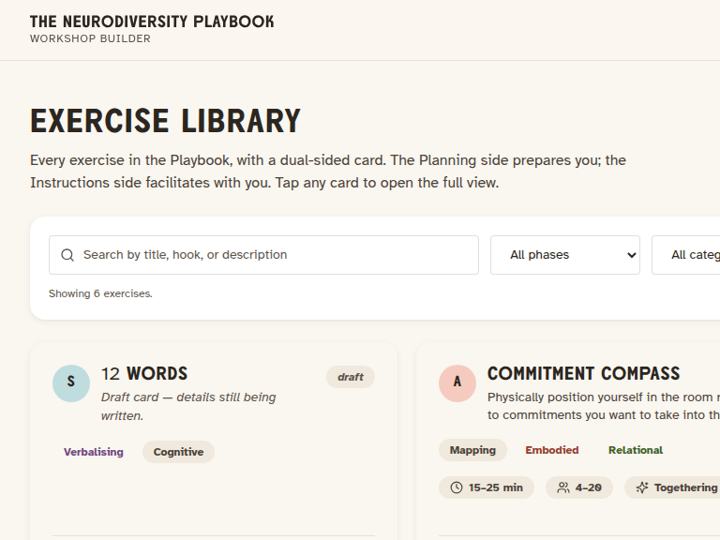
One exercise, interlude or resource per card, each with a planning side and a delivery side.
Facilitator Moves and Gestures
Particular turns of phrase, and details in the design of the materials, smooth out an exercise’s introduction. To make these replicable, each exercise card has short priming scripts and prompts to help situate an exercise. These facilitation gestures can make a large difference in the accessibility and uptake of an exercise.
Care is enacted through details like the tone of voice, the quality of materials, the responsiveness to a participant’s hesitation; attunement to these collective sensibilities constitutes the core of the pedagogical practice. I discussed in Chapter Four how participants valued the quality of the materials and how they communicated dignity and respect to participants who distrust formal organisations; one participant directly noted how they read the scenario cards’ visual richness as encouragement to engage.
See the creative artefactFabled extension cards
Cards for imagining situations and the extensions that might meet them, used in the scenario matching exercise.
By providing specific guidance on these subtle, facilitative actions, the playbook aims to cultivate a neuro-affirming environment that fosters engagement and inclusivity. The playful learning literature arrives at a kindred position. Kim Holflod’s (2022a, 2022b) studies of playful learning across higher education locate much of its value in relational qualities, trustful collaboration and affective-experiential processes rather than in activities alone, and recent work from the same research program shows playful approaches widening who participates in a classroom and how (Jørgensen et al., 2025). Pulling on the attributes of playful learning, the playbook aids the facilitator by breadcrumbing many relational conditions, to turn potential barriers into pluriversal and improvisational pathways for participation and learning.
Quotes, Stories and Framing Statements
Before each exercise, narrative and theoretical snippets position learners within a wider intellectual and historical context. Why that framing matters, and what happened without it, is discussed in Chapter 6.
How do quotes and stories expand the field of discussion? Introductions, quotes, and stories can go beyond context and work as a deliberate pedagogical move to situate the learners’ personal experiences within a wider world of ideas, history, and community, preventing the learning from becoming purely internal and self-referential. Quotes and stories are chosen to propagate a sense that participants come to feel part of the wider world without standing at its centre, Biesta’s (2021) truly eccentric learner, at home in a world that exceeds them (Arendt, 1994; Biesta, 2016). It is a device I have used in the workshops and in this exegesis alike, allowing the full force of human experience to be acknowledged inside the microcosm of this single learning environment.
Play Interludes
Play interludes are the interstitial activities that sit between the major surfacing, envisaging, and actioning exercises of the Neuroformer workshops. They’re extremely adaptable, and while some are directed to prime the next exercise, others exist entirely to be pleasurable experiences in and of themselves. They are designed to offer back to the learner the freedom that play can afford (Skovbjerg et al., 2024). Play as a theoretical device can lower the friction of handling the “disorienting dilemma” of transformation (Mezirow, 1991), where novelty and change, because of their disjuncture with past experiences, can be rocky to navigate.
See the creative artefactPlay interludes
Play between the exercises: fast bursts that shift the room's register, and quieter interludes that let it settle.
See the creative artefactThe Neuroformer Workshop Series
Three workshops with neurodivergent young people at Youth Inc in Adelaide, where both communities met; the materials are photographed on the outputs page.
Examples from the Neuroformer series include Kitty Wants a Corner and 1, 2, 3, fast bursts of play that shift the room’s register between heavier provocations; quieter interludes worked through objects, a puzzle box passed from hand to hand, the Columbus egg spun and marvelled at, a rattleback doing its stubborn physics on the table. The interludes threaded between this exegesis’s fits and chapters try to use the same device in written form: interstitial shifts of register, placed so that you can breathe between denser passages, modelling on the page the priming and pacing work the play interludes perform during a workshop. Reading an exegesis is a long encounter too, and I have tried to design it like one.
See the creative artefactRattleback
Spins smoothly one way and, spun the other, wobbles and reverts. A 3D-printable file is on the outputs page.
See the creative artefactColumbus Egg
A spheroid that, spun quickly, lifts itself upright. A 3D-printable file is on the outputs page.
There is also politics at play here; playful moments are used as an emancipatory intervention (Bennett, 1979; Hirsh-Pasek & Golinkoff, 2008). They can disrupt normative expectations of academic seriousness and productivity, by creating a space where different ways of being are celebrated. Play can also encourage people to engage deeply and for longer (Christiansen, 2022). While play and the positive effects that come with it are critical for creating psychologically safe spaces that scaffold change, playfulness comes with the risk of participants feeling infantilised. Although adults can and do play very often, play itself is often viewed as a childish endeavour (Christiansen, 2022). Framing and priming unstick some of these challenges, along with open environments for comment and critique fostered through collaborative, relational sensibilities.
Exercise Cards
Exercise cards are the main exercises I developed or collected to speak to one or more of the SEAT framework stages. They can take a variety of forms including discussion, embodied playful games, mapping and card sorting activities or open mark making sessions.
See the creative artefactMark-Making Cognition
The stamp-based cognition mapping exercise: custom stamps, ink pads and a canvas, with the feelings stickers over the top.
Each exercise exists as a card with two sides:
The Planning side – This side provides detail that can aid the facilitator in selecting an exercise, such as what psychological shifts it cultivates with participants, what cohorts it tends to work best with, what other exercises it pairs well with and any other details to consider when selecting it.
The Delivery side – The delivery side provides direct instructions on how you might introduce the exercise to the participants, what materials, physical space and time you need to run the exercise. It also contains supplementary notes such as where to cut it short if you’re running over time, or how variants can be used to reduce sensory overwhelm.
5.3.3Materials and Ephemera
The workshop ‘materials’ are seen here from the facilitator’s side: how they are stored, staged and handed over in order to best support the participants. They act as cognitive partners, designed to actively enable learners to physically and visually transgress current self-perspectives and explore complex new ideas about themselves. Playfulness, wonder and novelty guided their design. The materials were designed to communicate care in their materiality (Diatta, 2015; Norman, 2004), a principle that was reinforced through conversations in the workshops. The use of these materials in practice has helped me realise the socio-material quality of designed creative artefacts as part of wider conceptual inquiries. I wanted the experience to feel otherwise, a landscape of possibility opening up. Here are three illustrations of these materials in practice:
Digital Twins of Workshops
In Miro and subsequently other custom websites, I could engage in digital space making. Used alongside physical cards it made a hybrid space, merging the accessibility of digital tools with the tactility of physical materials, and a visual overview of a whole workshop, exercises and materials in one place that facilitators can use to read its shape.
See the creative artefactMiro digital twins
Digital twins of the workshops, used alongside the physical cards to make a hybrid space.
Tiffin Tins
I stored and presented many of my workshop materials in tiffin tins. In the workshops they became a pacing and care device for learning encounters: I could progressively uncover the materials, one at a time, slowly expanding the complexity of the workshop once people have become accustomed to what had come before. Usefully, this also maintained novelty both for me as the facilitator and for the participants to enjoy a shot of something new once every 10-15 minutes. This ability to pace out the participants’ responses to each object inspired some of the playbook’s staging guidance.
See the creative artefactTiffin tin staging
Workshop materials staged in tiffin tins and revealed one tier at a time.
Exercise cards indicate what to reveal when; material lists are ordered by moment of use; facilitator notes suggest keeping later materials out of sight so that novelty and complexity arrive at the group’s pace rather than all at once. Notably, a facilitator does not need my tins: any container, box, bag, or vessel can perform the same choreography of delight.
Playing with expected and unexpected materials
My aim for the materials was for them to be either known in playful contexts or entirely unexpected. Materials that are familiar from playful contexts, like, playing cards, stickers, stamps, arrive carrying an existing register of low-stakes pleasure. Materials that are entirely unfamiliar, tiffin tins, rattlebacks, arrive carrying nothing at all, and curiosity fills the gap. What I could not risk was the territory in between: worksheets, laminated sheets, the formats of the classroom, which arrive pre-loaded with deficit histories.
Many of the cards were poker-sized because that is the size our hands already know from card games and magic tricks: a deck deals, shuffles and invites turn-taking as an A4 sheet never will, and the multi-modality of the cards begins working the moment someone picks one up. Irregular sizes did related work; the cognition-mapping canvases of Chapter 4 were rounded pieces of thick off-white cardstock, familiar as mark-making materials rather than classroom worksheets, on the hunch that divergent minds are primed by divergent forms.
5.4Conclusion
The creative outputs described above from the database to the puzzle boxes, from the Playbook to the feeling stickers, are the “hazard”, designed to be made and remade by neurodivergent communities and those who care for them. These outputs fulfil a central purpose of this research program, to effectively develop and model practicable scaffolds for mindset shift and the adoption of instruments of transformed learning, let’s now explore how this inquiry might offer a contribution to new knowledge.
See the creative artefactFeelings stickers
Round stickers, each carrying a feeling word in its design, used in the room and kept afterwards. They are also offered in the margin of this edition.
See the creative artefactJapanese puzzle boxes
Boxes that look alike from the outside and open by different methods: a metaphor for invisible difference.
Interlude beginsInterlude 6: Tao Te Ching, Lao Tzu
“The five colors blind man’s eyes.
The five notes deafen his ears.”
Lao-tzu’s Tao Te Ching (1977, p. 20)
If you force cognition into strict categories, you can limit your discussion of how cognition operates in real contexts. The capacities and variation of the mind are infinite, and it is only in accepting this that you can see the true scale of it.
Interlude ends
Fit the Third
Territories
The isles in the fog
In which we explore the ideas that have been surfaced and refined throughout this research, and we see how they may be used beyond this project.
Containing: Chapter 6: Contributions & Chapter 7: Reasons to be Excited
Interlude beginsInterlude 7: Little Gidding, T. S. Eliot
“We shall not cease from exploration
And the end of all our exploring
Will be to arrive where we started
And know the place for the first time.”
T. S. Eliot, Four Quartets (1943)
Interlude ends
Chapter 6
Contributions
In which this project is distilled and its contributions to new knowledge are made known.
6.1Introduction
In the dim and distant past of the first few months of this PhD study, I adopted what I now see as a reductive mindset around change. I felt I needed to start already knowing the types of contributions I could offer and exactly how I would engage them. My feeling was that impact could only really be delivered through a small number of direct interventions in specific, disciplinarily bound, predetermined sections of a single sub-field. I could pick a database of assistive tools or a new assistive technology or a new creative workshop structure or a new contribution to creative practice, but not all of them at the same time and not incrementally. I thought I might dilute them, you see.
This chapter is organised around the three main contributions of this research, each addressing a research question and directed to a particular community: a research orientation offered to practice-informed design research; insights and designed outputs offered to the neurodivergent community and those who care for them; and a way of designing for transformation offered to anyone who makes learning encounters. The three overlap, and they are teased apart here so that a reader can find each one, not because the practice ever kept them separate. A reader who has come here from Chapter 1 will find each contribution pointing back to the chapter that holds its evidence; a reader who has come through the middle chapters can move quickly.
6.2Research Orientation: A Contribution to Practice-Informed Design Research
The first question asked how practice-informed design research might shape the development of transformative encounters. The response was formed by developing a participatory, designerly, material and autoethnographic praxis of co-learning, translated through SEAT so that others could use it to design their own transformative encounters. What this practice called for was a research orientation with two parts: participatory engagement with both the community of care and the community of experience, and a reflexive engagement with my own position among them. The contribution is a precedent for practice-informed design research that recognises these two parts cannot be easily separated. Specifically, we can learn from the design of a research program that respects material care, storytelling through objects and relational togethering, as well as articulating lived experience, orchestrating instruments, and interrogating from within.
See the creative artefactThe SEAT framework
Surfacing, Envisaging, Actioning, Togethering: the structuring logic of the Playbook and its workshop builder.
See SEAT in the PlaybookSEAT in actionBuild a workshop with it
6.2.1Participatory Engagements and Revelatory Insights
The insights below are what the swans of Chapter 5 carry, gathered here so the ducklings of Chapter 4 can be seen to have hatched into something. Each emerged from practice without being planned for: where a duckling was a reflection tied to a single moment, these are the patterns that recurred across the series. They were latent in the exercises, the materials and the way participants responded to one another, and became visible only through the doing.
Material Care
The effort invested in crafting beautiful, high-quality workshop artefacts proved to be a tangible form of care above and beyond aesthetics. Before any pedagogical content was actively engaged with, the physical materials communicated consideration, dignity, and respect. Grounded in a commitment to non-verbal dialogue, this material message of worth was particularly resonant for neurodivergent learners whose formal schooling and institutional encounters have often signalled the opposite (Norman, 2004; Diatta, 2015).
Empirically, this dynamic was laid bare during an early session when Alex, a Youth Inc. teacher, observed that high-quality scenario cards communicated dignity to students accustomed to distrusting formal organisations. Recognising that carefully made objects explicitly signal you were worth preparing for, this observation prompted a clear shift in design practice. Subsequent artefacts, including custom stamps, cognition mapping canvases, and tiffin tins, were intentionally crafted with visuo-tactile affordances (Galigani et al., 2025) that deliberately eased participants into engagement through materiality.
See the creative artefactMark-Making Cognition
The stamp-based cognition mapping exercise: custom stamps, ink pads and a canvas, with the feelings stickers over the top.
See the creative artefactMapping Neurowiggly Cognition
Drawing the shape of a cognition, then the extensions, tools and strategies that reach from it; a variant of the stamps and the Visualiser.
The exercise in the PlaybookVisualising Your Wiggly Cognition
What this reveals is that leading with material care disrupts deficit narratives. Physical objects can re-script the emotional baseline of a learning environment. As literature across craft and organisational settings documents, materials carry relational weight and communicate institutional values (Orlikowski, 2006; Sørensen, 2009; Rosner, 2012). In an educational landscape that frequently treats accommodations as logistical burdens, this creates a space where learners feel valued before they are asked to perform, lowering psychological barriers and restoring a sense of agency. For practice-informed design research, this makes the quality of what participants are handed part of the method: it shapes who chooses to take part and what they are willing to share.
Storytelling through Objects
Producing narratives around personal experience, physical objects, and learning creates psychological distance from deficit, allowing participants to examine complex learning circumstances obliquely rather than head-on. By granting participants the emotional and cognitive space to choose how they interpret a story, narrative distance fosters a genuine sense of possibility where new self-conceptions and potentialities can be imagined (Taeger, 2020; Taeger & Yanchar, 2019). Furthermore, storytelling models how interventions layer incrementally upon one another and demonstrates how simple reframing opens previously intractable situations. In the workshop environment, these narratives catalysed new visual metaphors and forms of inquiry, offering pathways into complex ideas that direct instruction could not achieve. Attaching these narratives directly to physical objects generates cognitive stickiness and durable meaning. Within the design process, objects serve simultaneously as extended thinking tools in the moment, as aide-mémoires of prior reflection, and as physical anchors when re-storying future circumstances.
This was demonstrated in Workshop 3 through the deployment of wind-up robot figures as physical commitment devices. Rather than operating as static souvenirs, these custom-designed artefacts were crafted with specific tactile affordances to position participants back into the workshop’s relational space, creating the conditions needed to re-enter a mindset of autonomous inquiry and self-expansion. The evidence came from an object I had not planned as a commitment device: when I returned for the third workshop, weeks after the first, feeling stickers had travelled onto a phone, a walking cane and a telepresence robot.
See the creative artefactFeelings stickers
Round stickers, each carrying a feeling word in its design, used in the room and kept afterwards. They are also offered in the margin of this edition.
See the creative artefactWind-up robot figures
Small wind-up robots given out in the third workshop as physical commitment devices, and taken home.
What this reveals is the capacity of object-attached storytelling to externalise neurodivergent sense-making in a tangible, non-linear form. In educational settings where abstract reflection can impose a heavy executive functioning burden, pairing personal narrative with a physical artefact grounds abstract insights in a material touchstone. The object acts as a portable instrument of agency, allowing participants to carry the psychological flexibility cultivated during the workshop into their daily environments without relying on continuous institutional support.
Relational Togethering
I conceptualise the relational work of the workshops as togethering: an emergent condition that runs beneath all phases of co-design, functioning as the relational glue that sustains lasting change and interdependence. One of the most significant expansions in my practice was recognising how community extends the cognition of neurodivergent learners far beyond the instruments an individual takes up alone (Barnes, 2012). Through shared rituals and vocabularies, such as the ‘What is the Weather’ or the ‘Have You Tried’ exercise, community itself becomes a dynamic substrate a learner can think with. It remembers on one’s behalf, lends activation energy when individual capacity is low, and holds a steady store of capability when personal reserves falter.
This relational dynamic was laid bare during an early workshop exchange, where three participants held space through a genuine disagreement to arrive at a more nuanced position together. Recognising that togethering could sustain itself once conditions of non-judgement were established, this observation prompted a shift toward designing explicit structures for collective problem-solving. Subsequent artefacts, such as the ‘Have You Tried’ exercise, were built to harness this collective intelligence and make a shared reflection routine. Crucially, as participants brought overlapping experiences of neurodivergence alongside race, class, gender, and sexuality, holding this space also required attending to intersectionality (Bayeh, 2022; Le Cunff, 2024).
What these insights reveal is that togethering is a live practice for rehearsing how to value difference rather than a prescribed pedagogical technique. This resonates with Harney and Moten’s (2013) concept of the undercommons, where marginalised communities make collective meaning on their own terms, alongside feminist design principles that centre power and intersectionality (Crenshaw, 1989; D’Ignazio & Klein, 2020). By embedding these relational commitments into design practice, this approach demonstrates that a space designed to honour cognitive difference inherently develops the capacity to value human difference of all kinds, providing a pathway toward pluriversal co-design.
6.2.2Reflexive engagement: Researching with My Lived Experience
Beyond drawing on this research to do the research, I found the articulation of my lived experience was consequential. The reflexive move of naming my own patterns as a neurodivergent learner, created a framework that others could hold up against their own. This is the fundamental work autoethnography asks of a researcher (Adams et al., 2021; Holman Jones, 2016). Brute forcing, sidestepping, and leapfrogging, the three stances introduced in Chapter 2, emerged from my describing to others how I had navigated the school system. Naming my learning experiences and noticing how far leapfrogging diverged from conventional educational discourses allowed me to refine this framing into a usable tool for learners and educators. Until someone points out, ‘What you are doing right here is brute forcing,’ a learner may not see another way. The value of engaging with my own lived experience lies in helping individuals recognise their own patterns and choose a different path.
This articulation resonated with participants and educators in every context where it has been shared. In Workshop 3, naming brute force for what it is, and acknowledging that I find it difficult too, opened the room to concepts of sidestepping and leapfrogging as alternatives; one participant recognised their habits and set them against the novelty-driven approach I had described in Workshop 2. In the first workshop a participant turned the framing back on the workshop itself, observing that because “we’re also used to just having things brute forced at us,” anything arriving in a different register was first read as demand rather than request.
Naming these three stances surfaces how neurodivergent learners can experience the friction of learning, and it illustrates why incremental adjustment may be insufficient: brute forcing and sidestepping are already incremental responses, and many neurodivergent learners have been doing them their whole lives. What the SEAT framework and the instruments of change offer is qualitatively different: conditions in which leapfrogging becomes practicable, and support for the shift in self-narrative required to believe leapfrogging is possible.
See the creative artefactThe four instruments of change
Digital prosthetics, mind-body strategies, relational practices and space-making: the four directions a learner's instruments of change can take, and the four rooms of the database.
Orchestrating Instruments
Orchestrating instruments is the reflexive move of treating my own stack of supports as the instrument of inquiry. Engaging directly with my own tools revealed that I could not simply lean on one instrument repeatedly. It was through applying my research in practice that I came to see how supports work in concert. Different instruments can address the interfacing components of the friction that makes up neurodivergent learning: reading, writing, relational engagement, and self-critique. This project proposes a re-conception of the tools, strategies, and environments that support neurodivergent learners as a concert of instruments across assistive technologies, psychological strategies, social relationships, and learning environments. Chapter 2 set out how this vocabulary sits between Clark and Chalmers’ (1998) extended mind, which dissolves a boundary without taxonomising the supports that cross it, and Bronfenbrenner’s (1979/2009) layers of setting; what is added here is the insistence on their orchestration.
The four directions instruments of change take - digital prosthetics, mind-body strategies, relational instruments, and space-making - are set out at the close of Chapter 4, enacted through the creative outputs of Chapter 5, and carried beyond this exegesis by the Neurodiversity Playbook and Neurodiversity.Tools. While each of these domains exists across many fields, the conceptual contribution of this work lies in the finding that they can be understood and deployed together, and in adopting the language of “instruments” itself. An instrument is something you learn to play, something that produces music in concert with others, something that develops intimacy over time, as Ingold (2013) says of the cello. The orchestration became visible in the workshops. Supports kept surfacing that would not fit the single, digitally mediated category I had arrived with. The design shift that followed was to show how instruments from different directions reinforce one another rather than compete.
See the creative artefactThe Neurodiversity Playbook
Exercises, materials and a workshop builder for the community of care, structured by SEAT.
See the creative artefactThe Neurodiversity Tools Database
A browsable database of tools, extensions and strategies, organised by the part of thinking they carry, with examples and advice.
I came to see that one good thing helping a little does not guarantee it will help a lot if used twice as much. What made the difference was a layered combination of interventions, and the finding emerged directly from this lived negotiation between theory and practice. Intervention types have non-linear, complementary effects, so that where stacking names their accumulation, their assemblage produces effects that are combinatorial rather than additive. This research names that layered combination the cohesive interface of instruments of change: technological, relational and introspective interventions acting together to extend the ability to live and produce research, the same configuration that let the writing of this exegesis happen at all.
The claim is propositional rather than definitive. This form of exploration works out vaguely where the land is in the fog: a claim that a territory exists and can be navigated through a cohesive assembly of instruments, with mapping it in full still ahead. For neurodivergent learners the resonance is direct, because the cohesive interface describes what a learner assembles when they extend their own cognition on their own terms, and the framing is offered to others working at the intersection of extended cognition and neurodivergent experience.
Interrogating from Within
I am using the tools and instruments of change I am theorising about in my own life to achieve this PhD. This self-emancipatory function means the autoethnographic insights come from being both a research practitioner and a beneficiary within the cohort. Clark and Chalmers (1998) proposed that our mind and its many functions can extend into the environment, and subsequent work has examined this claim philosophically and through third-person observation. This research offers a sustained, first-person investigation of an extended cognitive system from within, conducted by a neurodivergent researcher whose daily practice depends on the very instruments being theorised. The exegesis is itself a record of that investigation: it was dictated, transcribed and listened back to through the instruments named in its opening pages. For design researchers, it offers a precedent for studying an assistive ecology by living inside it, where the researcher’s own friction, triumphs and lived experience count as rigorous data (Adams et al., 2021).
Researching Alongside and From Within
Material care, storytelling through objects and relational togethering operate as interlocking moves that support transformative encounters. Material care signals dignity to dismantle institutional guardedness and self-critique before collaborative inquiry begins. Storytelling through objects captures the relational insights generated during these interactions, translating fleeting moments of shift into portable physical anchors that endure into daily life. The psychological safety produced from these design commitments is a necessary precondition for togethering, enabling participants to do relational work and navigate difference without the pressure of forced consensus. In weaving material readiness, relational negotiation, and object-based memory, this practice-informed approach establishes the relational baseline necessary to research alongside, and from within, lived experience.
Articulating lived experience, orchestrating instruments and interrogating from within are one reflexive movement. Naming the three stances gave me a language for my own patterns before I could offer it to anyone else; that language made the instruments of change legible as a concert rather than a catalogue, because the stance a learner takes decides which instruments they can reach for; and using that concert to produce this research is what let the orchestration be described from inside, as a cohesive interface rather than an observed effect. Together with the participatory engagements above, this is the research orientation the first question called for: practice-informed design research that researches alongside lived experience and from within it and treats the two as inseparable. What that orientation made possible for learners, the experiences and playful interventions that invite mindset shift, is the second contribution.
6.3Designing learning experiences: A Contribution to the Neurodivergent Community
The second question asked what experiences and playful design interventions invite mindset shift in neurodivergent learners. For learners historically stranded in encounters dominated by normative standards, the answer lay in acknowledging difficulty collectively while surfacing excitement for future engagements with the world. Shifting from a self-critical to an excited mindset called for piloting experiential encounters that could surface what story, made objects and collective reflection each make possible. The contribution has two parts. The first is a set of practice insights about how to design for mindset shift, gathered here as the boundary before uptake, the move from self-critique to excitement, playful narratives and praxis objects. The second is an applied set of outputs for the community of care, whose use flowed to the ultimate beneficiaries, the community of experience: the SEAT scaffold, the Neurodiversity Playbook and neurodiversity.tools, with the creative outputs as their ambassadors.
6.3.1The boundary before uptake
The boundary before uptake is the dispositional barrier that sits prior to every practical barrier to adoption: the mindset that tells a learner they are not someone who could or even should be helped. Neurodivergent learners hold an enormous potential to autonomously pursue the meeting of their own social, educational and developmental needs with tools and strategies that already exist (McNicholl et al., 2021; Pontikas et al., 2020). This research explores and affirms the emancipatory potential is real and present. Uptake is where it stalls, made difficult by limiting mindsets and a foggy awareness of what adopting these tools would look like, what it might feel like to be helped by them and what kind of learner one might become in their company (Ravneberg & Söderström, 2017). The assistive technology literature has documented the practical barriers to adoption, including device mismatch, cost and changing needs (Phillips & Zhao, 1993; Scherer, 2005); that dispositional barrier remains insufficiently explored, and Chapter 2’s account of how deficit-fuelled language calcifies into self-concept sits upstream of it.
In the tutoring that preceded the workshops, students given a database of recommendations reported overwhelm rather than delight, and one asked whether wanting the tools meant they were broken; in the workshops, instruments of change repeatedly arrived as good news to participants, who asked how to find them again afterwards. The design shift was to treat readiness as the first thing to design for: a scaffolded process through which neurodivergent learners can shift their self-narratives toward openness and begin to assemble instruments of change on their own terms, with practical instruments alongside it so that facilitators, educators and other members of the community of care can create similar conditions in their own contexts without the researcher’s direct involvement.
If a learner’s self-narrative forecloses the possibility of being extended by a tool, no amount of improved tool design or information provision will create lasting change. Naming the boundary before uptake locates the work of this contribution at the point where most assistive technology efforts have not looked, and it explains why the experiences that follow, playful narratives, praxis objects and the SEAT scaffold, are designed to work on readiness first.
6.3.2From self-critique to excitement
Neurodivergent learners can feel very critical about their own cognitive capacity even when there is so much to feel excited about: what they might be, what they already are and what they might become. Difficulty exists, and a strengths-based framing should never paper over genuine friction. The insight is that difficulty and excitement need not arrive in sequence: for many participants, attuning to the troughs of their cognition was bound up with understanding the peaks, and a strengths-based framing directs introspection toward excitement only when it accepts that shame exists and that engaging with difficulty is a necessary part of understanding who you are. For the community of care, the orientation sets the register of every encounter that follows: a space that begins by naming what is wrong can be more credible than one that opens in celebration, and it is from that credibility that excitement becomes believable. The Neurodiversity Visualiser (visualiser.neurodiversity.tools) grew from this insight: it draws a learner’s cognition as a shape across ten domains of neurodivergent cognition rather than a score, so that the first invitation is visual, non-imperial and strengths-based with prompts for self-extension offered broadly before any instrument is specifically named.
See the creative artefactThe Neurodiversity Visualiser
A strengths-based portrait of a cognition, extended by instruments of change, drawn from your own words.
The workshops were built to make excitement for extending cognition reachable, and the design shift was in sequencing. By naming difficulty together in a conversational register that was open to multiple interpretations, shift work could take place. This looked like a participant reframing the “overwhelmed” feelings sticker from deficit into the enjoyable experience of overwhelm the first time they saw snow. Surfacing came first, so that the deficit stories learners already carried could be named before any envisaging began; the tutoring episode Chapter 4 recounts, in which a student asked whether wanting the tools meant they were broken, is the tension in miniature, and it resurfaced in the workshops’ group reflections about what conditions would relax the stress and worry participants felt. Chapter 4 records the moments that ground this reading and their limits: several participants described new perspectives on their own minds, and the spoken before-and-after reflection moved from one participant’s “drowsy fog and uncertainty” to another’s “petrichor”, a sense of grounded replenishment of self-perception, within a single session.
See the creative artefactFeelings stickers
Round stickers, each carrying a feeling word in its design, used in the room and kept afterwards. They are also offered in the margin of this edition.
In that way this project contributes to the strengths-based neurodiversity literature (Chapman & Botha, 2023; Armstrong, 2010) by showing, through creative design practice, how the shift from self-critique to positive self-regard can be scaffolded through specific, designed encounters that engage learners with both the difficulty and the possibility of their own cognition at the same time.
6.3.3Playful narratives
Playful narratives break apart the lines of logic needed to be open to new futures involving extended cognition, introducing practical concepts through more abstract sub-steps. Specific tools with specific affordances and constraints immediately trigger myriad implementation questions and practical frictions. For neurodivergent learners those questions can be paralysing: the moment a tool becomes concrete it brings with it questions of how, when, where and whether it will actually work for me, and those questions can overwhelm executive function before the tool has been tried.
Even once a learner is open to extension, a foggy awareness of what is out there remains, and the conceptualisation of what a future might look like is impaired. The fog was visible across this research: Chapter 4 recounts students overwhelmed by a raw list of recommendations, and an experienced learner who applied only one or two suggestions from a long list because it was unclear how they would fit into everyday life. The design shift was the fabled extensions of the scenario matching exercise, which scaffolded the idea of an intervention, and acceptance of it, before any implementation detail arrived. Participants who met the reminder elf were not being told to install a task manager, and the ideas travelled anyway: of their own accord, participants later connected fabled cards to real tools in discussion. The same recognition shaped the outputs: the Visualiser could offer a shape to cognition, and the database could surface what might extend it, but neither could with certainty carry a learner across the boundary to uptake by themselves. The fabled extensions, the scenario cards and the play interludes were made to work in concert with them, engaging playfully where the direct instruments suggestions may only inform.
See the creative artefactFabled extension cards
Cards for imagining situations and the extensions that might meet them, used in the scenario matching exercise.
See the creative artefactPlay interludes
Play between the exercises: fast bursts that shift the room's register, and quieter interludes that let it settle.
The playful interludes and exercises work as more than icebreakers. They offer an embodied scaffold for engagement with the idea of extending cognition before the practical friction of doing so arrives. Against the top-down, extrinsically driven play research Chapter 2 records, the standing tension Sutton-Smith (1997) identifies between play’s two rhetorics and Spiel and Gerling’s (2021) finding about research with neurodivergent populations, play here is designed with and for neurodivergent learners, and it is mobilised one step further than usual: not only to scaffold content but to scaffold the adoption of cognitive instruments themselves, so that learners can approach cognitive extension and mindset transformation without the weight of implementation bearing down prematurely.
6.3.4Praxis objects
Praxis objects, the tangible takeaways Chapter 5 introduced, embody the proposition that theory can overlay onto creative practice infinitely: a designed object in the built world can absorb an enormous amount of theoretical complexity and deepens the fidelity and granularity of theoretical engagement by opening new modes of inquiry. This research extends the concept of boundary objects (Star & Griesemer, 1989; Fox, 2011) by identifying two subtypes that emerged through creative design practice: praxis objects, which bridge theory into practice by embedding conceptual frameworks into material form, and reflexive objects, which aid the learner in introspection by providing a structured surface for self-examination. Both are designed for neurodivergent learning contexts, where abstract theoretical engagement and low-friction sensory experience need to coexist within the same artefact. Sicart’s (2022) concept of playthings, which proposes that the ontology of objects we play with is distinct from their epistemology, resonates here: a praxis object is simultaneously a material thing with weight, texture and sensory affordance, and a knowledge carrier embedding the theoretical commitments of the research that produced it.
The puzzle boxes are the cleanest demonstration of a praxis object: identical from the outside and each opening differently, they carry the proposition that every neurodivergent mind might contain a different mechanism, a different way of opening, even when the exterior appears uniform. Likewise, the Columbus egg’s startling self-righting carries the metaphors that Chapter 5 describes: of momentum producing stability, inversion from the bottom into clarity, the sudden resolution of a bottleneck that seemed immovable. The narrative of each object introduces participants to objects as tools for thinking (Fox, 2011) and the participants’ delight and increased engagement with the Columbus egg as it was passed around demonstrates the utility of praxis objects in easing mindset change and the adoption of instruments of change.
See the creative artefactColumbus Egg
A spheroid that, spun quickly, lifts itself upright. A 3D-printable file is on the outputs page.
See the creative artefactJapanese puzzle boxes
Boxes that look alike from the outside and open by different methods: a metaphor for invisible difference.
Similarly, the cognition mapping canvases and stamps of the workshops were reflexive objects: structured surfaces on which private cognitive experiences can be laid out, looked at, and introspected upon. The materiality of these designed objects, made to be accessible across spoken, written, tactile and pictorial domains, appeared in practice to both lower the threshold for engaging with instruments of change and solidify that change by acting as aide-mémoires post workshop, as discussed in Chapter 5.
See the creative artefactMark-Making Cognition
The stamp-based cognition mapping exercise: custom stamps, ink pads and a canvas, with the feelings stickers over the top.
See the creative artefactMapping Neurowiggly Cognition
Drawing the shape of a cognition, then the extensions, tools and strategies that reach from it; a variant of the stamps and the Visualiser.
The exercise in the PlaybookVisualising Your Wiggly Cognition
Together, both praxis objects and reflexive objects lend support to an argument I have frequently returned to, low-friction instruments of change can increase cognitive capacity without being visible to the world at large, extending cognition so that a learner can navigate the world with the same fidelity as their neurotypical peers, and without the judgement that accompanies visible difference.
6.3.5SEAT: A Practical Scaffold for the Community of Care
SEAT (Surfacing, Envisaging, Actioning, Togethering) is the scaffold this research offers the community of care for sequencing a transformative encounter, adapted from Grocott’s (2022) SEED framework. Each of SEAT’s departures from SEED carries a position, and this section concentrates on them. “Experiencing shifts” became “Actioning” because contemplative or experiential processing alone proved insufficient for learners navigating executive dysfunction, an insight that emerged through the workshop series and my own practice; what is needed is a pivot toward agentic, practical steps that direct the energy generated by new self-narratives toward tangible change. “Driving intentions” became “Togethering”, trading an individualistic endpoint for a communal companion process and embedding the disability studies emphasis on solidarity and collective identity formation as a structural component of the framework rather than a welcome side effect. The relational care of Togethering is the framework’s foundation; without it the other three phases lose the safety and communal energy that makes transformation possible.
SEAT proved workable for neurodivergent learners at different stages of engagement with their own cognition, across different ages and with varied experiences of difficulty within educational systems. Its flexibility lies in the capacity of each phase to be adapted in duration, depth and the style of exercises used to scaffold it: Workshop 1 leaned on surfacing, Workshop 2 on envisaging and Workshop 3 on actioning, and when Actioning landed it created a positive feedback loop, a successful experience with one instrument increasing the likelihood of subsequent engagement with surfacing and envisaging new parts of cognition that may need attention. For some individuals, particularly those encountering their own cognitive landscape for the first time, certain phases may be harder to process alone. Surfacing asks learners to sit with difficulty, and without Togethering to hold that process the experience can feel exposing rather than generative. The practical significance for the community of care is that SEAT is a framework that offers a pluriversal and deployable path to meet learners where they are.
6.3.6Creative outputs as ambassadors for change
I hope the creative outputs act as ambassadors for the concepts and principles this research wants to disseminate, a postman for ideas, sending them multiple degrees of separation from myself. The research produced two main outputs, each a house for smaller things. The Neurodiversity Playbook holds the SEAT framework, the exercises, the facilitation notes and the materials, and is made for the community of care: its non-linear, pluriversal and modular structure lets facilitators bend its activities to the cohort in front of them, and its physical card and interactive digital database formats make it portable enough to be used far beyond its original context. Neurodiversity.tools is a living library of instruments of change, made for the community of experience. The commitment devices and reflective materials travel between the two. Chapter 5 describes each in detail and Table 5.1 pairs them with their audiences; Table 6.1 summarises what each community receives.
| Community | The community of experience: neurodivergent learners themselves | The community of care: teachers, facilitators, parents, and space makers |
|---|---|---|
| What the outputs offer | Mindset shift with minimal friction and low activation costs, and a bridge between workshop insight and daily life. Access to the Neurodiversity.tools library ensures learning experience can extend beyond a workshop. This allows ideas to be more readily brought back into everyday learning. | Customisable, flexible resources that lower the burden of producing pluriversal, transformational learning environments. Guidance on how to offer a menu of supports for self-selection by participants. |
| Served through | Neurodiversity.tools, a living digital library of instruments of change filtered by cognitive extensions and difficulty rather than diagnosis; Visual, physical, and perceptual reflective materials; and commitment devices, tangible aide-mémoires that travel with the learner beyond the workshop. | The SEAT framework as a structure for building workshops, detailed facilitation notes and priming scripts, and guidance on the gestures of care that, in aggregate, create a psychologically calming pedagogical practice. |
The PhD document itself may not be the most vital vessel for these findings. Further impact lies in what happens in the minds of learners, and in reformatting these contributions into accessible contexts: playbooks, tactile design artefacts and distributed workshop kits, with the framings and intentions of the research accounted for in them so that an experienced design researcher need not be present as facilitator. This shift is already under way: the playbook has moved the logistics from my hands into the community of care, and materials like the feeling stickers, cognition maps and robot figures went on living in participants’ lives after the series ended.
See the creative artefactWind-up robot figures
Small wind-up robots given out in the third workshop as physical commitment devices, and taken home.
They act as ambassadors by leveraging creativity and play to aid mindset shifts; utilising materiality to telegraph care; and enacting democratic space-making that adjusts the participatory demands so they do not overwhelm under-resourced learners. I hope that appropriation by communities of care extends the impact of the research beyond what any single researcher could achieve.
A Path for the Community of Care
Read as a path rather than a list, these insights suggest how facilitators might enable changeful learning encounters using these contingent principles. Treat readiness as the first thing to design for: the tutoring students who felt broken when handed a list of tools needed a story before they needed a recommendation. Begin by naming friction and difficulty so that excitement is grounded in lived reality when it arrives: for example, a first session that opens on the deficit stories learners already carry, as the scenario cards did. Introduce instruments through narrative and material distance before implementation: a reminder elf before a task manager, a puzzle box before a conversation about how minds open differently. Stack the experiences on purpose with SEAT, so that surfacing, envisaging and actioning arrive in an order the room can bear and let the Playbook and neurodiversity.tools carry the sequence into rooms the designer will never enter. The experiences and playful design interventions that invite mindset shift stay responsive to the personal and pluriversal needs of different neurodivergent learners, meeting the different styles, complexities, communication mediums and novelty-seeking they bring, and help move them past precontemplation and into active transformation. What holds that path in place when the exercises are not enough, the enabling conditions and the facilitation gestures, is the subject of the third contribution.
6.4Designing Transformation: A Contribution to Transformative Design Practice
The third question asked how facilitation, specific practices, and enabling conditions can be designed to support learner transformation. It speaks to anyone who designs or facilitates learning encounters. Facilitators embedded within a community of care can cultivate environments that support transformation together, enacting psychological care through material engagement and holding togethering as a submergent condition, so that change begins in spaces already attuned to existing frictions. Answering the question called for attending to everything that designing for transformation involves beyond the activities and the outputs. The contribution is theorised from a reflexive praxis of facilitation, and it has two parts: the enabling conditions the research revealed, and the facilitation gestures that let those conditions take hold.
6.4.1Enabling Conditions
In systems thinking, the term “enabling conditions” signals an ecological perspective: background contexts, relational structures, and broader environments continuously inhibit or support transformation. Rejecting linear causality and direct interventions, this approach prioritises a system’s often-invisible contextual dynamics. This research balances the vast systemic entanglements of education and neurodivergent learning with the practical scope of a design PhD, focusing on what can emerge in a workshop setting over a few hours. Drawing on Nora Bateson’s work with warm data and submergent conditions (Bateson, 2016), the study cultivates enabling conditions for mutual learning by leaning into the relational space the workshops create.
The conditions were recognised through the messy, iterative, relational work of being in practice together. The ugly ducklings of the workshop series, the exercises that misfired, the tensions that surfaced, the moments that seemed like failures, turned out to be the conditions under which the swans could be recognised. As 6.2.1 recounts, it took the teacher’s observation about the scenario cards for me to understand the relational power of material care, and the contentious exchange and the Have You Tried exercise for me to name togethering as a submergent condition (Bateson, 2016) rather than a facilitation technique. The instruments of change were always there in the theory, but it took the workshops for me to name, define and categorise them, and add the weight of lived experience.
See the creative artefactFabled extension cards
Cards for imagining situations and the extensions that might meet them, used in the scenario matching exercise.
For any learner, and acutely for neurodivergent learners, the difference between a condition and a technique is the difference between a space that holds them and a move that is done to them. Enabling conditions are what anyone designing a learning encounter must attend to before any exercise is chosen, and they are what let a relational instrument sustain itself once set up, with little facilitation required in the moment.
Co-engagement: threading the needle
Co-engagement is the first enabling condition: before material care or togethering can take hold, the labour of the workshop has to be shared out so that participating does not exhaust the people it supports. Restoring a positive mindset is a difficult exercise that can be enabled by collaborative environments that are also playful. Building on co-design principles, co-engagement names a stance for neurodivergent learning environments. Where co-design is understood as collective creativity, in which participants share responsibility for generating and resolving decisions across the whole design process (Sanders & Stappers, 2008), co-engagement has the designer take on the labour of pre-emptive scaffolding while keeping the standing between designer and participants equal through transparency.
Part of my own experience of neurodivergence is the feeling of not being able to adhere to specific norms and the sense of being trapped in the inability to meet my autonomous preferences. To be told you have desires in a workshop and not be supported to meet them can be a deeply frustrating experience, one that undermines the self-transformation the workshop exists to support. Parity here means nothing about the workshop’s workings is withheld showing participants the effort and decisions that went into creating resources acts as a counterweight to their inability to redesign every component in real time. The scaffold itself stays flexible, able to change on the fly at participants’ direction, while providing exercises built with clear intentions. The clarity afforded by this work’s scaffolding is evidenced in Workshop 2, where a participant who could see the scaffold built their cognition map in anticipation of the extending exercise that followed.
See the creative artefactMapping Neurowiggly Cognition
Drawing the shape of a cognition, then the extensions, tools and strategies that reach from it; a variant of the stamps and the Visualiser.
The exercise in the PlaybookVisualising Your Wiggly Cognition
This transparency is a response to the recognition that insisting on participatory involvement regardless of cognitive capacity can itself become a form of exclusion. Co-engagement threads the needle between horizontal openness and pre-emptive design scaffolding, safeguarding the psychological safety that neurodivergent learners require while preserving the democratic ethos that makes transformational learning possible. Where the workshops themselves are co-learning environments in which participants and facilitator generate knowledge together, co-engagement describes the stance that makes those environments possible: the pre-emptive design scaffolding that creates the conditions for co-learning to take place without requiring participants to bear the full weight of designing those conditions themselves. As a designerly stance it may travel to any learning encounter where full participation would cost participants more than it gives them.
6.4.2Facilitation Gestures
Across the workshops the conditions were held in place by small moves rather than solely by the exercises themselves. These facilitation gestures create a more comfortable and relational space for change: small, concrete moves of modelling, framing and responsiveness. I call them gestures in the spirit of Erin Manning’s (2016) minor gesture, introduced in Chapter 2, since each is a small relational act that shifts what can be felt and done in the room without waiting for structural permission. These gestures design transformation at the scale of seconds, single moves, and the tone of a sentence or a pause before a prompt as impactfully as designing at the scale of frameworks and materials.
Modelling orientations by sharing my own experiences
From the opening, joining with my own story as a neurodivergent facilitator with my own instruments of change on the table invited a vulnerability that participants then extended to one another (hooks, 1994). In Workshop 2, when I opened with my own history of dictation software, a participant answered with their story of educators who removed a support once a child was functioning well with it. Often, I demonstrate these tools and technologies in the context of my own stack of uses. By using my story, my experiences, I can model the orientation of someone who is further along in adopting these tools and using them to extend my cognition. These personal reflections also reinforce that I am a member of the neurodivergent community rather than apart from it (Ne’eman & Pellicano, 2022). However, I don’t think this sort of demonstration in practice is unique to neurodivergent experience; I think any facilitator can demonstrate the exercises and tools with reflections of their own personal practice to great effect.
Introductory Facilitation Gestures
Multiple facilitation gestures arose around introducing exercises in a low-friction way. Before each exercise, narrative and theoretical snippets position learners within a wider intellectual and historical context and gently make space for change. These priming moments are crucial, and I know it from both directions of the workshop series. When framing was thin, participants told me: after Workshop 1, several said they did not know why they were doing the exercises, and the absence of framing read as disconcerting rather than open. When framing was full, the same cohort moved further: Workshop 2’s theory-first opening was received as useful scaffolding that justified the invitation to continue, and the Have You Tried exercise worked precisely because its framing converted advice from an imposition into something solicited. With many groups it can be more powerful to frame the next part of a workshop as an invitation rather than a demand. This is doubly true when neurodivergent participants are actively demand avoidant (Green et al., 2018) and so may forcefully resist demands on their behaviour.
Precision of language in what David Robertson (personal communication, September 4, 2025) called “passages of seconds” decided whether a prompt landed as an invitation or a demand:
“There is power in the language that we use as facilitators when we’re framing, and there are certain passages of seconds in which the precision of language used by a facilitator is at its most important.”
Novelty, magic and doing things otherwise kept the encounter from collapsing back into a lesson. Another introductory facilitation gesture emerged in the form of presenting a relevant concept through a magic trick before entering the full exercise. This technique was drawn from my magic practice and Grocott and Norman’s assertions that visual and physical metaphors can be used to present key conceptual shifts in a way that invites the individual to map that concept onto their own experience and invites them to use those metaphors in future experiences as they encounter them (Grocott, 2022; Norman, 1998). Participants are presented with a sudden, dramatic shift in the form of an illusion, such as a transposition, a vanish, or a physical transformation. These brief performances model the affordance that a particular learning approach offers, without feeling evangelised to use a specific tool. The effectiveness of this gesture was seen in the first workshop, where a participant said that the opening trick, The Word That Wasn’t There, together with the 1, 2, 3 game, “immediately gave me the vibe that it’s an unlearning thing. That we’re meant to be looking at things through a slightly different frame of reference.”
Establishing Psychological Safety
Establishing psychological safety is the gesture of making each step into introspection scaffolded and free for the learner to actively choose. Psychological distance is one part of it, allowing the facilitator to present tools and reflection without imposing or prescribing them or triggering resistance, overwhelm, or oppositional defiance. Psychological distance allows participants to choose the manner in which they take up these principles and pattern them onto their own ways of thinking. The literature names the mechanism: spontaneous self-distancing can support adaptive self-reflection rather than rumination (Ayduk & Kross, 2010), and stories created with narrative distance grant listeners room to choose their own sense-making (Taeger & Yanchar, 2019).
Signalling that anyone could leave, building in breaks, and treating the encounter as permeable to personal needs made surfacing survivable (Dietkus, 2022). The distance was made by the materials and the gathering: a reminder elf stood in for a task manager, and What’s the Weather let the group say how they felt without naming it head-on. A participant who arrived late to the first workshop, saying they would rather just observe, ended up engaging actively and joyously. From that footing there is a path to deeper engagement: a learner can reflect more personally because the choice to do so is theirs.
I saw what happened when an exercise was perceived as too direct by some. In the split response in the first workshop, it seemed to trigger years of accumulated resistance to being managed. The resistance seemed to be more attached to the framing rather than the ideas. The demand-avoidant profile documented in the literature predicts exactly this pattern (Green et al., 2018). If ideas are introduced too directly, the workshop risks proselytising the usefulness of a tool, asking the learner to navigate not only the suggested concept, strategy, or tool but also their response to being told about it didactically. By using psychological distancing as a design principle, the learner is given room to take up an idea as theirs, to adapt it to their own context, and even to share that mapping onward, creating a second-order space for change.
One Live Practice
Enabling conditions, co-engagement and facilitation gestures work at three depths of the same encounter. Co-engagement comes first, sharing out the labour so that being in the room costs participants less than it gives. With co-engagement, material care and togethering can be held as conditions rather than performed as techniques; and the facilitation gestures keep those conditions alive second by second in the tone of a prompt, the permeability of the room and the distance a story leaves for its listener. Collectively, these conditions and gestures set the material and relational conditions under which learners can hold difficulty and excitement at once and reach for an instrument of change on and as their own. Facilitation, specific practices and enabling conditions support transformation when they are designed together and read as one live practice. The Neurodiversity Playbook is where this live practice is made accessible: each exercise card carries a planning side and a delivery side, and the workshop builder at playbook.neurodiversity.tools lets a facilitator curate the set of instruments that fits their objectives, their room and their learners’ sensibilities, so that uptake is made as frictionless as possible.
See the creative artefactExercise cards
One exercise, interlude or resource per card, each with a planning side and a delivery side.
6.5What this project offers
The three contributions described in this chapter are interdependent: what was learned about researching, what was made for the neurodivergent community, and what was learned about designing for transformation are components of a single understanding rather than discrete contributions to separate fields. The boundary before uptake cannot be addressed without the transformational ambition of SEAT; SEAT cannot function without instruments of change acting in concert; those instruments cannot be adopted without the playful, narrative scaffolding that lowers the friction of engagement; the workshops cannot produce lasting change without the co-engagement stance that safeguards psychological safety; and none of it holds together without Togethering beneath it all and the material care embedded in the creative outputs that carry these principles forward.
Does this interdependency mean everything must be in place before the work can take place? Not in an all-or-nothing sense. Each element holds impact: a single exercise can surface a story, one instrument can ease a single bottleneck or handful of frictions, and the playbook is deliberately modular so that different parts can travel by themselves. Individually, experiences, exercises and components seek to provide catharsis and relief. When drawn and layered together, however, the different elements can weave the conditions of an environmental fabric that durably shift self-perception and can allow for a transformational change to last.
What this project offers, finally, is an orientation, a set of conceptual framings, practical instruments, and designed encounters that together suggest neurodivergent learners can navigate the self and the world with greater ease and joy by adopting an expanded sense of self, a positive mindset, and a positive self-regard through the uptake of instruments of change in playful, pluriversal co-learning spaces. This orientation is offered beyond the community of experience, to the community of care who can gain an affirmative framework that incorporates existing contributions, in education, psychology, psychiatry, technology and design so that they can act cumulatively rather than discretely.
Interlude beginsInterlude 8: Education as Initiation, Richard Peters
‘Not to have arrived at a destination but to travel with a different view’
Richard Peters, Education as Initiation (1964)
Interlude ends
Chapter 7
Reasons to Be Excited!
In which the significance of contributions is elucidated, and next steps are expanded upon.
7.1Introduction
This document and the wider creative practice it describes, has tried to capture a realisation that so many people, both neurodivergent members of our community and educators, technologists, researchers, parents, friends, and family in the community of care, know to be true: that change is on the way. That as we become more connected, we might become more open. As technologies mature, they might emancipate rather than constrain. That as educational systems grow older, they might become wiser to the pluriversal landscape of potential that exists inside the mind of every neurodivergent learner they meet.
This work has offered a series of suggestions that have grown from praxis. This conclusion is not exhaustive or meant to act as a final resolution to the needs of the communities this project has pledged to serve. Rather, it sets out to discuss what this project sought to know, what we know now, and what might be next in terms of increasing the future impact, accessibility, and distribution of the kinds of changes this project argues neurodivergent learners are in need of.
7.2Conclusion
7.2.1What the Practice-informed Research Surfaced
Participants shifted their use of language and the content of their reflections from externalised, deficit-based language towards a social, relational, and posthuman framing. At the beginning of a workshop series, learners would often describe their cognition using static, diagnostic terms borrowed from clinical encounters. For example, one participant located their struggle squarely in a broken internal capacity, reflecting that, before diagnosis, they consistently made sense of their experience as “thinking that I was broken” and “just drowning in everything” rather than questioning the environments and supports around them.
By the later sessions, many were discussing where their cognition was extending rather than where it was broken. One learner, for instance, described art-making and “mark making” as a deliberate cognitive strategy: that lets them remain grounded and remain “contributing, even if I don’t really process everything that’s coming at me” in overwhelming group situations. They framed aesthetic work, doodling, and collage as habits that “give me a foundation to build off… even in uncertain circumstances,” repositioning crafting as part of an extended cognitive system rather than a symptom of inattention.
See the creative artefactMark-Making Cognition
The stamp-based cognition mapping exercise: custom stamps, ink pads and a canvas, with the feelings stickers over the top.
I learned that the SEAT framework can support and scaffold this shift; Chapter 5 sets out each of its four moves. When the environment was scaffolded in this way, a form of emergent, connectivist, transformational learning appeared to take place through these deep interactions.
See the creative artefactThe SEAT framework
Surfacing, Envisaging, Actioning, Togethering: the structuring logic of the Playbook and its workshop builder.
See SEAT in the PlaybookSEAT in actionBuild a workshop with it
Evaluating mindset shifts is inherently difficult. Rather than conducting a durational study that treats neurodivergent individuals as research subjects, this PhD prioritised iterating and learning alongside participants. Consequently, this research surfaces their stories of mindset shift, focusing on what emerges when we design spaces for transformation.
This work does not claim that the workshops themselves directly produced transformation. Rather, it suggests they created conditions that supported participants to hold excitement and difficulty simultaneously. It is this holding, this psychological flexibility, that invoked an openness to explore new self-conceptions and instruments of change, seeding the potential for neurodivergent learners to shift how they navigate their world. Nor do I claim the workshops were smooth or free of tension. Chapter 4 records the misfires alongside the swans: an exercise received as infantilising, framing that arrived too thin in the first session, timing that ran long, and moments where surfacing pain required a different touch. These hard lessons helped make visible the precise conditions a facilitator taking up the playbook must attend to.
See the creative artefactThe Neurodiversity Playbook
Exercises, materials and a workshop builder for the community of care, structured by SEAT.
The outputs go on generating knowledge in use, as Chapter 5 argued: each adoption and adaptation is new evidence of how mindset shift can be scaffolded, and of what neurodivergent learners actually take up when conditions allow. By baking design principles into the artefacts, the contributions can be adopted by other practitioners independently of my direct involvement. Figure 3.5 restates the questions and the contributions that answer them in a single view.
7.3What’s Next: Invitations for Future inquiry
This section names the inquiries this project now makes possible. There are a number of directions this work points. I offer a few scenarios in different disciplinary lenses, which I am particularly excited to see unfold:
This PhD began before the crest of the current wave of generative artificial intelligence. This deluge reshaped how we think about cognition, learning and technology, and the expanse it opens for neurodivergent learners. The contribution this exegesis can make to it is a critical perspective that refuses techno-determinism in either direction: systems built to absorb human activity will fail the convivial test however capable they become, while systems built to stretch cognition inside a learner-chosen zone of proximal extension could become the most intimate instruments of change yet. I have been writing on and hoping for a rosy version of our AI infused future for some time (Gurling & Barlock, 2020). However, which future arrives is in no small part a design and governance question, and the principles this research offers, learner-set standards, legible intent and pluriversal adaptation, are the tests such systems should be held to. Whether current systems reflect predominantly neurotypical patterns of language and thought, as disability-studies critiques of AI would predict (Whittaker et al., 2019; Bennett & Keyes, 2020), is an empirical question to which this research has no answer.
What can be said is that the systematic underrepresentation of neurodivergent knowledge in traditional educational structures means neurodivergent ways of thinking, precisely because they have not been fully documented, retain a novelty and divergence that may prove increasingly valuable in a landscape saturated by machine-generated pattern recognition. This is a direction rather than a finding, and I am personally excited to pursue it next. The optimism of this exegesis, its insistence that as we become more connected, we might become more open, needs to be held with care. Connection is not inherently emancipatory, and technologies that promise to expand cognition can just as easily constrain it. Future work on AI and neurodivergent learning will need to navigate that tension directly.
Driven by regular requests from teachers, parents, and educators seeking to adapt these materials, a pressing consideration going forward is how to place these tools directly into the hands of the communities it seeks to serve. The central tension point for sharing at scale is preserving situated pluriversality: while traditional models achieve reach through standardisation, this work advocates for bespoke and customised interventions. In social innovation research, Tatiana Fraser (2023) distinguishes between scaling out, or geographic replication, and scaling deep, a relational model that attends to the cultural roots, mindsets and relationships that allow for sustained, transformative change. This aligns directly with WonderLab’s commitment to designing for social impact, which carefully negotiates how research is handed over to the community of care so they can scaffold meaningful change alongside the community of experience.
Rather than offering a top-down intervention, the online database, modular Playbook, and adaptable kits allow tools to be taken up, remade, and embodied locally without the researcher present. Together with the ambassadorial logic of Chapter 6, these outputs point toward scale not as the wide distribution of a fixed program, but as a proliferation of situated adaptations that transform culture from within. Crucially, this opens further empirical questions regarding how psychological safety travels with a kit, how fidelity to core principles is maintained through community appropriation, and how such grassroots efforts are resourced. While meaningfully scaling deep extends beyond the scope of a PhD, my ongoing commitment through WonderLab to support both communities makes addressing this demand an immediate priority.
The project opens lines of inquiry across several disciplines. In inclusive education, researchers could test the SEAT framework with new cohorts such as non-verbal autistic learners or those navigating co-occurring physical and mental health difficulties, reconfiguring exercises to meet their specific needs. Technologists could examine how the boundary before uptake operates during assistive technology onboarding, designing introduction processes that account for a learner’s affective and narrative relationship to their cognition rather than focusing solely on the functional interface. Design researchers could isolate individual instrument domains to explore strengths-based digital prosthetics or apply this logic of space-making to architectural design in classrooms and workplaces. Finally, educational researchers interested in democratic pedagogies could investigate how the horizontal, non-hierarchical learning environments created here might operate and be sustained at institutional scale.
7.4The Stilts
You may remember that this exegesis began with a story. A teacher asked what could be done about me being too short. My answer was one word: stilts.
Two things happened in that moment that prefigure what this exegesis has tried to do. The first was an act of imagination. I imagined myself as more than I was, took a conceptual leap, and validated my own capacity to grow, to be autonomous, to transform. The second was a call to create something, to design and adopt an external entity, an extension, that would help me extend my capacity. The prerequisite to actually putting on the stilts was the belief that I was capable of wearing them in the first place. That limitation was an example of a prescribed, defined, and enforced limitation from outside, bound up in societal norms and neurotypical matrices that continue to shape educational life. The stilts story is the social model of disability in miniature: it is society, not the child, that constructs the barrier.
What I have come to understand, and what the stilts story already contains if you look closely, is that excitement and difficulty are not necessarily sequential. They might be simultaneous. The child who imagines being taller is also the child who has been told they are too short. Both things can be true at the same time: the capacity to hold excitement about what cognition might become alongside an honest recognition of the friction it currently encounters. It is not about clearing one boundary and arriving cleanly at the next. It is about learning to hold both, and discovering that the holding itself is where transformation begins.
This exegesis positions itself in the space between self-belief and the instruments we use to lower the friction of navigating learning and the world. There is no absence of emancipatory potential in neurodivergent learners, and there is certainly no shortage of tools; rather, what I have learned and often experienced through this research is a gap in uptake. Our limiting mindsets hinder adoption through cycles of shame and self-critique, alongside a limited awareness of what exists and what it might feel like to be helped by these things. This exegesis argues that self-belief comes alongside extension, that the imagination of a different self, acts in concert with the instruments of change that enable it, and that adopting these instruments creates the enabling conditions for new self-perceptions. It is cyclical. It does not resolve.
This work has tried to demonstrate that it is possible to scaffold not only extensions through improved interfaces, but environments and encounters that increase readiness to use those methods. It is for everyone who has ever imagined that they could be more than they were told they could be. It is for the learners who were told their cognition was a deficit and discovered that it was a landscape worthy of exploration. It is for the facilitators who knew something was possible but did not have a framework or the time to name it, and perhaps now they can.
These ideas, extensions, instruments of change, tools and strategies can continue to grow, be adapted by others, and contribute to creating more playful and equitable learning environments. This conclusion is not a final resolution. It is the beginning of a discussion about what more joyful, posthuman, creative, transformational learning environments for neurodivergent learners might look like.
To you, the reader, remember one thing: both you and I can be as tall as we want to be.
Interlude beginsInterlude 9: The Bone People, Keri Hulme
‘They were nothing more than people, by themselves. Even paired, any pairing, they would have been nothing more than people by themselves.
But all together, they have become the heart and muscles and mind of something perilous and new, something strange and growing and great.
Together, all together, they are the instruments of change.’
Keri Hulme, The Bone People (1984)
Note: This is a quote from Lisa’s favourite book that she shared with me only a few days before completing this exegesis. I think it lines up quite well, don’t you?
Interlude ends
Appendix
References
The 333 works the exegesis cites, in APA 7. The interactive bibliography adds search, filters, where each work is cited, and downloads for Zotero.
- 99% Invisible. (2010, July 1). Design is everywhere. 99% Invisible. https://99percentinvisible.org/article/design-is-everywhere/
- Abbas, A. E., van Velzen, T., Ofe, H., van de Kaa, G., Zuiderwijk, A., & de Reuver, M. (2024). Beyond control over data: Conceptualizing data sovereignty from a social contract perspective. Electronic Markets, 34(1), 20. https://doi.org/10.1007/s12525-024-00695-2
- Abrams, E. J., Floyd, C. E., & Abes, E. S. (2024). Prioritizing crip futures: Applying crip theory to create accessible academic experiences in higher education. Disability Studies Quarterly, 43(4). https://doi.org/10.18061/dsq.v43i4.8270
- Adams, T. E., Holman Jones, S., & Ellis, C. (Eds.). (2021). Handbook of autoethnography (2nd ed.). Routledge. https://doi.org/10.4324/9780429431760
- Addessi, A. R. (2020). A device for children’s instrumental creativity and learning: An overview of the MIROR platform. Frontiers in Psychology, 11, 516478. https://doi.org/10.3389/fpsyg.2020.516478
- Adkins, B. (2015). Deleuze and Guattari’s A Thousand Plateaus: A critical introduction and guide. Edinburgh University Press. https://www.jstor.org/stable/10.3366/j.ctt1g0b18p
- American Psychiatric Association. (2013). Diagnostic and statistical manual of mental disorders (5th ed.). American Psychiatric Publishing.
- Andersen, H. C. (1843). The ugly duckling. In New fairy tales (Nye eventyr). C. A. Reitzel.
- Andrade, J. (2010). What does doodling do? Applied Cognitive Psychology, 24(1), 100–106. https://doi.org/10.1002/acp.1561
- Ansbacher, H. L., & Ansbacher, R. R. (Eds.). (1956). The individual psychology of Alfred Adler. Basic Books.
- Apple, M. W., Biesta, G., Bright, D., Giroux, H. A., McKay, A., McLaren, P., Riddle, S., & Yeatman, A. (2022). Reflections on contemporary challenges and possibilities for democracy and education. Journal of Educational Administration and History, 54(3), 245–262. https://doi.org/10.1080/00220620.2022.2052029
- Arendt, H. (1994). Essays in understanding, 1930–1954: Formation, exile, and totalitarianism (J. Kohn, Ed.). Harcourt, Brace & Co.
- Armstrong, T. (2010). Neurodiversity: Discovering the extraordinary gifts of autism, ADHD, dyslexia, and other brain differences. Da Capo Lifelong Books.
- Armstrong, T. (2012). Neurodiversity in the classroom: Strength-based strategies to help students with special needs succeed in school and life. ASCD.
- Attoe, D. E., & Climie, E. A. (2023). Miss. Diagnosis: A systematic review of ADHD in adult women. Journal of Attention Disorders, 27(7), 645–657. https://doi.org/10.1177/10870547231161533
- Auzoult, L. (2015). Autonomy and resistance to authority. Swiss Journal of Psychology, 74(1), 49–53. https://doi.org/10.1024/1421-0185/a000149
- Ayduk, Ö., & Kross, E. (2010). From a distance: Implications of spontaneous self-distancing for adaptive self-reflection. Journal of Personality and Social Psychology, 98(5), 809–829. https://doi.org/10.1037/a0019205
- Baglieri, S. (2020). Toward inclusive education? Focusing a critical lens on Universal Design for Learning. Canadian Journal of Disability Studies, 9(5), 42–74. https://doi.org/10/gqxjbr
- Bandura, A. (2001). Social cognitive theory: An agentic perspective. Annual Review of Psychology, 52(1), 1–26. https://doi.org/10.1146/annurev.psych.52.1.1
- Barad, K. (2007). Meeting the universe halfway: Quantum physics and the entanglement of matter and meaning. Duke University Press.
- Barclay, S. (2019). I wonder what it’s like to be dyslexic.
- Barnes, M. (2012). Care in everyday life: An ethic of care in practice. Policy Press. https://doi.org/10.1332/policypress/9781847428233.001.0001
- Bateson, G. (1955). A theory of play and fantasy. Psychiatric Research Reports, 2, 39–51.
- Bateson, N. (2016). Small arcs of larger circles: Framing through other patterns. Triarchy Press.
- Bauer, E., Greiff, S., Graesser, A. C., Scheiter, K., & Sailer, M. (2025). Looking beyond the hype: Understanding the effects of AI on learning. Educational Psychology Review, 37(2), 45. https://doi.org/10.1007/s10648-025-10020-8
- Bayeh, R. (2022). Neurodiversity, intersectionality and distress: A quantitative survey on the experiences of university students [Master’s thesis, Concordia University]. https://spectrum.library.concordia.ca/id/eprint/990885/
- Beaux, H., Karimi, P., Pop, O., & Clark, R. (2024). Guiding Empowerment Model: Liberating neurodiversity in online higher education. arXiv. https://doi.org/10.48550/arXiv.2410.18876
- Beck, T. J. (2024). Neurodivergent culture and embodied knowledge beyond neoliberal identity politics. Culture & Psychology, 30(3), 736–756. https://doi.org/10.1177/1354067X231191489
- Beckett, A. E., & Callus, A.-M. (Eds.). (2023). The Routledge international handbook of children’s rights and disability. Routledge. https://doi.org/10.4324/9781003056737
- Bedrossian, L. (2021). Understand and address complexities of rejection sensitive dysphoria in students with ADHD. Disability Compliance for Higher Education, 26(10), 4. https://doi.org/10.1002/dhe.31047
- Belek, B. (2019). Articulating sensory sensitivity: From bodies with autism to autistic bodies. Medical Anthropology, 38(1), 30–43. https://doi.org/10.1080/01459740.2018.1460750
- Belland, B. R., Kim, C., & Hannafin, M. J. (2013). A framework for designing scaffolds that improve motivation and cognition. Educational Psychologist, 48(4), 243–270. https://doi.org/10.1080/00461520.2013.838920
- Bennett, C. L., & Keyes, O. (2020). What is the point of fairness? Disability, AI and the complexity of justice. ACM SIGACCESS Accessibility and Computing, (125), 1. https://doi.org/10.1145/3386296.3386301
- Bennett, W. L. (1979). When politics becomes play. Political Behavior, 1(4), 331–359. https://www.jstor.org/stable/586098
- Berlant, L., & Stewart, K. (2019). The Hundreds. Duke University Press. https://doi.org/10.1515/9781478003335
- Berners-Lee, T. (2025). This is for everyone: The unfinished story of the World Wide Web. Macmillan.
- Bertilsdotter Rosqvist, H., Botha, M., Hens, K., O’Donoghue, S., Pearson, A., & Stenning, A. (2023). Cutting our own keys: New possibilities of neurodivergent storying in research. Autism, 27(5), 1235–1244. https://doi.org/10.1177/13623613221132107
- Biesta, G. (2007a). Education and the democratic person: Towards a political conception of democratic education. Teachers College Record: The Voice of Scholarship in Education, 109(3), 740–769. https://doi.org/10.1177/016146810710900302
- Biesta, G. (2007b). Why “what works” won’t work: Evidence-based practice and the democratic deficit in educational research. Educational Theory, 57(1), 1–22. https://doi.org/10/bmd2vj
- Biesta, G. (2015). Improving education through research? From effectiveness, causality and technology to purpose, complexity and culture. Policy Futures in Education, 14(2), 194–210. https://doi.org/10.1177/1478210315613900
- Biesta, G. (2016). Reconciling ourselves to reality: Arendt, education and the challenge of being at home in the world. Journal of Educational Administration and History, 48(2), 183–192. https://doi.org/10.1080/00220620.2016.1144580
- Biesta, G. (2020). Risking ourselves in education: Qualification, socialization, and subjectification revisited. Educational Theory, 70(1), 89–104. https://doi.org/10.1111/edth.12411
- Biesta, G. (2021). World-centred education: A view for the present. Routledge. https://doi.org/10.4324/9781003098331
- Biggs, M. (2002). The rhetoric of research. In D. Durling & J. Shackleton (Eds.), Common ground: Proceedings of the Design Research Society International Conference 2002 (pp. 111–118). Staffordshire University Press.
- Birsh, J. R., & Carreker, S. (2018). Multisensory teaching of basic language skills. Brookes Publishing.
- Biswas-Diener, R., Kashdan, T. B., & Minhas, G. (2011). A dynamic approach to psychological strength development and intervention. The Journal of Positive Psychology, 6(2), 106–118. https://doi.org/10.1080/17439760.2010.545429
- Blume, H. (1998, September 30). Neurodiversity. The Atlantic. https://www.theatlantic.com/magazine/archive/1998/09/neurodiversity/305909/
- Bochman, D. J., & Kroth, M. (2010). Immunity to transformational learning and change. The Learning Organization, 17(4), 328–342. https://doi.org/10/dcrcq7
- Borsotti, V., Begel, A., & Bjørn, P. (2024). Neurodiversity and the accessible university: Exploring organizational barriers, access labor and opportunities for change. Proceedings of the ACM on Human-Computer Interaction, 8(CSCW1), 1–27. https://doi.org/10.1145/3641011
- Botha, M., Chapman, R., Giwa Onaiwu, M., Kapp, S. K., Stannard Ashley, A., & Walker, N. (2024). The neurodiversity concept was developed collectively: An overdue correction on the origins of neurodiversity theory. Autism, 28(6), 1591–1594. https://doi.org/10.1177/13623613241237871
- Bradley, L., Ptolomey, A. M., & Mirza, N. (2026). From emotional interruptions to wilful disruptions: Zine-making as a post-qualitative method for locating, articulating, navigating, and doing emotion in research. Qualitative Research. Advance online publication. https://doi.org/10.1177/14687941261430648
- Braidotti, R. (2006). Posthuman, all too human: Towards a new process ontology. Theory, Culture & Society, 23(7–8), 197–208. https://doi.org/10/bhgdxp
- Braidotti, R. (2019). A theoretical framework for the critical posthumanities. Theory, Culture & Society, 36(6), 31–61. https://doi.org/10/gdtg8t
- Braidotti, R., & Hlavajova, M. (Eds.). (2018). Posthuman glossary. Bloomsbury Academic.
- Brandalise, I. (2024). Institutional disorientations: Spirallings of a design practice within entrenched structures [Doctoral thesis, RMIT University]. https://doi.org/10.25439/rmt.28012778
- Bratteteig, T., & Wagner, I. (2012). Disentangling power and decision-making in participatory design. Proceedings of the 12th Participatory Design Conference: Research Papers - Volume 1, PDC ’12, 41–50. https://doi.org/10.1145/2347635.2347642
- Bratteteig, T., & Wagner, I. (2014). Disentangling participation. Springer. https://doi.org/10.1007/978-3-319-06163-4
- Braun, V., & Clarke, V. (2019). Reflecting on reflexive thematic analysis. Qualitative Research in Sport, Exercise and Health, 11(4), 589–597. https://doi.org/10.1080/2159676X.2019.1628806
- Bronfenbrenner, U. (1979). The ecology of human development: Experiments by nature and design. Harvard University Press.
- Brown, S. A. (2023). From assistive to adaptive: Can we bring a strengths-based approach to designing disability technology? In B. J. Dunstan, J. T. K. V. Koh, D. Turnbull Tillman, & S. A. Brown (Eds.), Cultural robotics: Social robots and their emergent cultural ecologies (pp. 101–108). Springer International Publishing. https://doi.org/10.1007/978-3-031-28138-9_7
- Buckle, K. L., Leadbitter, K., Poliakoff, E., & Gowen, E. (2021). “No way out except from external intervention”: First-hand accounts of autistic inertia. Frontiers in Psychology, 12. https://doi.org/10.3389/fpsyg.2021.631596
- Candy, L. (2006). Practice based research: A guide. Creativity & Cognition Studios, University of Technology Sydney. https://www.creativityandcognition.com/resources/PBR%20Guide-1.1-2006.pdf
- Carnine, D. W. (1994). Introduction to the mini-series: Diverse learners and prevailing, emerging, and research-based educational approaches and their tools. School Psychology Review, 23(3), 341–350.
- Chalmers, D. (2018, April 20). What is extended mind? (R. L. Kuhn, Interviewer). Closer to Truth. https://www.youtube.com/watch?v=Jg00gK43Id4
- Chapman, R. (2021). Neurodiversity and the social ecology of mental functions. Perspectives on Psychological Science, 16(6), 1360–1372. https://doi.org/10.1177/1745691620959833
- Chapman, R., & Botha, M. (2023). Neurodivergence-informed therapy. Developmental Medicine & Child Neurology, 65(3), 310–317. https://doi.org/10.1111/dmcn.15384
- Chappell, A. L., Goodley, D., & Lawthom, R. (2001). Making connections: The relevance of the social model of disability for people with learning difficulties. British Journal of Learning Disabilities, 29(2), 45–50. https://doi.org/10.1046/j.1468-3156.2001.00084.x
- Charlton, J. I. (1998). Nothing about us without us: Disability oppression and empowerment. University of California Press. https://www.jstor.org/stable/10.1525/j.ctt1pnqn9
- Chen, C.-Y., Liu, C.-Y., Su, W.-C., Huang, S.-L., & Lin, K.-M. (2007). Factors associated with the diagnosis of neurodevelopmental disorders: A population-based longitudinal study. Pediatrics, 119(2), e435–e443. https://doi.org/10/ds2ddz
- Christiansen, L. G. (2022). Meaningful participation: Motivating young people’s participation through play probes. BUKS - Tidsskrift for Børne- & Ungdomskultur, 38(66), 16. https://doi.org/10.7146/buks.v38i66.133788
- Clark, A. (2001). Reasons, robots and the extended mind. Mind & Language, 16(2), 121–145. https://doi.org/10/d8dc7h
- Clark, A. (2008). Supersizing the mind: Embodiment, action, and cognitive extension. Oxford University Press.
- Clark, A., & Chalmers, D. (1998). The extended mind. Analysis, 58(1), 7–19. https://doi.org/10/gdm72m
- Clarke, A. C. (1973). Profiles of the future (Rev. ed.). Harper & Row.
- Clouder, L., Karakus, M., Cinotti, A., Ferreyra, M. V., Fierros, G. A., & Rojo, P. (2020). Neurodiversity in higher education: A narrative synthesis. Higher Education, 80(4), 757–778. https://doi.org/10.1007/s10734-020-00513-6
- Corbett, F., & Spinello, E. (2020). Connectivism and leadership: Harnessing a learning theory for the digital age to redefine leadership in the twenty-first century. Heliyon, 6(1), e03250. https://doi.org/10/ggjfdk
- Corker, M., & French, S. (Eds.). (1999). Disability discourse. Open University Press.
- Costanza-Chock, S. (2020). Design justice: Community-led practices to build the worlds we need. MIT Press.
- Crenshaw, K. (1989). Demarginalizing the intersection of race and sex: A Black feminist critique of antidiscrimination doctrine, feminist theory and antiracist politics. University of Chicago Legal Forum, 1989(1), 139–167.
- Cross, N. (1982). Designerly ways of knowing. Design Studies, 3(4), 221–227. https://doi.org/10/bwrjf5
- Cross, N. (2025). Designerly ways of knowing and thinking (2nd ed.). Springer.
- Curtis, A. (2010, November). From the pigeon to Superman, back again. Adam Curtis: The Medium and the Message. https://www.bbc.co.uk/webarchive/https%3A%2F%2Fwww.bbc.co.uk%2Fblogs%2Fadamcurtis%2F2010%2F11%2Fpost_1.html
- D’Ignazio, C., & Klein, L. F. (2020). Data feminism. MIT Press. https://doi.org/10.7551/mitpress/11805.001.0001
- Daskalovska, N., Gudeva, L. K., & Ivanovska, B. (2012). Learner motivation and interest. Procedia - Social and Behavioral Sciences, 46, 1187–1191. https://doi.org/10.1016/j.sbspro.2012.05.272
- Davis, E. A., & Miyake, N. (2004). Explorations of scaffolding in complex classroom systems. Journal of the Learning Sciences, 13(3), 265–272. https://doi.org/10.1207/s15327809jls1303_1
- Davis, J. L. (2020). How artifacts afford: The power and politics of everyday things. MIT Press.
- Dawe, M. (2006). Desperately seeking simplicity: How young adults with cognitive disabilities and their families adopt assistive technologies. Proceedings of the SIGCHI Conference on Human Factors in Computing Systems (CHI ’06), 1143–1152. https://doi.org/10.1145/1124772.1124943
- Dawkins, R. (1999). The extended phenotype: The long reach of the gene (Rev. ed.). Oxford University Press.
- Daya, S. (2025). Changing cultures of critique: Towards context, creativity and care in academic practice. Teaching in Higher Education, 30(6), 1539–1545. https://doi.org/10.1080/13562517.2025.2468976
- Deleuze, G. (1994). Difference and repetition (P. Patton, Trans.). Columbia University Press. (Original work published 1968)
- Deleuze, G., & Guattari, F. (1987). A thousand plateaus: Capitalism and schizophrenia (B. Massumi, Trans.). University of Minnesota Press. (Original work published 1980)
- den Houting, J. (2019). Neurodiversity: An insider’s perspective. Autism, 23(2), 271–273. https://doi.org/10.1177/1362361318820762
- Dernikos, B., Lesko, N., McCall, S. D., & Niccolini, A. (Eds.). (2020). Mapping the affective turn in education: Theory, research, and pedagogy. Routledge. https://doi.org/10.4324/9781003004219
- Dewey, J. (1916). Democracy and education: An introduction to the philosophy of education. Macmillan. http://archive.org/details/democracyandeduc00deweuoft
- Dewey, J. (1938). Logic: The theory of inquiry. Henry Holt.
- Diatta, D. (2015). Material communications. JAWS: Journal of Arts Writing by Students, 1(1), 63–75. https://doi.org/10.1386/jaws.1.1.63_1
- Dietkus, R. (2022). The call for trauma-informed design research and practice. Design Management Review, 33(2), 26–31. https://doi.org/10/gsj47g
- Dietz, D., Dupuis, A., Lafontaine Carboni, J., & Negueruela Del Castillo, D. (2020). A performative threshold between teaching research and practice. Atlas Poliphilo as scaffold. The Practice of Teaching / the Teaching of Practice: the Teacher’s Hunch. https://infoscience.epfl.ch/handle/20.500.14299/166410
- Doctorow, C. (2021). How to destroy surveillance capitalism. Medium Editions.
- Doughty, M. J. (2025). It doesn’t have to be this way: Cultivating change praxis in the art institutional ecosystem [Doctoral thesis, Monash University]. https://doi.org/10.26180/30907238
- Downes, S. (2008). An introduction to connective knowledge. In T. Hug (Ed.), Media, knowledge & education: Exploring new spaces, relations and dynamics in digital media ecologies (pp. 77–102). Innsbruck University Press.
- Doyle, N. (2020). Neurodiversity at work: A biopsychosocial model and the impact on working adults. British Medical Bulletin, 135(1), 108–125. https://doi.org/10.1093/bmb/ldaa021
- Drayson, Z. (2010). Extended cognition and the metaphysics of mind. Cognitive Systems Research, 11(4), 367–377. https://doi.org/10.1016/j.cogsys.2010.05.002
- Dror, I. E., & Harnad, S. (Eds.). (2008). Cognition distributed: How cognitive technology extends our minds (Vol. 16). John Benjamins.
- Duckworth, A. L., Peterson, C., Matthews, M. D., & Kelly, D. R. (2007). Grit: Perseverance and passion for long-term goals. Journal of Personality and Social Psychology, 92(6), 1087–1101. https://doi.org/10.1037/0022-3514.92.6.1087
- Duke, B., Harper, G., & Johnston, M. (2013). Connectivism as a digital age learning theory. The International HETL Review, Special Issue 2013, 4–13.
- Dunne, A., & Raby, F. (2013). Speculative everything: Design, fiction, and social dreaming. MIT Press.
- Dweck, C. S. (2017). From needs to goals and representations: Foundations for a unified theory of motivation, personality, and development. Psychological Review, 124(6), 689–719. https://doi.org/10.1037/rev0000082
- Dweck, C. S., & Yeager, D. S. (2019). Mindsets: A view from two eras. Perspectives on Psychological Science, 14(3), 481–496. https://doi.org/10.1177/1745691618804166
- Edwards, S., & Sudlow-Haylett, A. (2023). Out of time: (Re)working disabled graduate employability. Journal of Teaching and Learning for Graduate Employability, 14(2), 104–116. https://doi.org/10.21153/jtlge2023vol14no2art1802
- Ehn, P. (1988). Work-oriented design of computer artifacts. Arbetslivscentrum.
- Eliot, T. S. (1943). Four quartets. Harcourt, Brace and Co.
- Elliott, J. G. (2020). Dyslexia: Conceptualization, assessment, and intervention. In Oxford research encyclopedia of education. Oxford University Press. https://doi.org/10.1093/acrefore/9780190264093.013.972
- Elliott, J. G., & Gibbs, S. (2008). Does dyslexia exist? Journal of Philosophy of Education, 42(3–4), 475–491. https://doi.org/10/dvvmdc
- Elmore, R. F. (2018). Design as learning, learning as design. In R. A. Ellis & P. Goodyear (Eds.), Spaces of teaching and learning: Integrating perspectives on research and practice (pp. 47–62). Springer. https://doi.org/10.1007/978-981-10-7155-3_4
- Engelbart, D. C., & English, W. K. (1968). A research center for augmenting human intellect. Proceedings of the December 9-11, 1968, Fall Joint Computer Conference, Part I (AFIPS ’68), 395–410. https://doi.org/10.1145/1476589.1476645
- Erdnase, S. W. (1995). The expert at the card table. Dover Publications. (Original work published 1902)
- Escobar, A. (2017). Designs for the pluriverse: Radical interdependence, autonomy, and the making of worlds. Duke University Press.
- Fallman, D. (2008). The interaction design research triangle of design practice, design studies, and design exploration. Design Issues, 24(3), 4–18. https://doi.org/10.1162/desi.2008.24.3.4
- Faraone, S. V., Banaschewski, T., Coghill, D., Zheng, Y., Biederman, J., Bellgrove, M. A., Newcorn, J. H., Gignac, M., Al Saud, N. M., Manor, I., Rohde, L. A., Yang, L., Cortese, S., Almagor, D., Stein, M. A., Albatti, T. H., Aljoudi, H. F., Alqahtani, M. M. J., Asherson, P., … Wang, Y. (2021). The World Federation of ADHD International Consensus Statement: 208 Evidence-based conclusions about the disorder. Neuroscience & Biobehavioral Reviews, 128, 789–818. https://doi.org/10/gjd3gj
- Fielding, C., Streeter, A., Riby, D. M., & Hanley, M. (2025). Neurodivergent pupils’ experiences of school distress and attendance difficulties. Neurodiversity, 3, Article 27546330251327056. https://doi.org/10.1177/27546330251327056
- Findeli, A. (2010). Searching for design research questions: Some conceptual clarifications. In R. Chow, W. Jonas, & G. Joost (Eds.), Questions, hypotheses & conjectures: Discussions on projects by early stage and senior design researchers. iUniverse.
- Flusser, V. (1999). The shape of things: A philosophy of design (A. Mathews, Trans.). Reaktion Books.
- Fox, N. J. (2011). Boundary objects, social meanings and the success of new technologies. Sociology, 45(1), 70–85. https://doi.org/10/dzn5d7
- Fraser, T. (2023). The art of scaling deep. The Systems Sanctuary. https://consciousfoodsystems.org/resource/fraser-2023-the-art-of-scaling-deep/
- Frayling, C. (1993). Research in art and design. Royal College of Art.
- Fredrickson, B. L. (2001). The role of positive emotions in positive psychology: The broaden-and-build theory of positive emotions. American Psychologist, 56(3), 218–226. https://doi.org/10.1037/0003-066X.56.3.218
- Freire, P. (2000). Pedagogy of the oppressed (M. B. Ramos, Trans.; 30th anniversary ed.). Continuum. (Original work published 1970)
- Fuller, J. (2024). The auto-ethnographic turn in design. Design and Culture, 16(1), 109–112. https://doi.org/10/gssnnc
- Fusar-Poli, L., Brondino, N., Politi, P., & Aguglia, E. (2022). Missed diagnoses and misdiagnoses of adults with autism spectrum disorder. European Archives of Psychiatry and Clinical Neuroscience, 272(2), 187–198. https://doi.org/10/gnghpx
- Galigani, M., Romeo, M., Bruno, V., Forster, B., & Garbarini, F. (2025). The somatosensory side of the affordance: How seeing an object influences touch. NeuroImage, 319, 121427. https://doi.org/10.1016/j.neuroimage.2025.121427
- Gergen, K. J. (2015). An invitation to social construction (3rd ed.). SAGE.
- Geyer, N. K. (2021). Beyond accommodations: Considerations for supporting and improving academic outcomes for neurodivergent students in post-secondary education [Seminar Paper]. University of Wisconsin-Platteville.
- Gibbs, K., Simpson, K., Paynter, J., Easte, C., & Fowler, J. (2025). Exploring the perspectives of Australian neurodivergent university students. The Australian Educational Researcher, 52(3), 2665–2687. https://doi.org/10.1007/s13384-025-00828-2
- Gibson, L. C. (2000). Who you were meant to be: A guide to finding or recovering your life’s purpose. New Horizon Press.
- Gillespie-Lynch, K., Daou, N., Obeid, R., Reardon, S., Khan, S., & Goldknopf, E. J. (2021). What contributes to stigma towards autistic university students and students with other diagnoses? Journal of Autism and Developmental Disorders, 51(2), 459–475. https://doi.org/10.1007/s10803-020-04556-7
- Goncalves, R. D. (2023). Awareness-based design: The role of making aware for a transformative learning practice [Doctoral thesis, Monash University]. https://doi.org/10.26180/24932691.v1
- Goodley, D. (1997). Locating self-advocacy in models of disability: Understanding disability in the support of self-advocates with learning difficulties. Disability & Society, 12(3), 367–379. https://doi.org/10/d3kmkw
- Goodley, D. (2001). “Learning difficulties”, the social model of disability and impairment: Challenging epistemologies. Disability & Society, 16(2), 207–231. https://doi.org/10.1080/09687590120035816
- Goodley, D. (2011). Disability studies: An interdisciplinary introduction. SAGE.
- Goodley, D. (2014). Dis/ability studies: Theorising disablism and ableism. Routledge. https://doi.org/10.4324/9780203366974
- Goodley, D. (2016). Disability studies: An interdisciplinary introduction (2nd ed.). SAGE.
- Goodley, D. (2021). Disability and other human questions. Emerald Publishing.
- Green, J., Absoud, M., Grahame, V., Malik, O., Simonoff, E., Le Couteur, A., & Baird, G. (2018). Pathological demand avoidance: Symptoms but not a syndrome. The Lancet Child & Adolescent Health, 2(6), 455–464. https://doi.org/10.1016/S2352-4642(18)30044-0
- Gregg, N. (2007). Underserved and unprepared: Postsecondary learning disabilities. Learning Disabilities Research & Practice, 22(4), 219–228. https://doi.org/10.1111/j.1540-5826.2007.00250.x
- Griffin, E., & Pollak, D. (2009). Student experiences of neurodiversity in higher education: Insights from the BRAINHE project. Dyslexia, 15(1), 23–41. https://doi.org/10/b596ws
- Grimes, S., Scevak, J., Southgate, E., & Buchanan, R. (2017). Non-disclosing students with disabilities or learning challenges: Characteristics and size of a hidden population. The Australian Educational Researcher, 44(4), 425–441. https://doi.org/10.1007/s13384-017-0242-y
- Grocott, L. (2012). Designerly ways of researching: Re-thinking the design process. Studies in Material Thinking, 6, 1–24.
- Grocott, L. (2022). Design for transformative learning: A practical approach to memory-making and perspective-shifting. Routledge.
- Grocott, L., & Korsmeyer, H. (2018). Designerly ways of researching: “Figuring” the practice of research. In J. Oliver (Ed.), Associations: Creative practice and research (pp. 170–174). Melbourne University Publishing.
- Grocott, L., & Sosa, R. (2018). The contribution of design in interdisciplinary collaborations: A framework for amplifying project-grounded research. In J. Oliver (Ed.), Associations: Creative practice and research (pp. 35–52). Melbourne University Publishing.
- Grocott, L., Holman Jones, S., Sand, A.-L., Skovbjerg, H. M., & Sumartojo, S. (2023). Wandering fests: Relational orientations in academic writing. Qualitative Studies, 8(1), 282–313. https://doi.org/10/gs6b3m
- Gudiksen, S., & Skovbjerg, H. M. (Eds.). (2020). Framing play design: A hands-on guide for designers, learners and innovators. BIS Publishers.
- Gurling, A., & Barlock, K. (2020). The intelligence renaissance: The coming era of the artificial muse. The Australian Humanist, (140), 8–10. https://search.informit.org/doi/10.3316/informit.586062863610617
- Haegele, J. A., & Hodge, S. (2016). Disability discourse: Overview and critiques of the medical and social models. Quest, 68(2), 193–206. https://doi.org/10/gcnztr
- Hamilton, L. G., & Petty, S. (2023). Compassionate pedagogy for neurodiversity in higher education: A conceptual analysis. Frontiers in Psychology, 14. https://doi.org/10.3389/fpsyg.2023.1093290
- Hamraie, A., & Fritsch, K. (2019). Crip technoscience manifesto. Catalyst: Feminism, Theory, Technoscience, 5(1), 1–33. https://doi.org/10.28968/cftt.v5i1.29607
- Han, B.-C. (2017). Psychopolitics: Neoliberalism and new technologies of power (E. Butler, Trans.). Verso.
- Haraway, D. (1988). Situated knowledges: The science question in feminism and the privilege of partial perspective. Feminist Studies, 14(3), 575–599. https://doi.org/10.2307/3178066
- Haraway, D. J. (1991). A cyborg manifesto: Science, technology, and socialist-feminism in the late twentieth century. In Simians, cyborgs, and women: The reinvention of nature (pp. 149–181). Routledge.
- Haraway, D. J. (2003). The companion species manifesto: Dogs, people, and significant otherness. Prickly Paradigm Press.
- Harland, T. (2003). Vygotsky’s zone of proximal development and problem-based learning: Linking a theoretical concept with practice through action research. Teaching in Higher Education, 8(2), 263–272. https://doi.org/10.1080/1356251032000052483
- Harney, S., & Moten, F. (2013). The undercommons: Fugitive planning & black study. Minor Compositions.
- Harris, A., Luckin, R., & Yuill, N. (2007). Creating contexts for productive peer collaboration: Some design considerations. Proceedings of the 2007 Conference on Artificial Intelligence in Education: Building Technology Rich Learning Contexts That Work, 391–398.
- Hayles, N. K. (1999). How we became posthuman: Virtual bodies in cybernetics, literature, and informatics. The University of Chicago Press. http://hdl.handle.net/2027/heb05711.0001.001
- Hirsh-Pasek, K., & Golinkoff, R. M. (2008). Why play = learning. In R. E. Tremblay, M. Boivin, & R. DeV. Peters (Eds.), Encyclopedia on early childhood development. Centre of Excellence for Early Childhood Development. https://www.child-encyclopedia.com/play/according-experts/why-play-learning
- Holdo, M. (2023). Critical reflection: John Dewey’s relational view of transformative learning. Journal of Transformative Education, 21(1), 9–25. https://doi.org/10/grth75
- Holflod, K. (2022a). Playful learning and boundary-crossing collaboration in higher education: A narrative and synthesising review. Journal of Further and Higher Education, 47(4), 465–480. https://doi.org/10.1080/0309877X.2022.2142101
- Holflod, K. (2022b). Voices of playful learning: Experimental, affective and relational perspectives across social education and teacher education. The Journal of Play in Adulthood, 4(1). https://doi.org/10.5920/jpa.1007
- Holman Jones, S. (2016). Living bodies of thought: The “critical” in critical autoethnography. Qualitative Inquiry, 22(4), 228–237. https://doi.org/10.1177/1077800415622509
- Holman Jones, S. (2021). Becoming wild: Autoethnography as feral pedagogy. In T. E. Adams, R. M. Boylorn, & L. M. Tillmann (Eds.), Advances in autoethnography and narrative inquiry: Reflections on the legacy of Carolyn Ellis and Arthur Bochner. Routledge.
- Holman Jones, S., Sumartojo, S., Grocott, L., Doughty, M., & Korsmeyer, H. (2026). Tomorrow stories: Autoethnographic futuring and possibilities for co-design. CoDesign, 22(1), 28–43. https://doi.org/10.1080/15710882.2024.2441368
- hooks, b. (1994). Teaching to transgress: Education as the practice of freedom. Routledge.
- Hull, L., Petrides, K. V., Allison, C., Smith, P., Baron-Cohen, S., Lai, M.-C., & Mandy, W. (2017). “Putting on my best normal”: Social camouflaging in adults with autism spectrum conditions. Journal of Autism and Developmental Disorders, 47(8), 2519–2534. https://doi.org/10.1007/s10803-017-3166-5
- Hulme, K. (1986). The bone people. Penguin Books. (Original work published 1984)
- Humphries, D. (2022, May 19). Practice foundations: What is the mauri of the system? [Video]. Auckland Co-Design Lab Practice Foundations webinar. https://www.youtube.com/watch?v=AOn2chacb0g
- Hyde, L. (2008). Trickster makes this world: How disruptive imagination creates culture. Canongate. (Original work published 1998)
- Illich, I. (1970). Deschooling society. Harper & Row. http://archive.org/details/DeschoolingSociety
- Illich, I. (1973). Tools for conviviality. Calder and Boyars.
- Ingold, T. (2000). The perception of the environment: Essays on livelihood, dwelling and skill. Routledge.
- Ingold, T. (2013). Making: Anthropology, archaeology, art and architecture. Routledge.
- Jamaludin, A., & Hung, D. W. L. (2016). Digital learning trails: Scaling technology-facilitated curricular innovation in schools with a rhizomatic lens. Journal of Educational Change, 17(3), 355–377. https://doi.org/10.1007/s10833-016-9280-x
- Johnson, J.-A., & Ahluwalia, S. (2025). Neurodiversity in the healthcare profession. Postgraduate Medical Journal, 101(1192), 167–171. https://doi.org/10.1093/postmj/qgae108
- Jones, S. D., Jones, M. W., Koldewyn, K., & Westermann, G. (2024). Rational inattention: A new theory of neurodivergent information seeking. Developmental Science, 27(4), e13492. https://doi.org/10.1111/desc.13492
- Jørgensen, H. H., Holflod, K., Boysen, M. S. W., Ahrenkiel, L., Duedahl, T. V., & Skovbjerg, H. M. (2025). Playful learning and participation in secondary school mathematics and language teaching. Social Sciences & Humanities Open, 12, 102289. https://doi.org/10.1016/j.ssaho.2025.102289
- Joubert, J., & Slabbert, J. (2017). Facilitating transformative learning: Supporting students experiencing unique challenges. Support for Learning, 32(2), 180–194. https://doi.org/10.1111/1467-9604.12161
- Kafer, A. (2013). Feminist, queer, crip. Indiana University Press. https://www.jstor.org/stable/j.ctt16gz79x
- Kaplan, B. J., Dewey, D. M., Crawford, S. G., & Wilson, B. N. (2001). The term comorbidity is of questionable value in reference to developmental disorders: Data and theory. Journal of Learning Disabilities, 34(6), 555–565. https://doi.org/10/dd9z4p
- Kegan, R., & Lahey, L. L. (2009). Immunity to change: How to overcome it and unlock the potential in yourself and your organization. Harvard Business Review Press.
- Kintsch, A., & DePaula, R. (2002). A framework for the adoption of assistive technology. SWAAAC 2002: Supporting Learning through Assistive Technology, 1–10.
- Kishimi, I., & Koga, F. (2018). The courage to be disliked: How to free yourself, change your life and achieve real happiness. Allen & Unwin.
- Korsmeyer, H., Light, A., & Grocott, L. (2022). Understanding feminist anticipation through ‘back-talk’: 3 narratives of willful, deviant, and care-full co-design practices. Futures, 136, 102874. https://doi.org/10.1016/j.futures.2021.102874
- Lao Tzu. (1977). A translation of Lao Tzu’s Tao te ching and Wang Pi’s commentary (P. J. Lin, Trans.). Center for Chinese Studies, University of Michigan. https://doi.org/10.3998/mpub.19935
- Latour, B. (2004). Why has critique run out of steam? From matters of fact to matters of concern. Critical Inquiry, 30(2), 225–248. https://doi.org/10.1086/421123
- Lave, J., & Wenger, E. (1991). Situated learning: Legitimate peripheral participation. Cambridge University Press. https://doi.org/10.1017/CBO9780511815355
- Le Cunff, A.-L. (2024). A neurodiversity-informed investigation of psychological experiences and neurophysiological correlates of cognitive load in online learning [Doctoral thesis]. King’s College London.
- Light, A., & Akama, Y. (2012). The human touch: Participatory practice and the role of facilitation in designing with communities. Proceedings of the 12th Participatory Design Conference: Research Papers - Volume 1, PDC ’12, 61–70. https://doi.org/10.1145/2347635.2347645
- Lockton, D., Chou, M., Krishnaprasad, A., Dixit, D., Vattiata, S. L., Shon, J., Geiger, M., & Zea-Wolfson, T. (2019). Metaphors and imaginaries in design research for change. Design Research for Change Symposium.
- Loomes, R., Hull, L., & Mandy, W. P. L. (2017). What is the male-to-female ratio in autism spectrum disorder? A systematic review and meta-analysis. Journal of the American Academy of Child & Adolescent Psychiatry, 56(6), 466–474. https://doi.org/10.1016/j.jaac.2017.03.013
- Loveless, N. (2019). How to make art at the end of the world: A manifesto for research-creation. Duke University Press.
- Luckin, R., & Cukurova, M. (2019). Designing educational technologies in the age of AI: A learning sciences-driven approach. British Journal of Educational Technology, 50(6), 2824–2838. https://doi.org/10.1111/bjet.12861
- Mackenzie, C., & Stoljar, N. (Eds.). (2000). Relational autonomy: Feminist perspectives on autonomy, agency, and the social self. Oxford University Press. https://doi.org/10.1093/oso/9780195123333.001.0001
- Manning, E. (2016). The minor gesture. Duke University Press.
- Mavrelos, M., & Daradoumis, T. (2020). Exploring multiple intelligence theory prospects as a vehicle for discovering the relationship of neuroeducation with imaginative/Waldorf pedagogy: A systematic literature review. Education Sciences, 10(11), 334. https://doi.org/10.3390/educsci10110334
- McGuire, A. E., & Michalko, R. (2011). Minds between us: Autism, mindblindness and the uncertainty of communication. Educational Philosophy and Theory, 43(2), 162–177. https://doi.org/10.1111/j.1469-5812.2009.00537.x
- McNicholl, A., Casey, H., Desmond, D., & Gallagher, P. (2021). The impact of assistive technology use for students with disabilities in higher education: A systematic review. Disability and Rehabilitation: Assistive Technology, 16(2), 130–143. https://doi.org/10/gs6bzq
- Meyer, A., Rose, D. H., & Gordon, D. (2014). Universal design for learning: Theory and practice. CAST Professional Publishing.
- Mezirow, J. (1991). Transformative dimensions of adult learning. Jossey-Bass.
- Mezirow, J. (1997). Transformative learning: Theory to practice. New Directions for Adult and Continuing Education, 1997(74), 5–12. https://doi.org/10/bc73nx
- Mezirow, J., & Taylor, E. W. (Eds.). (2009). Transformative learning in practice: Insights from community, workplace, and higher education. Jossey-Bass.
- Milton, D. (2020). Neurodiversity past and present: An introduction to the Neurodiversity Reader. In D. Milton, D. Murray, S. Ridout, N. Martin, & R. Mills (Eds.), The neurodiversity reader: Exploring concepts, lived experience and implications for practice (pp. 3–6). Pavilion Publishing and Media. https://www.pavpub.com/mental-health/the-neurodiversity-reader
- Milton, D. E. M. (2012). On the ontological status of autism: The ‘double empathy problem.’ Disability & Society, 27(6), 883–887. https://doi.org/10.1080/09687599.2012.710008
- Montessori, M. (1967). The discovery of the child. Ballantine Books.
- Mörtberg, C., Bratteteig, T., Wagner, I., Stuedahl, D., & Morrison, A. (2010). Methods that matter in digital design research. In I. Wagner, T. Bratteteig, & D. Stuedahl (Eds.), Exploring digital design: Multi-disciplinary design practices (pp. 105–144). Springer. https://doi.org/10.1007/978-1-84996-223-0_4
- Motti, V. G. (2019). Assistive wearables: Opportunities and challenges. Adjunct Proceedings of the 2019 ACM International Joint Conference on Pervasive and Ubiquitous Computing and Proceedings of the 2019 ACM International Symposium on Wearable Computers, UbiComp/ISWC ’19 Adjunct, 1040–1043. https://doi.org/10.1145/3341162.3349573
- Mueller, F. F., Lopes, P., Strohmeier, P., Ju, W., Seim, C., Weigel, M., Nanayakkara, S., Obrist, M., Li, Z., Delfa, J., Nishida, J., Gerber, E. M., Svanaes, D., Grudin, J., Greuter, S., Kunze, K., Erickson, T., Greenspan, S., Inami, M., … Maes, P. (2020). Next steps for human-computer integration. Proceedings of the 2020 CHI Conference on Human Factors in Computing Systems, CHI ’20, 1–15. https://doi.org/10.1145/3313831.3376242
- Ne’eman, A., & Pellicano, E. (2022). Neurodiversity as politics. Human Development, 66(2), 149–157. https://doi.org/10.1159/000524277
- Neill, A. S. (1960). Summerhill: A radical approach to child rearing. Hart Publishing.
- Nelson, R. (2013). Practice as research in the arts. Palgrave Macmillan.
- Newen, A., De Bruin, L., & Gallagher, S. (Eds.). (2018). The Oxford handbook of 4E cognition. Oxford University Press.
- Nicolaides, A., Eschenbacher, S., Buergelt, P. T., Gilpin-Jackson, Y., Welch, M., & Misawa, M. (Eds.). (2022). The Palgrave handbook of learning for transformation. Palgrave Macmillan.
- Nicolescu, B. (2002). Manifesto of transdisciplinarity (K.-C. Voss, Trans.). State University of New York Press.
- Noddings, N. (2013). Caring: A relational approach to ethics and moral education (2nd ed.). University of California Press.
- Norman, D. A. (1998). The design of everyday things. MIT Press.
- Norman, D. A. (2004). Emotional design. Basic Books.
- Oliver, M. (1983). Social work with disabled people. Macmillan.
- Oliver, M. (1990). The politics of disablement. Macmillan.
- Orlikowski, W. J. (2006). Material knowing: The scaffolding of human knowledgeability. European Journal of Information Systems, 15(5), 460–466. https://doi.org/10.1057/palgrave.ejis.3000639
- Palmer, M., & Harley, D. (2012). Models and measurement in disability: An international review. Health Policy and Planning, 27(5), 357–364. https://doi.org/10/dxxf59
- Panksepp, J. (1998). Attention deficit hyperactivity disorders, psychostimulants, and intolerance of childhood playfulness: A tragedy in the making? Current Directions in Psychological Science, 7(3), 91–98. https://doi.org/10.1111/1467-8721.ep10774709
- Pea, R. D. (2004). The social and technological dimensions of scaffolding and related theoretical concepts for learning, education, and human activity. Journal of the Learning Sciences, 13(3), 423–451. https://doi.org/10.1207/s15327809jls1303_6
- Pearn, M., & Downs, S. (1989). Developing skilled learners: A strategy for coping with new technology. Industrial and Commercial Training, 21(3). https://doi.org/10.1108/EUM0000000001558
- Pearson, A., & Rose, K. (2021). A conceptual analysis of autistic masking: Understanding the narrative of stigma and the illusion of choice. Autism in Adulthood, 3(1), 52–60. https://doi.org/10.1089/aut.2020.0043
- Peters, R. S. (1964). Education as initiation. Evans Brothers.
- Peterson, R. L., & Pennington, B. F. (2012). Developmental dyslexia. The Lancet, 379(9830), 1997–2007. https://doi.org/10/f2ftd8
- Phillips, B., & Zhao, H. (1993). Predictors of assistive technology abandonment. Assistive Technology, 5(1), 36–45. https://doi.org/10.1080/10400435.1993.10132205
- Polanyi, M. (1966). The tacit dimension. Routledge & Kegan Paul.
- Pontikas, C.-M., Tsoukalas, E., & Serdari, A. (2020). A map of assistive technology educative instruments in neurodevelopmental disorders. Disability and Rehabilitation: Assistive Technology, 17(7), 738–746. https://doi.org/10.1080/17483107.2020.1839580
- Postman, N. (1992). Technopoly: The surrender of culture to technology. Vintage Books.
- Poulsen, M. (2022). The junk playground as agora: Designing spaces to re-invigorate democratic participation. In D. Lockton, S. Lenzi, P. Hekkert, A. Oak, J. Sádaba, & P. Lloyd (Eds.), DRS2022: Bilbao. Design Research Society. https://dl.designresearchsociety.org/drs-conference-papers/drs2022/researchpapers/246
- Pritchard, D., English, A. R., & Ravenscroft, J. (2021). Extended cognition, assistive technology and education. Synthese, 199(3), 8355–8377. https://doi.org/10.1007/s11229-021-03166-9
- Prochaska, J. O., & DiClemente, C. C. (1983). Stages and processes of self-change of smoking: Toward an integrative model of change. Journal of Consulting and Clinical Psychology, 51(3), 390–395. https://doi.org/10.1037/0022-006X.51.3.390
- Puccini, A. M., Puccini, M., & Chang, A. (2013). Acquiring educational access for neurodiverse learners through multisensory design principles. Proceedings of the 12th International Conference on Interaction Design and Children, IDC ’13, 455–458. https://doi.org/10.1145/2485760.2485848
- Puckett, K., Mathur, S. R., & Zamora, R. (2017). Implementing an intervention in special education to promote social skills in an inclusive setting. Journal of the International Special Needs Education, 20(1), 25–36. https://doi.org/10.9782/2159-4341-20.1.25
- Quinlan, E., & Emery, H. (2026). ‘Joining the dots across time’: A temporal conceptual model of self-concept reconstruction following late recognition of autism. Autism. Advance online publication. https://doi.org/10.1177/13623613261486062
- Raihan, N., & Cogburn, M. (2025). Stages of change theory. In StatPearls. StatPearls Publishing. http://www.ncbi.nlm.nih.gov/books/NBK556005/
- Raman, S., & French, T. (2022a). Enabling genuine participation in co-design with young people with learning disabilities. CoDesign, 18(4), 431–447. https://doi.org/10.1080/15710882.2021.1877728
- Raman, S., & French, T. (2022b). Participatory design in sensitive contexts: A proposal for a conceptual framework. The Design Journal, 25(5), 752–767. https://doi.org/10.1080/14606925.2022.2088091
- Ravneberg, B., & Söderström, S. (2017). Disability, society and assistive technology. Routledge.
- Reis, S. M., Baum, S. M., & Burke, E. (2014). An operational definition of twice-exceptional learners: Implications and applications. Gifted Child Quarterly, 58(3), 217–230. https://doi.org/10/gk5b
- Rizza, M. (2006). Computer-assisted technology for the twice exceptional. Understanding Our Gifted, 18(4), 11–15.
- Rose, T. (2016). The end of average: How we succeed in a world that values sameness. HarperOne.
- Rosner, D. K. (2012). The material practices of collaboration. Proceedings of the ACM 2012 Conference on Computer Supported Cooperative Work (CSCW ’12), 1155–1164. https://doi.org/10.1145/2145204.2145375
- Rotter, J. B. (1966). Generalized expectancies for internal versus external control of reinforcement. Psychological Monographs: General and Applied, 80(1), 1–28. https://doi.org/10.1037/h0092976
- Russell, G., & Wilkinson, S. (2023). Co-opting the “neuro” in neurodiversity and the complexities of epistemic injustice. Cortex, 169, 1–4. https://doi.org/10.1016/j.cortex.2023.09.002
- Ryan, R. M., & Deci, E. L. (2000). Self-determination theory and the facilitation of intrinsic motivation, social development, and well-being. American Psychologist, 55(1), 68–78. https://doi.org/10.1037/0003-066X.55.1.68
- Ryan, R. M., & Deci, E. L. (2017). Self-determination theory: Basic psychological needs in motivation, development, and wellness. Guilford Press. https://doi.org/10.1521/978.14625/28806
- Sanders, E. B.-N., & Stappers, P. J. (2008). Co-creation and the new landscapes of design. CoDesign, 4(1), 5–18. https://doi.org/10/cbgdq5
- Sanders, E. B.-N., & Stappers, P. J. (2012). Convivial toolbox: Generative research for the front end of design. BIS Publishers.
- Sandland, B. (2025). Neurodivergent experiences of rejection sensitive dysphoria expose the environmental factors too often overlooked. Neurodiversity, 3, Article 27546330251394516. https://doi.org/10.1177/27546330251394516
- Sant, E. (2019). Democratic education: A theoretical review (2006–2017). Review of Educational Research, 89(5), 655–696. https://doi.org/10/ghcq3g
- Saunders, G. (2026). Vigil. Random House.
- Scherer, M. J. (2005). Living in the state of stuck: How assistive technology impacts the lives of people with disabilities (4th ed.). Brookline Books.
- Schmengler, H., Cohen, D., Tordjman, S., & Melchior, M. (2021). Autism spectrum and other neurodevelopmental disorders in children of immigrants: A brief review of current evidence and implications for clinical practice. Frontiers in Psychiatry, 12, 566368. https://doi.org/10/gs3ndc
- Schön, D. A. (2017). The reflective practitioner: How professionals think in action. Routledge. https://doi.org/10.4324/9781315237473 (Original work published 1983)
- Schouwenberg, L., & Kaethler, M. (Eds.). (2021). The auto-ethnographic turn in design. Valiz.
- Sedgwick, P. (1982). PsychoPolitics: Laing, Foucault, Goffman, Szasz and the future of mass psychiatry. Pluto Press.
- Seligman, M. E. P., & Csikszentmihalyi, M. (2000). Positive psychology: An introduction. American Psychologist, 55(1), 5–14. https://doi.org/10.1037/0003-066X.55.1.5
- Shields, G. S., Sazma, M. A., & Yonelinas, A. P. (2016). The effects of acute stress on core executive functions: A meta-analysis and comparison with cortisol. Neuroscience & Biobehavioral Reviews, 68, 651–668. https://doi.org/10.1016/j.neubiorev.2016.06.038
- Short, R. (Director). (1968). Towards tomorrow: A utopia [Broadcast]. BBC. https://genome.ch.bbc.co.uk/7a413dac427d45a6ea44cd5de5e52ff1
- Sicart, M. (2014). Play matters. MIT Press.
- Sicart, M. (2022). Playthings. Games and Culture, 17(1), 140–155. https://doi.org/10.1177/15554120211020380
- Siebers, T. (2008). Disability theory. University of Michigan Press.
- Siemens, G. (2005). Connectivism: A learning theory for the digital age. International Journal of Instructional Technology and Distance Learning, 2(1), 3–10. http://www.itdl.org/Journal/Jan_05/article01.htm
- Siemens, G., & Tittenberger, P. (2009). Handbook of emerging technologies for learning. University of Manitoba. https://www.bucks.edu/media/bcccmedialibrary/documents/academics/facultywebresources/Handbook_Emerging-Technologies.pdf
- Silberman, S. (2015). NeuroTribes: The legacy of autism and the future of neurodiversity. Avery.
- Simonsen, J., & Robertson, T. (Eds.). (2012). Routledge international handbook of participatory design. Routledge.
- Singer, J. (2017). NeuroDiversity: The birth of an idea.
- Sissay, L. (2016). Listener. Canongate Books.
- Skovbjerg, H. M. (2021). On play (Vol. 1). Samfundslitteratur.
- Skovbjerg, H. M., & Sand, A.-L. (2022). Play in school: Toward an ecosystemic understanding and perspective. Frontiers in Psychology, 12. https://doi.org/10/gshcd9
- Skovbjerg, H. M., Eriksen Ødegaard, E., Lund, O., Have, M., Hovgaard Jørgensen, H., Schrøder, V., Oreskov, S., & Wilms Boysen, M. S. (2024). Special issue on Nordic perspectives on play and playful approaches to pedagogy, teaching and learning. Nordisk tidsskrift for pedagogikk og kritikk, 10(5). https://doi.org/10.23865/ntpk.v10.6563
- Smith, L. T. (2021). Decolonizing methodologies: Research and Indigenous peoples (3rd ed.). Zed Books.
- Smith, R. C., Loi, D., Winschiers-Theophilus, H., Huybrechts, L., & Simonsen, J. (Eds.). (2025). Routledge international handbook of contemporary participatory design. Routledge. https://doi.org/10.4324/9781003334330
- Smith, T. J. (2024). Crip time travels through the membrane and vortex: An autoethnographic inquiry of neurodivergent student temporality in higher art education. International Journal of Art & Design Education, 43(4), 683–697. https://doi.org/10.1111/jade.12538
- Sørensen, E. (2009). The materiality of learning: Technology and knowledge in educational practice. Cambridge University Press.
- Southall, A. E., Baxter, L. P., & Gardner, F. (2023). Transforming trauma-informed understanding into trauma-informed practice: The Reflective Circle Education Model. Australian Journal of Education, 67(1), 62–75. https://doi.org/10.1177/00049441221146555
- Spiel, K., & Gerling, K. (2021). The purpose of play: How HCI games research fails neurodivergent populations. ACM Transactions on Computer-Human Interaction, 28(2), 1–40. https://doi.org/10.1145/3432245
- Star, S. L., & Griesemer, J. R. (1989). Institutional ecology, “translations” and boundary objects: Amateurs and professionals in Berkeley’s Museum of Vertebrate Zoology, 1907-39. Social Studies of Science, 19(3), 387–420. https://doi.org/10.1177/030631289019003001
- Steinberg, S. R. (1992). Critical multiculturalism and democratic schooling: An interview with Peter McLaren and Joe Kincheloe. International Journal of Educational Reform, 1(4), 392–405. https://doi.org/10.1177/105678799200100407
- Sterelny, K. (2010). Minds: Extended or scaffolded? Phenomenology and the Cognitive Sciences, 9(4), 465–481. https://doi.org/10/fkn9sm
- Suchman, L. (2002). Located accountabilities in technology production. Scandinavian Journal of Information Systems, 14(2), 91–105.
- Sukhai, M. A., & Mohler, C. E. (2017). Creating a culture of accessibility in the sciences. Academic Press.
- Sullivan, G. (2010). Art practice as research (2nd ed.). SAGE.
- Sumartojo, S., Pink, S., Duque, M., & Vaughan, L. (2020). Atmospheres of care in a psychiatric inpatient unit. Design for Health, 4(1), 24–42. https://doi.org/10/gs6bx6
- Sutton-Smith, B. (1997). The ambiguity of play. Harvard University Press. https://doi.org/10.2307/j.ctv1q16s5b
- Sweeney, L. B., & Meadows, D. L. (2001). The systems thinking playbook: Exercises to stretch and build learning and systems thinking capabilities. Institute for Policy and Social Science Research.
- Syharat, C. M., Hain, A., Zaghi, A. E., Gabriel, R., & Berdanier, C. G. P. (2023). Experiences of neurodivergent students in graduate STEM programs. Frontiers in Psychology, 14. https://doi.org/10.3389/fpsyg.2023.1149068
- Taeger, S. D. (2020). Using narrative distance to invite transformative learning experiences. Journal of Research in Innovative Teaching & Learning, 13(2), 211–227. https://doi.org/10.1108/JRIT-05-2019-0057
- Taeger, S. D., & Yanchar, S. C. (2019). Principles and practices of designing narrative distance for transformative learning experiences. Educational Media International, 56(2), 164–181. https://doi.org/10.1080/09523987.2019.1614322
- Taylor, C. L., Jang, S., Motaref, S., Roy, M., Chrysochoou, M., & Zaghi, A. E. (2025). Examining neurodiversity and student resources in an engineering universal design learning context. Frontiers in Education, 10, 1654115. https://doi.org/10.3389/feduc.2025.1654115
- Taylor, H., & Vestergaard, M. D. (2022). Developmental dyslexia: Disorder or specialization in exploration? Frontiers in Psychology, 13. https://doi.org/10.3389/fpsyg.2022.889245
- Taylor, H., Fernandes, B., & Wraight, S. (2022). The evolution of complementary cognition: Humans cooperatively adapt and evolve through a system of collective cognitive search. Cambridge Archaeological Journal, 32(1), 61–77. https://doi.org/10/grzxhq
- Taylor, H., Zaghi, A., & Rankin, S. (2023). Marginalising dyslexic researchers is bad for science. eLife, 12, e93980. https://doi.org/10.7554/eLife.93980
- Tcherdakoff, N. A. P., Marshall, P., Dowthwaite, A., Bird, J., & Cox, A. L. (2025). Burnout by design: How digital systems overburden neurodivergent students in higher education. Proceedings of the 4th Annual Symposium on Human-Computer Interaction for Work (CHIWORK ’25), 1–18. https://doi.org/10.1145/3729176.3729193
- Tcherdakoff, N. A. P., Stangroome, G. J., Milton, A., Holloway, C., Cecchinato, M. E., Nonnis, A., Eagle, T., Al Thani, D., Hong, H., & Williams, R. M. (2025). Designing for neurodiversity in academia: Addressing challenges and opportunities in human-computer interaction. Extended Abstracts of the CHI Conference on Human Factors in Computing Systems (CHI EA ’25), 1–5. https://doi.org/10.1145/3706599.3716288
- Thomas, C. (1999). Female forms: Experiencing and understanding disability. Open University Press. http://archive.org/details/femaleformsexper0000thom
- Thomas, C. (2007). Sociologies of disability and illness: Contested ideas in disability studies and medical sociology. Palgrave Macmillan.
- Tick, B., Bolton, P., Happé, F., Rutter, M., & Rijsdijk, F. (2016). Heritability of autism spectrum disorders: A meta-analysis of twin studies. Journal of Child Psychology and Psychiatry, 57(5), 585–595. https://doi.org/10.1111/jcpp.12499
- Tong, L., & Diatta, M. D. (2018). A lookbook for emotion-centered design. Medium. https://medium.com/emotion-centered-design
- Tonkinwise, C. (2014a). Design away. In S. Yelavich & B. Adams (Eds.), Design as future-making (pp. 198–213). Bloomsbury Academic. https://doi.org/10.5040/9781474293907-0022
- Tonkinwise, C. (2014b). Design studies: What is it good for? Design and Culture, 6(1), 5–43. https://doi.org/10.2752/175470814X13823675225036
- Tuckwell, D. (2020). Joining practice research [Doctoral thesis]. Monash University.
- Union of the Physically Impaired Against Segregation & The Disability Alliance. (1976). Fundamental principles of disability. https://disability-studies.leeds.ac.uk/wp-content/uploads/sites/40/library/UPIAS-fundamental-principles.pdf
- Vaughan, L. (Ed.). (2017). Practice based design research. Bloomsbury Academic.
- Verbeek, P.-P. (2005). What things do: Philosophical reflections on technology, agency, and design (R. P. Crease, Trans.). Pennsylvania State University Press.
- Verbeek, P.-P. (2011). Moralizing technology: Understanding and designing the morality of things. University of Chicago Press.
- Vines, J., Clarke, R., Wright, P., McCarthy, J., & Olivier, P. (2013). Configuring participation: On how we involve people in design. Proceedings of the SIGCHI Conference on Human Factors in Computing Systems (CHI ’13), 429–438. https://doi.org/10.1145/2470654.2470716
- Voinea, C. (2018). Designing for conviviality. Technology in Society, 52, 70–78. https://doi.org/10.1016/j.techsoc.2017.07.002
- von Busch, O. (2022). Making trouble: Design and material activism. Bloomsbury Visual Arts.
- Vygotsky, L. S. (1978). Mind in society: The development of higher psychological processes (M. Cole, V. John-Steiner, S. Scribner, & E. Souberman, Eds.). Harvard University Press. https://doi.org/10.2307/j.ctvjf9vz4
- Wallace, D. F. (2009). This is water. Little, Brown and Company.
- Walters, T. (2025). A genealogy of neurodiversity and its entangled politics. Journal of Social Issues, 81(4), e70036. https://doi.org/10.1111/josi.70036
- Want, R., Pering, T., Borriello, G., & Farkas, K. I. (2002). Disappearing hardware [ubiquitous computing]. IEEE Pervasive Computing, 1(1), 36–47. https://doi.org/10.1109/MPRV.2002.993143
- Weiss, C. H. (1995). Nothing as practical as good theory: Exploring theory-based evaluation for comprehensive community initiatives for children and families. In J. P. Connell, A. C. Kubisch, L. B. Schorr, & C. H. Weiss (Eds.), New approaches to evaluating community initiatives: Concepts, methods, and contexts (pp. 65–92). Aspen Institute.
- Wells, C. G. (1999). Dialogic inquiry: Towards a sociocultural practice and theory of education. Cambridge University Press.
- Wenger, E. (1998). Communities of practice. Cambridge University Press.
- Whittaker, M., Alper, M., Bennett, C. L., Hendren, S., Kaziunas, L., Mills, M., Morris, M. R., Rankin, J., Rogers, E., Salas, M., & West, S. M. (2019). Disability, bias, and AI. AI Now Institute.
- Wiener, N. (2019). Cybernetics: Or control and communication in the animal and the machine (2nd ed.). MIT Press. https://doi.org/10.7551/mitpress/11810.001.0001 (Original work published 1948)
- Winner, L. (1980). Do artifacts have politics? Daedalus, 109(1), 121–136. https://www.jstor.org/stable/20024652
- Yunkaporta, T. (2019). Sand talk: How Indigenous thinking can save the world. Text Publishing.
- Zembylas, M. (2022). Affirmative critique as a practice of responding to the impasse between post-truth and negative critique: Pedagogical implications for schools. Critical Studies in Education, 63(2), 229–244. https://doi.org/10.1080/17508487.2020.1723666
- Zuboff, S. (2019). The age of surveillance capitalism: The fight for a human future at the new frontier of power. Profile Books.
Designing Instruments of Change · Neurodiversity, mindset shift, and the extended mind · Alisdair Gurling · The text as submitted for examination
Comments
No comments yet.