Preliminary vii
Abstract
Neurodivergent learners are continually pushing back against the bounds of educational settings and societal narratives that fail to empower us. The obstruction lies not only in an external lack of adaptability to our learning, but in the deficit-focused stories neurodivergent learners absorb from our environments and go on to tell ourselves, where inhibitions and prohibitions narrow self-directedness and joyful being. This difficulty is rarely met once; it can feel like a chronic, compounding mismatch in which low confidence and difficulty deepen one another. This sketches parts of the landscape that informs this doctoral inquiry. The resulting approach to research resists incremental adjustments and seeks to explore a more transformative response to how neurodivergent learners relate to our own minds, and to the tools, people and places that extend them.
Grounded in the social model of disability, the neurodiversity paradigm, and extended mind theory, this practice-informed design PhD examines how we can design pluriversal learning encounters to expand capacity for agency, learning, and positive self-perception, extending what neurodivergent learners perceive as possible for ourselves. This PhD’s wager is that once a learner becomes open to extending their cognition, they can do so by assembling instruments of change spanning digital prosthetics, introspective mind-body strategies, relational practices, and space-making practices. These instruments are not prescribed; each learner assembles them into a personal repertoire for extending their own cognition. Three questions guide it: how practice-informed design research can shape transformative encounters; which experiential and playful interventions invite mindset shifts; and how facilitation, specific practices and enabling conditions can support learner transformation.
The approach is a reflexive, practice-informed design inquiry, carried out across a series of co-learning workshops with neurodivergent young people at Youth Inc, Australia. The design workshops were supported by a parallel making practice and followed up with semi-structured interviews and ethnographic reflection. The inquiry iteratively developed and tested inclusive, collaborative, and adaptive frameworks for transformational change for neurodivergent learners. Subsequently, created materials and digital artefacts were designed to further enable this agency-growing mindset shift.
This practice revealed several contributions for designing and delivering transformational experiences for neurodivergent learners. First, key principles for supporting and sustaining neurodivergent shiftwork emerged: a strengths-based focus, the value of playful and material sense-making, and need for relational care. Secondly, alongside these principles, this work also produced materials to guide the design of further transformative learning encounters: the Neurodiversity Playbook, which offers modular exercises, materials and facilitation guidance for scaffolding mindset shift for neurodivergent learners, and SEAT (Surfacing, Envisaging, Actioning, Together), a framework for assembling these exercises into broader transformative learning experiences. Finally, the Neurodiversity.tools database offers learners a guided exploration of instruments of change via cognition area to support further shiftwork after workshop experiences.
See the creative artefactThe Neurodiversity Playbook
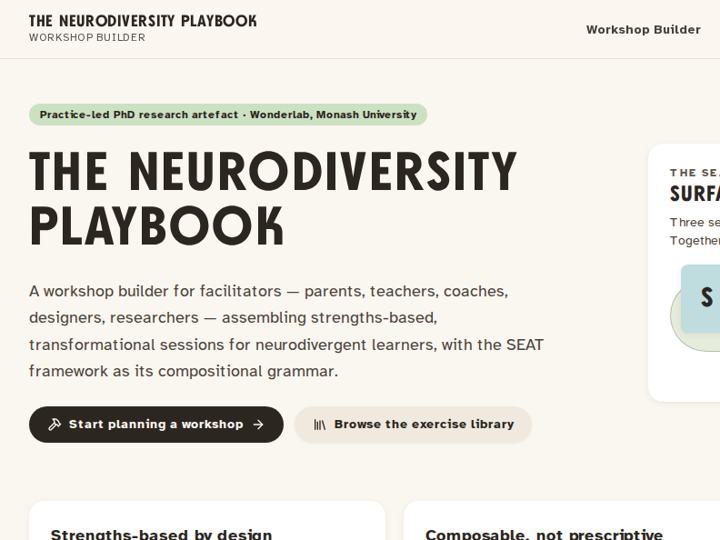
Exercises, materials and a workshop builder for the community of care, structured by SEAT.
See the creative artefactThe SEAT framework
Surfacing, Envisaging, Actioning, Togethering: the structuring logic of the Playbook and its workshop builder.
See SEAT in the PlaybookSEAT in actionBuild a workshop with it
This work was crafted by and for those of us who think differently. I occupy both positions at once, as designer of the practice and member of the cohort it is built with. Its contribution is a practice and a framework that reveal the methods and materials that support neurodivergent learners to take up new ways of thinking and to extend our own cognition. It is an invitation to a wider community of care to create encounters that scaffold mindset shift built on lived experience and embodied knowledge and sustained through continued experimentation.
KEYWORDS: Neurodiversity, Transformative Learning, Mindset shift, Cognitive extension, Practice-based design research, Strengths-based learning, Pluriversal design
Preliminary viii
Acknowledgements
Three marvellous supervisors, a delightful partner, a fun and raucous family, a bunch of friends and a (literally) wonderful community have fundamentally shaped, formed and reformed this research many times. I cannot overstate how much joy and gratitude I have for all those that have helped me along this winding way, named below or otherwise, thank you.
Lisa Grocott gave me an understanding of what creative design practice can look like as a form of research inquiry and demonstrated that it is possible to actively design experiences, workshops, and artefacts for transformation and transformational learning environments and that these sorts of research projects can be specifically designed for impact.
Dion Tuckwell demonstrated, through his concept of joining in his PhD work, how meaningful it is to actively communicate towards the communities you join; that by studying and learning from a community, you are necessarily joining it.
Isa Brandalise joined my supervision team in the last year and has been an enormous help in refining and discussing my thoughts and positioning them in writing. Through her own PhD work, Isa also helped me realise that I am still engaged in an active process of disenthralling myself from the self-importance of bureaucracies, and that the frictions and stuffiness of academia are not the same as the value of academics and their theoretical outputs.
My partner, Kate Barlock, has acted as an intellectual and creative partner throughout all of these years. Their skill, kindness and support has been boundless. Their existing creative practice, along with their independent inquiry into psychology, neuroscience, and behaviour studies, has produced a rich ongoing dialogue that echoes back and forth, up and down this exegesis, my practice and our live. I would certainly not have been attuned to where this research sits both comfortably and discordantly within prevailing discourses of care had we not been able to discuss it over this time.
Meryl Dahlitz, my mother, has helped me down this intellectual path at so many different junctures with prescient advice and warm encouragement. My twin Laurel and elder sister Holly have been kind, unwaveringly supportive and have aided in my thinking in all manner of ways. I also want to thank and say hello to my lovely nephew Caspian who was born during this process.
A wider community of collaborators and friends have equally shaped this work. I first bonded with Myriam D. Diatta, Iran Sanadzadeh, Paris Balla, and Myfanwy Doughty in Prato through a shared project, Ethnographies of the Ineffable. Myriam showed me, through her work and temperament, a quiet grace that can permeate academic thinking with a social conscience. Myf highlighted the power of submerging conditions and demonstrating what a better world would actively look like, rather than simply critiquing what is wrong with this one. She also helped soften the artificial gravity that made my final weeks’ writing so hard. Iran demonstrated the strength required to navigate academic spaces and the pressing need for creative practitioners to remain in them. Paris helped me understand, in a bodily sense, the power of Crip theory and togethering, through their work and through their own period of introspection after our time in Prato.
Stacy Holman Jones showed me the power of autoethnography and using, as she puts it, tools for writing as tools for living. Shanti Sumartojo demonstrated the power of ethnographic interviewing and how gentleness and forcefulness in research environments are not always in tension but can work together to create deep shifts in the kinds of knowledge and concepts that can be generated through engagement with participants.
To Ali Colwell-Matsuura who started this PhD with me and to Anna Conrick who finished with me, we did it!
Together, these people constitute the WonderLab, a research group and community of practice inside Monash University, that focuses on designing transformative learning encounters. The WonderLab has been, in my experience, a singular place to conduct design and creative arts research with a social conscience that is concerned about impact, and a place that wants to experiment with different ways of being in academia and making an academic community.
Branden Nickerson very kindly lent his support to use his beautiful fonts to many parts of this project.
James Meadowcroft very generously offered his creative counsel and technical advice on the underlying informational and technical architecture that the neurodiversity.tools database utilises.
To the WonderLab Goslings, past, present and future: Kelly Anderson, Paris Balla, Nicola Brown, Sofia Carbonara, Ali Colwell-Matsuura, Anna Conrick, Myfanwy Doughty, Alli Edwards, Megan Flamer, Laura Hartnell, Nic Hearn, Vera Hijkoop, Leander Kreltszheim, Aleithia Low, Robbie Lundberg, Josh Richardson, David Robertson, Katie Stubley, Delaram Talebkhangarouss, Linda Tan, Karissa Taylor, Yuzhe Zhu and the wider set of academic colleagues and friends; Zanitha Hamilton Månegaard, Maryke Laubscher, Troy McGee, Arth Misra, Michel Nehme, Paulina Noches, Conner O’Brien and Belinda Routley, it has been a pleasure to think with you.
This community of thinkers, collaborators, and friends has shown me another way of engaging with academic life, a way of delight and warmth. I am immensely excited to keep wandering down that path.
This research was supported by an Australian Government Research Training Program (RTP) Scholarship and the Monash Equity Scholarship.
Preliminary ix
Exegesis Structure
This PhD and this exegesis are organised in a set of three sections or fits. The term fit is from Old English, particularly poetry, meaning a section break in an ongoing story or dialogue. In this case it is also used to mean in good health, and a tantrum of ideas.
Between each fit and chapter, there are a series of interstitial quotes, poems, and short ethnographic reflections that make up interludes. These epigraphs aim to contextualise this writing within my wider sensibilities, orientations, and inspirations demonstrating the priming and interstitial materials I have used before, during, and after research workshops to reinforce senses of comfort, care, and playfulness.
The exegesis proceeds as follows:
Chapter One - The Boat, introduces the researcher and the research: who is conducting this work and what I carried into it, what the work is and aims to do, and why it matters now.
Chapter Two - The Ocean, concerns itself with theory and context, the ideas I am working with and the threads that bind them together actively holding space for interdependencies.
Chapter Three - Charting a Course, sets out how the work was done: its methodology, research design and methods, the shape of the Neuroformer workshop series, and the research question.
See the creative artefactThe Neuroformer Workshop Series
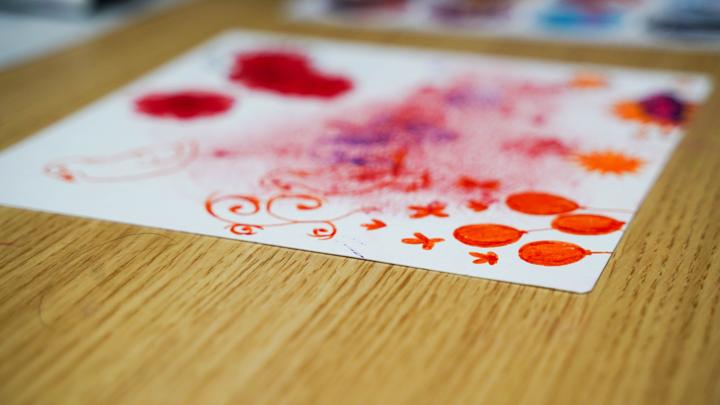
Three workshops with neurodivergent young people at Youth Inc in Adelaide, where both communities met; the materials are photographed on the outputs page.
Chapter Four - Ugly Ducklings, is a practice chapter that explains and analyses the circumstances of this research’s creative practice, blending my professional, theoretical, and lived experience to document what happened and why it matters.
Chapter Five - The Swans, explores the project’s creative outputs, explored across two communities: that of care for neurodivergent learning and direct experience of neurodivergent learning. It details what artefacts, materials, exercises, and workshop structures round out this research and bridge the gap between theoretical contribution and tangible social impact.
Chapter Six - Contributions, the penultimate chapter discusses the contributions of this program of inquiry and distils the new concepts and creative practices that are designed to help neurodivergent learners make sense of themselves and the world.
Chapter Seven - Reasons to be Excited, concludes and summarises the effect of this work and speaks to the kinds of actors that might take these ideas up and move them further forward. It articulates why this research is exciting and is designed for impact.
Preliminary x
Engaging with this PhD by Project
The development of this doctoral inquiry has been an ongoing process of probing, querying, questioning, clarifying, and sense-making. The creative practice took shape through an iterative sequence of design practice experiments and activities co-created with WonderLab, a co-design research community at Monash University’s Department of Design, as well as with collaborators and workshop participants. The exegesis came together through a series of Socratic dialogues with my supervisors, my partner Kate, and friends. The writing itself, all too often, I had to do alone.
Choosing to bring a practice-informed approach to my PhD inquiry was a deliberate, strengths-based decision. My neurotype enjoys divergent thinking, persuasive storytelling, playful material making, reflexive engagement, and synthesis of oftentimes incommensurable threads and novel ideas. My practice thrives when co-creating, playtesting tactile activities, facilitating with care, and building relational connections in real time with neurodivergent kin. This doctoral inquiry offered the space to honour that creative practice as my primary site of research, while designing a writing approach that actively plays to those same strengths.
To construct this accompanying exegesis, I operationalised my own research framework and extended my cognitive capacity. I brought voice recordings, recursive transcriptions, and AI tools to my Socratic discussions as intermediary agents to deepen my thinking and translate my ideas. This setup allowed me to be kind to my dyslexic mind. I was able to leapfrog the mechanical drag of raw drafting by translating dynamic, spoken, divergent thought iteratively and patiently into academic prose. More than a workaround, this auditory and dialogic approach is an intentional experiment in research-creation (Loveless, 2019) where I could model a creative-relational state of academic being (Grocott et al., 2023). I leaned into writing methods that embraced playful constraints and prototypical thinking, like using writing prompts to create one hundred-word paragraphs that pursue one line of thought, at a time (Berlant & Stewart, 2019).
This exegesis represents years of creative research during which my interpretation of what was important changed frequently. I love that my mind generates new stories, new ways of interpreting the research, and new ways to support people. I think this is a strength. You will find traces of my old thoughts in this document, even though three years later they no longer match my perspective. Leaving these visible threads of evolving thought honours the dynamic reality of practice-informed inquiry, offering a level of integrity that a sanitised hindsight narrative simply flattens out. For my neurotype, structuring, refining, and re-entering a large body of text presents a fair degree of cognitive friction. Working with a document of this scale was especially challenging. I am grateful to my research inquiry for granting me the grace to step away from obsessing over academic research standards imported from another period in time and from other disciplines. I chose instead to focus on writing for the educators, parents, facilitators, and neurodivergent learners who want to put these ideas to work in the world. My commitment is to story, clarity, and impact.
Preliminary xi
Wayfinding the PhD Components
What you are reading here is the exegesis for a PhD by Project, it tells the story of the research inquiry.
The exegesis serves as the translation layer that bridges and contextualises the creative artefacts and tools generated through the research. There are two primary pathways to navigate this document:
The Full Journey: Follows all seven chapters, using interludes as brief reflective rests between them.
The Core Synthesis: Reads Chapters 1, 3, 6 and 7 to move directly through the core research questions, the design of the inquiry, the primary contributions, and future directions. Chapters 2, 4 and 5 hold the underlying theory, workshops and outputs supporting those contributions, which Chapter 6 references whenever you wish to examine the underlying evidence.
Creative Outputs: There is a panoply of practice components, the production of which has suited me, my sensibilities, and my neurotype. A map of key outputs made through the research, sits at overview.neurodiversity.tools. This is the primary site of the research’s exhibition, the place where the practice is indexed, can be shared, and is brought to life. It offers a repository of resources, insights, and materials for people who want to put the research to work. The digital exhibition materials and exegesis speak to each other and can be engaged with as parallel texts for understanding the inquiry.
As this is a PhD grounded in practice, I invite you to spend some time with the practice before engaging with the exegesis. The website presenting the text of the exegesis is phd.neurodiversity.tools and contains interactive elements, links to practice examples of what is being described and embedded image galleries.
I want to offer readers the same relational integrity and care I bring to workshop participants and my design practice. Because I value auditory ways of knowing, I have produced an accessible audio version of this exegesis. You can listen to the text at: phd.neurodiversity.tools/audio.
Four components are worth meeting first. The Neurodiversity Visualiser (visualiser.neurodiversity.tools) offers a scaffolded strengths-based way of picturing your own cognition and how instruments of change might extend it. The neurodiversity.tools database (neurodiversity.tools) gathers the tools and strategies themselves, organised by the part of thinking each one supports rather than by diagnosis. The stamp sheet (stamps.neurodiversity.tools) lets you try a digital version of the cognition-mapping exercise participants did with ink and paper in the workshops. The Neurodiversity Playbook (playbook.neurodiversity.tools) holds the exercises those workshops were built from and lets you curate a workshop of your own, including run sheets, slides, interactive timers, print packs to make facilitating learning encounters as low friction as possible.
See the creative artefactMark-Making Cognition
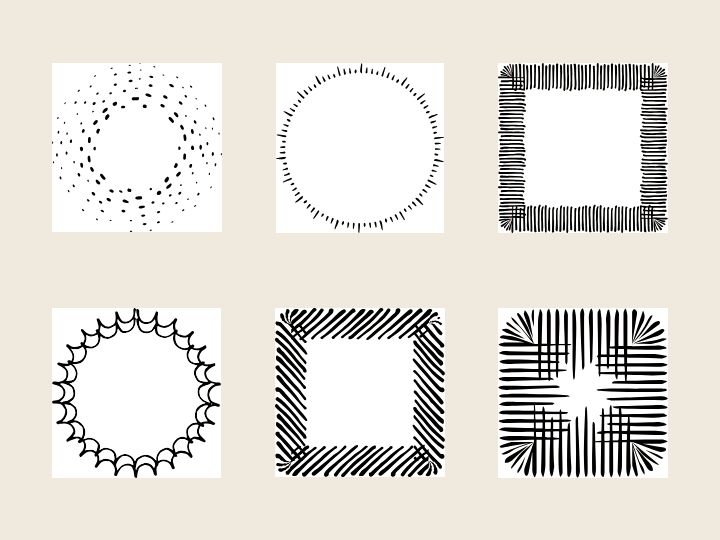
The stamp-based cognition mapping exercise: custom stamps, ink pads and a canvas, with the feelings stickers over the top.
See the creative artefactThe Neurodiversity Visualiser
A strengths-based portrait of a cognition, extended by instruments of change, drawn from your own words.
Whichever path you take, I encourage you to spend time with the website and the exegesis together. It will be easier to read Chapters 4 and 5, with the workshops and the materials made for them engaged with side by side.
Preliminary xii
Prolegomena: Conceptual Foundations
This prolegomenon outlines the core concepts, introduces basic terms and nods to the research orientation that underpin this PhD by Project.
From Diagnostic Deficit to Human Variation
To begin, let’s re-evaluate the primary paradigm through which cognitive difference is conventionally understood. Neurodivergence refers to natural variations in human cognition that diverge from what is considered neurotypical, a term collectively developed by neurodivergent people (Botha et al., 2024). Diagnostic frameworks such as the DSM-5 categorise these variations as “neurodevelopmental learning difficulties” or “disorders,” encompassing conditions including dyslexia, ADHD, autism spectrum disorder (ASD), and dyscalculia, a framing this exegesis returns to and complicates below.
An individual is neurodivergent; a community is neurodiverse. I use neurodiversity, neurodivergent, Dyslexic, ASD/Autism, and ADHD/VAST (variable attention stimulus trait) interchangeably throughout this exegesis, though I often find VAST the more useful term. These broad descriptions let the analysis move across interconnected neurodivergent experiences, particularly given the crosscurrents and emerging links between conditions such as ADHD and dyslexia.
Thinking with Systems, Communities and Strengths
Understanding cognitive difference requires an equal understanding of how environments disable or support those differences. This exegesis moves away from an individualised deficit view and toward systemic barriers, neuro-affirming practices, and strengths-based approaches, an argument the literature review develops in full.
Disability, as I use it here, follows the social model (Oliver, 1990): it is something produced by an environment’s barriers, not something located in an individual’s impairments or differences; ability and disability sit in tension with one another rather than in opposition, the relation Dan Goodley (2014) writes as dis/ability. Extending beyond clinical categories, I intentionally adopt language forged within lived neurodivergent communities. Neurospicy and neurowiggly are emergent, community-generated terms that playfully reframe identity away from deficit; including them signals a commitment to language coming from these communities. I use “neurowiggly” throughout this exegesis to describe the non-linear, associative, and sometimes unpredictable qualities of neurodivergent cognition, including my own.
This is, at its foundation, a strengths-based project: it begins from what individuals and communities already possess rather than from deficits to be remediated, positioning participants throughout as experts in their own experience. This doesn’t mean denying difficulty, a tension the literature review takes up directly, only that difficulty is never the starting point.
Creative Practice in Action
Having established a strengths-based, extended view of cognition, a PhD by Project in Design requires a precise vocabulary for how research moves through action, self-examination, and material form:
Practice, the noun, names a sustained and situated body of doing: my creative practice, the WonderLab community of practice, or a doctor’s practice. Practise, the verb in Australian English, names the doing itself, particularly rehearsal: participants practise with an instrument of change inside a workshop so it can travel beyond it. Praxis names the reciprocal movement where theory and practice remake one another: theory imbricated within practice (Nelson, 2013) and reflection/action transforming the world (Freire, 1970/2000). In this research, praxis is reserved for moments where a theoretical idea and a practice move changed one another in a spiralling exchange: carrying extended cognition or the social model into exercise design, observing what happened in the room, and letting the outcome revise the idea. Where insights arose simply from doing, the exegesis uses practice or practice informed. Praxis objects (defined below) are the material form this exchange takes.
Because praxis is an ongoing spiral, the researcher cannot remain a detached observer. This inquiry requires a reflexive methodology that turns critical attention back onto my own embodied, neurodivergent positionality. This research distinguishes Donald Schön’s (1983/2017) reflective practice (thinking within action to improve it) from reflexivity, which turns attention back onto the practitioner’s assumptions and onto how being a dyslexic, dyspraxic researcher with ADHD shapes what I notice, make, and claim (Braun & Clarke, 2019). Reflexive praxis names this mode of inquiry: theory and practice remade one another while I remained one of the systems under transformation, applying what the research surfaced to my own learning and treating those findings as evidence rather than noise.
Extended cognition also asks that this reflexivity extend beyond cognitive self-inspection to encompass the emotional and felt experiences of being a neurodivergent researcher, an affective engagement aligning with post-qualitative calls to recognise researcher emotion as a site of knowledge rather than noise (Bradley et al., 2026). Attending to these lived experiences offers what Stacy Holman Jones (2016) describes as a “living body of thought,” where personal narrative directly illuminates the doing of creative work. It is why the practice stories are written in the first person and why the autoethnographic thread runs alongside the participatory one.
Finally, to anchor this reflexive praxis in collaborative environments, the research deploys boundary objects. These are entities that translate ideas across culturally defined boundaries between communities of practice (Star & Griesemer, 1989; Fox, 2011). In this research, workshop materials and design provocations function as boundary objects enabling shared meaning-making. This exegesis identifies two subtypes: praxis objects, which embed conceptual frameworks into physical form, and reflexive objects, which provide structured surfaces for participant introspection.
Preliminary xiii
Preface
When I was four years old, my mum needed to find a school for me to attend for a few weeks when I joined her on a work trip. After a trial day at one school, the head teacher sat me down and said, “Alisdair, you can’t stay…... The problem is, you’re too short…. Now, what can you do about that?”
That moment was perhaps the first time in my life I felt really, truly, small. Everyday millions of neurodivergent learners are made to feel small and in many different ways. It might be ADHD, Dyslexia or Autism, and the challenges can range from struggling to focus, spell, read or sensory overload. It can be crippling to be constantly bucked off the horse you’re told you need to ride to be a success.
It is important here to note that being neurodivergent is not all deficits and limitations. There are strengths too, attention to detail, extraordinary hyper-focus, the ability to make unusual connections. These strengths and weaknesses are inextricably linked. However, the problem remains, we neurodivergent learners (myself included) suffer from educational environments and social norms that can fail to empower us and, over time, limit our mindsets and tell us the story that it’s us who are broken and that we cannot ever be fixed.
This exegesis and my PhD practice have explored how design, learning and technology can work together to create transformational encounters for neurodivergent learners and begin to shift our narratives and the limiting effect they have on educational outcomes.
So, what did I say to the head teacher that asked what I could do about being too short? I replied with one word, “Stilts”.
I think there are a few things that happened when I said the word stilts. I imagined myself as being more than I am, which was a conceptual leap that validated my own capacity to grow, to be autonomous, to transform myself. I called into being the idea of an external entity that would help me achieve that goal, in this case it was stilts, but it could’ve been anything.
The thing that was the prerequisite to adopting the technology of stilts was the belief that I was capable of wearing them, that my height was not a limitation that was prescribed, defined, and enforced on my end, but instead from another, external, side.
Initially, my research was focused solely on designing ways of recommending emerging assistive tools, but over the first few months of my PhD, I came to realise there is a hidden friction that hinders uptake. In my interactions with neurodivergent students, I noticed that students lacking an open, strengths-based mindset, struggled to adopt assistive strategies and tools even if they knew what they were. So, I began to create workshops and develop exercises that scaffold mindset shifts in order to extend cognition and develop a sense of ownership, self-direction and autonomy over our own minds and capacity for growth.
To create the initial round of mindset workshops, I also drew from my experiences at the progressive, play-based, experiential, embodied school I ended up attending after being turned away from the school that demanded there be more of me. I was never able to recreate the depth of joy, play, and learning that I experienced there during the remainder of my school years. I did, however, get to revel in it for those four weeks, all because I was rejected from the norms and structures of a conventional school. This school helped solidify my self-conceptual jump from insufficient to capable, and in many ways inspired the playful, experiential tenets at the centre of this transformation work.
For me, I recall these stories as living evidence of possibility in the face of opposition and a kindling of belief towards a deeper and more expansive sense of my own mind. The potential impact of this work is more than just allowing neurodivergent learners to reach beyond parity with our neurotypical counterparts. I hope it can unlock, in each wonderful neurodivergent mind, a sense of joy in learning that could be lying dormant for a chance to be unleashed.
This exegesis is for the stilt people.
Alisdair Gurling - 17th February 2026
Interlude beginsInterlude 1: Some Things I Like, Lemn Sissay
Some Things I like by Lemn Sissay (2016)
I like wrecks, I like ex-junkies,
I like flunks and ex-flunkies,
I like the way the career-less career,
I like flat beer,
I like people who tell half stories and forget the rest,
I like people who make doodles in important written tests,
I like being late. I like fate. I like the way teeth grate,
I like laceless shoes cordless blues,
I like the one-bar blues,
I like buttonless coats and leaky boats,
I like rubbish tips and bitten lips,
I like yesterday’s toast,
I like cold tea, I like reality,
I like ashtrays, I write and like crap plays.
I like curtains that don’t quite shut,
I like bread knives that don’t quite cut,
I like rips in blue jeans,
I like people who can’t say what they mean,
I like spiders with no legs, pencils with no lead,
Ants with no heads, worms that are half dead.
I like holes, I like coffee cold. I like creases in neat folds.
I like signs that just don’t know where they’re going,
I like angry poems,
I like the way you can’t pin down the sea.
See.
Interlude ends