Fit the Third
Territories
The isles in the fog
Interlude beginsInterlude 7: Little Gidding, T. S. Eliot
“We shall not cease from exploration
And the end of all our exploring
Will be to arrive where we started
And know the place for the first time.”
T. S. Eliot, Four Quartets (1943)
Interlude ends
Chapter 6
Contributions
In which this project is distilled and its contributions to new knowledge are made known.
6.1Introduction
In the dim and distant past of the first few months of this PhD study, I adopted what I now see as a reductive mindset around change. I felt I needed to start already knowing the types of contributions I could offer and exactly how I would engage them. My feeling was that impact could only really be delivered through a small number of direct interventions in specific, disciplinarily bound, predetermined sections of a single sub-field. I could pick a database of assistive tools or a new assistive technology or a new creative workshop structure or a new contribution to creative practice, but not all of them at the same time and not incrementally. I thought I might dilute them, you see.
This chapter is organised around the three main contributions of this research, each addressing a research question and directed to a particular community: a research orientation offered to practice-informed design research; insights and designed outputs offered to the neurodivergent community and those who care for them; and a way of designing for transformation offered to anyone who makes learning encounters. The three overlap, and they are teased apart here so that a reader can find each one, not because the practice ever kept them separate. A reader who has come here from Chapter 1 will find each contribution pointing back to the chapter that holds its evidence; a reader who has come through the middle chapters can move quickly.
6.2Research Orientation: A Contribution to Practice-Informed Design Research
The first question asked how practice-informed design research might shape the development of transformative encounters. The response was formed by developing a participatory, designerly, material and autoethnographic praxis of co-learning, translated through SEAT so that others could use it to design their own transformative encounters. What this practice called for was a research orientation with two parts: participatory engagement with both the community of care and the community of experience, and a reflexive engagement with my own position among them. The contribution is a precedent for practice-informed design research that recognises these two parts cannot be easily separated. Specifically, we can learn from the design of a research program that respects material care, storytelling through objects and relational togethering, as well as articulating lived experience, orchestrating instruments, and interrogating from within.
See the creative artefactThe SEAT framework
Surfacing, Envisaging, Actioning, Togethering: the structuring logic of the Playbook and its workshop builder.
See SEAT in the PlaybookSEAT in actionBuild a workshop with it
6.2.1Participatory Engagements and Revelatory Insights
The insights below are what the swans of Chapter 5 carry, gathered here so the ducklings of Chapter 4 can be seen to have hatched into something. Each emerged from practice without being planned for: where a duckling was a reflection tied to a single moment, these are the patterns that recurred across the series. They were latent in the exercises, the materials and the way participants responded to one another, and became visible only through the doing.
Material Care
The effort invested in crafting beautiful, high-quality workshop artefacts proved to be a tangible form of care above and beyond aesthetics. Before any pedagogical content was actively engaged with, the physical materials communicated consideration, dignity, and respect. Grounded in a commitment to non-verbal dialogue, this material message of worth was particularly resonant for neurodivergent learners whose formal schooling and institutional encounters have often signalled the opposite (Norman, 2004; Diatta, 2015).
Empirically, this dynamic was laid bare during an early session when Alex, a Youth Inc. teacher, observed that high-quality scenario cards communicated dignity to students accustomed to distrusting formal organisations. Recognising that carefully made objects explicitly signal you were worth preparing for, this observation prompted a clear shift in design practice. Subsequent artefacts, including custom stamps, cognition mapping canvases, and tiffin tins, were intentionally crafted with visuo-tactile affordances (Galigani et al., 2025) that deliberately eased participants into engagement through materiality.
See the creative artefactMark-Making Cognition
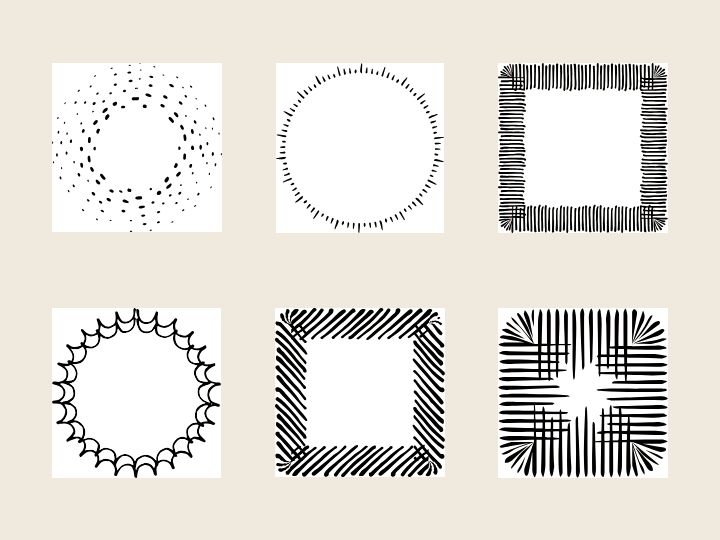
The stamp-based cognition mapping exercise: custom stamps, ink pads and a canvas, with the feelings stickers over the top.
See the creative artefactMapping Neurowiggly Cognition
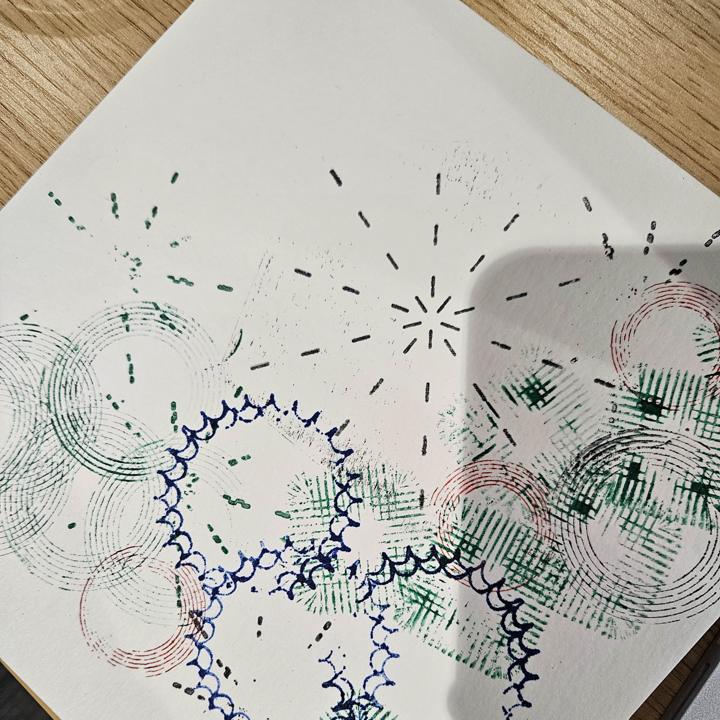
Drawing the shape of a cognition, then the extensions, tools and strategies that reach from it; a variant of the stamps and the Visualiser.
The exercise in the PlaybookVisualising Your Wiggly Cognition
What this reveals is that leading with material care disrupts deficit narratives. Physical objects can re-script the emotional baseline of a learning environment. As literature across craft and organisational settings documents, materials carry relational weight and communicate institutional values (Orlikowski, 2006; Sørensen, 2009; Rosner, 2012). In an educational landscape that frequently treats accommodations as logistical burdens, this creates a space where learners feel valued before they are asked to perform, lowering psychological barriers and restoring a sense of agency. For practice-informed design research, this makes the quality of what participants are handed part of the method: it shapes who chooses to take part and what they are willing to share.
Storytelling through Objects
Producing narratives around personal experience, physical objects, and learning creates psychological distance from deficit, allowing participants to examine complex learning circumstances obliquely rather than head-on. By granting participants the emotional and cognitive space to choose how they interpret a story, narrative distance fosters a genuine sense of possibility where new self-conceptions and potentialities can be imagined (Taeger, 2020; Taeger & Yanchar, 2019). Furthermore, storytelling models how interventions layer incrementally upon one another and demonstrates how simple reframing opens previously intractable situations. In the workshop environment, these narratives catalysed new visual metaphors and forms of inquiry, offering pathways into complex ideas that direct instruction could not achieve. Attaching these narratives directly to physical objects generates cognitive stickiness and durable meaning. Within the design process, objects serve simultaneously as extended thinking tools in the moment, as aide-mémoires of prior reflection, and as physical anchors when re-storying future circumstances.
This was demonstrated in Workshop 3 through the deployment of wind-up robot figures as physical commitment devices. Rather than operating as static souvenirs, these custom-designed artefacts were crafted with specific tactile affordances to position participants back into the workshop’s relational space, creating the conditions needed to re-enter a mindset of autonomous inquiry and self-expansion. The evidence came from an object I had not planned as a commitment device: when I returned for the third workshop, weeks after the first, feeling stickers had travelled onto a phone, a walking cane and a telepresence robot.
See the creative artefactFeelings stickers
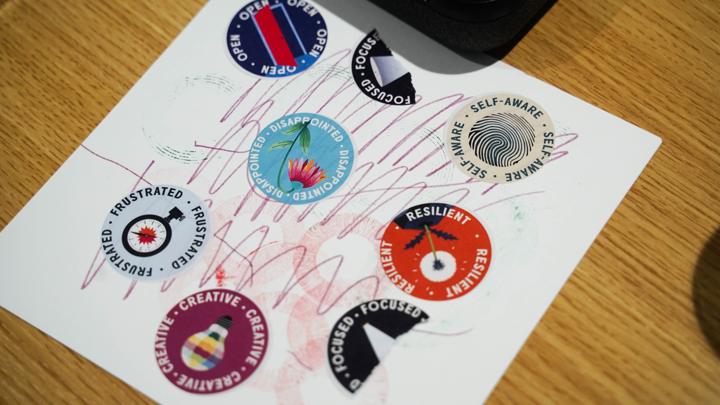
Round stickers, each carrying a feeling word in its design, used in the room and kept afterwards. They are also offered in the margin of this edition.
See the creative artefactWind-up robot figures
Small wind-up robots given out in the third workshop as physical commitment devices, and taken home.
What this reveals is the capacity of object-attached storytelling to externalise neurodivergent sense-making in a tangible, non-linear form. In educational settings where abstract reflection can impose a heavy executive functioning burden, pairing personal narrative with a physical artefact grounds abstract insights in a material touchstone. The object acts as a portable instrument of agency, allowing participants to carry the psychological flexibility cultivated during the workshop into their daily environments without relying on continuous institutional support.
Relational Togethering
I conceptualise the relational work of the workshops as togethering: an emergent condition that runs beneath all phases of co-design, functioning as the relational glue that sustains lasting change and interdependence. One of the most significant expansions in my practice was recognising how community extends the cognition of neurodivergent learners far beyond the instruments an individual takes up alone (Barnes, 2012). Through shared rituals and vocabularies, such as the ‘What is the Weather’ or the ‘Have You Tried’ exercise, community itself becomes a dynamic substrate a learner can think with. It remembers on one’s behalf, lends activation energy when individual capacity is low, and holds a steady store of capability when personal reserves falter.
This relational dynamic was laid bare during an early workshop exchange, where three participants held space through a genuine disagreement to arrive at a more nuanced position together. Recognising that togethering could sustain itself once conditions of non-judgement were established, this observation prompted a shift toward designing explicit structures for collective problem-solving. Subsequent artefacts, such as the ‘Have You Tried’ exercise, were built to harness this collective intelligence and make a shared reflection routine. Crucially, as participants brought overlapping experiences of neurodivergence alongside race, class, gender, and sexuality, holding this space also required attending to intersectionality (Bayeh, 2022; Le Cunff, 2024).
What these insights reveal is that togethering is a live practice for rehearsing how to value difference rather than a prescribed pedagogical technique. This resonates with Harney and Moten’s (2013) concept of the undercommons, where marginalised communities make collective meaning on their own terms, alongside feminist design principles that centre power and intersectionality (Crenshaw, 1989; D’Ignazio & Klein, 2020). By embedding these relational commitments into design practice, this approach demonstrates that a space designed to honour cognitive difference inherently develops the capacity to value human difference of all kinds, providing a pathway toward pluriversal co-design.
6.2.2Reflexive engagement: Researching with My Lived Experience
Beyond drawing on this research to do the research, I found the articulation of my lived experience was consequential. The reflexive move of naming my own patterns as a neurodivergent learner, created a framework that others could hold up against their own. This is the fundamental work autoethnography asks of a researcher (Adams et al., 2021; Holman Jones, 2016). Brute forcing, sidestepping, and leapfrogging, the three stances introduced in Chapter 2, emerged from my describing to others how I had navigated the school system. Naming my learning experiences and noticing how far leapfrogging diverged from conventional educational discourses allowed me to refine this framing into a usable tool for learners and educators. Until someone points out, ‘What you are doing right here is brute forcing,’ a learner may not see another way. The value of engaging with my own lived experience lies in helping individuals recognise their own patterns and choose a different path.
This articulation resonated with participants and educators in every context where it has been shared. In Workshop 3, naming brute force for what it is, and acknowledging that I find it difficult too, opened the room to concepts of sidestepping and leapfrogging as alternatives; one participant recognised their habits and set them against the novelty-driven approach I had described in Workshop 2. In the first workshop a participant turned the framing back on the workshop itself, observing that because “we’re also used to just having things brute forced at us,” anything arriving in a different register was first read as demand rather than request.
Naming these three stances surfaces how neurodivergent learners can experience the friction of learning, and it illustrates why incremental adjustment may be insufficient: brute forcing and sidestepping are already incremental responses, and many neurodivergent learners have been doing them their whole lives. What the SEAT framework and the instruments of change offer is qualitatively different: conditions in which leapfrogging becomes practicable, and support for the shift in self-narrative required to believe leapfrogging is possible.
See the creative artefactThe four instruments of change
Digital prosthetics, mind-body strategies, relational practices and space-making: the four directions a learner's instruments of change can take, and the four rooms of the database.
Orchestrating Instruments
Orchestrating instruments is the reflexive move of treating my own stack of supports as the instrument of inquiry. Engaging directly with my own tools revealed that I could not simply lean on one instrument repeatedly. It was through applying my research in practice that I came to see how supports work in concert. Different instruments can address the interfacing components of the friction that makes up neurodivergent learning: reading, writing, relational engagement, and self-critique. This project proposes a re-conception of the tools, strategies, and environments that support neurodivergent learners as a concert of instruments across assistive technologies, psychological strategies, social relationships, and learning environments. Chapter 2 set out how this vocabulary sits between Clark and Chalmers’ (1998) extended mind, which dissolves a boundary without taxonomising the supports that cross it, and Bronfenbrenner’s (1979/2009) layers of setting; what is added here is the insistence on their orchestration.
The four directions instruments of change take - digital prosthetics, mind-body strategies, relational instruments, and space-making - are set out at the close of Chapter 4, enacted through the creative outputs of Chapter 5, and carried beyond this exegesis by the Neurodiversity Playbook and Neurodiversity.Tools. While each of these domains exists across many fields, the conceptual contribution of this work lies in the finding that they can be understood and deployed together, and in adopting the language of “instruments” itself. An instrument is something you learn to play, something that produces music in concert with others, something that develops intimacy over time, as Ingold (2013) says of the cello. The orchestration became visible in the workshops. Supports kept surfacing that would not fit the single, digitally mediated category I had arrived with. The design shift that followed was to show how instruments from different directions reinforce one another rather than compete.
See the creative artefactThe Neurodiversity Playbook
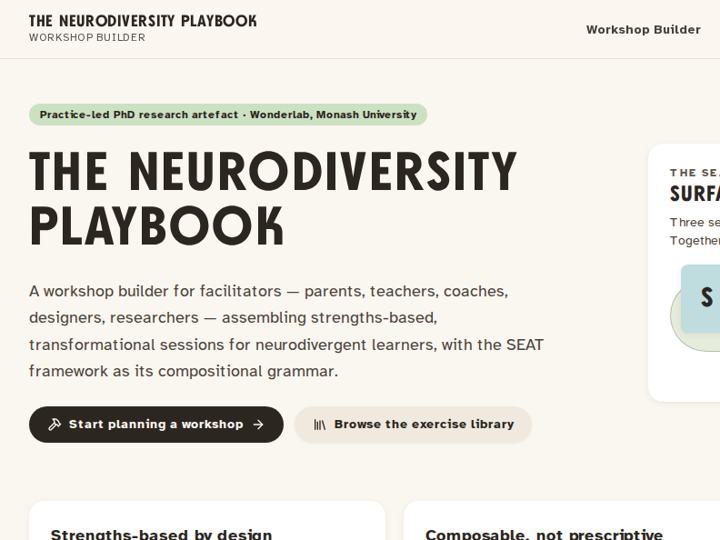
Exercises, materials and a workshop builder for the community of care, structured by SEAT.
See the creative artefactThe Neurodiversity Tools Database
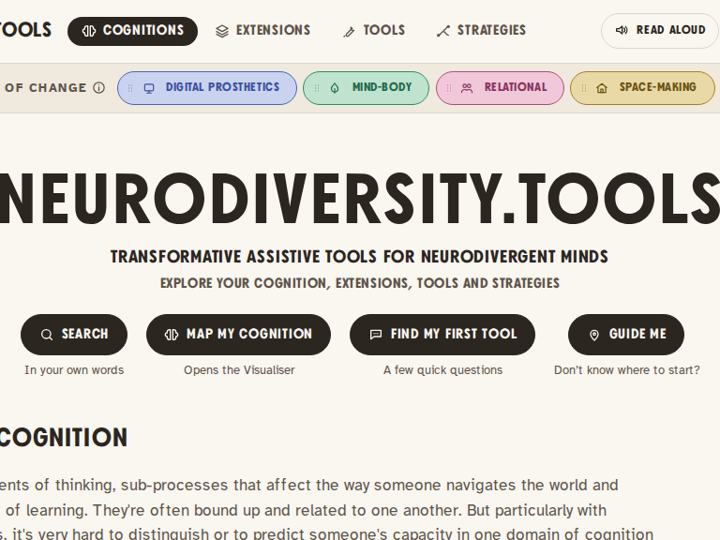
A browsable database of tools, extensions and strategies, organised by the part of thinking they carry, with examples and advice.
I came to see that one good thing helping a little does not guarantee it will help a lot if used twice as much. What made the difference was a layered combination of interventions, and the finding emerged directly from this lived negotiation between theory and practice. Intervention types have non-linear, complementary effects, so that where stacking names their accumulation, their assemblage produces effects that are combinatorial rather than additive. This research names that layered combination the cohesive interface of instruments of change: technological, relational and introspective interventions acting together to extend the ability to live and produce research, the same configuration that let the writing of this exegesis happen at all.
The claim is propositional rather than definitive. This form of exploration works out vaguely where the land is in the fog: a claim that a territory exists and can be navigated through a cohesive assembly of instruments, with mapping it in full still ahead. For neurodivergent learners the resonance is direct, because the cohesive interface describes what a learner assembles when they extend their own cognition on their own terms, and the framing is offered to others working at the intersection of extended cognition and neurodivergent experience.
Interrogating from Within
I am using the tools and instruments of change I am theorising about in my own life to achieve this PhD. This self-emancipatory function means the autoethnographic insights come from being both a research practitioner and a beneficiary within the cohort. Clark and Chalmers (1998) proposed that our mind and its many functions can extend into the environment, and subsequent work has examined this claim philosophically and through third-person observation. This research offers a sustained, first-person investigation of an extended cognitive system from within, conducted by a neurodivergent researcher whose daily practice depends on the very instruments being theorised. The exegesis is itself a record of that investigation: it was dictated, transcribed and listened back to through the instruments named in its opening pages. For design researchers, it offers a precedent for studying an assistive ecology by living inside it, where the researcher’s own friction, triumphs and lived experience count as rigorous data (Adams et al., 2021).
Researching Alongside and From Within
Material care, storytelling through objects and relational togethering operate as interlocking moves that support transformative encounters. Material care signals dignity to dismantle institutional guardedness and self-critique before collaborative inquiry begins. Storytelling through objects captures the relational insights generated during these interactions, translating fleeting moments of shift into portable physical anchors that endure into daily life. The psychological safety produced from these design commitments is a necessary precondition for togethering, enabling participants to do relational work and navigate difference without the pressure of forced consensus. In weaving material readiness, relational negotiation, and object-based memory, this practice-informed approach establishes the relational baseline necessary to research alongside, and from within, lived experience.
Articulating lived experience, orchestrating instruments and interrogating from within are one reflexive movement. Naming the three stances gave me a language for my own patterns before I could offer it to anyone else; that language made the instruments of change legible as a concert rather than a catalogue, because the stance a learner takes decides which instruments they can reach for; and using that concert to produce this research is what let the orchestration be described from inside, as a cohesive interface rather than an observed effect. Together with the participatory engagements above, this is the research orientation the first question called for: practice-informed design research that researches alongside lived experience and from within it and treats the two as inseparable. What that orientation made possible for learners, the experiences and playful interventions that invite mindset shift, is the second contribution.
6.3Designing learning experiences: A Contribution to the Neurodivergent Community
The second question asked what experiences and playful design interventions invite mindset shift in neurodivergent learners. For learners historically stranded in encounters dominated by normative standards, the answer lay in acknowledging difficulty collectively while surfacing excitement for future engagements with the world. Shifting from a self-critical to an excited mindset called for piloting experiential encounters that could surface what story, made objects and collective reflection each make possible. The contribution has two parts. The first is a set of practice insights about how to design for mindset shift, gathered here as the boundary before uptake, the move from self-critique to excitement, playful narratives and praxis objects. The second is an applied set of outputs for the community of care, whose use flowed to the ultimate beneficiaries, the community of experience: the SEAT scaffold, the Neurodiversity Playbook and neurodiversity.tools, with the creative outputs as their ambassadors.
6.3.1The boundary before uptake
The boundary before uptake is the dispositional barrier that sits prior to every practical barrier to adoption: the mindset that tells a learner they are not someone who could or even should be helped. Neurodivergent learners hold an enormous potential to autonomously pursue the meeting of their own social, educational and developmental needs with tools and strategies that already exist (McNicholl et al., 2021; Pontikas et al., 2020). This research explores and affirms the emancipatory potential is real and present. Uptake is where it stalls, made difficult by limiting mindsets and a foggy awareness of what adopting these tools would look like, what it might feel like to be helped by them and what kind of learner one might become in their company (Ravneberg & Söderström, 2017). The assistive technology literature has documented the practical barriers to adoption, including device mismatch, cost and changing needs (Phillips & Zhao, 1993; Scherer, 2005); that dispositional barrier remains insufficiently explored, and Chapter 2’s account of how deficit-fuelled language calcifies into self-concept sits upstream of it.
In the tutoring that preceded the workshops, students given a database of recommendations reported overwhelm rather than delight, and one asked whether wanting the tools meant they were broken; in the workshops, instruments of change repeatedly arrived as good news to participants, who asked how to find them again afterwards. The design shift was to treat readiness as the first thing to design for: a scaffolded process through which neurodivergent learners can shift their self-narratives toward openness and begin to assemble instruments of change on their own terms, with practical instruments alongside it so that facilitators, educators and other members of the community of care can create similar conditions in their own contexts without the researcher’s direct involvement.
If a learner’s self-narrative forecloses the possibility of being extended by a tool, no amount of improved tool design or information provision will create lasting change. Naming the boundary before uptake locates the work of this contribution at the point where most assistive technology efforts have not looked, and it explains why the experiences that follow, playful narratives, praxis objects and the SEAT scaffold, are designed to work on readiness first.
6.3.2From self-critique to excitement
Neurodivergent learners can feel very critical about their own cognitive capacity even when there is so much to feel excited about: what they might be, what they already are and what they might become. Difficulty exists, and a strengths-based framing should never paper over genuine friction. The insight is that difficulty and excitement need not arrive in sequence: for many participants, attuning to the troughs of their cognition was bound up with understanding the peaks, and a strengths-based framing directs introspection toward excitement only when it accepts that shame exists and that engaging with difficulty is a necessary part of understanding who you are. For the community of care, the orientation sets the register of every encounter that follows: a space that begins by naming what is wrong can be more credible than one that opens in celebration, and it is from that credibility that excitement becomes believable. The Neurodiversity Visualiser (visualiser.neurodiversity.tools) grew from this insight: it draws a learner’s cognition as a shape across ten domains of neurodivergent cognition rather than a score, so that the first invitation is visual, non-imperial and strengths-based with prompts for self-extension offered broadly before any instrument is specifically named.
See the creative artefactThe Neurodiversity Visualiser
A strengths-based portrait of a cognition, extended by instruments of change, drawn from your own words.
The workshops were built to make excitement for extending cognition reachable, and the design shift was in sequencing. By naming difficulty together in a conversational register that was open to multiple interpretations, shift work could take place. This looked like a participant reframing the “overwhelmed” feelings sticker from deficit into the enjoyable experience of overwhelm the first time they saw snow. Surfacing came first, so that the deficit stories learners already carried could be named before any envisaging began; the tutoring episode Chapter 4 recounts, in which a student asked whether wanting the tools meant they were broken, is the tension in miniature, and it resurfaced in the workshops’ group reflections about what conditions would relax the stress and worry participants felt. Chapter 4 records the moments that ground this reading and their limits: several participants described new perspectives on their own minds, and the spoken before-and-after reflection moved from one participant’s “drowsy fog and uncertainty” to another’s “petrichor”, a sense of grounded replenishment of self-perception, within a single session.
See the creative artefactFeelings stickers
Round stickers, each carrying a feeling word in its design, used in the room and kept afterwards. They are also offered in the margin of this edition.
In that way this project contributes to the strengths-based neurodiversity literature (Chapman & Botha, 2023; Armstrong, 2010) by showing, through creative design practice, how the shift from self-critique to positive self-regard can be scaffolded through specific, designed encounters that engage learners with both the difficulty and the possibility of their own cognition at the same time.
6.3.3Playful narratives
Playful narratives break apart the lines of logic needed to be open to new futures involving extended cognition, introducing practical concepts through more abstract sub-steps. Specific tools with specific affordances and constraints immediately trigger myriad implementation questions and practical frictions. For neurodivergent learners those questions can be paralysing: the moment a tool becomes concrete it brings with it questions of how, when, where and whether it will actually work for me, and those questions can overwhelm executive function before the tool has been tried.
Even once a learner is open to extension, a foggy awareness of what is out there remains, and the conceptualisation of what a future might look like is impaired. The fog was visible across this research: Chapter 4 recounts students overwhelmed by a raw list of recommendations, and an experienced learner who applied only one or two suggestions from a long list because it was unclear how they would fit into everyday life. The design shift was the fabled extensions of the scenario matching exercise, which scaffolded the idea of an intervention, and acceptance of it, before any implementation detail arrived. Participants who met the reminder elf were not being told to install a task manager, and the ideas travelled anyway: of their own accord, participants later connected fabled cards to real tools in discussion. The same recognition shaped the outputs: the Visualiser could offer a shape to cognition, and the database could surface what might extend it, but neither could with certainty carry a learner across the boundary to uptake by themselves. The fabled extensions, the scenario cards and the play interludes were made to work in concert with them, engaging playfully where the direct instruments suggestions may only inform.
See the creative artefactFabled extension cards
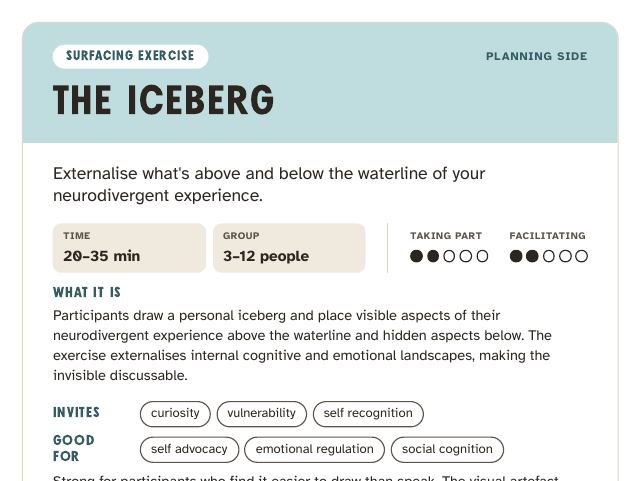
Cards for imagining situations and the extensions that might meet them, used in the scenario matching exercise.
See the creative artefactPlay interludes
Play between the exercises: fast bursts that shift the room's register, and quieter interludes that let it settle.
The playful interludes and exercises work as more than icebreakers. They offer an embodied scaffold for engagement with the idea of extending cognition before the practical friction of doing so arrives. Against the top-down, extrinsically driven play research Chapter 2 records, the standing tension Sutton-Smith (1997) identifies between play’s two rhetorics and Spiel and Gerling’s (2021) finding about research with neurodivergent populations, play here is designed with and for neurodivergent learners, and it is mobilised one step further than usual: not only to scaffold content but to scaffold the adoption of cognitive instruments themselves, so that learners can approach cognitive extension and mindset transformation without the weight of implementation bearing down prematurely.
6.3.4Praxis objects
Praxis objects, the tangible takeaways Chapter 5 introduced, embody the proposition that theory can overlay onto creative practice infinitely: a designed object in the built world can absorb an enormous amount of theoretical complexity and deepens the fidelity and granularity of theoretical engagement by opening new modes of inquiry. This research extends the concept of boundary objects (Star & Griesemer, 1989; Fox, 2011) by identifying two subtypes that emerged through creative design practice: praxis objects, which bridge theory into practice by embedding conceptual frameworks into material form, and reflexive objects, which aid the learner in introspection by providing a structured surface for self-examination. Both are designed for neurodivergent learning contexts, where abstract theoretical engagement and low-friction sensory experience need to coexist within the same artefact. Sicart’s (2022) concept of playthings, which proposes that the ontology of objects we play with is distinct from their epistemology, resonates here: a praxis object is simultaneously a material thing with weight, texture and sensory affordance, and a knowledge carrier embedding the theoretical commitments of the research that produced it.
The puzzle boxes are the cleanest demonstration of a praxis object: identical from the outside and each opening differently, they carry the proposition that every neurodivergent mind might contain a different mechanism, a different way of opening, even when the exterior appears uniform. Likewise, the Columbus egg’s startling self-righting carries the metaphors that Chapter 5 describes: of momentum producing stability, inversion from the bottom into clarity, the sudden resolution of a bottleneck that seemed immovable. The narrative of each object introduces participants to objects as tools for thinking (Fox, 2011) and the participants’ delight and increased engagement with the Columbus egg as it was passed around demonstrates the utility of praxis objects in easing mindset change and the adoption of instruments of change.
See the creative artefactColumbus Egg
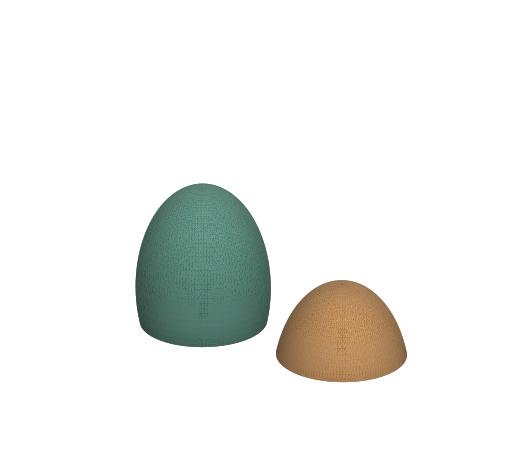
A spheroid that, spun quickly, lifts itself upright. A 3D-printable file is on the outputs page.
See the creative artefactJapanese puzzle boxes
Boxes that look alike from the outside and open by different methods: a metaphor for invisible difference.
Similarly, the cognition mapping canvases and stamps of the workshops were reflexive objects: structured surfaces on which private cognitive experiences can be laid out, looked at, and introspected upon. The materiality of these designed objects, made to be accessible across spoken, written, tactile and pictorial domains, appeared in practice to both lower the threshold for engaging with instruments of change and solidify that change by acting as aide-mémoires post workshop, as discussed in Chapter 5.
See the creative artefactMark-Making Cognition
The stamp-based cognition mapping exercise: custom stamps, ink pads and a canvas, with the feelings stickers over the top.
See the creative artefactMapping Neurowiggly Cognition
Drawing the shape of a cognition, then the extensions, tools and strategies that reach from it; a variant of the stamps and the Visualiser.
The exercise in the PlaybookVisualising Your Wiggly Cognition
Together, both praxis objects and reflexive objects lend support to an argument I have frequently returned to, low-friction instruments of change can increase cognitive capacity without being visible to the world at large, extending cognition so that a learner can navigate the world with the same fidelity as their neurotypical peers, and without the judgement that accompanies visible difference.
6.3.5SEAT: A Practical Scaffold for the Community of Care
SEAT (Surfacing, Envisaging, Actioning, Togethering) is the scaffold this research offers the community of care for sequencing a transformative encounter, adapted from Grocott’s (2022) SEED framework. Each of SEAT’s departures from SEED carries a position, and this section concentrates on them. “Experiencing shifts” became “Actioning” because contemplative or experiential processing alone proved insufficient for learners navigating executive dysfunction, an insight that emerged through the workshop series and my own practice; what is needed is a pivot toward agentic, practical steps that direct the energy generated by new self-narratives toward tangible change. “Driving intentions” became “Togethering”, trading an individualistic endpoint for a communal companion process and embedding the disability studies emphasis on solidarity and collective identity formation as a structural component of the framework rather than a welcome side effect. The relational care of Togethering is the framework’s foundation; without it the other three phases lose the safety and communal energy that makes transformation possible.
SEAT proved workable for neurodivergent learners at different stages of engagement with their own cognition, across different ages and with varied experiences of difficulty within educational systems. Its flexibility lies in the capacity of each phase to be adapted in duration, depth and the style of exercises used to scaffold it: Workshop 1 leaned on surfacing, Workshop 2 on envisaging and Workshop 3 on actioning, and when Actioning landed it created a positive feedback loop, a successful experience with one instrument increasing the likelihood of subsequent engagement with surfacing and envisaging new parts of cognition that may need attention. For some individuals, particularly those encountering their own cognitive landscape for the first time, certain phases may be harder to process alone. Surfacing asks learners to sit with difficulty, and without Togethering to hold that process the experience can feel exposing rather than generative. The practical significance for the community of care is that SEAT is a framework that offers a pluriversal and deployable path to meet learners where they are.
6.3.6Creative outputs as ambassadors for change
I hope the creative outputs act as ambassadors for the concepts and principles this research wants to disseminate, a postman for ideas, sending them multiple degrees of separation from myself. The research produced two main outputs, each a house for smaller things. The Neurodiversity Playbook holds the SEAT framework, the exercises, the facilitation notes and the materials, and is made for the community of care: its non-linear, pluriversal and modular structure lets facilitators bend its activities to the cohort in front of them, and its physical card and interactive digital database formats make it portable enough to be used far beyond its original context. Neurodiversity.tools is a living library of instruments of change, made for the community of experience. The commitment devices and reflective materials travel between the two. Chapter 5 describes each in detail and Table 5.1 pairs them with their audiences; Table 6.1 summarises what each community receives.
| Community | The community of experience: neurodivergent learners themselves | The community of care: teachers, facilitators, parents, and space makers |
|---|---|---|
| What the outputs offer | Mindset shift with minimal friction and low activation costs, and a bridge between workshop insight and daily life. Access to the Neurodiversity.tools library ensures learning experience can extend beyond a workshop. This allows ideas to be more readily brought back into everyday learning. | Customisable, flexible resources that lower the burden of producing pluriversal, transformational learning environments. Guidance on how to offer a menu of supports for self-selection by participants. |
| Served through | Neurodiversity.tools, a living digital library of instruments of change filtered by cognitive extensions and difficulty rather than diagnosis; Visual, physical, and perceptual reflective materials; and commitment devices, tangible aide-mémoires that travel with the learner beyond the workshop. | The SEAT framework as a structure for building workshops, detailed facilitation notes and priming scripts, and guidance on the gestures of care that, in aggregate, create a psychologically calming pedagogical practice. |
The PhD document itself may not be the most vital vessel for these findings. Further impact lies in what happens in the minds of learners, and in reformatting these contributions into accessible contexts: playbooks, tactile design artefacts and distributed workshop kits, with the framings and intentions of the research accounted for in them so that an experienced design researcher need not be present as facilitator. This shift is already under way: the playbook has moved the logistics from my hands into the community of care, and materials like the feeling stickers, cognition maps and robot figures went on living in participants’ lives after the series ended.
See the creative artefactWind-up robot figures
Small wind-up robots given out in the third workshop as physical commitment devices, and taken home.
They act as ambassadors by leveraging creativity and play to aid mindset shifts; utilising materiality to telegraph care; and enacting democratic space-making that adjusts the participatory demands so they do not overwhelm under-resourced learners. I hope that appropriation by communities of care extends the impact of the research beyond what any single researcher could achieve.
A Path for the Community of Care
Read as a path rather than a list, these insights suggest how facilitators might enable changeful learning encounters using these contingent principles. Treat readiness as the first thing to design for: the tutoring students who felt broken when handed a list of tools needed a story before they needed a recommendation. Begin by naming friction and difficulty so that excitement is grounded in lived reality when it arrives: for example, a first session that opens on the deficit stories learners already carry, as the scenario cards did. Introduce instruments through narrative and material distance before implementation: a reminder elf before a task manager, a puzzle box before a conversation about how minds open differently. Stack the experiences on purpose with SEAT, so that surfacing, envisaging and actioning arrive in an order the room can bear and let the Playbook and neurodiversity.tools carry the sequence into rooms the designer will never enter. The experiences and playful design interventions that invite mindset shift stay responsive to the personal and pluriversal needs of different neurodivergent learners, meeting the different styles, complexities, communication mediums and novelty-seeking they bring, and help move them past precontemplation and into active transformation. What holds that path in place when the exercises are not enough, the enabling conditions and the facilitation gestures, is the subject of the third contribution.
6.4Designing Transformation: A Contribution to Transformative Design Practice
The third question asked how facilitation, specific practices, and enabling conditions can be designed to support learner transformation. It speaks to anyone who designs or facilitates learning encounters. Facilitators embedded within a community of care can cultivate environments that support transformation together, enacting psychological care through material engagement and holding togethering as a submergent condition, so that change begins in spaces already attuned to existing frictions. Answering the question called for attending to everything that designing for transformation involves beyond the activities and the outputs. The contribution is theorised from a reflexive praxis of facilitation, and it has two parts: the enabling conditions the research revealed, and the facilitation gestures that let those conditions take hold.
6.4.1Enabling Conditions
In systems thinking, the term “enabling conditions” signals an ecological perspective: background contexts, relational structures, and broader environments continuously inhibit or support transformation. Rejecting linear causality and direct interventions, this approach prioritises a system’s often-invisible contextual dynamics. This research balances the vast systemic entanglements of education and neurodivergent learning with the practical scope of a design PhD, focusing on what can emerge in a workshop setting over a few hours. Drawing on Nora Bateson’s work with warm data and submergent conditions (Bateson, 2016), the study cultivates enabling conditions for mutual learning by leaning into the relational space the workshops create.
The conditions were recognised through the messy, iterative, relational work of being in practice together. The ugly ducklings of the workshop series, the exercises that misfired, the tensions that surfaced, the moments that seemed like failures, turned out to be the conditions under which the swans could be recognised. As 6.2.1 recounts, it took the teacher’s observation about the scenario cards for me to understand the relational power of material care, and the contentious exchange and the Have You Tried exercise for me to name togethering as a submergent condition (Bateson, 2016) rather than a facilitation technique. The instruments of change were always there in the theory, but it took the workshops for me to name, define and categorise them, and add the weight of lived experience.
See the creative artefactFabled extension cards
Cards for imagining situations and the extensions that might meet them, used in the scenario matching exercise.
For any learner, and acutely for neurodivergent learners, the difference between a condition and a technique is the difference between a space that holds them and a move that is done to them. Enabling conditions are what anyone designing a learning encounter must attend to before any exercise is chosen, and they are what let a relational instrument sustain itself once set up, with little facilitation required in the moment.
Co-engagement: threading the needle
Co-engagement is the first enabling condition: before material care or togethering can take hold, the labour of the workshop has to be shared out so that participating does not exhaust the people it supports. Restoring a positive mindset is a difficult exercise that can be enabled by collaborative environments that are also playful. Building on co-design principles, co-engagement names a stance for neurodivergent learning environments. Where co-design is understood as collective creativity, in which participants share responsibility for generating and resolving decisions across the whole design process (Sanders & Stappers, 2008), co-engagement has the designer take on the labour of pre-emptive scaffolding while keeping the standing between designer and participants equal through transparency.
Part of my own experience of neurodivergence is the feeling of not being able to adhere to specific norms and the sense of being trapped in the inability to meet my autonomous preferences. To be told you have desires in a workshop and not be supported to meet them can be a deeply frustrating experience, one that undermines the self-transformation the workshop exists to support. Parity here means nothing about the workshop’s workings is withheld showing participants the effort and decisions that went into creating resources acts as a counterweight to their inability to redesign every component in real time. The scaffold itself stays flexible, able to change on the fly at participants’ direction, while providing exercises built with clear intentions. The clarity afforded by this work’s scaffolding is evidenced in Workshop 2, where a participant who could see the scaffold built their cognition map in anticipation of the extending exercise that followed.
See the creative artefactMapping Neurowiggly Cognition
Drawing the shape of a cognition, then the extensions, tools and strategies that reach from it; a variant of the stamps and the Visualiser.
The exercise in the PlaybookVisualising Your Wiggly Cognition
This transparency is a response to the recognition that insisting on participatory involvement regardless of cognitive capacity can itself become a form of exclusion. Co-engagement threads the needle between horizontal openness and pre-emptive design scaffolding, safeguarding the psychological safety that neurodivergent learners require while preserving the democratic ethos that makes transformational learning possible. Where the workshops themselves are co-learning environments in which participants and facilitator generate knowledge together, co-engagement describes the stance that makes those environments possible: the pre-emptive design scaffolding that creates the conditions for co-learning to take place without requiring participants to bear the full weight of designing those conditions themselves. As a designerly stance it may travel to any learning encounter where full participation would cost participants more than it gives them.
6.4.2Facilitation Gestures
Across the workshops the conditions were held in place by small moves rather than solely by the exercises themselves. These facilitation gestures create a more comfortable and relational space for change: small, concrete moves of modelling, framing and responsiveness. I call them gestures in the spirit of Erin Manning’s (2016) minor gesture, introduced in Chapter 2, since each is a small relational act that shifts what can be felt and done in the room without waiting for structural permission. These gestures design transformation at the scale of seconds, single moves, and the tone of a sentence or a pause before a prompt as impactfully as designing at the scale of frameworks and materials.
Modelling orientations by sharing my own experiences
From the opening, joining with my own story as a neurodivergent facilitator with my own instruments of change on the table invited a vulnerability that participants then extended to one another (hooks, 1994). In Workshop 2, when I opened with my own history of dictation software, a participant answered with their story of educators who removed a support once a child was functioning well with it. Often, I demonstrate these tools and technologies in the context of my own stack of uses. By using my story, my experiences, I can model the orientation of someone who is further along in adopting these tools and using them to extend my cognition. These personal reflections also reinforce that I am a member of the neurodivergent community rather than apart from it (Ne’eman & Pellicano, 2022). However, I don’t think this sort of demonstration in practice is unique to neurodivergent experience; I think any facilitator can demonstrate the exercises and tools with reflections of their own personal practice to great effect.
Introductory Facilitation Gestures
Multiple facilitation gestures arose around introducing exercises in a low-friction way. Before each exercise, narrative and theoretical snippets position learners within a wider intellectual and historical context and gently make space for change. These priming moments are crucial, and I know it from both directions of the workshop series. When framing was thin, participants told me: after Workshop 1, several said they did not know why they were doing the exercises, and the absence of framing read as disconcerting rather than open. When framing was full, the same cohort moved further: Workshop 2’s theory-first opening was received as useful scaffolding that justified the invitation to continue, and the Have You Tried exercise worked precisely because its framing converted advice from an imposition into something solicited. With many groups it can be more powerful to frame the next part of a workshop as an invitation rather than a demand. This is doubly true when neurodivergent participants are actively demand avoidant (Green et al., 2018) and so may forcefully resist demands on their behaviour.
Precision of language in what David Robertson (personal communication, September 4, 2025) called “passages of seconds” decided whether a prompt landed as an invitation or a demand:
“There is power in the language that we use as facilitators when we’re framing, and there are certain passages of seconds in which the precision of language used by a facilitator is at its most important.”
Novelty, magic and doing things otherwise kept the encounter from collapsing back into a lesson. Another introductory facilitation gesture emerged in the form of presenting a relevant concept through a magic trick before entering the full exercise. This technique was drawn from my magic practice and Grocott and Norman’s assertions that visual and physical metaphors can be used to present key conceptual shifts in a way that invites the individual to map that concept onto their own experience and invites them to use those metaphors in future experiences as they encounter them (Grocott, 2022; Norman, 1998). Participants are presented with a sudden, dramatic shift in the form of an illusion, such as a transposition, a vanish, or a physical transformation. These brief performances model the affordance that a particular learning approach offers, without feeling evangelised to use a specific tool. The effectiveness of this gesture was seen in the first workshop, where a participant said that the opening trick, The Word That Wasn’t There, together with the 1, 2, 3 game, “immediately gave me the vibe that it’s an unlearning thing. That we’re meant to be looking at things through a slightly different frame of reference.”
Establishing Psychological Safety
Establishing psychological safety is the gesture of making each step into introspection scaffolded and free for the learner to actively choose. Psychological distance is one part of it, allowing the facilitator to present tools and reflection without imposing or prescribing them or triggering resistance, overwhelm, or oppositional defiance. Psychological distance allows participants to choose the manner in which they take up these principles and pattern them onto their own ways of thinking. The literature names the mechanism: spontaneous self-distancing can support adaptive self-reflection rather than rumination (Ayduk & Kross, 2010), and stories created with narrative distance grant listeners room to choose their own sense-making (Taeger & Yanchar, 2019).
Signalling that anyone could leave, building in breaks, and treating the encounter as permeable to personal needs made surfacing survivable (Dietkus, 2022). The distance was made by the materials and the gathering: a reminder elf stood in for a task manager, and What’s the Weather let the group say how they felt without naming it head-on. A participant who arrived late to the first workshop, saying they would rather just observe, ended up engaging actively and joyously. From that footing there is a path to deeper engagement: a learner can reflect more personally because the choice to do so is theirs.
I saw what happened when an exercise was perceived as too direct by some. In the split response in the first workshop, it seemed to trigger years of accumulated resistance to being managed. The resistance seemed to be more attached to the framing rather than the ideas. The demand-avoidant profile documented in the literature predicts exactly this pattern (Green et al., 2018). If ideas are introduced too directly, the workshop risks proselytising the usefulness of a tool, asking the learner to navigate not only the suggested concept, strategy, or tool but also their response to being told about it didactically. By using psychological distancing as a design principle, the learner is given room to take up an idea as theirs, to adapt it to their own context, and even to share that mapping onward, creating a second-order space for change.
One Live Practice
Enabling conditions, co-engagement and facilitation gestures work at three depths of the same encounter. Co-engagement comes first, sharing out the labour so that being in the room costs participants less than it gives. With co-engagement, material care and togethering can be held as conditions rather than performed as techniques; and the facilitation gestures keep those conditions alive second by second in the tone of a prompt, the permeability of the room and the distance a story leaves for its listener. Collectively, these conditions and gestures set the material and relational conditions under which learners can hold difficulty and excitement at once and reach for an instrument of change on and as their own. Facilitation, specific practices and enabling conditions support transformation when they are designed together and read as one live practice. The Neurodiversity Playbook is where this live practice is made accessible: each exercise card carries a planning side and a delivery side, and the workshop builder at playbook.neurodiversity.tools lets a facilitator curate the set of instruments that fits their objectives, their room and their learners’ sensibilities, so that uptake is made as frictionless as possible.
See the creative artefactExercise cards
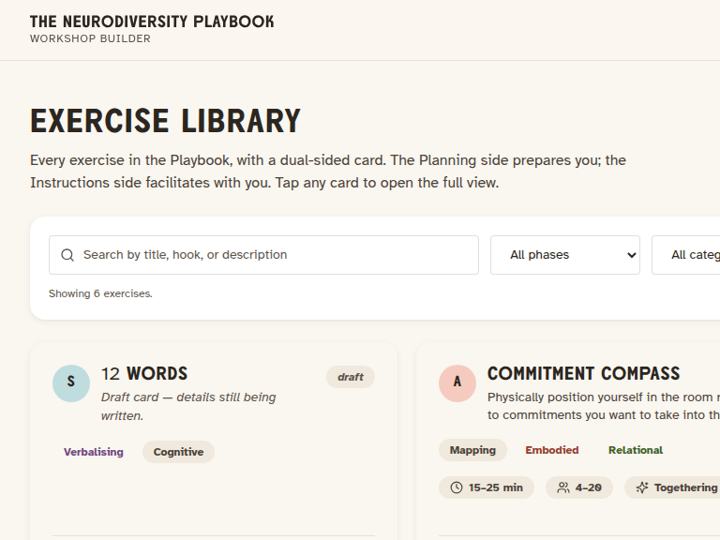
One exercise, interlude or resource per card, each with a planning side and a delivery side.
6.5What this project offers
The three contributions described in this chapter are interdependent: what was learned about researching, what was made for the neurodivergent community, and what was learned about designing for transformation are components of a single understanding rather than discrete contributions to separate fields. The boundary before uptake cannot be addressed without the transformational ambition of SEAT; SEAT cannot function without instruments of change acting in concert; those instruments cannot be adopted without the playful, narrative scaffolding that lowers the friction of engagement; the workshops cannot produce lasting change without the co-engagement stance that safeguards psychological safety; and none of it holds together without Togethering beneath it all and the material care embedded in the creative outputs that carry these principles forward.
Does this interdependency mean everything must be in place before the work can take place? Not in an all-or-nothing sense. Each element holds impact: a single exercise can surface a story, one instrument can ease a single bottleneck or handful of frictions, and the playbook is deliberately modular so that different parts can travel by themselves. Individually, experiences, exercises and components seek to provide catharsis and relief. When drawn and layered together, however, the different elements can weave the conditions of an environmental fabric that durably shift self-perception and can allow for a transformational change to last.
What this project offers, finally, is an orientation, a set of conceptual framings, practical instruments, and designed encounters that together suggest neurodivergent learners can navigate the self and the world with greater ease and joy by adopting an expanded sense of self, a positive mindset, and a positive self-regard through the uptake of instruments of change in playful, pluriversal co-learning spaces. This orientation is offered beyond the community of experience, to the community of care who can gain an affirmative framework that incorporates existing contributions, in education, psychology, psychiatry, technology and design so that they can act cumulatively rather than discretely.
Interlude beginsInterlude 8: Education as Initiation, Richard Peters
‘Not to have arrived at a destination but to travel with a different view’
Richard Peters, Education as Initiation (1964)
Interlude ends