Fit the First
Dolphin Diving
The seas of praxis
This Fit contains three chapters:
The first, The Boat, is shaped and formed by my positionality and context. It establishes what this work is and why it matters: who is conducting this research, why it is needed at this moment in time, and the research goals, questions, and methodological orientations that guide the inquiry.
The second, The Ocean, concerns itself with theory and context, exploring the ideas this research works with and the warm data threads that bind them together, holding space for their interdependencies. Warm data is Nora Bateson’s (2016) term for the trans-contextual interrelationships that hold a complex system together; Chapter 2 defines it in full.
The third, Charting a Course, sets out how the work was done: the methodology and research design, the methods and the shape of the Neuroformer workshop series, and the research questions with the contributions that answer them.
See the creative artefactThe Neuroformer Workshop Series
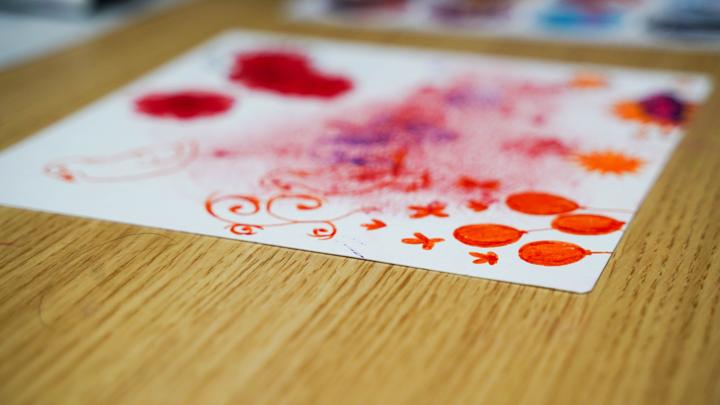
Three workshops with neurodivergent young people at Youth Inc in Adelaide, where both communities met; the materials are photographed on the outputs page.
When I call this research practice informed, I mean that as a researcher I do not privilege the academic bias toward theoretical or oftentimes abstract knowledge. The contribution I wish to make visible is less to the discipline of design, the field of neurodivergence, or the social model of disability than to the practice space where they intersect. My hope for this research is that it supports the practitioners designing pluriversal learning encounters that ultimately help learners navigate cognition, technology, and self-perception. The dolphin is my visual metaphor for how theory and practice interact in this research. Academic theory and concepts are the ocean, creative practice is the air above, and the researcher is the dolphin. The deeper the dolphin dives toward the ocean floor, the more immersed it becomes in the academy; and when it rises out of theory and into practice, it is made more buoyant and given ever more momentum to soar into the air. Practice allows more freedom of movement, more joy, is more visible, and lets the researcher orient themselves before immersing again in the ocean of theory and its unknown depths.
Chapter 1
The Boat
In which the researcher is introduced, and the orientation to practise, practice, and praxis is delineated.
1.1Introduction
The prologue to this exegesis tells a story of possibility and belief in the face of opposition. It introduces the personal and affective stakes of this research through a personal narrative, because the felt experience of being made small, and the impulse to imagine oneself as more, is central to the inquiry. This narrative orientation is meaningful and constitutes a key stance within this research. This chapter takes up where the Prologue leaves off, formalising that orientation into a scholarly frame and research design.
The inquiry is guided by a central research question:
How can we design learning encounters that extend what neurodivergent students perceive as possible for themselves?
Three questions sit beneath it and guide it. The first asks how practice-informed design research might shape the development of transformative encounters. The second asks what experiences and playful design interventions invite mindset shift in neurodivergent learners. The third asks how facilitation, specific practices, and enabling conditions can be designed to support learner transformation.
These questions were pursued through practice. I designed, prototyped, and playtested creative methods and materials with the WonderLab community through playdates, and with neurodivergent educators at the Neuro-Ability Symposium in Dunedin, New Zealand. I then took those prototypes into the field to learn from neurodivergent students themselves: the Neuroformer workshop series, three participatory co-learning workshops with fifteen neurodivergent young people aged 17 to 24 at Youth Inc., a partner educational organisation in Adelaide, run across in-person and online formats with iteration between each session. What the workshops surfaced was later analysed through a mix of qualitative methods. Chapter 3 breaks down each question alongside the mode of inquiry that pursued it and the contribution that resulted.
See the creative artefactThe Neuroformer Workshop Series
Three workshops with neurodivergent young people at Youth Inc in Adelaide, where both communities met; the materials are photographed on the outputs page.
The chapter moves in three movements: the researcher and what I carried in; where the research is located, in the ontology, epistemology, axiology and methodology it works from; and why this inquiry matters now and the challenge of compatibility that shadows it. Chapter 2 then maps the theory the work thinks with, and Chapter 3 sets out how the work was done, from methodology to the shape of the Neuroformer series and the full expansion of the questions, ending with an evaluative commitment about who defines success.
1.2Positioning Myself
I acknowledge the confluence of experiences that led me to this work at this point in time, and how the contexts I draw from inform the kind of person I am and the kind of work I engage in. I arrived at this PhD carrying five starting points: training as an industrial designer with an ongoing making practice and a belief in materiality; a lifelong practice of magic, which brought with it a commitment to playfulness and delight; years of one-on-one tutoring with neurodivergent learners and the conviction that my own neurodivergence is an asset; and a belief in the value of assistive technology. These are intersecting sensibilities more than discrete roles, and they collectively orient how I approach questions of learning, technology, and cognition. This section introduces each as I held it when the research began. The section that follows traces how the research shifted each of them.
My training as an industrial designer gave me a making practice and a conviction that materials matter. Ideas that can be held, turned over, and passed between hands behave differently from ideas that remain on slides or in speech. I entered the PhD believing that the physical quality of what a designer brings into a room performs communicative and relational work of its own, a belief this exegesis develops considerably.
From the age of eight or so, magic has been a lifelong hobby and vocation. By early adulthood I was regularly performing professionally at shows and parties. When I say magic, I do not suggest anything supernatural; I mean illusion, showmanship, and performance. This interest has wound its way into my sensibility as both a designer and technologist. Indeed Arthur C. Clarke (1973, p. 21) famous third law holds that “any sufficiently advanced technology is indistinguishable from magic,” and I am not the first to notice the kinship between design and trickery. Magic surfaces and subverts expectations, expands our sense of what is possible, and encourages us to imagine what could be. Vilém Flusser (1999, p. 17), in his etymological meditation on the word “design,” observes that “a designer is a cunning plotter laying his traps,” connecting the term to the Greek mechos, a device designed to deceive, and the Latin “ars,” sleight of hand. Lewis Hyde (1998/2008) extends this logic through trickster mythology: tricksters are boundary-crossers and culture-makers whose deceptions are generative, producing new possibilities from the disruption of the expected.
Magic contributed two enduring commitments to my practice. The first is directed attention. Successful prestidigitation depends on direction, and it is directed attention that makes illusions appear impossible and, at their best, delightful. Considered, curated design is a way to avert mundanity and resist things feeling commonplace, which matters most when the aim is transformational change. The second is an experiential, embodied way of knowing. A trick lands in the body of the spectator before it is understood analytically. The experience comes first, and the sense-making follows. Both commitments, to delight and to experience preceding explanation, travel throughout this research.
Alongside and after my design training, I spent years as a tutor and coach working one-on-one with neurodivergent young people navigating institutional expectations, meeting them individually and advising them on assistive tools they could integrate into their lives. The magical sensibility bled into this work. I noticed early on that small sleight-of-hand reframes could shift a stuck conversation. When a student arrived convinced, they could not write, I might ask them to describe their idea aloud, transcribe it back to them, and reveal that they had just composed their opening paragraph. The trick is simple, and its effect disrupts a limiting self-perception and opens space for a different story. These sessions taught me that the barrier was rarely capability itself; more often it was the story a learner had absorbed about their capability, and that story could move.
I brought my own neurodivergence with me too. I am dyslexic, dysgraphic, dyspraxic and have ADHD, and I entered the PhD believing at various times that my own neurodivergence wasn’t relevant or that I ought to keep it hidden to avoid judgement. In other moments I saw my neurowiggly cognitions were assets, sources of insight, pattern recognition, and lateral connection that the deficit framing surrounding me had never been able to describe. This conviction was personal before it was scholarly. Lived experience gave me an interior view of what it feels like when a learning environment is built for a cognition other than your own, and equally what it feels like when a tool, an environment, or a person meets your cognition where it is.
The final starting point is the one that named the project. My early educational experiences with assistive technology taught me the tension between tools that grant a greater feeling of autonomy and other external supports that, however well-intentioned, can diminish it. I experienced the difference between having dictation software on a personal laptop and having a human scribe. The two produced the same outputs, yet working with just myself and my tools came with far more sustenance for self-perception and agency. This lived understanding, that technology can extend cognition and amplify ability when the learner holds an open, strengths-based mindset, seeded the belief I carried to my application, where I named it with the language of digital prosthetics, a term Chapter 2 defines in full and places among the instruments of change.
1.2.1The Paradox of the Neurodivergent Researcher
There is a profound, almost cruel paradox inherent in this research project. For me, dyslexia can mean that words unexpectedly gang up on me, fuse together, and block my attempts to penetrate them. My dyspraxia means that, try as I might, long before I started my PhD, I had developed a doctor’s scrawl so illegible that not even I could decipher my own written hieroglyphics. My neurowiggly cognition means ideas can bubble up unexpectedly or resolutely pop at the slightest handling. I have known these things about myself since childhood. No two people’s experiences of neurodivergence are the same, and yet the institutional burden is weighted in consistent ways: the academy demands a performance of neurotypical linearity that my cognition does not naturally align with. It is well documented that stress can exacerbate these patterns, creating a perilous spiral where the ground feels as though it is giving way (Shields et al., 2016). This tension has surfaced within my own research experience, where the stasis of dyslexia has collided with the institutional imperative to produce.
This struggle is a hurdle to be overcome and tender data. The pain of this friction arises because I know, intimately, that, as my colleague Myfanwy Doughty (2025) has it, “it does not have to be this way.” My research challenges standard assumptions of “good scholarship” by recognising that intellectual rigour can be achieved through plural pathways. The experience of navigating this friction makes clear the two duelling forces at play.
The first is the terrible truth that this kind of work is so often a painful experience at the very edge of my own capacity to push through it. Writing this document and adhering to academic expectations feels like a windy outcrop on a blustery day, hammered by rain, facing the sea at the end of the world.
The second is that the world turns and the sun shines through the storm. In practice, this has meant I have come to rely on my own research findings to get me this far. The reframing exercises I developed for workshop participants became strategies I applied to my own writing process. The SEAT framework, introduced in Chapter 3 and unpacked in Chapter 5, helped me recognise when I was reaching for survival rather than flourishing. This double agent position, as researcher and beneficiary of my own findings, deepened the research and helped me to navigate these wild, rocky cliffs.
See the creative artefactThe SEAT framework
Surfacing, Envisaging, Actioning, Togethering: the structuring logic of the Playbook and its workshop builder.
See SEAT in the PlaybookSEAT in actionBuild a workshop with it
The paradox at the heart of my writing, also governs how I read and engage with scholarly literature. Sustained, linear immersion in dense text is where my dyslexia exacts its highest toll, and for most of my education I treated that as a private deficit to be mitigated and kept out of sight. Through this PhD, I have given permission to myself to dive, surface, swim and resurface in a manner that suits me, taking scholarship in through audiobooks, podcasts, recorded lectures, and Socratic conversation as readily as through chapters and papers. Taylor and Vestergaard (2022) identify dyslexic cognition as specialised for explorative search, and Taylor, Zaghi and Rankin (2023) argue that marginalising dyslexic researchers, and the connective moves we make, is bad for science. I therefore leap between fields to test what connects, and I have come to understand this as a designerly way of reading (Cross, 2025), one that makes connections in service of the practice contribution rather than exhaustive coverage of any single sub-discipline’s scholarship.
1.2.2What the Research Made of my Assumptions
Materiality proved the most generative starting point, resolving into three distinct concepts. Material care names the way the designed quality of workshop materials signals to participants that the facilitator has considered them and cares, reinforcing the psychological comfort that transformation requires. Psychological scaffolding names sequences of incremental exercises built for shifts too large to take on all at once. Praxis objects are made things that carry a metaphor and help a person think. Each receives its full treatment in the practice chapters, where the materials themselves appear.
One starting point was a nascent belief in relationality, present in the one-on-one tutoring work and in the collaborative principles of my design practice. This matured into togethering, a concept introduced with the SEAT framework in Chapter 3 and developed across the exegesis. Another seminal belief was a desire to serve the neurodivergent community, but servicing my own neurodiversity and surfacing what my experiences could contribute to the research was not something I initially sought to or wanted to centre.
Alongside these conceptual maturations sat an assumption that the practice dismantled early. I arrived believing the problem was fundamentally one of access: that a vast system of capable hardware and software already existed, and that if the right tools could be discovered, catalogued, and surfaced in the right way, neurodivergent learners would adopt them and their learning would be radically improved. I blindly assumed that everyone I worked with shared my open intent, a willingness to experiment with new tools and to try familiar ones in speculative new ways. Both assumptions were complicated almost as soon as the practice began. What emerged in their place, the recognition that readiness precedes adoption and that mindset must be scaffolded before a tool can land, became the evolving theory of change this exegesis follows, and Chapter 4 traces how.
Digital prosthetics, the founding idea of this exegesis, now lives as one of four instruments of change, alongside mind-body strategies, relational practices, and space-making. The expansion of that taxonomy (set out in Chapter 2) is itself a record of the expansion of the work: what began as an inquiry into digital tools became an inquiry into the wider ecology of things a learner can reach for.
That dismantling did constructive work too, braiding with the culture I was researching within to mature what my training had left most settled: my sense of what a designer is for. WonderLab has a distinctly co-learning, co-creative culture, most visible in its playdates, where the community learns alongside one another. Researching inside that culture expanded what I believed my role as a designer was. I arrived intending to design tools for neurodivergent learners to use, and the research redirected that intention toward the encounter itself. The tools I made, the praxis objects and workshop materials, are designed to establish the psychological, environmental, and conceptual conditions a transformative encounter depends on. The instruments a learner reaches for remain theirs to choose and assemble; my designing concentrates on the conditions of the reaching.
The remaining starting points transformed differently. Magic and playfulness underwent less a conceptual maturation than a diffusion into method, becoming the facilitation sensibility of delight, directed attention, and experience preceding analysis that runs through every workshop and learning encounter. The tutoring practice, likewise, dissolved into the co-learning stance of the workshop series, where advising an individual gave way to learning alongside a group.
| What I carried in | What the research made of it |
|---|---|
| A belief in assistive technology | Extended cognition, arrived at through cybernetics |
| Digital prosthetics, the founding idea | One of four instruments of change |
| Materiality | Material care; psychological scaffolding; praxis objects |
| Relationality informed by co-design principles | Togethering as part of community that I am a part of |
| A tool-maker’s idea of the designer’s role | Designing encounters, and the material conditions that enable them |
| Magic and playfulness | A facilitation sensibility of delight, directed attention, and embodied knowing |
| One-on-one tutoring | The co-learning stance of the workshop series |
1.3Locating the Research
1.3.1Research Ontology, Epistemology, Axiology and Methodology
This research operates from a relational, pluriversal ontology grounded in social constructivism (Vygotsky, 1978; Gergen, 2015) and critical relational theory (Escobar, 2017). It views reality not as a static, objective truth awaiting external measurement, but as a fluid landscape constituted through entanglements between the researcher, the community of caregivers and people with lived experience of neurodivergence and the broad range of tactile and experiential tools developed across this inquiry. Rather than viewing the individual as an isolated, self-contained unit, this stance understands human existence as fundamentally interconnected and relational. In alignment with Arturo Escobar’s concept of the pluriverse, a world where many worlds fit, this inquiry rejects the reductive dichotomies that percolate through normative educational discourses, such as able/disabled, normal/abnormal, and expert/novice. Instead, reality is understood as plural, dynamic, and co-constituted through the active interactions of human actors, the social environment and the material tools designed to be adapted across diverse learning contexts.
Epistemologically, this inquiry brings together Interpretivism and Pragmatism to treat knowledge as inherently subjective, contextual, and functional (Dewey, 1938; Schön, 1983/2017). To navigate these two epistemic orientations, this Design PhD by Project anchors its subjective, autoethnographic inquiry in a pragmatic commitment to real-world impact (Biesta, 2015). Here, knowledge is validated not through detached abstraction, but through its functional utility: testing whether the resulting design tools, playbooks, and workshop activities actually work to empower the neurodivergent learners, educators, and communities they are built to serve. Over the course of the inquiry, treating the researcher’s positionality as a vital primary resource rather than a bias to be controlled for became essential (Dietz et al., 2020). This interpretive lens validates embodied, affective, and intuitive knowing over detached, objectivist observation (Holman Jones, 2021; Adams et al., 2021), positioning lived experience as both the site of insight and the generator of practical action.
The axiological framework of this inquiry is explicitly value-driven, centred on care, relational ethics, and justice (Noddings, 2013; Costanza-Chock, 2020). It accords primary value to a participatory approach that honours and elevates the Lived Experience of neurodivergent participants and the researcher alike, an ethic enacted directly in the room during the participatory workshops with Youth Inc. Rejecting deficit-oriented models that position neurodivergent individuals as objects of study or clinical correction, this work treats young neurodivergent people as the true experts of their own lives and cognitive modes. Inheriting its ethical commitments from participatory design traditions (Ehn, 1988) and co-design principles (Sanders & Stappers, 2008), the research holds a fundamental value for agency, mutual care, and accessibility. The worth of the research outputs, whether physical artefacts, digital tools, or workshop activities, is evaluated by their capacity to nurture generative, supportive relations between learners, facilitators, and their environments.
Methodologically, this Research by Project adopts a practice-informed design framework, an approach I draw directly from Robin Nelson (2013). Nelson distinguishes practice-based research, where the creative artefact is the primary research output, from practice-led research, which foregrounds the practitioner’s internal process. He proposes practice-informed research to emphasise the recursive conversation where theoretical knowledge and practical making continuously inform one another. This inquiry operationalises that recursive loop across iterative cycles: prototyping experiential activities, facilitating participatory workshops, and synthesising findings into open-access playbooks and digital platforms. The creative practice did not follow a pre-established theory, nor was theory simply extracted post-hoc from the practice; instead, practice and theory engaged in a continuous Socratic dialogue supported by autoethnographic reflections, ethnographic field interactions, and iterative design prototyping.
1.4Why This Work, Why Now?
We live in a time of enormous technological and social flux. Awareness of neurodivergence is growing (den Houting, 2019; Johnson & Ahluwalia, 2025), more neurodivergent people are entering education, and many experience considerable distress while doing so (Fielding et al., 2025). At the same time, AI and increasingly automated digital technologies have been systematically tearing up historical norms in teaching and learning environments (Bauer et al., 2025). Technology is developing at a pace that risks neurodivergent individuals being forgotten, or their experiences distorted, if that development is not guided by careful, human-centred approaches to technology and change. I want this work to be a practice proof of a human-strength-centred way of approaching neurodivergent autonomy in our current social and technological context.
This convergence creates fertile ground. Design leads the inquiry into it, and the dolphin values diving into many waters: the research is enriched by engaging with disability studies and the neurodiversity paradigm, the psychology of mindset and motivation, learning theory, cybernetics and extended cognition alongside posthuman thought, and the scholarship of play. Chapter 2 maps each of these waters and the currents that run between them. What makes this moment fertile is the collision of speed and stasis: understandings of cognition and learning are being rapidly renegotiated, while the institutional environments that hold neurodivergent learners remain calcified, and practical creative outputs that carry strengths-based understandings into those environments remain infrequent. Practice-informed research is how the dolphin navigates all this. It is how a researcher learns what is truly possible for neurodivergent learners, and how these rhizomatic theoretical threads are held together. This work endeavours to help people live lives and learn things in ways that meet their own personal, subjective, interior standards rather than adhering to normative standards directed by others.
Interlude beginsInterlude 2: Who You Were Meant to Be, Lindsay Gibson
“That is what this book is for: preparation for your new life. It will help you move aside the tangled debris of old loyalties and mistaken self-identities in order to find the part of you that is still green and growing.”
Excerpt from Who You Were Meant to Be by Lindsay Gibson (2000)
Interlude ends