Fit the Second
Travels
The landscape of practice
This Fit documents the landscape of practice: the workshops conducted with neurodivergent learners, the iterative design of materials and exercises, and the discoveries that emerged through facilitation.
Chapter 4: Ugly Ducklings traces the arc of practice from initial assumptions through the messy reality of three workshops.
Chapter 5: The Swans presents the creative outputs that crystallised from this work.
To demonstrate how theory and practice co-produce one another across this Fit, the chapters that follow contain reflective notes. These are sightlines: moments where the narrative pauses to look sideways, forward, or inward. Each is indented and labelled so that the register of praxis it works in stays visible, and each show how my experience as a designer and facilitator shaped an iteration, or how a material informed an output.
There are three types: practice, impact and theoretical. Together, these sightlines embody the rich relationality between theory and practice that make up praxis, functioning as what Nora Bateson (2016) calls warm data: threads of living context that resist being separated from the relationships that give them meaning.
A [PRACTICE STORY] grounds frameworks and methods, drawing on participant quotes, artefact descriptions and my own ethnographic and autoethnographic reflections as a designer, facilitator and neurodivergent person.
An [IMPACT SIGHTLINE] casts forward, articulating what the potential value of an idea or approach might be in the real world, helping people in the day-to-day trenches of everyday life.
A [THEORETICAL GROUNDING] note situates wider reading or theory that enriches the work and frames my understanding, while still connecting it back to practice.
Interlude beginsInterlude 4: This Is Water, David Foster Wallace
“There are these two young fish swimming along and they happen to meet an older fish swimming the other way, who nods at them and says, ‘Morning, boys. How’s the water?’
And the two young fish swim on for a bit, and then eventually one of them looks over at the other and goes, ‘What the hell is water?’
This is a standard requirement of US commencement speeches,
the deployment of didactic little parable-ish stories.
The story thing turns out to be one of the better, less bullshitty conventions of the genre... but if you’re worried that I plan to present myself here as the wise old fish explaining what water is to you younger fish, please don’t be.
I am not the wise old fish.
The immediate point of the fish story is merely that the most obvious, ubiquitous, important realities are often the ones that are hardest to see and talk about. Stated as an English sentence, of course, this is just a banal platitude — but the fact is that, in the day-to-day trenches of adult existence, banal platitudes can have a life-or-death importance.
Or so I wish to suggest to you on this dry and lovely morning.”
The opening of David Foster Wallace’s commencement address to Kenyon College (2009, p. 8)
Interlude ends
Chapter 4
Ugly Ducklings
In which we travel through practice and see what happened there and underscore what came from it.
4.1Introduction
In 1843, the Danish author Hans Christian Andersen published a short fairy tale (Andersen, 1843). The story, if you’re not familiar with it, revolves around the experience of an ugly duckling, who never seems to fit into their brood. They are bullied, belittled, and minimised for all the things that make them different, only to discover that they were never truly a duck as they had been led to believe, but were in fact a beautiful swan, realising their true identity when they came across and then joined a wedge of swans in flight.
The tale epitomises a few of the central discoveries of the Neuroformer workshop series, a sequence of three participatory workshops I designed and facilitated with neurodivergent learners as part of this research. First, that navigating the at-times adversarial neurotypical world requires an active acknowledgement of what you have internalised from that experience. Second, neurodivergent learners seldom experience their lives independent of other intersectional concerns. Third, that people are positioned at different places along a continuum of self-acceptance: as an egg, perhaps undiagnosed and unaware of why the world feels ill-fitting (Gibbs et al., 2025; Quinlan & Emery, 2026); as an ugly duckling, perhaps undisclosed or without a supportive learning environment in which to make sense of their difference (Grimes et al., 2017; Gregg, 2007); or already a swan, searching for a community to be together with.
See the creative artefactThe Neuroformer Workshop Series
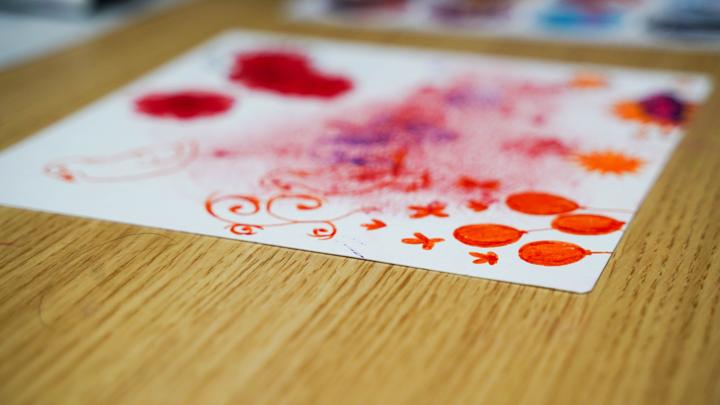
Three workshops with neurodivergent young people at Youth Inc in Adelaide, where both communities met; the materials are photographed on the outputs page.
As such, I have used the structure of this story to break this chapter into two parts.
First, The Eggs lays out the arcs of expansion and manoeuvring across successive theories of change, each encouraging a successor, until these frames could hatch firmly into the current practice.
Second, The Ducklings explores the messy and exciting process of producing practice-informed, collaborative, pluriversal workshops and what many of the exercises that I developed did for the participants and myself.
4.2What did I do?
Before tracing the realisations that emerged from practice, it is worth laying out what that practice entailed; Table 4.1 gathers it. I had an existing relationship with Youth Inc, an alternative education provider in Adelaide, and through it with Alex, the teacher coordinating Metaversity, its experimental program in technology and gamification. I petitioned them to let me join their community and run workshops that were at once a creative output and a space to experiment with exercises and formats. Participants chose which workshops, group reflections and interviews to take part in, so the series flexed around availability and need; some attended all three, others one or two. The wide variance and co-occurrence of conditions, experiences and diagnoses across the cohort meant meeting people where they were, finding a way into their lives through their neurodivergence, learning and cognition while holding space for other intersectionalities.
| Detail | |
|---|---|
| Partner | Youth Inc, Adelaide, through Metaversity (coordinator: Alex) |
| Cohort | Fifteen young adults aged 17 to 24, most disengaged from mainstream education; invited regardless of formal, undisclosed or no diagnosis; many with co-occurring ASD, ADHD, depression, anxiety, visual impairment, and other intersecting disadvantage |
| Workshops | 3 Workshops over two months: Workshop 1 in person, Workshop 2 online, Workshop 3 in person |
| Exercises | About twenty across the series, new, adapted and repeated |
| Follow-up | Unstructured group reflections after each workshop; individual semi-structured interviews by consent, including repeat interviews |
| Data | Images, video and audio, transcripts, researcher, participant and staff observations, interview notes, and the physical artefacts produced, particularly the mark-making outputs |
The three-workshop structure gave enough time to test a spread of exercises across two vectors, the conceptual scaffold of SEAT and the format of the exercises themselves. Of roughly twenty exercises, some were new, some drawn from an existing repertoire (the Systems Thinking Playbook (Booth Sweeney & Meadows, 2001), WonderLab workshops, the mindset and motivation workshops I co-facilitated with Lisa Grocott and Shanti Sumartojo for Melbourne Design Week), some built inside known co-design structures such as card sorting; some were repeated to be refined, some tested as variants, and some entirely new for each session. In a way, the workshop materials are collaboratively designed datums that leave a material impression on future workshops. What follows traces the realisations that hatched from this entanglement of data, practice and iteration.
See the creative artefactThe Neurodiversity Playbook
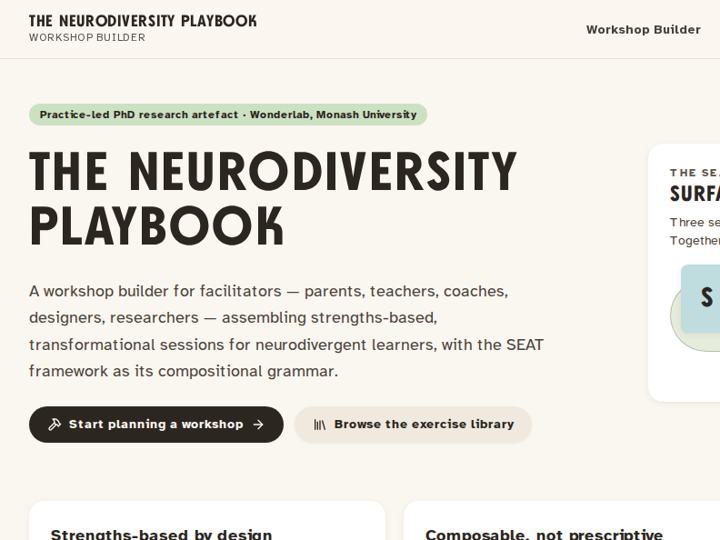
Exercises, materials and a workshop builder for the community of care, structured by SEAT.
See the creative artefactThe SEAT framework
Surfacing, Envisaging, Actioning, Togethering: the structuring logic of the Playbook and its workshop builder.
See SEAT in the PlaybookSEAT in actionBuild a workshop with it
4.3Eggs (Initial Realisations)
Each workshop has been formed by the theory of change I held when I designed it, this section traces the assumptions that undergird these frames and how they began to shift in dialogue with the workshops.
4.3.1How has the project’s theory of change evolved, and why?
Going into the PhD, my work was oriented around hardware and software interventions with little to no mindset intervention. My conception of this research space was that there was a system of technologies, both software and hardware (Mueller et al., 2020; Engelbart & English, 1968; Want et al., 2002), and that bringing them into the learning environments of neurodivergent learners would instantaneously help (Motti, 2019; Puckett et al., 2017). Because of the actions and reactions that have fuelled my personal experience in this space, I felt that the problem was one of access (Puccini et al., 2013). If only these tools were discovered, tested, catalogued, and surfaced in the “right” way then we could recommend the best possible tool to a neurodivergent learner, and that they would adopt the tool and have their learning in and out of any classroom radically improved (Southall et al., 2023; Puckett et al., 2017; Carnine, 1994).
As I worked with a wider community of neurodivergent learners the convictions of my personal experience were complicated and extended. I became aware of the limitations of this simplistic technological solutionism (Nicolaides et al., 2022). My theory of change (the underlying logic of how transformation occurs) had assumed that a mindset shift would mostly occur after confidence had been bolstered by the uptake of assistive tools. Many of these tools do carry transformational potential for neurodivergent learners’ lives (Pontikas et al., 2020). Yet through the research I started to recognise that the process at play is not unidirectional or sequential. Something else needs to happen concurrently.
4.3.2Realising that simply offering tools is insufficient; learners first need a scaffolded process to become ready to adopt them
The nuance that became clear around the end of my first year of research was the need to scaffold mindset shift towards an open and expansive frame that allows neurodivergent learners to be excited and willing to test and experiment with new tools and play with them. All the theory and practice I had been engaging in over that year showed the importance of this scaffolding process (Davis & Miyake, 2004; Pea, 2004; Harris et al., 2007; Belland et al., 2013; Joubert & Slabbert, 2017; Elmore, 2018; Grocott, 2022), a process whose conceptual roots in Vygotsky’s zone of proximal development are laid out in Chapter 2. Through discussions with my WonderLab colleagues, I interrogated my own neurodivergent experience of adopting new ways of learning and researching, and the experiences of other people I had run programs with professionally, in schools and as a tutor. This revealed that I had been pre-emptively assuming an open intent, that we were all willing to experiment and try out numerous tools or even the same tool in speculative new ways. Implicit in this assumption is the premise that different tools work differently for different minds, and that neurodivergence may offer unique and useful paths forward that normative, prescriptive methods of learning may not open up (Hamilton & Petty, 2023; Chapman & Botha, 2023; Armstrong, 2012; Sullivan, 2010). I had not yet created the conditions to ensure that people would always arrive at that premise themselves.
The value of exploring strengths-based mindsets was, if not invisible, then foggy to me to begin with: I was inadvertently applying it to myself and the other neurodivergent learners I worked with, without fully seeing the necessity of it. I kept saying, “Aren’t we lucky we get to leapfrog all of these challenges with these new emerging tools!”, reinforcing my excitement towards a positive and strengths-based mindset (Dweck & Yeager, 2019; Pearn & Downs, 1989; Daskalovska et al., 2012; Duckworth et al., 2007). Where I was challenged was in really breaking down this scaffold into observable, replicable steps so that I could reliably construct this mindset shift in a participatory, power-sharing way with anyone I worked with, and then to observe how this, in turn, impacted tool adoption.
Two experiences prior to this research crystallised the need for scaffolding. The first was in my work as a tutor for neurodivergent students for a dozen or so schools and families around Melbourne. I would try to encourage them to take up the use of assistive tools from my database of recommendations (Sukhai & Mohler, 2017). I was surprised that they didn’t accept and adopt the tools delightedly on their own accord. Many students frequently told me they were getting overwhelmed. I kept saying, “Why? They’re so exciting. Aren’t you excited to try them?” A student said, “Well, I am excited, but I’m also nervous, doesn’t this mean I’m broken?” I heard versions of this from neurodivergent colleagues too. The resistance was not stubbornness or apathy; it was often the recognition that adopting a new tool carried identity implications. To accept a prosthetic is, for some, to accept the premise that something about you needs to be extended, which can easily be cast as a negative act.
[THEORETICAL GROUNDING] - Beginning with what hurts is a deliberate sequencing choice, and it cuts against the grain of some positive psychology practice, where interventions often open by inventorying strengths and cultivating positive affect before difficulty is approached (Seligman & Csikszentmihalyi, 2000; Biswas-Diener et al., 2011). The workshops move the other way: surfacing the deficit stories a learner already carries, sitting with the feeling of them, and only then moving towards envisaging and action. The strengths-based commitment of this research is a destination rather than an opening condition. For learners whose institutional experience of positivity has often been a demand to perform wellness, an invitation that starts by naming what is wrong can be more credible than one that opens in celebration, and a positive frame is made believable in the later shift towards excitement. Surfacing, in SEAT, exists precisely because the shame is already in the room, named or not.
The second signal was an assistive technology audit I conducted with one of my supervisors. I sent my supervisor a long list of suggestions from my database of recommendations, and they came back having applied only one or two. Not because the suggestions were necessarily bad, but because they saw that it was not clear how they could apply them to everyday life, what kind of trajectory they would set, and what kind of effect they would actually have.
That opacity probably made it so much harder for them to build momentum or to experiment with new approaches. That even someone deeply embedded in this research space struggled to integrate tools into daily practice reinforced that this was a structural problem in how tools are introduced, not a deficit in the person receiving them. The opportunity, I realised, was to create exercises that build an internal narrative where you have agency over the boundaries of your own capacity, your own cognition and your own learning (Biswas-Diener et al., 2011).
4.3.3Situating digital prosthetics among a broader set of interventions
I’ve realised that there are so many approaches that are really effective for learning and for being a neurodivergent person in the world. Yes, they often complement the digital prosthetics of hardware and software, but they also move beyond them and can be far more expansive. So, in addition to my language around digital prosthetics, I describe a few of these approaches as instruments of change. These instruments include interventions like breathwork and body-doubling and can play together to produce a kind of symphonic resonance to complement ways of being. This incredible orchestra of interventions offers both a more structured way of learning with a melody to pull you forward, and an instrument that you can learn to play. This wider thinking about instruments of change, which I arrived at by the latter half of this research, has led me to pull away from just tools and traditional learning approaches and to integrate these new potentialities into my practice (Addessi, 2020). Unpicking the frictions and limitations of this research was for me an act of unlearning. What these instruments look like in practice, and the framework I have developed to describe them, will be explored in the final section of this chapter.
See the creative artefactThe four instruments of change
Digital prosthetics, mind-body strategies, relational practices and space-making: the four directions a learner's instruments of change can take, and the four rooms of the database.
4.3.4Shifting from ‘tools’ to ‘instruments of change’
I have used the language of tools from the very beginning of this work. The reason I originally gravitated to tools is that the word seemed to imply agency, the learner wielding and directing the intervention rather than being passively subjected to it. This resonates with Illich’s conviviality, which describes tools that enable autonomous and creative engagement rather than dependency. For Illich, “tools foster conviviality to the extent to which they can be easily used, by anybody, as often or as seldom as desired, for the accomplishment of a purpose chosen by the user” (Illich, 1973, p. 22). Drawing on affordance theory (Davis, 2020), these tools can go further than enabling action; they can actively encourage it. Tools grant capacity: a hammer lets you hit things harder than before, and you can feel good about your increased ability, not because you suddenly have developed calluses on your hands that let you hit things with more force, but because you’ve developed an understanding of the nature of the tool and how it can be utilised by you, in certain contexts, to achieve certain ends. You begin to develop yourself and capacity symbiotically with the tool. Similarly, the language of prosthetics speaks to me because it feels even closer to self. It’s about extending deep qualities of yourself rather than just extending general capacities reaching out to normative standards.
The danger of instrumentalised language is centring the tool at the heart of the ecosystem, instead of the learner, and inadvertently adopting a techno-rationalist and techno-deterministic view of assistive technology and technology adoption. I am shifting the language from tools to instruments of change to reflect the centre of this research, which is the intentions and the latent potential of the learner to build positive agency and mindset shift (Pritchard et al., 2021; Dawe, 2006; Kintsch & DePaula, 2002). The distinction I have come to make is this: a tool extends a capacity, but an instrument can reshape how you understand yourself in relation to that capacity. The conceptual statement of this distinction, and the four directions it opens onto, was laid out at the close of Chapter 2; this section has traced how the practice forced me to arrive at it. The full vocabulary, from extended cognition down to individual tools and strategies, is gathered at the close of Chapter 2 and put to operational work in the neurodiversity.tools ontology in Chapter 5.
See the creative artefactThe Neurodiversity Tools Database
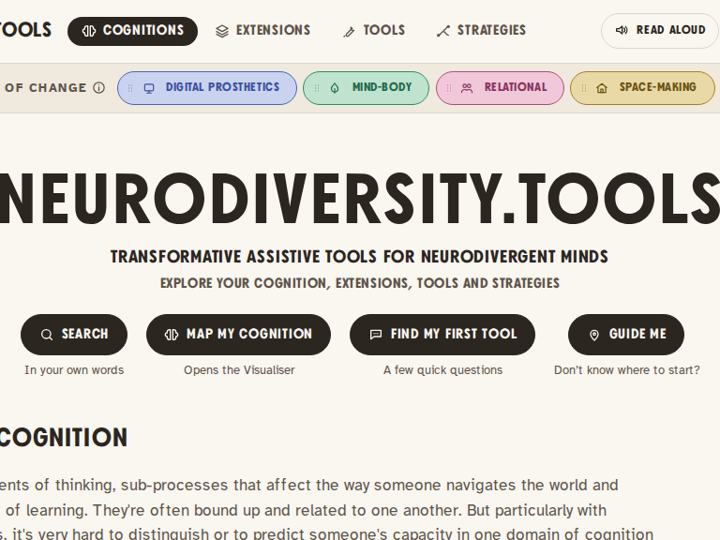
A browsable database of tools, extensions and strategies, organised by the part of thinking they carry, with examples and advice.
4.5Ducklings (The Messy Middle)
4.5.1What has hatched in practice?
What follows is the messy, iterative, practice-led account of what happened when those realisations were formed in the unpredictable reality of working with neurodivergent learners in a real educational setting. The workshops did not unfold as planned. They unfolded as received, and the distance between those two things is where much of the learning took place.
4.5.2Joining Practice: The intentional work required to build trust and respectfully enter a community as an outsider
As I began to prepare for the workshops, designing structure, collecting and testing exercises and developing materials, I realised that I was at the messy, pulsating, practice-based heart of my PhD. There were a few principles that I kept pulling on. I wanted to join and participate fully in the educational community that I was researching with. I sought to centre the participants and create spaces open to their experiences, meeting the exercises as they were received rather than as I designed them. I sought to respond to the immediate, emergent needs of the participants in the room, rather than pursuing a static, platonic archetype of the “perfect” workshop, a fantasy where, after cycles of iterative refinement, one might declare “Eureka” and unveil a universal template that forecloses the necessity for further design. This adaptive, pluriversal orientation was a way to signal that I deeply valued the community’s collective wisdom, time, and lived experiences (Russell & Wilkinson, 2023) and that those needs were constantly evolving and emerging, requiring cycles of design and iteration.
Multiple inroads sought to signal that I valued Youth Inc’s community and my place as a part of it. I spent just over two full days in and around Youth Inc in Adelaide and another online. Saying I was neurodivergent made an enormous difference in the participants’ comfort and awareness of my positionality and speaks to the idea of “nothing about us without us” that we see across neurodiversity literature (Ne’eman & Pellicano, 2022). Dialogue with my participants also made me feel differently. It revealed that being neurodivergent was not a burden on my research or on these participants but rather a tool for connection (Gillespie-Lynch et al., 2021; McGuire & Michalko, 2011). For me this research is informed not just by what I read and speak to people about, but also by what I experience.
One of the ways I tried to signal care to my participants in the workshops was in preparing my explanatory statement and ethics documentation. Rather than just attaching a wall of text to an email to be supposedly scrutinised, comprehended and signed off on by the participants, some of whom were likely to be dyslexic and/or ADHD, I recorded audio and video versions of the explanatory statement so that participants could navigate it in whatever medium suited them. Alex, the teacher coordinating my presence, told me that this gesture increased the sign-up for my workshops because participants potentially saw the invitation as acknowledging other ways of being. Given the impacts of adopting emerging tools, truly informed consent seemed particularly important (Abbas et al., 2024).
In one sense providing accessible documentation was a small, administrative act. It was what Erin Manning (2016) might call a minor gesture: a subtle shift in the conditions of encounter that quietly reconfigures who feels invited to participate and on what terms. It was also an early instance of the scaffolding logic that would run through the workshops themselves. Before asking participants to engage with unfamiliar ideas about their own cognition, the invitation to do so needed to meet them in a form they could actually access.
4.5.4Workshop 1: Neuroformer
Initial exercise selection, underlying framework, and scope
All three workshops were first developed with the SEED framework in mind, with exercises and discussions that engaged in surfacing (S), envisaging (E), experiencing (E) and driving (D) new intentions. I found that many of the exercises I developed with the aim of generating new or renewed intentions were grounded through active experience (Grocott, 2022), so I began using the term actioning to encompass both frames. The first workshop was primarily designed to surface: to draw out participants’ general awareness of what neurodiversity was and to encourage strengths-based discourses around the abstract concept of neurodivergence (Goodley, 1997, 2011, 2014).
I went into this first workshop, a 3 hour in-person session at Youth Inc, with an underlying structure and more exercises prepared than I had spaces in that structure. The surplus meant that the repertoire could be varied in register: some exercises were contemplative, mapping cognition or reflecting on past experience, while others were energetic, involving pairs or whole-group movement. In instruction, some needed detailed explanation, like card sorting with its interlocking steps, while others were intuitive and driven by self-discovery, like the puzzle boxes. The structure also held spaces for play interludes, games like Kitty Wants a Corner or 1, 2, 3, designed to shift register and allow the room to breathe between heavier provocations (Gudiksen & Skovbjerg, 2020). Which exercises filled the structure could only be decided in the room. I knew from past experience as a facilitator to read the room first, to understand what the group was showing up for that day and what excited or unsettled this particular cohort, before determining the final sequence. Light and Akama (2012) describe this as the human touch of participatory practice: methods and tools do not run themselves, and what they become depends on the situated, improvised judgement of the person facilitating. There was a deliberately emergent quality to this design, and it bore out in ways I had not anticipated: the workshop became much more introspective, and at times contentious, than I expected, with moments where real tension and pain were surfaced, where exercises opened experiences of institutional failure and accumulated harm that participants carried with them.
See the creative artefactPlay interludes
Play between the exercises: fast bursts that shift the room's register, and quieter interludes that let it settle.
See the creative artefactJapanese puzzle boxes
Boxes that look alike from the outside and open by different methods: a metaphor for invisible difference.
It was important to communicate to the participants, and to remind myself, that my place here was not to magically make the challenges of education go away, or to render their relationship with their neurodivergence instantaneously harmonious. Nor was it to build a grand unifying theory to improve their psychological wellbeing across every domain of their lives. That goal is too expansive, and one I am not trained for. I am not a mental health care professional, and it was important that I did not purport to be. The presence of play interludes from the very beginning signalled that the exercises would not all be heavy, while also allowing participants to accept that the structured exercises were designed to allow the documenting of a particular belief or the discovery of a particular relationship between cognition and extension, rather than being entirely open.
[THEORETICAL GROUNDING] This emergent approach to facilitation resonates with the argument in Gudiksen and Skovbjerg (2020) and Skovbjerg et al. (2024) that play has been historically placed outside adult learning spheres but is now being revived for its phenomenal characteristics and potential in structured pedagogical settings. The deliberate inclusion of play interludes within a serious facilitation process is a design decision that acknowledges different registers of engagement and allows participants to move between them. It also connects to Dietkus’s (2022) call for trauma-informed design research and practice: when exercises risk surfacing pain, the design of the session itself needs to hold space for that possibility without either forcing or foreclosing it. I felt an obligation to design responsibly for contexts where this pain might emerge. That involved actively signalling that participants could step out of the workshop at any time and for any reason, building in numerous coffee breaks, and cultivating a sense that the room was a permeable space, one you could move through and out of rather than one you were sealed inside.
The Word That Wasn’t There
The workshop opened with an exercise from the systems thinking playbook that I modified to be about learning and education. Twelve words are on a slide. Words like “education,” “classroom,” “study,” and “curriculum.” I then asked participants to close their eyes, and read out a series of words, asking them to raise their hand if they thought the word had appeared on the slide. The one word I named that was not on the slide was “learning.” This exercise was a kind of magic trick that I designed to surface two things: that the mind can generate stories that differ from what we objectively experience; and, more directly, that all the accoutrements of educational systems and structures can exist and learning can still not take place if the individual learner is not considered and their needs are not met.
See the creative artefact12 Words
Twelve words to describe how your thinking works, before any label does it for you.
One participant picked up immediately that there was a semantic relationship between all the words. They were so caught up in the semantic analysis that they found it hard to track what the wider point of the magic trick was. A few others described the words as “rigid” and “tethered to expectations,” highlighting that they already had a negative relationship with the language of educational systems. One participant observed that “divergence defines itself against the normative standard.”
[PRACTICE STORY] I chose these twelve words for a simple reason. I think if you are neurodivergent, or you are just disadvantaged in a normal learning environment, there can be a push for literacy, there can be teaching, there can be lessons, there can be knowledge that someone is trying to show you, and yet no learning can actually happen if people don’t respond to you and the way you think about the world. Teachers, institutions, and sometimes learners themselves can be convinced that learning was there when it was not.
This exercise was also the first moment where my own neurodivergent experience became visible in the room. I told the group directly: “I do this work in part because I am neurodivergent, with ADHD and dyslexia. And so, for me, this is both research for people, and those people are me.” This disclosure was intentional and again speaks to the principle of “nothing about us without us” that runs through neurodiversity research (Bertilsdotter Rosqvist et al., 2023; Ne’eman & Pellicano, 2022). I also said clearly: “This is an experiment that I am really interested in what you guys think about. But it’s not a test.” I attempted to soften the evaluative register of the workshop by framing it as an experiment rather than an assessment, based on advice from other facilitators of neurodivergent spaces that many neurodivergent learners have been primed by past adverse educational experiences to notice and feel judgement. Several participants in the post-workshop group reflection verified this.
The Scenario Matching Exercise
The workshop’s core exercise was a scenario matching exercise. I presented participants with scenario cards depicting situations where someone’s neurodivergence was creating friction in their learning: a student being forgetful, a student struggling to read, a student experiencing sensory overwhelm. Alongside these were extension cards, but not literal tools or software recommendations. These were fabled extensions: a reminder elf that would remember things for you, an idea catcher, a focus magnifier. I scaffolded the idea of an intervention, and acceptance of it, first; the details of implementation could follow. The fundamental purpose of the exercise was to drive people towards acknowledging that a situation is flexible, mutable, and can be responded to, and then to help them consider what that response might be in an abstract or narratively driven way. Every scenario card had at least one or two extension cards that would map onto it, but there was no one-to-one relationship and no overwhelmingly obvious response, although some were easier than others.
See the creative artefactFabled extension cards
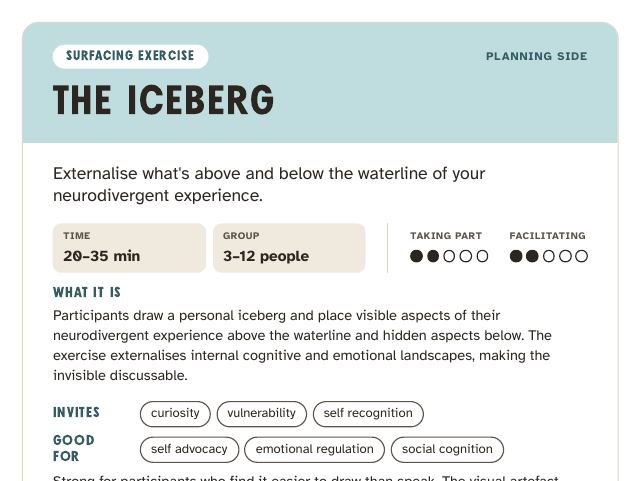
Cards for imagining situations and the extensions that might meet them, used in the scenario matching exercise.
The feeling component used a palette sheet of emotions that I had designed for participants to consult as they reflected on the scenarios. This palette was later revealed to be a sticker sheet, and the feeling stickers reappeared in exercises across the workshop series. Their first appearance here established them as a resource for naming emotional experience in the context of learning. This think-feel-do structure was important: it asked participants to sit with the emotional reality of a situation before moving to intervene (Sanders & Stappers, 2012). Lisa Grocott and I had adapted the say, think, feel, do structure described by Sanders and Stappers into this form across a number of motivation workshops we designed together, and it carried over into the Neuroformer series.
See the creative artefactFeelings stickers
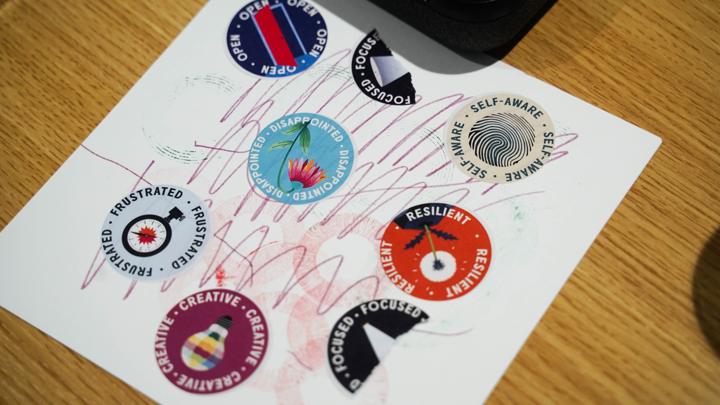
Round stickers, each carrying a feeling word in its design, used in the room and kept afterwards. They are also offered in the margin of this edition.
One participant engaged with the fogginess of this exercise. They described how the non-obvious structure made intuitive sense to them: “The fact that we had the five situations, but then we have like ten extension cards, and yes, out of those ten there’s five that clearly map. And then your kind of like, okay, I have these other five. What am I meant to do with those? It’s clear these don’t map. There’s clearly meant to be some outside of the box thinking here.” They described pairing a card with an image because they could “just imagine this image, that little blimp flying around inside.” It seemed that for this participant, the mismatches were not confusing, they explained: “not being logical and direct made sense to me, as we just had different experiences.”
[PRACTICE STORY] I was delighted when this participant described the cards as visually rich, as being able to imagine what the illustrations might do in movement. It told me that the fidelity and care I had put into producing these materials was communicating something beyond the content of the exercise. The cards were just clear enough to understand in more ways than just words. There was a multi-modality to them. This connected to something I was beginning to understand about the role of material care in this work: that the effort invested in the design of the physical materials was in fact relational, signalling to participants that their engagement was valued and that the exercises were worthy of their attention.
The Split Response
This first workshop involved physical materials, and the form of those materials, as much as their content, surfaced tensions that ran across the workshop series. The scenario matching exercise had three layers. First, participants identified a scenario. Then they matched a feeling sticker to it, naming the emotional register of the situation before reaching for a solution. Only then did they match a fabled extension to the scenario.
One participant had a visceral and negative response. They described the exercise as too constrained, obvious, and infantilising. Their reaction was grounded in years of clinical experience: “I am someone who has been in and out of counselling and therapy pretty much all my life, and it felt like, it feels like we just had an interpersonal therapy session.” They then connected the activity to the specific practice of being shown scenario cards depicting emotional states and being asked to identify and resolve them: “This person feels sad. Why do they feel sad? How can we make them feel better?” For this participant, the exercise triggered a frame of reference they had spent years trying to move beyond. Another participant resonated: “It felt very close to play therapy.” The participant who had the strongest negative reaction elaborated: “As someone who’s always been in counselling, it just felt like being a child again and having to be told I don’t understand things. Here’s cards helping you figure out how to understand things that you’re not understanding.”
Their history of being given emotion-recognition exercises in clinical settings, of being “sat down to do these things and learn how to read emotions, how to understand people, because I was always getting in trouble for not being able to read people,” meant that the scenario matching exercise, regardless of its actual intent, was received through a lens of clinical management.
A third participant described it as “reminding me of primary school, but not in a bad way,” noting that they could see how it could feel infantilising for others while they personally found it fun and restorative. And responding to the same exercise, another participant offered an entirely different reading:
“Doing the 1-2-3 thing,” an earlier exercise designed to help participants become comfortable with failure and with extending beyond their comfort zone, “and also the memory, twelve words, immediately gave me the vibe that it’s an unlearning thing. That we’re meant to be looking at things through a slightly different frame of reference.”
This split was revelatory. The same exercise, operating on the same group in the same room, was being received simultaneously as patronising clinical assessment and as a beautiful unlearning provocation. Neither reading was wrong. The participant who found it infantilising was drawing on a long and painful history of being clinically managed; the one who found it generative came from a place where they could suspend that frame and engage playfully. What the split revealed to me was that participants were at radically different points in their relationship to their own neurodivergence, and that a single exercise could not assume a uniform nor universal starting point.
[PRACTICE STORY] This threw me into the deep end as a facilitator. I had to navigate this interaction into a moment of productive tension, to help people see the duality and the spectrum of responses in the room rather than collapsing into one reading. To begin with, it was hard for me to process the critique because I was worried that I had seriously mis-targeted the tone of the workshop, that it was all too childish and paternalistic. It took me a few days of reflecting on it to really feel confident that there was always going to be this wide spread of responses, and that the spread itself was informative rather than damaging. When I had play-tested this exercise with younger neurodivergent participants and with older neurodivergent play researchers, the accusation of infantilisation and paternalism had not come up. As an educator I am familiar with mixed receptions; I have seen the same exercise light up one student and leave another cold. What surprised me was the forcefulness and spread of response inside a small group and aimed at a perceived register of clinical management over care rather than at the content. Some younger participants were still open to being presented with an experience and running with it, without engaging in the critique of power structures. Adults, particularly those who had experienced playful interventions and creative exercises before, could bring a sense of security to the experience. This cohort of young adults was in between: still moving into their sense of selves and perhaps more temperamental in their response and less able to stand on their own position than those at either end of the age spectrum. The exercise had inadvertently revealed a developmental sensitivity between adolescence and adulthood that I had not designed for.
[IMPACT SIGHTLINE] This split response directly informed the design of subsequent workshops. The critical thing I took away was that perhaps I hadn’t offered enough theoretical context, and these students seemed hungry for it. They seemed eager to engage with theoretical ideas and eager to move beyond abstraction into practical ways to improve their learning experiences. After Workshop 1, there was a clear request for more context. A few participants said that while the exercises were explained well, they did not know exactly why they were doing them, and this led to a sense of being disconcerted rather than having an open and reciprocal space to explore. One participant put it plainly: “I already know what answers you’re looking for. It doesn’t mean anything. Because I knew it was a workshop.” Another suggested that perhaps some participants would only need Workshops 2 and 3, because Workshop 1 covered ground they had already traversed in their own lives. This feedback reshaped how Workshop 2 introduced theoretical underpinnings directly to participants, and also began to suggest that a fixed, linear workshop structure might need to give way to something more like a playbook.
Stepping back from the specifics of the exercise, one participant observed something about the shape of the workshop that has stayed with me. They noted that the workshop “essentially works really well, but because we’re also used to just having things brute forced at us, someone presents one of the other two options,” referring to the three paths framework of brute force, sidestep and leapfrog explained in chapter two, “and we don’t even recognise it. We just go into it assuming it’s more brute force.” In other words, the very conditioning that the workshop sought to unsettle was also shaping how the workshop itself was received. The participants’ prior experience of education had trained them to expect a particular register, and when something arrived in a different register, some read it through the only frame they had been given.
The Feelings Palette
Within the scenario matching exercise, the feelings palette surfaced a rich conversation about the interpretive frames that participants were bringing into the room. Several participants noticed a personal bias towards seeking out negative emotions, partly because the exercise began with a moment of discomfort. One participant observed: “I noticed that I subconsciously weigh ‘sensitive’ as a neutral, a good thing. And I just realised most people probably wouldn’t weigh that as a good thing.”
Another offered a striking reframe of “overwhelmed”: “Overwhelmed isn’t always negative. The first time I saw snow, I was so overwhelmed I had to just sit down. But it wasn’t an uncomfortable overwhelmed. It was, oh my god, this is gorgeous, I need to sit down and take this in. I’ve been positively overwhelmed a lot as well.”
The group noted that the colour and design of the stickers themselves shaped interpretation: “overwhelmed” rendered in red and black invoked a negative reading regardless of the participant’s own relationship to the word. Participants suggested that “joy” should be included, that “energised” would work better than “hyperactive,” and that “righteousness” or “misunderstood” were common neurodivergent experiences worth naming. One participant described the concept of distraction as “a leaf floating and footsteps leading off to the side, or a half-drawn design.” Some participants tore up the feeling stickers to communicate a disjuncture between parts of emotions and their experience, reassembling fragments to better represent what they actually felt. I had also included blank stickers so that people could draw their own emotions if the existing palette did not hold what they needed.
This moment revealed something important about the design of the materials themselves. The visual language of the stickers pre-emptively shaped the emotional register of the exercise. Norman (2004) argues that objects evoke emotional responses through their aesthetic qualities before any cognitive evaluation takes place. Tong and Diatta (2018) extend this consideration of the affect to centre emotion as a material to be designed with and for. Dernikos and colleagues (2020) make the case that affect is not incidental to learning but constitutive of it. The way something feels shapes what it becomes possible to learn. What participants were telling me was that the affordances of the sticker design either opened or closed certain readings before anyone had even begun the exercise. The initial set was based on the feelings I noticed when engaging with my own cognition, along with those suggested by neurodivergent colleagues while prototyping. The visual vocabulary of rounded forms and relatively vibrant pastels was selected to be as engaging and varied as possible while still feeling cohesive. The goal was for the objects to be memorable. The participants’ suggestions were used to collaboratively redesign the materials and also show, through discussion, the plurality of emotions that can come from similar experiences and how those emotions can coexist amongst us. The frame we enter with, as one participant put it, determines what we find.
These comments directly informed the updated version of the feelings palette used in subsequent workshops: it engaged more deeply with colour theory and offered a broader spread of emotions, positive, negative and neutral, to map the register learners bring to reflecting on their own learning. The act of tearing stickers apart, of drawing new ones, of refusing the given palette, these were themselves acts of design, and they taught me that the materials needed to be as flexible and as varied as the minds they were designed to serve.
Before and After
Near the end of the workshop, I invited participants into a spoken reflection on how they felt before and after the session by asking them to describe their ‘emotional weather’. Before, one participant suggested; “drowsy fog and uncertainty”, after, “still clouds in the sky but the fog has mostly cleared. Dewy.” One participant offered the word “petrichor,” which is the smell of the air, concrete and earth after rain. This language was striking because it was sensory, atmospheric, tentative, and hopeful. Their descriptions of changing weather systems evidenced the shift that had taken place through the workshops.
[PRACTICE STORY] It was not an accident that students used sensory language to describe their emotions. I introduced the What’s the weather exercise by telling the group about how I reflect with my twin, Laurel. Both of us are neurodivergent. We have joked for years that Laurel can’t read very well and I can’t write or spell very well, but together we function much better. One of the things we have been doing for a number of years is to ask one another, rather than how we are or how we feel, what the weather is. We don’t mean the weather outside. We mean the weather in our own minds, the emotional weather. Is it dry, wet, blustery, ominous? I offered this to the group as a way in, and the language they returned was richer and more textured than anything a single-word feeling descriptor could have captured. The atmosphere of the weather seems to allow us to engage more deeply with the subtlety of emotion, and might help us sidestep any pre-existing difficulties we have sharing our feelings. I am also not sure this level of introspection, this sense of a collective breathing out, would have happened in the same way if I had asked participants to fill in a survey or to give their quantitative judgements out of ten. The spoken, relational quality of the reflection mattered. It was itself an exercise in the kind of atmospheric attunement the workshop had been building towards.
[THEORETICAL GROUNDING] The atmospheric quality of this language connects to Sumartojo and colleagues’ (2020) work on designed atmospheres and the ways in which environments are felt before they are cognitively apprehended. The shift from “fog” to “petrichor” is not a measurable outcome in any conventional sense, and yet it speaks to a felt change in the conditions under which learning and self-reflection might become possible. It also resonates again with Nora Bateson’s (2016) warm data: relational, contextual, and resistant to being reduced to a single variable.
The Understory: What Was Not Immediately Visible
What I could observe in the room was only part of the story. After the workshop, the teacher coordinating my presence shared observations that reframed what I thought had happened. The teacher told me that one participant had been smiling during the session and actively engaging with others for the first time at the school, as far as they could tell. Another was actively participating in discussion rather than prioritising other activities like coding, again perhaps for the first time. A third participant, who had told both me and the teacher that they had initially not wanted to take part, arrived late and said they would rather just observe but ended up engaging actively and joyously.
One participant in particular unsettled my assumptions. Throughout the workshop, they kept using their laptop rather than engaging in the exercises. They occasionally looked up and joined parts of the discussion, picked up one of the decks of cards I had produced or explored the feeling stickers for a few minutes before returning to their screen. I worried that I hadn’t fully engaged them and that for this participant the workshop hadn’t been especially meaningful. That concern faded when I heard feedback from the teacher after the workshop ended. They told me that this participant had been at the school for more than eight months and that this was, in this teacher’s experience, the most they had engaged in a learning activity and also the most they had smiled at anybody at any point over that time. My expectation of what real change and transformation looked like was entirely at odds with the way it manifested in the mind and outward temperament of this participant.
The teacher also noted that the high quality of the physical materials, despite being early prototypes, communicated dignity, respect and value for participants from backgrounds where they were generally distrusting of formal organisations and guest facilitators (Diatta, 2015). The teacher and I both observed that this care increased a sense of psychological safety and of being seen, heard and validated.
[PRACTICE STORY] I had been focused on the vocal responses, the critiques, the tensions, while underneath the conversation shifts were taking place that I could not have detected through observation alone. What I read as the laptop participant’s disengagement was, by the measure of someone who knew them far better than I did, their most sustained engagement in months. Because the cognition of neurodivergent learners is so varied, and when you bring even a few neurodivergent learners together you experience the range of that variance, it can be easy to mistake engagement of a different kind for indifference. Even asking participants directly or encouraging them to self-report might not yield the clarity you are seeking. Rather, someone who has a deeper understanding of the context and the way excitement or interest manifests can offer clarity. It is also true that some people are already more open than others, and that some people might make a really significant change that still does not put them in an idealised position after the workshop, whereas there are others who are already primed and pre-resourced to get more out of it.
A Participant Interview Following the First Workshop
Following the first workshop, I conducted a semi-structured interview with one of the participants. Interviews were offered to everyone as part of the consent design rather than selected by me. This participant volunteered, and their willingness, given how much the session had visibly surfaced for them, was itself significant. This conversation deepened and complicated much of what had surfaced in the group session, and it remains one of the most moving and meaningful exchanges of the entire research. The participant described their relationship to learning with an intensity that reframed the entire premise of the workshop: “I adore learning. It used to be my escape at school. The passion of knowing that I would learn more was enough to get me through the bullying and everything. I put hope into being able to learn and experience over everything else that was happening in my life.”
Yet, as they reported, the educational institutions they had moved through had systematically misread this love of learning. They described a moment that I think is possibly the clearest illustration of the gap between capacity and normative measurement, and is the entire argument of my PhD in miniature:
“I had the lowest reading level in my year level for years, and then I got caught in the library reading a really advanced book and they were like, what the fuck? And I was like, I can’t borrow these and they don’t count towards the quizzes. And then the SSO [School Services Officer] worker was like, we can finagle that. And then I got the best reading level in the class. It’s just because it wasn’t the way that they wanted it or in the sequence that they wanted it.”
What I read from this episode is that the capacity was always there. The system simply could not see it until it was expressed in the form the system recognised.
Punished Strategies
This participant that I interviewed had also developed their own cognitive strategies long before any formal support was offered. They described mark-making, doodling and drawing as a habitual practice that helped them sequence information, maintain interest, and feel like they were contributing even when they could not process everything coming at them: “It gives me a habitual thing that I can fall back on, that I can transmute into whatever I’m doing, which then creates some semblance of comfort and gives me a foundation to build off of, even in uncertain circumstances.”
See the creative artefactMark-Making Cognition
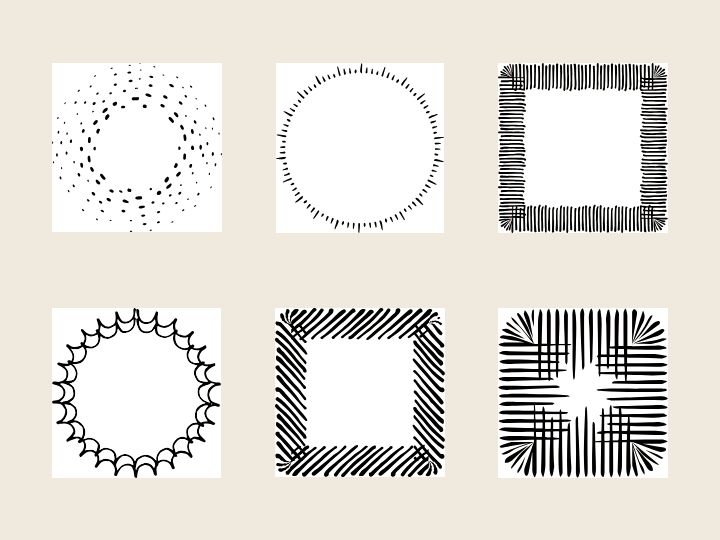
The stamp-based cognition mapping exercise: custom stamps, ink pads and a canvas, with the feelings stickers over the top.
This practice had been punished in school. They told me they were reprimanded for “destroying” textbooks, for drawing during class, for carrying an art book. I understand these as self-developed cognitive strategies being punished rather than supported. The participant was undiagnosed until their twenties, and the absence of clarity around their cognition, in the form of a diagnosis, had led to a broken self-conception: “I was undiagnosed until I was 20, 21-ish. I’ve been my entire life just thinking that I was broken and like I was just drowning in everything that I was going through.”
[THEORETICAL GROUNDING] The participant’s self-developed practice of doodling and mark-making as a cognitive strategy resonates with Jackie Andrade’s (2010) research on what doodling does for attention and information retention, and more broadly with the argument that neurodivergent learners often develop effective learning strategies independently, only to have them punished or pathologised by normative educational environments (Geyer, 2021; Syharat et al., 2023). What was characterised as distraction or destruction by the school system was in fact a sophisticated self-regulatory mechanism.
From Shame to Understanding
When I asked in the interview whether it was possible to believe in yourself without a diagnosis, the response was unequivocal:
“I tried for so long but I would just reach a point where, why can’t I function? Why aren’t I the same? I always thought it was a mix between being my fault because I couldn’t overcome what had happened to me, or that it was the fault of the people around me. And now I know that it’s a mix, but it’s predominantly the fact that I have lived a, thankfully, not standard life on top of not seeing or experiencing the world in the same way as other people.”
The narrative here moves from self-blame to release. The diagnosis, when it finally arrived, freed them to understand who they were: “It has helped me to not be so mean to myself, to try to let go of a lot of the shame. It has helped me to grow as a person because now I can look at the fact that I do need support, I do need help.”
They framed the difference with striking clarity: “Do you want your child to live out their life with the thought, ‘I’m struggling because I have this condition that means I need extra help,’ or do you want them to go, ‘I’m terrible, I’m so bad at life, I can’t function, I’m a failing human’? That is the difference.”
Accessibility as a Standpoint
This interview also surfaced perspectives on assistive technology that connected directly to the research. The participant described the Temi robot, which allowed them to hold spatial presence in the classroom while attending remotely, as a transformative tool: “I hold space in a room and I can move. People acknowledge it. They’re like, oh yeah, that thing is a thing.” They described subtitles, transcripts, recordings, and multiple modalities of access as essential: “It’s such a capacity to give you multi-levels of learning, whereas in school a lot of times it’s a projector screen and a person talking while there’s a ton of other people talking in a room with shitty lights.”
See the creative artefactWind-up robot figures
Small wind-up robots given out in the third workshop as physical commitment devices, and taken home.
And they articulated something that could stand as a design principle for the entire research: “Accessibility shouldn’t be built in when it’s needed. It should be there as a standpoint so that people aren’t excluded from the get-go.”
[PRACTICE STORY] This interview confronted me with the depth of what participants were carrying into the room. These workshops were operating on people whose relationship to learning had been shaped by years of institutional failure, misdiagnosis or non-diagnosis, punished self-advocacy, and the compounding effects of intersecting marginalisation (Dietkus, 2022). The participant’s self-developed strategy of mark-making, independently arrived at and then punished by the very system that in my view should have supported it, is a precise example of what happens when normative educational environments cannot recognise capacity that presents in non-standard forms. That this participant could still say “I adore learning” after everything they had been through is not a testament to resilience in the individualised, bootstrapping sense. I see it as evidence that the desire to learn persists even when institutional signals tell you that the way you learn is wrong.
The Contentious Exchange: Collective Sense-Making in Action
We had a group reflection following the first workshop, in which a participant made a provocative claim: “Society is currently incapable of producing an autistic person who isn’t traumatised, and that’s just a huge problem.” They elaborated: “If we somehow stopped doing that, probably everyone would have a much better view of themselves, including neurotypical people, oddly enough.”
Other participants met this with immediate and genuine disagreement. In what unfolded I could notice at least three distinct perspectives emerging in real time. The first was an absolute, universal claim: that society is incapable of producing an untraumatised autistic person. The second was a counter-example: another participant responded that they had met autistic people who had grown up fine, functioned well, and did not carry trauma. The third was a complication: a participant observed that events most neurotypicals would not consider traumatising can be genuinely traumatising for neurodivergent people, but the neurodivergent person experiencing them may not recognise them as trauma because they have been told “it should not be a problem, you should feel fine about this, this is normal.”
What happened next seemed to me remarkable. The participant who had made the original claim paused, took in the responses, and publicly amended their position: “If you don’t identify as traumatised and you are autistic, that is totally valid, and I apologise for insinuating otherwise.” They then extended the provocation further: “I would probably honestly extend my statement to say that it is impossible for our society to produce any person who is entirely untraumatised, which is its whole other thing.”
The initial statement was collectively considered, challenged, and then retracted and amended to incorporate a more capacious view of what it was possible to feel about oneself while being neurodivergent. The blunt assertion of something being universally true was sharpened into one that described more deeply what was true for the person who said it. This was not a facilitated therapeutic resolution. Nobody mediated. Nobody corrected. The participants held space for a genuine disagreement, and they arrived at a more nuanced position together.
This exchange demonstrated the need for pluriversal approaches and framings rather than universal ones (Escobar, 2017) which I talked about in Chapter 2. Declarative, empirical statements about the neurodivergent experience, much like claims of universal design as an absolute statement of accessibility, can flatten the very variance they seek to advocate for. What this room showed me was that three people with significantly overlapping experiences of neurodivergence could hold three genuinely incompatible readings of the same phenomenon, and that the incompatibility itself was the data, not an obstacle to be resolved.
This exchange became, for me, a foundational example of what I would come to call togethering: the process by which collective, participatory reflection among neurodivergent learners can gently unsettle fixed narratives about the neurodivergent experience. By dis-intermediating educational systems or curricula, creating direct, horizontal learning encounters that bypass hierarchical structures, and encouraging collaborative, participatory reflection, the participants and I could begin to disassemble the deterministic impulse that comes from reflecting on our experiences only as individuals. Making visible the non-homogeneity of neurodivergent experience might allow us to understand and respond to the depth and variety of it. Actively valuing and interrogating together how varied their experiences and perceptions were gently upset settled notions of how other people respond to the world, and by consequence the definitions and rules that arise from those responses.
[IMPACT SIGHTLINE] This moment also carried a methodological implication. As a researcher trying to analyse and reflect on what took place in these workshops, I might miss or flatten the complexity of the sense-making taking place in the minds of participants. The difference, when compared to other quantitative or positivist research orientations, is in the stated goal: to notice the complexity of what actually took place and attune to it, rather than dismissing the non-homogeneity as outlying, non-statistically-significant data points, or attempting to justify, adjust for, or simply ignore a version of events that cannot be cleanly modelled beyond an individual scale. I believe this form of ethnographic reflection is particularly powerful at serving the actual theory of change that will benefit neurodivergent learners: personalised, responsive shifts in individual experience.
4.5.5Workshop 2: Neuroformer - Return of the Neurowiggly
Responding to the Room
The first workshop had surfaced a clear request: participants wanted to know not just what they were doing, but why. This second workshop leaned further on introducing participants directly to theory, and specifically to the nature of their own mind and how it is possible to have digitally mediated cognitive extensions (Clark & Chalmers, 1998; Drayson, 2010; Dror & Harnad, 2008). By offering some of the theoretical underpinnings and intentions behind the workshops directly to the participants as part of the workshop itself, my intention was to gesture towards the greater context of the exercises, so that participants could examine each one’s didactic intent.
Each workshop engaged all four moves of what I have come to call the SEAT framework, surfacing, envisaging, actioning, and togethering, a modified version of Grocott’s (2022) SEED framework developed specifically for the context of neurodivergent learning, and I described this structure to participants in plain terms. There was a deliberate bias towards experimenting with different components across the different workshops. Where the first workshop leaned most heavily on surfacing, this second workshop leaned towards envisaging: what might it look like to think of your mind as something that extends beyond your skull?
This workshop was conducted online, and there seemed to be an increased willingness to be introspective. Participants volunteered first-person reflections earlier and with less prompting than in the first workshop, and pauses were held rather than filled. This may have been due to a few things. Each participant was comfortable in their own space and could disengage on their own terms simply by muting their microphone or turning off their camera. The participant group was smaller, and all had attended the first workshop. The exercises used the impermanence of a digital space: shapes and marks could be configured and reconfigured infinitely (Bratteteig & Wagner, 2012; Mörtberg et al., 2010). The malleability of a digital canvas invites speculation in a way the permanence of physical mark-making does not always allow; you can try something, discard it, and try again without waste or evidence of failure. The connection to introspection is direct: when every mark can be unmade, looking inward costs less, because whatever surfaces can be revised before it hardens into a statement about the self.
Opening with Context: My Own Story
Before sharing the theoretical underpinnings and intentions of the workshop, and rather than opening with an exercise, I began this second workshop with context. I shared my own history with assistive technology, academic struggle and neurodiversity. I told the group that among other things I am dyslexic, and that there was always a large gap between the kind of writing I could do and the kind of thinking I was doing. In other words, I told them it is possible to be literary before you are literate. I described being the first student in the UK to be permitted to use dictation software for my GCSEs, and of having a laptop so heavy that it caused me back pain, along with the fact that there was a single plug in the back of a room so I was always at the back of the class. I told them, to illustrate the rate of change in technology, that I had finally removed the dictation software I first used from my database of recommended tools because emerging ones had far surpassed it. The tools had moved on, but the need to find them, test them, and build relationships with them remained.
[PRACTICE STORY] I shared this story to demonstrate three things. First, that I had been able to engage with assistive technology in embodied, material ways for as long as the possibility had been open. Second, that the space to do that work had not existed for most of my education. When I first used the dictation software Dragon, it had been expensive, clunky, physically burdensome, and onerous. Third, that this landscape of tools had changed so rapidly that awareness and selection of tools had little utility compared with developing a sensibility and capacity to evaluate and adopt new tools. For me, the Dragon story is not just useful as a personal anecdote to demonstrate the history of technology. It is evidence of structural, ongoing problems without fixed solutions.
A participant responded with a story about educators in specialised settings who, when a child was functioning well with a particular support, meaning meeting the classroom’s expectations while the support was in place, would remove it so the child could “learn how to be normal functional.” I offered a response: it is a little bit like asking someone who wears a prosthetic every day to practise hopping. The logic assumes the aid is a crutch when it is in fact a capacity. I found that this exchange set the tone for the workshop: personal, grounded, and willing to name what was broken.
Ka Mua, Ka Muri: Walking Backwards into the Future
At the transition of the workshop from surfacing to envisaging, I introduced a whakatauki shared with me by my supervisor Lisa Grocott, who often brings Māori knowledge into contact with discourses around transformation, design, and relationality. I chose that moment because envisaging asks participants to face a future, and ka mua, ka muri offers an expansive framing for doing so.
Ka mua, ka muri, walking backwards into the future, inverts the typical Western orientation towards what comes next. You turn around and face the past: the further back you look, the foggier your memory becomes, but the present might be immediate and clear. The future is behind you, emerging and undetermined. I offered this to the group as a way of thinking about neurodivergence: it allows acknowledgement of the past without being trapped by it and positions the future as something you can influence but cannot see. The reorientation did observable work in the room: throughout the rest of the session, participants spoke differently about their futures and were able to posit possibilities. In that uncertainty, experimentation was allowed to blossom. Offering the future as something emerging behind you, rather than a wall to be faced, lowered the demand of the exercises that followed. Participants could begin from grounding in evidence instead of prophecy.
[THEORETICAL GROUNDING] Integrating indigenous knowledge into a design research context carries responsibilities. Western engagement with indigenous thought has historically overemphasised content at the expense of the processes of knowledge transmission and creation, as Tyson Yunkaporta (2019) argues. My use of Ka mua, ka muri is an attempt to engage with the process: to bring a relational and non-linear orientation to time into contact with the workshops, not to extract or instrumentalise a cultural concept but to allow it to reframe what is possible. Linda Tuhiwai Smith (2021) reminds us that research involving indigenous knowledge must be conducted with care, reciprocity, and an awareness of the colonial histories that have shaped academic inquiry. Humphries (2022) asks what the mauri, the life force, of a system is, and whether a colonial system can naturally produce indigenous outcomes. I do not claim that it can. I think that allowing indigenous orientations of time and knowledge to sit in contrast to Western pedagogical frames, without subordinating to the latter, is a necessary step towards the pluriversal approach this work aspires to. More capacious knowledge systems exemplify other ways of knowing that many neurodivergent learners seem so hungry for. Both Escobar (2017) and Yunkaporta (2019) model this holding-in-contrast, indigenous and Western knowledge thinking alongside one another.
From the Platonic Learner to the Neurowiggly Shape
After the whakatauki, I presented a sequence of learning theory diagrams directly to participants, drawing on the theories laid out in Chapter 2. The sequence of diagrams explained first a traditional model of learning, where a teacher delivers content and a neurotypical learner absorbs it, through progressive and connectivist models, to a posthumanist connectivist frame in which responsive technology mediates between human cognition and the world (Siemens, 2005). The conceptual move represented in the diagrams was from the platonic ideal of the learner, equally capable in all domains, to the neurowiggly shape: the jagged, asymmetric, spiky form that neurodivergent cognition actually takes.
See the creative artefactMapping Neurowiggly Cognition
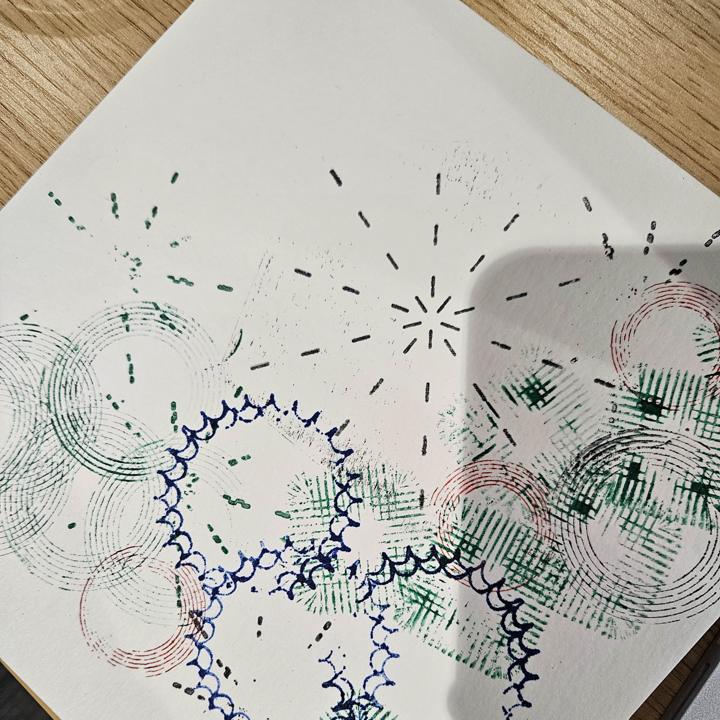
Drawing the shape of a cognition, then the extensions, tools and strategies that reach from it; a variant of the stamps and the Visualiser.
The exercise in the PlaybookVisualising Your Wiggly Cognition
I shared the results of my own educational psychology assessment from 2015, as an illustration of what I was trying to represent through the diagrams. The scores were so varied that the system could not derive a standard IQ. It simply said: “IQ cannot be derived.” I showed the group how those scores produced a shape and told them: “I don’t think those numbers matter nearly as much as that shape.”
[PRACTICE STORY] I found it quite vulnerable to share my Ed Psych report the first time I did it. Vulnerability comes from clarity about my weaknesses. It is very easy, when introducing it, to just focus on the strengths, on what you are good at, but that necessarily contrasts with what Alex, the teacher, observed: that assessments tend to say less about strengths. In a way, I am quite proud of the idea that my IQ cannot be derived. That my mind breaks a system I don’t believe in just by existing. It cannot be constrained into a particular box. I think communicating how I struggle and how I am strong may well be useful because it reveals more of who I am than just naming my diagnosis. This is the same move as the Dragon dictation story that opened the workshop: sharing my own history so it can do pedagogical work.
Participants immediately tested this against their own experience. One described being told they were “dumb” despite having “incredible intellectual capacity” in some areas. Another had been given multiple hearing tests as a child because they were quiet, not because they couldn’t hear. A third described how their occupational assessment barely registered them as disabled because “on paper I seem fine,” but real-world application told a different story. It was nice to see other participants share moments where they jarred or disrupted systems trying to categorise them.
Standardised measurements that average a neurowiggly profile into a handful of flat numbers (or in the case of IQ a single number), misrepresents and flattens the scope, scale, depth and breadth of neurodivergent cognition. This flattening has insidious consequences, once you have optimised for a diminished environment, once a limiting belief has been locked in and reinforced, unpicking it is extraordinarily difficult. This phenomenon, described by Robert Kegan and Lisa Laskow Lahey (2009) as immunity to change, explains how people resist transformation not because they lack motivation but because tacit assumptions produce competing commitments that maintain the status quo. For neurodivergent learners who have spent years internalising a deficit narrative, these competing commitments can be deeply entrenched, a structure visible in the first workshop’s interview: strategies punished in one environment, commitments formed to survive it, both outliving the environment itself. Sharing the neurowiggly shape was an attempt to interrupt this immunity by providing a visual language for something participants had felt but perhaps had not been able to articulate. Visual metaphors and externalisations provide different ways into understanding that verbal or written articulation alone cannot access (Lockton et al., 2019). The shape enabled the texture of my cognition to become legible to me, and in doing so, invited others to consider the form of their own cognition.
Assembling and Extending Cognition
The central exercise of this second workshop asked participants to build a visual representation of their own cognition using semi-transparent shapes on a Miro board, and then to extend it with a second set of shapes representing the instruments of change they wished they had: the tools, strategies, supports, and spaces that would let the cognition they had just mapped flourish.
See the creative artefactMiro digital twins
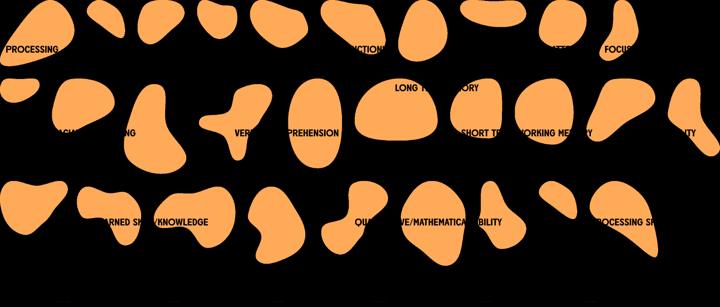
Digital twins of the workshops, used alongside the physical cards to make a hybrid space.
The exercise was preceded by a brief mindfulness exercise in which I asked participants to notice a point of friction in their immediate environment: a dead leg, wool on skin, the smell of cold coffee, a fridge buzzing through the wall. This was an instrument of change in action: a mind-body strategy, a strategy for self, practised before the mapping began.
The cognition shapes participants built were remarkably varied, and each revealed something different about how people engage with the idea of their own mind. One looked like a dog, which the participant told us they built without intention but recognised with delight afterwards, showing how playfulness can emerge even in an exercise designed for introspection. Another was described by peers as both an explosion and a flower, suggesting that people often engaged with one another’s cognitions differently to how the maker themselves understood it. One participant placed executive functioning at the centre, the spikiest shape, because they said it took the most effort to maintain. A further participant described their cognition as a web of strings and loops rather than blobs: “I string things together in my mind to make a bigger picture.” Another spontaneously shared a hand-drawn map they had previously created, featuring locations like “Seeker’s Plight,” “Get Me Not Forest,” and “Bloom Island,” a landscape of past trauma and future hope.
One participant placed learned skills at the centre and explained: “I sat there for a good minute being like, I don’t know who I am. So I kind of just went, who am I trying to be? Everything is just a learned skill.” This is a statement shows some degree of introspection. What it surfaced to me was an awareness that masking was occurring: a pressure to and practice of diminishing the self, to adapt or conform to the world without an intermediary layer taking up the slack. For this participant, it seemed, the shape they built represented who they had learned to perform rather than who they were.
When I introduced the extending exercise, one participant said they had anticipated it: “I did hope this was coming, because I literally built parts of my structure with the intention of, I can also map out the way I would add things to this.” The workshop’s design logic had become legible. The participant could see the scaffold, and seeing it was part of what made it work. The exercise asked for honest self-mapping, and with a legible scaffold that lowers the suspicion that something is being done to you, the design itself becomes material a participant can work with, and even ahead of. Chapter 2 traced why visible decisions (Bratteteig & Wagner, 2012) and a disclosed configuration of participation (Vines et al., 2013) matter in co-design; here the principle stopped being procedural and became felt. For a cohort whose educational histories often involved having rationales withheld, an open pedagogy that shows its working seemed a precondition for introspection.
This workshop enacted the SEAT framework with greater visibility to participants than the first. I also interleaved this activity with physical metaphors and experiential exercises, including a wrist-turning exercise that asked participants to turn their palm from up to down without twisting their wrist to show that seemingly impossible movements are within reach with a change of insight and strategy (it’s not just or even primarily about bodily awareness). These were designed to help them attune to their position, to their body in space, rather than living entirely inside the shared digital environment.
The Tool Line: Who Draws It, and Where
I brought the tool line, the provocation about the nature of extended cognition discussed in Chapter 2, directly into the workshop.
I prompted the students: We accept clothes, pens, laptops, and glasses as extensions of self. So where do we draw the line? And why do we draw it where we do? One participant responded through the Zoom chat:
“As a creative writer I have never used Grammarly, I turn off spell checker wherever I can, because I love to use odd grammar, deliberate misspellings, weird page formatting as a thematic part of my writing, to produce a specific effect, which Grammarly would erase. What would be useful is a tool that can adapt to my style more effectively to ignore things I’m doing on purpose and catch my actual mistakes instead.”
To me, this comment pointed towards a distinction between tools that flatten towards a median and tools that extend what is already there. The participant was not rejecting assistive technology; they were requesting assistive technology that actually assists and extends. The same participant challenged the logic of aid dependency: “The whole idea of an aid is to make things easier and accessible. There’s no over-using an aid. That is not a thing.” It is not possible to overuse a part of self that helps you meet your needs. The comment arrived in the chat while I was speaking, and I almost missed it. The online format had created a parallel channel of conversation, and some of the sharpest contributions emerged there. I saw the Zoom chat as itself an example of cognitive extension. A participant who might have needed to wait for a gap in spoken conversation could compose their thoughts fully and offer it without social friction. That the tool line provocation generated its sharpest response through a digitally extended mode of participation was not lost on me.
4.5.6Workshop 3: Neuroformer Three - The Final Extension
The final workshop returned in person and moved the discourse outward with 14 participants, all of whom had attended at least one earlier workshop. Where Workshop 1 had leaned on surfacing and Workshop 2 on envisaging, this workshop focused more on actioning: grounding the conversation in the real-world constraints and hardships documented across disability studies (Goodley, 2001, 2014; Siebers, 2008), the lived negotiation of assistive technology (Ravneberg & Söderström, 2017), and the untapped potential of the neurodivergent experience (S. A. Brown, 2023; Beckett & Callus, 2023). Through collective mapping exercises, participants were invited to lay out the boundaries of their personal cognitive mobility, as well as how it fit into the mobility of the neurotypical community more broadly.
By exploring cognitive extension in the context of the world, the exercises aimed at grounding the discourse of disability in societal disabling rather than individual incapacity. The sense of the world being something participants could engage with and as part of, but were not responsible for, sought to soften the self-critique that can otherwise take hold when exploring new ways of learning (Chappell et al., 2001; Biesta, 2021). By leaning further on a world-centred frame, this workshop encouraged me to think of participants as primarily human beings and as recipients of education afterwards (Apple et al., 2022; Biesta, 2007a, 2007b).
[IMPACT SIGHTLINE] Actioning, in the context of the SEAT framework, is not about deploying a single intervention. It is about orienting participants towards the possibility that transformation is not confined to the workshop but extends into the whole of their lives. The world-centred frame matters because it resists the implication that learning, introspection, and cognitive extension are experiences bound to this learning environment or to institutional or educational contexts only (Biesta, 2020, 2021). If we accept that neurodivergent learners navigate the world as whole people, not as students in a classroom, then the instruments of change they adopt must be responsive to that whole life, and the shift from bounded learning to living must be made visible and actionable.
The Clasping Trick
One of the workshop exercises detailed in the playbook involved a magic trick from my performance repertoire. I asked participants to clasp their hands together, and then I unclasped them in a way that they were unable to. Here is how I put it during the workshop:
“You and I, we look like we’ve done the same activities. I’ve done this, I’ve done this, I’ve done this. And in that moment, I can just do that, which looks a lot like this, but is in fact a magic trick. Here’s the point: what might appear to be the same experience, under the surface, often isn’t. In fact, you can be living worlds away in the recesses of your mind. Your experience can be fundamentally different from the way people interpret you and from what it looks like to someone next to you doing exactly the same thing. I just want to acknowledge that what I’m suggesting to you is not a universal strategy, but I think it’s a path that works, even if it doesn’t solve every possible problem.”
One participant later reflected that “acknowledgement is really useful, either acknowledging that things are difficult and hard, that’s enough for us all to go, yeah, it is hard, isn’t it.”
[PRACTICE STORY] I would not have done this exercise in the first workshop. The clasping trick creates a momentary separation between facilitator and participants, a knowledge asymmetry, since the performer briefly holds a secret, which can be confronting if the horizontal, collaborative environment has not yet been established. By the third workshop, there was enough trust and comfort that this separation could be read as playful rather than hierarchical. If I were to run this workshop again, I might teach one of the less engaged participants to perform it with me, or instead of me, to further distribute the facilitation and avoid centring myself unnecessarily. For me, magic entertains cyclically: first as it delights, and then again when I understand how it works. I wanted this exercise to do a similar thing: to create a moment of surprise that becomes, on reflection, an illustration of something the participants already knew to be true about their own experience.
See the creative artefactPerspective Circles, Wrist Twist and the Clasping Trick
Brief exercises that give a felt sense of perspective shift in the body.
Mapping Cognition into the World
The mapping exercises asked participants to first identify parts of their cognition, then the elements that extended it, and finally to explore how a hybrid, extended self could navigate the wicked problems of the world. The workshop tried to situate the shift work of extending cognition in a zone of proximal development (Wells, 1999; Harland, 2003), moving from what participants could already do to what became possible with appropriate instruments and community.
The materials, custom stamps and cognition-mapping canvases revealed progressively, were designed to act as boundary objects (Fox, 2011): objects that translate between the internal experience of cognition, which is private and difficult to articulate, and an external, shared representation that can be collectively examined, discussed and built upon. In this sense the workshop operated as a temporary community of practice (Wenger, 1998) in which learning took place through the social act of making and reflecting together rather than through instruction (Lave & Wenger, 1991).
I introduced the idea of stacking: that no single tool or strategy solves everything, but that you layer interventions on top of one another until you build something more complete. I did this by demonstrating and talking through my own stacks:
“There’s no one thing. You just stack things on top of another until you build an environment, a framework that surrounds you completely. It’s not just a partial thing. It’s a more complete thing.”
The model is one of accumulation, a set of instruments, digital, relational, environmental and internal, that together create the conditions for a different way of being in the world.
Educated vs Well-Learned
A discussion during the group reflection at the close of the workshop surfaced a distinction that felt important to me. Participants considered what it means to be educated. One participant said:
“When you are finished with school or your growth, that’s it for you. You don’t get supports anymore. You are ready to work, to be a functioning member of society. You can take care of yourself. You are not a problem to the people around you. That is what it is to be educated. You’ve passed the test.”
Another responded: “Well-learned, I think of a person who’s gone through a lot of shit and who’s grown from it. But if you tell me someone’s well-educated, I presume they mean they’ve gone to the big schools and they’ve learned, they’ve got the big degree. And to me that means they are probably emotionally stunted. They’re a good worker for the machine.”
This debate was not one I had introduced. It emerged from the group and articulated the difference between being processed by an educational system and having actually learned, on your own terms, in ways that matter to you. To me, the first participant’s description of being “educated,” no longer a problem, ready to work, having passed the test, reads as the successful production of a compliant, self-managing subject who has internalised the metrics of the system as self-worth (Han, 2017). The distress this produces in neurodivergent learners who cannot or will not comply can go beyond a personal grievance; it can manifest as a suffering that demands structural change and deeper relational engagement (Sedgwick, 1982). The second participant’s reframe, that being “well-learned” means having grown through difficulty, suggests a fundamentally different relationship with knowledge, one that is experiential, relational, and earned as opposed to credentialed. Education, in the world-centred sense, is not the production of competent workers but the cultivation of grown-up, agential, responsible relationships with the world (Biesta, 2021), and these participants were articulating that critique from inside their own experience of it (Goodley, 2014).
Have You Tried: Togethering in Action
In the latter half of the workshop, I introduced an exercise called “Have you tried,” where I asked participants to discuss their experience of unsolicited advice and how unpleasant it can be to receive. Once that discussion was over, I explained that this exercise was about solicited advice. Participants were invited to share a problem they were facing, and others would respond with ideas that might help, with one condition: “It’s very important that you don’t assume judgement. If someone has a problem, don’t say that’s a stupid problem. Just say, have you tried this?”
This exercise, adapted from my WonderLab colleagues, was, to me, the moment that most directly demonstrated togethering without centring me as the facilitator. Once I set up the conditions for the gathering to take place, collective problem-solving took over. In pairs, participants bounced ideas off one another, built on suggestions, and offered perspectives the person with the problem had not encountered. One participant described how helpful it was to “speak ideas after somebody, have them criticise or just bounce off ideas together.” Another noted the value of body doubling and doing things in groups, even when the extensions being discussed were not actively being used: “Creating a space to do that, I think, is beneficial for the students who don’t feel comfortable experimenting on their own.”
[PRACTICE STORY] When I saw this exercise working, I felt giddy. The scaffolding of consent to provide solicited advice, producing a space that tried to encourage inquiry and personal introspection without judgement, seemed so clarifying. It was clarifying for me too: it was genuinely useful to get all this advice from such a wonderful array of thinkers and people. I think the trust built across all three workshops created the conditions to engage in this collective sense-making, and once those conditions were set up, little facilitation from me was required in the moment. This is what togethering can look like in practice: it is a set of submergent conditions of safety, curiosity, generosity, and pluralism. For me, Bateson’s (2016) concept of submergent conditions was repeatedly shown as a way to enliven and configure practice through Myf Doughty’s (2025) PhD exegesis and exhibition. Myf’s work helped me see how participants held space for one another’s difficulties to sit in right relation, and how the gathering sustained itself.
Excitement followed the structured sharing. Participants were bursting with ideas. Many wanted to keep going even after they had each had a turn. The desire to help was palpable in the growing length of the exchanges. Some suggestions were silly and playful, others were serious and sincere, and in every case, learners were opening up to supporting one another beyond the bounds of the workshop. This is evidence that a relational instrument, such as Have You Tried, designed carefully and scaffolded with the fitting conditions, can generate a disposition toward mutual support that the participants carry with them.
Grit and the Three Paths
Chapter 2 introduced the Three Paths framework for navigating educational challenges: brute force, sidestep, and leapfrog. In this workshop, I brought it directly to participants. I named brute force for what it is: the sheer, bloody-minded determination to keep going, which is sometimes the only option and is almost always the most painful one. I acknowledged that I find it difficult too, and I think that mattered. Naming the reality of struggle without pretending to resolve it, meeting difficulty with compassion rather than performance pressure, can be a pedagogical act that creates conditions for persistence (Hamilton & Petty, 2023). Participants may benefit from hearing directly that their brute force work was recognised as real and valid before they could be open to alternatives.
Alongside brute force, we explored sidestep and leapfrog. One participant reflected on their own relationship to tool adoption:
“I tend to habitualise, and then go back to comfort. So I find it incredibly difficult to use new software or materials without being prompted to, or without having access to somebody helping me with it.”
In Workshop 2, I had described my own approach as driven by novelty: trying new tools constantly, drifting in and out, treating experimentation as worthwhile even when things do not stick. The contrast illustrated exactly why a one-size-fits-all approach to tool adoption fails. Different minds adopt differently.
The habitualisation pattern is one I recognise in myself and in many of the neurodivergent learners I have worked with. It is not laziness or resistance. It might be the friction of cognitive switching costs compounded by the absence of scaffolding. The framework seeks to hold both novelty-driven and comfort-driven patterns of adoption, not privilege one over the other.
Resolving the Infantilisation Tension
A thread that ran across all three workshops reached its resolution here. In Workshop 1, a participant had described the scenario matching exercise as infantilising. In Workshop 3, one participant offered a retrospective reframe comparing the two experiences:
“Today’s exercise didn’t feel infantilising.”
When the group discussed how they felt about the first workshop, the consensus was revealing. One participant synthesised it as: “It felt childish, not because of the format and the tools, but because it lacked challenge.” Another participant reflected:
“Part of why it came across that way is because for a lot of schools, they stop doing engaging, hands-on learning really young, so it reminds you of before they stopped that. Because you’re consciously taught that hands-on, engaging learning is for little kids and you’re a big kid now, you don’t get that anymore.”
The association between play and childhood is not inherent; it is taught (Sutton-Smith, 1997; Christiansen, 2022). The participants were identifying a conditioning process by which the educational system trains out the very modes of engagement that might serve neurodivergent learners best (Gudiksen & Skovbjerg, 2020). The addition of introspection was perhaps what made the later workshops feel more adult, as declared by a participant: “Having it be more introspective and thinking about your own cognition, I think that makes it feel more adult.”
[IMPACT SIGHTLINE] This resolution has implications for how future workshops might be designed. The issue is not whether to use playful, hands-on exercises with adults, but whether those exercises are pitched at a level of cognitive challenge that respects the depth of introspective work participants have already done. One participant proposed an opt-in model: from a cohort of 25, perhaps 10 would opt in to all three workshops, 10 would do Workshops 2 and 3, and the remaining 5 would only require Workshop 3. This treats the workshops less as a fixed sequence and more as a playbook, where people enter depending on where they are in their journey.
Commitment Devices in the Final Workshop
At the close of Workshop 3, I gave participants small robot figures to take with them. “I really want you guys to walk from your minds into the world. And this is kind of my little mind.” The robots were metaphorical objects: commitment devices that could carry the ideas from the workshop out into everyday life. I imagined them sitting on a desk as a physical reminder of extensions generally or of one chosen strategy, prompting a return to other materials, or by starting the conversation in which a participant explains concepts from their experience to someone else. As later discussed in Chapter 5, the feelings stickers unintentionally ended up serving a similar capacity for many of the participants, who stuck them to their personal belongings and kept them there long after the workshop series ended.
4.6In summary: What the Workshops Revealed
The first workshop and interview communicated to me that the act of doing was much harder for participants than the act of saying. People responded to the exercises in different ways, in part because they varied in the extent to which they had done introspective work on their own neurodivergence, and in part because of genuine differences in preference, belief, and the weight of prior institutional experience. A single workshop could not assume a uniform starting point. The design of the exercises themselves, their visual language, their material quality, their degree of openness, shaped what was possible before anyone had even begun. And underneath the visible surface of the conversation, shifts were taking place that I could not have registered through observation alone. The interview revealed the depth of what participants carried into the room and the distance between institutional readings of capacity and actual capacity. What I believe the first workshop achieved was a surfacing: of attitudes, of frames, of the sheer variety of ways that a room of neurodivergent young adults could receive the same provocation. That surfacing was the necessary first layer.
The second workshop demonstrated that providing theoretical context was not just an iteration to Workshop 1’s feedback but was itself a form of scaffolding. When participants engaged with the extended mind thesis, the exercises that followed seem to be received not as opaque provocations but as invitations to test a hypothesis against their own experience. The online format revealed that some participants were more willing, or more able, to contribute through text than through speech, and that designing for multiple channels of engagement seemed essential. Even in an online environment, it was the collective reflection and group interaction where I could notice new knowledge was most often generated: participants building on one another’s observations, challenging one another’s self-representations, and arriving at shared language for experiences they may have had to previously navigate alone.
The final workshop grounded the earlier work in the world. While all three workshops engaged in surfacing, envisaging, actioning, and togethering, this one spent more time in the actioning space than its predecessors. It moved participants from thinking about neurodivergence abstractly to thinking about how an extended, hybrid self could navigate the demands and difficulties of daily life. The mapping exercises, the stacking concept, the Three Paths, the “Have you tried” exercise, and the collective reflection on what it means to be “educated” versus “well-learned” all pointed towards a richer, more personalised, more responsive approach to supporting neurodivergent learners than any single strategy could offer.
4.7Four Types of Instruments of Change
To create change and mindset shift for neurodivergent learners, I found that the workshops were scaffolding a new narrative around participants’ own cognition, with the goal of helping them become more open to adopting what I have come to call instruments of change. The four types of instruments were modelled on the embodied, embedded, enacted and extended 4Es of cognition and assembled and tested for use as interventions through the workshops. Each session kept surfacing supports that would not fit the category I had arrived with the mindfulness exercise in Workshop 2 was doing real work with no software in sight; Have You Tried extended thinking through other people; the pacing, and the arrangement of the room were changing what participants could engage with before any exercise began. Digital prosthetics, my founding category, acquired three companions. Differentiating the four proved helpful in two ways. Naming lets a learner see which registers of support they already draw on and which they have never been offered, and separation makes the complementarity visible: instruments from different directions reinforce one another rather than compete, which is what the stacking concept in Workshop 3 put into participants’ hands.
Instrument 1: Digital Prosthetics. Digital prosthetics are individual tools that can modify or enhance cognition. The concept is that you have a tool which utilises a known psychological strategy, but it is enabled by a digital prosthetic. For example, a task manager utilises the strategy that if you write down tasks you do not need to remember them; the digital tool facilitates this offloading of cognitive load. In Workshop 2, the extending exercise on the Miro board asked participants to identify the digital instruments they wished they had, and the neurodiversity tools database offered a practical endpoint for discovering specific tools mapped to cognitive need instead of diagnosis.
See the creative artefactMiro digital twins
Digital twins of the workshops, used alongside the physical cards to make a hybrid space.
Instrument 2: Mind-Body Strategies (Strategies for Self). Mind-body strategies involve metacognition, awareness of needs, and wrangling feelings to position emotions so that one is able to learn more deeply. These can be as simple as breathing exercises or as complex as engaging with therapy to work through ideas. In Workshop 2, the mindfulness exercise that asked participants to notice a point of friction in their immediate environment was a strategy for self in action: an introspective instrument designed to accept what is present before attempting to imagine what could be different.
Instrument 3: Relational Instruments. Relational instruments of change are things you do through collective challenge, collective experience, and collective sense-making. Examples include collective reflection or friendship that expands a deep relational social life with other neurodivergent learners. This involves the joy of finding yourself surprised and delighted by the fact that people think in very different ways to you. The “Have you tried” exercise in Workshop 3, where participants solicited advice from one another without judgement, was a relational instrument in action, as was the contentious exchange in Workshop 1 where disagreement became a site of collective growth.
Instrument 4: Space Making. Space making refers to the direct environment: the lights, soundscape, temperature, and sensory environment as well as the educational pedagogy used. This includes the material conditions (such as the architectural environment) and the conceptual environment (whether it is structured and segmented, or loose and rhizomatic). It asks whether the space suits your temperament, mind, and wellbeing. The atmosphere is not a fixed property of an environment, but something actively produced through relational, caring practices within it (Sumartojo et al., 2020). The workshops demonstrated the impact of space making. The atmosphere shifted not just when the space changed from physical to digital to physical, but when the quality of care, pacing, and facilitation shifted. The Miro board’s impermanence invited speculation, while the physical materials communicated care and dignity. Space making, in the context of this framework, encompasses both the architectural and the relational.
4.8From Workshops to Playbook
Feedback through collective discussion and individual semi-structured interviews across the three workshops converged on several practical points. The group’s consensus was that ninety minutes in one go was too long; one hour was preferable. Less is more: fewer exercises, delivered with more depth. One participant’s suggestion was to end on a high note: “No matter what you add to it, if people feel fatigued and they feel tired, even if it’s good things you’re implementing, it still always ends on a lower note than if it was shorter and ended more on a higher note.”
A movement the participants initiated was to move discussion away from the workshop format and towards something more like a playbook: a collection of exercises, provocations, and materials that could be easily selected, sequenced, and adapted.
“I’ve taken the idea and run with it, which is now thinking, well, what if it’s less of a structured workshop and more of a kind of playbook where it’s like, here are all the things you could do.”
4.9What Took Flight
What hatched here does not resolve in this chapter. The swans are the outputs that follow in Chapter 5. The insights that recurred across the series, about material care, storytelling through objects and togethering, together with the four instruments of change and what each workshop revealed about the conditions for change, took form there as a playbook, materials and a library that other people can pick up, and Chapter 6 reads what they carry as the contributions of this research.
Interlude beginsInterlude 5: Expert at the Card Table, S. W. Erdnase
There’s a book I’ve loved all my adult life. It’s called Expert at the Card Table and was published at the start of the twentieth century, by an unknown author, publishing pseudonymously as S.W. Erdnase. In it the author teaches the reader sleight of hand and how to cheat at cards (this is perhaps why he was so cagey about his identity). This book is so famous in the world of legerdemain and card manipulation that it is commonly referred to as “the Bible.” Here is what its introduction has to say on the nature of play:
‘The passion for play is probably as old, and will be as enduring, as the race of man. Some of us are too timid to risk a dollar, but the percentage of people in this feverish nation who would not enjoy winning one is very small. The passion culminates in the professional. He would rather play than eat. Winning is not his sole delight. Some one has remarked that there is but one pleasure in life greater than winning, that is, in making the hazard.’
— S.W. Erdnase, Expert at the Card Table (1902)
Over the course of this PhD, I’ve realised that when it comes to spaces of transformational learning, in addition to enjoying being in them, I really love constructing them; in other words, I want, desperately, to design the hazard. The Playbook is my attempt to make something for other people who want help making the hazard.
Interlude ends