In which methods, methodology, and research design are elucidated.
3.2Introduction
Chapter 2 argued that cognition is ecological, extended through instruments, environments and other people, and that a strengths-based reading of neurodivergence follows from locating barriers in systems rather than in individuals. Those are the waters this research navigates, and this chapter sets out how they were translated into a way of working: into the SEAT framework, the instruments of change, the Neuroformer workshop series and neurodiversity.tools. What follows is the methodological ground, the research design, the methods, the shape of the workshop series, and the research questions with the contributions that answer them.
See the creative artefactThe SEAT framework
Surfacing, Envisaging, Actioning, Togethering: the structuring logic of the Playbook and its workshop builder.
See SEAT in the PlaybookSEAT in actionBuild a workshop with it
See the creative artefactThe Neurodiversity Tools Database
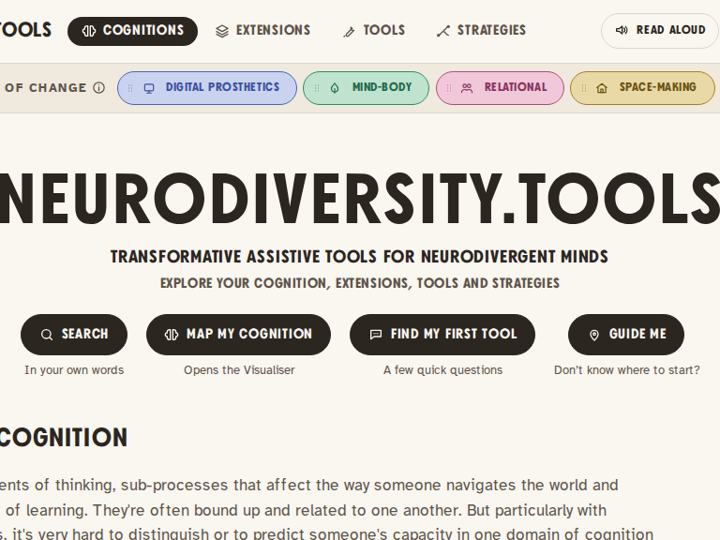
A browsable database of tools, extensions and strategies, organised by the part of thinking they carry, with examples and advice.
This research is methodologically grounded in the posthumanist ontology (Braidotti & Hlavajova, 2018) (see Section 2.5.4). It offers a strengths-based way to extend what neurodivergent learners perceive as possible for themselves. Cognition here is treated as something that can be extended through instruments of change, with the boundary between learner and instrument negotiable and productive rather than fixed. Read alongside crip technoscience (Hamraie & Fritsch, 2019), this ontology has a direct methodological consequence: neurodivergent learners are positioned throughout as active agents in the design of their own instruments of change, as expert knowers and makers in their own right, rather than consumers of solutions designed for them.
| Layer | Position |
|---|---|
| Ontology | Posthuman, relational |
| Epistemology | Social constructivist, pluriversal, embodied knowing |
| Methodology | Practice-informed, design-led, participatory |
| Methods | Co-learning workshops, playdates and playtesting, practice stories, interviews, debriefs, autoethnographic reflection, designerly inquiry through making |
| Types of Knowing | Experiential, procedural, narrative, material |
3.3Research Design
For the research design to meet the intention to be practice-informed this PhD program is exploratory. It proceeds through design practice, generating practical creative outputs and reflecting on their effects. The underlying aim is to create instruments of change, materials, and frameworks that may support educators, facilitators, parents, and other space-makers, the community of care this research designs primarily for. Neurodivergent learners (whether students or themselves, the community of experience, are understood to be the ultimate beneficiaries: the people who may be further empowered by strengths-based, autonomy-oriented approaches to learning. Informed by WonderLab’s community of practice that understands the potential for “designing for social impact,” the prospective social impact of the research arrives through resources that scale, travel, and transform (Grocott & Sosa, 2018). This orientation, designing from the outset with potential impact in mind, calls for a commitment to co-engagement, working with participants and communities rather than for them; the co-learning environments this stance produced are described in Methods below, and the relationship between these two communities is developed further in the discussion of scales that follows.
3.3.1Practice-Informed Research
As I introduced earlier the Nelson’s (2013) practice-informed methodological framing foregrounds the practitioner’s process, emphasising the interplay between theoretical knowledge and practical knowing. In this research program this frame sits within a living tradition, and my relationship to it is direct. Lisa Grocott and Dion Tuckwell, whose work anchors what follows, are my supervisors within WonderLab, the design research community where this PhD lived. Their approach was informed by Donald Schön’s (1983/2017) concept of the reflective practitioner, a mode of knowing that surfaces through action and doing, where the designer remains in dialogue with the materials of the situation.
Grocott’s (2012) doctoral research advocated for design-oriented inquiry, drawing on Fallman (2008) to position design practice as a primary means of producing knowledge. In this view, design practice is a legitimate mode of research that generates insights through the iterative framing and reframing of problems. Vaughan (2017) extends this by arguing that design research yields knowledge through prototyping new possibilities, while Tuckwell (2020) demonstrates how practice connects ways of becoming with collaborative research. What I take from this tradition is less a set of labels than a shared set of commitments: an embrace of the slipperiness practice brings to research, a reflexive orientation, and a recognition of material artefacts as knowledge productive.
The context this research works within makes that frame apt. The questions it asks are transdisciplinary by nature. No single discipline holds the learner, the technology, the pedagogy, and the politics of neurodivergence in view. Design is well suited to working across those bodies of knowledge. Contemporary design practice is framed less by a parent field than by the context it works within. A design inquiry organises itself around the situation at hand, recruiting whatever knowledge that situation requires. Design, as Tonkinwise (2014a, 2014b) argues, generates knowledge through its own processes of making, prototyping and intervening. I am a designer working with ideas from other fields to advance a problem outside of design. The conscious act of taking those theoretical understandings and weaving them into the design of workshops and creative outputs is what constitutes praxis (Nelson, 2013; Freire, 1970/2000). Practice, meanwhile, suits work that is constructivist in its paradigm and seeks to make a practical, pragmatic contribution: the knowledge this research generates is meant to be used.
Within that praxis, made things matter as knowledge. The quality and care of workshop materials perform communicative and relational work of their own, signalling to participants that they have been considered; care of this kind is, as design scholars Ann Light and Yoko Akama (2012) argue, a designed condition of participation. The praxis objects and creative outputs of the research embed logics of eccentricity, transformation, and strengths-based orientation, carrying the tacit knowing that design research has long recognised in designed materials (Polanyi, 1966; Cross, 1982). The practice was grounded in the sites of its future use: following Alain Findeli’s (2010) account of project-grounded research, where the design project itself serves as the research vehicle, this inquiry was framed in the context it hopes to serve, shortening the gap between its academic contribution and its practice contribution.
Using a practice-informed frame means I am able to access multiple registers of knowing: my experience as a practitioner-researcher documenting what I thought whilst facilitating; my reflections as a neurodivergent designer following design hunches of the kind validated under the paradigm above; and my perspective as a neurodivergent learner with my own lived experience. This methodology is entangled and co-created with others (Sanders & Stappers, 2008) in pursuit of relevance and usability. The method of knowledge generation must not reproduce the very barriers the research seeks to dismantle.
The instruments of change produced through this research are working prototypes rather than resolved artefacts, useful in their current form and open to further development. In Fallman’s (2008) terms, design here is the means and knowledge the goal: the prototypes have demonstrated their capacity to shift mindsets in co-learning workshops, and they may yet travel beyond this research into the hands of educators and learners, but their role within the PhD has been generative. Throughout this exegesis I locate a discursive engagement with theory alongside other interwoven practices. Theoretical insights emerge from a practice of making, a participatory practice is shaped by thinking with extended cognition theory, just as a practice of teaching and reflecting is drawn on throughout. Here I tease out the practices that are always entangled, as to make visible the different strands being drawn into the research conversation.
3.3.2Five Interwoven Practices
The inquiry was conducted through five interwoven practices, concurrent strands that ran the length of the PhD and continually informed one another.
A theory practice: reading, and extended conversations with my primary supervisor Lisa Grocott, the WonderLab community, and authors living and dead. This strand surfaces throughout the exegesis and receives its fullest expression in Chapter 2.
A participatory practice: the Neuroformer workshop series with Youth Inc., where each workshop was informed by the participants of the one before.
See the creative artefactThe Neuroformer Workshop Series
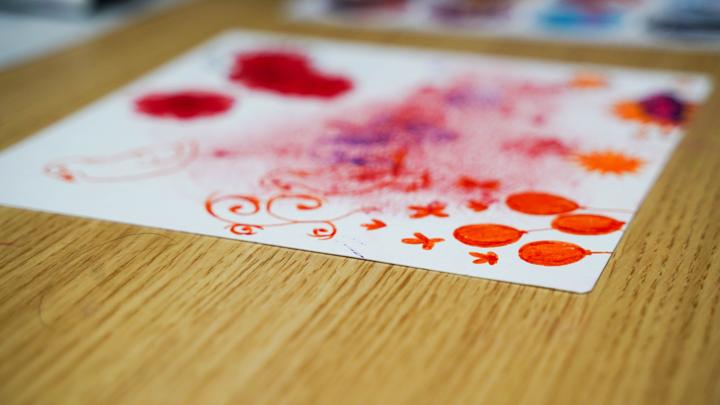
Three workshops with neurodivergent young people at Youth Inc in Adelaide, where both communities met; the materials are photographed on the outputs page.
A making practice: an experimental design practice probing extended cognition, mindset, surfacing, imagination, agency, and playfulness through small exercises. This strand shaped the workshops, the creative artefacts, and the analysis.
A design education practice: classroom teaching and facilitating design workshops for a range of WonderLab co-creative, learning projects was instructive to the inquiry. The mentoring opportunities to practise how to design for and facilitate clarified the transferability of these methods beyond the context of my own inquiry.
An autoethnographic practice: experimenting and introspecting with and on myself with techniques for extending my own cognition. As the Paradox of the Neurodivergent Researcher in Chapter 1 records, my cognition sat at the edge of being unable to do this kind of work at all. Configuring the work so that I could do it was research in its own right, and it directly informed how I ran and analysed the workshops.
3.3.3Three Phases
These five practices moved through three broad phases. Figure 3.1, which opens this chapter, maps the phases, the activities nested within each, the methods employed, and the types of knowing each generated.
The first phase, Discovery, combined theoretical exploration with the design, prototyping, and playtesting of materials alongside my supervisors and the WonderLab community. This happened through playdates, a neurodivergence conference, and adjacent projects. Playtests and playdates are focused iterative testing sessions with the WonderLab community who offer feedback that can guide further iteration and development of a specific prototype. The phase generated the interventions themselves and, through continuous practice reflection, the first practice insights.
The second phase, Application, was the main fieldwork in the middle of the second year: the Neuroformer series at Youth Inc, three workshops on non-consecutive days, one online and two in person, the count chosen to balance a workshop weighted toward research insight against one aimed squarely at transformation. The phase closed analytically, with interviews, debriefs and a warm data synthesis of the material, procedural, experiential and narrative knowing accumulated to that point.
The third phase, Translation, turned synthesis outward: documenting what happened, theorising why it might be useful elsewhere, and curating the playbook for the community of care.
See the creative artefactThe Neurodiversity Playbook
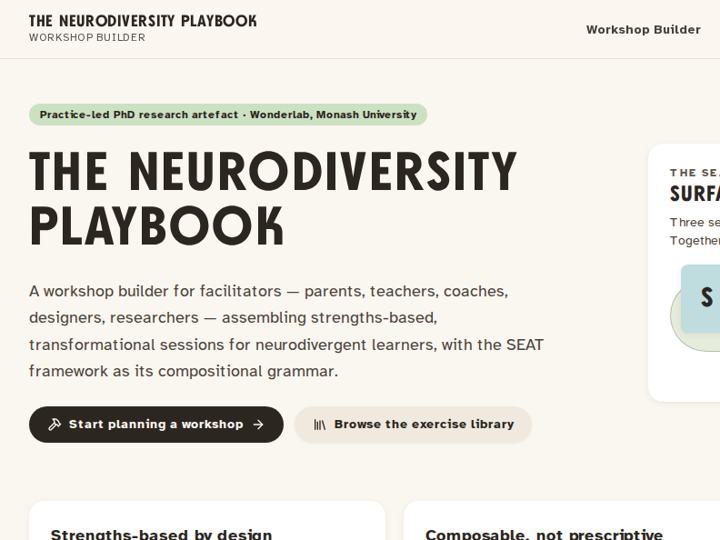
Exercises, materials and a workshop builder for the community of care, structured by SEAT.
3.3.4The Through-Line: Scales, Warm Data, and the Formation of SEAT
A compelling through-line holds the phases together. Thinking with cybernetics and Nora Bateson’s (2016) warm data, drew my attention to the interactions between scales: the personal and highly varied experience of neurodivergence set against society-scale shifts in technology, education, and norms. Two communities sit between these scales and give them shape:
The community of experience is the neurodivergent learners themselves: the primary audience and ultimate beneficiaries of this research’s creative outputs, whose direct experience of barriers to learning and being in the world I treat, following the logics of co-design, as legitimate expertise and an essential partner in design.
The community of care extends the concept of community of practice to foreground affective, ethical, and relational dimensions, mutual responsibility, vulnerability, and sustaining connection, and refers here to the teachers, facilitators, parents, and other space-makers who create the environments in which neurodivergent learners can do this work. The Neurodiversity Playbook and SEAT framework (see Chapter 5) are designed primarily for this second community, offloading organisational and administrative burden so that uptake does not depend on already-overtaxed learners.
Impact, in this sense, moves outward in stages: from the individual encounters of the workshops, through the community of care that sustains them, to the wider community of experience and the mindset and practice shifts this research hopes will ripple beyond the scope of the PhD itself. The workshops consequently became a site for prototyping a framework, systems that work at the level of the individual yet could be used beyond this one inquiry. That framework is SEAT: Surfacing, Envisaging, Actioning, and Togethering. SEAT is in conversation with and extends the SEED framework Lisa developed in Design for Transformative Learning (Grocott, 2022). SEAT began to emerge in my practice at the end of the first year before the main workshops. Within the workshop series, SEAT names four moves: surfacing current mindsets, envisaging different stories neurodivergent learners can tell themselves, anchoring changed narratives in action, and amplifying change within mutual community support. Togethering, the fourth move, is my addition to the lineage. The mechanics of SEAT in practice are unpacked in Chapter 5.
3.4Methods
The research was conducted across a landscape of practice that included multiple sites, communities, and modes of creative engagement. At its centre were the Neuroformer workshops, a series of participatory co-learning workshops with neurodivergent young people aged 17 to 24 at Youth Inc., a youth-focused organisation in Adelaide, South Australia. Alex Bruhn, the project lead at Metaversity, an experimental program within Youth Inc., partnered with me to recruit participants and organise the workshops, while the workshop content remained my own design.
This formal inquiry ran concurrently with the living reflexive praxis described in the previous section, which spurred the development of the materials and exercises that both served and generated insights within those workshops. Reflective practice, in Schön’s (1983/2017) sense, operates here as a disposition rather than a standalone method, holding the other methods together and providing continuity across the life of the inquiry; reflexivity is the turn of that attention back onto myself as a neurodivergent researcher inside the system being studied (see Reflexive praxis in the lexicon).
The specific contexts, participants, exercises, and creative outputs are described in detail in the practice chapters that follow. What matters here is orientation: every method employed was designed to be consonant with the community, to generate knowledge through engagement rather than extraction, and to position neurodivergent learners as contributors to the development of the instruments that support them.
Participants were the neurodivergent young people who engaged in the Neuroformer workshop series; Youth Inc invited them to take part regardless of whether they had a formal diagnosis, and regardless of whether they were disclosed, undisclosed, or undiagnosed. Many carried multiple concurrent conditions alongside intersecting forms of disadvantage and marginalisation, though the wide variance and co-occurrence of conditions across the cohort was not itself what this research set out to explore. It is worth noting that the specific cohort engaged with, i.e. learners whose support needs allowed participation in group workshop settings, reflect a practical constraint of the scope of a PhD rather than a theoretical limitation of the work’s broader applicability. A diagnostic or medicalised framing of this cohort would describe mild-to-moderate neurodivergence or neurodevelopmental learning difficulties; I note this framing for clarity while declining its deficit orientation. Participants are understood throughout as collaborators and co-learners rather than subjects; consistent with the co-engagement stance described below, and for clarity, brevity, and the anonymity of a relatively small cohort, their contributions are described collectively rather than attributed individually.
3.4.1Participatory Co-Learning Workshops
The primary method of engagement was the participatory co-learning workshop. Prior to the Youth Inc. series, I developed and explored creative methods through WonderLab playdates. Playdates are a place where the community gathers to test, play with, and refine research in progress. I further learned from bringing these approaches to conferences, symposia, and events. These allowed me to refine exercises before bringing them to the Youth Inc. community, a process whose implications I explore later.
The Neuroformer workshops were collaborative environments where exercises were iterated and reshaped with the input of participants, who were invited to be contributors rather than just experiencers, offering suggestions that were adapted into exercises used and updated in subsequent workshops. This was co-learning rather than co-design in the strict sense: participants did not collaboratively author the creative methods themselves but commented on them and informed their iteration and development, shaping the direction of inquiry through their responses and contributions. The stance that made this possible I call co-engagement, where the designer takes on the labour of pre-emptive scaffolding and keeps the standing between designer and participants even through transparency, so that participating does not exhaust the people it is for.
3.4.2Ethnographic Methods
I chose ethnographic methods, specifically semi-structured interviews and unstructured group reflections, because they allowed me to listen carefully and gather insight from participants about their experiences without imposing the hierarchical, literacy-dependent, and attention-demanding instruments that would work against the needs of this community. Individual semi-structured interviews with participants at Youth Inc. probed their experiences, perceptions, and shifts in thinking. Unstructured group reflections followed each workshop, creating space for collective sense-making.
The ethnographic gaze also turned toward my own practice. As the facilitator-designer, I closely observed and reflected-in-action on what was occurring in the room, and used the intuition gathered through that engagement to author ethnographic reflections. Here I draw on the WonderLab method of practice stories: first-person accounts that engage with theorising from practice by storying a kind of knowing which can be lost in third-person academic prose (Korsmeyer et al., 2022; Holman Jones et al., 2026).
These practice stories sit within a broader autoethnographic method (Adams et al., 2021) that validates the researcher’s own friction, triumphs, and lived experience as rigorous data. Autoethnography is increasingly valued by designers exploring social-material relations (Schouwenberg & Kaethler, 2021; Fuller, 2024). The practice stories may not always be critical autoethnography in the sense Holman Jones (2016) or Adams and colleagues (2021) would recognise, because they do not always connect to theory. They connect to practice, and they surface the experiential and procedural knowing that emerged through facilitation. While autoethnography is not the sole mode of knowledge generation in this research, it provides a crucial reflexive layer, mapping my intellectual and emotional journey in a way that resonates with the community of experience, something the clinical language of the medical model has limited capacity to do. The full role of this strand is formalised among the five interwoven practices above, and it included experiments in extending my own cognition.
3.4.3Designerly Inquiry Through Making
A third method encompassed the design of creative materials, the development of exercises, and the making through which creative outputs took shape. Making was a method of knowledge production in its own right. Building these materials involved learning from the act of designing them, generating new metaphors and new ways into mindset shift that could not have arrived at through analysis alone. This method is consistent with a practice-informed approach (Nelson, 2013) in which the act of making is itself a form of inquiry in pursuit of know-what, where tacit praxis is made explicit through critical reflection.
3.5Workshop Trajectories
The Neuroformer series set out to magnify participants’ sense of agency and autonomy in extending their own minds with different instruments of change. This section gives the structural logic of the series: how each workshop was built, what participants encountered, and how the series shifted as it progressed. The detailed account of what happened in the room, and the analysis of why it mattered, belongs to Chapter 4.
3.5.1Before, During, and After
Each workshop is best understood through three acts, and each act carried distinct work for the participants and for me as researcher. Figure 3.3 maps this architecture.
Before each workshop, my work was preparatory in two registers. The first was material: designing, prototyping, and playtesting the exercises and materials through the playdates, conferences, and events described above, then preparing the considered, carefully made materials whose quality itself signals care to participants. The second was relational: working with Alex, the teacher coordinating the program at Youth Inc., to recruit participants and organise the setting, so that the practical conditions for psychological comfort were in place before anyone arrived. For participants, the before phase meant recruitment, consent, and orientation, arriving with some sense of what the space would ask of them and what it would not.
During each workshop, participants moved through a sequence of playful exercises and experiences structured by SEAT’s four moves. The exercises themselves, and the creative materials that carried them, are described fully in Chapter 4, with the mechanics of SEAT unpacked in Chapter 5. My concurrent work was facilitation in the practice-informed mode established: holding the room, directing attention, and tracking what was occurring so that the intuition gathered could be authored into ethnographic reflection.
After each workshop, the acts diverged. Participants took part in unstructured group reflections, and individually in semi-structured interviews, making collective and personal sense of the experience. Beyond the research frame, they carried forward whatever strategies and reframes had landed. For me, the after phase was where the practice generated its insights: authoring practice stories, conducting the debriefs, and feeding what was learned directly into the design of the next workshop, so that each workshop was informed by the participants of the one before.
3.5.2Shifts Across the Series
The series was designed to shift in character as it progressed. The inquiries prior to the Youth Inc. days, the playdates and adjacent workshop opportunities, were generative: they existed to produce and refine methods. Within the series itself, the first workshop ran in person, the second online, and the third in person again, with iteration running between the days. The initial Youth Inc. day remained particularly generative in this sense. I was learning alongside my participants about what worked for us collectively, and about what shifts needed to take place for the workshops to genuinely achieve their goals. The subsequent workshops carried those adjustments, and the balance moved accordingly, away from generating research insight about the methods and toward the transformative encounter itself, magnifying participants’ agency and autonomy in extending their own minds. Figure 3.4 maps this movement across the series.
3.6Research Questions and Contributions
The introduction to Chapter 1 stated the questions guiding this inquiry in brief. With the methodology, research design, methods, and workshop structure now established, they can be expanded in full, each paired with the mode of inquiry that pursued it and the contribution that resulted. Figure 3.5 maps this structure.
Question diagram containing, methods and contributions.
The central research question is:
How can we design learning encounters that extend what neurodivergent students perceive as possible for themselves?
Beneath it sit three questions that guide it.
How might practice-informed design research shape the development of transformative encounters?
Practice-informed design research, following Robin Nelson (2013), is a mode of inquiry in which theoretical knowledge and practical knowing inform one another recursively. Here, the emphasis falls on how insights shuttle back and forth between making and theorising, drawing on multiple registers of knowing: experiential, procedural, narrative, and material (Vaughan, 2017; Grocott & Korsmeyer, 2018). In this research, that means the creative workshops, artefacts, and facilitation experiences generate the theoretical insights the exegesis offers to the field, rather than merely illustrating pre-existing theory.
This question was pursued iteratively, through the recursive loop between the five interwoven practices, where each round of designing, delivering, and reflecting reshaped the approach itself. Its contribution is a research orientation: a precedent for practice-informed design research in which participatory and reflexive engagement cannot easily be pulled apart.
What experiences and playful design interventions invite mindset shift in neurodivergent learners?
This question was pursued by surfacing lived experience, creating co-learning conditions in which participants’ own accounts, responses, and contributions revealed what landed and what did not. Its contribution is a set of practice insights for designing mindset shift, carried by the Neurodiversity Playbook and the SEAT framework for the community of care.
How can facilitation, specific practices, and enabling conditions be designed to support learner transformation?
This question was pursued through warm data synthesis, interpreting the material, procedural, experiential, and narrative knowing the research accumulated in a way that respects different types of knowing rather than flattening them into a single register. Its contribution is a theorisation of the enabling conditions and facilitation gestures that support transformation, told through the practice stories.
3.7What Does Success Look Like, and Who Gets to Define It?
This research’s theory of change (Weiss, 1995) operates at two levels: the explicit articulation of how workshop encounters are designed to shift participants’ relationships with assistive technologies, and the broader argument for how strengths-based approaches can transform neurodivergent learning experiences. At that broader level, the ultimate goal, the state of preferred transformation, is greater self-efficacy, quality of life, easefulness, and joy, achieved through lower friction and difficulty in everyday life. Consistent with the principle that learners’ own standards, and no one else’s, set the direction of this work, that goal becomes an evaluative commitment: the standards against which transformation is judged are self-developed, vary radically across cognitions, and evolve as the needs of the learner change. Critically, I consider the deepest determinant of transformation to be when the learner thinks so, rather than by applying externally defined neurotypical standards of the kind embedded throughout educational policy and the normative assumptions it is built on.
3.8Boundaries of the Inquiry
Before the questions are put to work, the boundaries of the inquiry are worth naming, so that the chapters that follow are read as situated provocations rather than universal claims. The boundaries are honest accounts of where this work sits in relation to what it did not do, what it cannot claim, and what must always accompany it.
3.8.1Situated Pluriversality
The workshops operated within specific contexts, with particular participants who self-selected into workshops aimed at neurodivergent learners. This means the findings are provocations, not prescriptions. The knowledge generated through this practice-informed, reflexive, autoethnographic inquiry draws its rigour from deep engagement with my own lived experience alongside the experiences of participants.
3.8.2The Legibility of Transformation
Transformation in neurodivergent cognition is difficult to observe and measure. Self-report provides some but not complete clarity, particularly because the shifts this work hopes to encourage are lifelong ones that unfold long beyond any researcher’s ability to track them. My orientation as a neurodivergent researcher helps me capture the complexity of what took place and attune to it in space.
3.8.3This Work Alongside Allied Practice
This research does not position itself as an anti-psychiatry, anti-medicine, or anti-medical model. The clinical, psychological, and therapeutic work that supports neurodivergent learners is critical, and this work is designed to sit alongside it, not replace it. Neurodivergent cognition is not discrete from other difficulties of life, and some participants navigate mental health challenges, trauma, and intersectional harms that exceed the scope of what a design-led workshop can address. Naming this clearly is important: the compatibilism between this practice and allied professional support is a feature of the work.
3.9Conclusion
This chapter has set out how the inquiry was designed and conducted: the practice-informed frame it inherits from WonderLab, the five interwoven practices and three phases through which it moved, the methods it used, the shape of the Neuroformer series, and the three questions with the contributions that answer them. Fit the Second, Travels, shows how this played out in practice, taking us on the journey into the workshops themselves.